Guide
Are Air Purifiers Safe for Pets?
The answer splits cleanly on one question: does the machine add something to the air, or only take things out? One of those is safe by construction.
By Scooter M. · Published · Last updated
How this page is funded: the buy links below are affiliate links. If you buy through one, we earn a commission at no extra cost to you. It does not change the order of the picks or what we say about them. Full disclosure.
The short answer
A purifier that only filters is safe for pets, because it puts nothing into the air at all - it pulls air through media and returns it with fewer particles in it. What changes the answer is any stage that emits something: EPA’s guide tells buyers to “Avoid portable air cleaners and furnace/HVAC filters that intentionally produce ozone,” and notes that cleaners containing “electrostatic precipitators, ionizers, UV lights without adequate lamp coatings” “may have the potential to emit ozone.” Our pick for a home with animals is the Coway Airmega AP-1512HH Mighty - it publishes power draw per fan speed, so you can leave it running cheaply - with the Levoit Vital 200S as the pet-specific alternative. If you keep birds, read the section on them before buying anything that emits.
The distinction that decides it
Almost every worry about purifiers and animals dissolves once you separate the two things a machine in this category can do.
A mechanical filter is a subtractive device. A fan draws room air through a pre-filter, a HEPA medium and usually some carbon, and returns the same air with fewer particles and some adsorbed gases removed. Nothing is generated, nothing is added, and nothing reacts. There is no exposure route to worry about because there is no emission - which is why the honest answer to the headline question, for the great majority of units sold, is simply yes.
An emitting stage is a different proposition. Ionizers, electrostatic precipitators, UV lamps and photocatalytic stages all act on the air rather than straining it, and some of them produce ozone as a by-product. Ozone generators produce it on purpose. That is the category where a question about safety is a real question rather than a reassurance, and it is worth asking separately from brand or price.
| Stage | Does it add anything to the air? | What we would do |
|---|---|---|
| Pre-filter, HEPA, carbon | No - subtractive only | Buy it. This is the part that does the work and the part with a published CADR |
| Ionizer / bipolar / plasma stage | Possibly. EPA lists ionizers among cleaners that “may have the potential to emit ozone” | Switch it off if it is optional; prefer a model where it is |
| UV-C lamp | Possibly - EPA names “UV lights without adequate lamp coatings” in the same list | Do not pay extra for it. Why it underdelivers anyway |
| Ozone generator | Yes, deliberately | Avoid. EPA: no federal agency has approved these “for use in occupied spaces” |
| Scented filter or added fragrance | Yes - and it is the one nobody thinks of as an emission | Skip it. It is a smell, not filtration, and see the bird section |
Birds are the genuine exception, and they deserve their own paragraph
Avian respiratory physiology is not a scaled-down version of ours. Dr. Judilee Marrow of the University of Illinois College of Veterinary Medicine puts it directly: “The avian respiratory system is very sensitive, and inhaled toxins can have prolonged exposure in birds due to their anatomy.” That column names household airborne hazards including nonstick cookware, aerosol products, smoking or vaping, and strong cleaners.
We want to be careful about what that does and does not establish. It is a statement about inhaled toxins in general, not a measurement of a consumer air purifier. We found no study measuring ozone output from a household purifier against harm to a pet bird, and we are not going to invent one. What the two sources together support is a precautionary rule rather than an alarm: in a house with birds, buy filtration only, and avoid anything with an emitting stage you cannot switch off. Given that the emitting stages have no published CADR to justify them in the first place, that rule costs you nothing.
The adjacent product is worth flagging in the same breath, because people buy both for the same reason. The ASPCA advises that “it is best to avoid using an essential oil diffuser in your house if you have birds,” because “Birds’ respiratory tracts are very sensitive, and they may develop more serious problems if you use a diffuser,” adding that the same concerns “will apply to other pets such as rabbits, guinea pigs and hamsters.” A purifier and a diffuser do opposite things, and only one of them adds something to the air.
The three checks to run before you pay
- Does it have an emitting stage, and can it be turned off? Look for the word ionizer, ionizing, plasma, bipolar, UV, UV-C or PCO in the specification - not the marketing copy, which often renames them. Where the stage is optional you can switch it off and run on the filters, which is what we would do in any house and certainly in one with animals.
- Is the model on the CARB certified list? Every portable indoor air cleaner sold in California must be CARB certified to meet ozone and electrical safety standards, and the list is public. EPA itself points buyers at the CARB and AHAM lists of air cleaners tested and shown to emit little or no ozone. One caveat we cover on the UV and ozone page: CARB has eliminated the ozone test requirement for portable cleaners that use UVGI lamps, so on a UV unit the badge does not mean the same thing.
- Is there a CADR? This is a safety question by a side door. A unit with no published clean air delivery rate is a unit whose only distinguishing features are the unproven stages - so the absence of a CADR and the presence of an emitting stage tend to travel together.
The practical risks nobody writes about
Having dealt with the air, the realistic hazards in a house with animals are physical and they are the ones we would actually plan around:
- Tipping. A tall tower on a hard floor next to an enthusiastic dog is a tower that goes over. A cylinder with a low center of gravity, or a unit placed with its back to a wall and clear of a run-up, solves it.
- The cord. Rabbits and some parrots chew cables, and a trailing cord across a room is also a trip hazard for you at 3am. Route it behind furniture.
- The intake grille. Pet hair loads a pre-filter fast. That is not a danger, it is a maintenance fact - and it is the strongest argument for a unit with a washable pre-filter, because otherwise the hair loads the expensive medium directly.
- Noise. We are not going to claim a decibel threshold for an animal, because we cannot source one. What we can say is that a unit at 50+ dBA on high is audible and continuous, that many animals avoid the room it is in, and that the published low-speed noise figure is therefore worth reading for a pet’s sake and not just yours.
- Placement. A purifier wants clearance on its intake and outlet. A bed or crate pressed against it is bad for the airflow and means a continuous draft on a sleeping animal.
This page is about the environment - humidity, particles, ventilation - and what changes it. It is not medical advice and we hold no medical qualification. If symptoms are persistent, severe or getting worse, that is a question for a clinician rather than a purchase.
Which of the three below, and their honest downsides
- Coway Airmega AP-1512HH Mighty - our pick for a house with animals because it publishes power draw per fan speed (3.7 W on speed one, 75.3 W on speed three), and a purifier in a pet household is a machine you leave on. The honest con: it has a bipolar device, which is a stage we would rather do without and would confirm can be disabled before buying - exactly the check this page asks you to run.
- Levoit Vital 200S - the pet-specific unit in our registry, with a washable pre-filter designed for hair, which is the consumable economics that actually decide a pet household’s running cost. It is the larger-footprint option.
- Levoit Core 400S - 231 CFM, coverage published at both one and 4.8 air changes per hour, no emitting stage at all. The con we always state: Levoit publishes no filter replacement interval for it, so we do not quote one, and the 1,718 sq ft headline is a single air change per hour rather than a usable rate.
What we would actually do
Buy a filter-only unit with a published CADR and a washable pre-filter, put it against a wall on a stable base with the cord tucked away, and run it on a low speed continuously rather than on high in bursts. That covers the actual problem in a pet household - dander and hair are particles, and particles are what filtration is good at - and it sidesteps the entire emitting-stage question rather than trying to adjudicate it. If you keep birds, treat the no-emitting-stage rule as absolute, and keep diffusers out of the house as well.
What we would buy for this
Chosen from the same registry as our roundups, on published specifications and computed running cost.
Coway Airmega AP-1512HH Mighty
Running continuously in a medium room
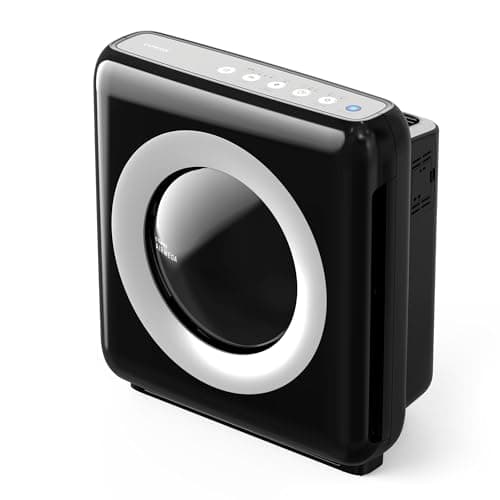
The most efficient unit here at low speed - 3.7 W on speed one - which matters enormously if you leave a purifier running all day and almost not at all if you do not.
#ad Price as of October 18, 2026, from Amazon. Prices change. How we make money.
Published specifications
| Specification | Value | Source |
|---|---|---|
| CADR (smoke) | 233 CFM | Coway published specification |
| CADR (dust) | 246 CFM | Coway published specification |
| CADR (pollen) | 240 CFM | Coway published specification |
| Coverage | 361 sq ft at 4.8 air changes/hr (1,748 sq ft at 1 ACH) | Coway published specification |
| Power draw by speed | 0.3 W standby / 3.7 W speed 1 / 8.7 W speed 2 / 75.3 W speed 3 | Coway published specification |
| Filtration | Pre-filter, odor filter, Green True HEPA, bipolar device | Coway published specification |
What it costs to run
About $6 a year running 24/7 on speed one, or $121 a year running 24/7 on speed three.
Speed 1: 3.7 W / 1000 x 24 x 365 = 32.4 kWh = $5.94 a year. Speed 3: 75.3 W / 1000 x 24 x 365 = 659.6 kWh = $120.97 a year. That twenty-fold spread is the most important number on this page, and it is why we chase per-speed figures instead of accepting a single rated wattage.
What is good about it
- Coway publishes power draw per fan speed, which almost nobody does and which is the only way to compute a real running cost
- 3.7 W on speed one is remarkable - cheaper to run continuously than most nightlights
- Coverage published at 1, 2 and 4.8 air changes per hour, so you can size it honestly
What is not
- 75.3 W on speed three is the highest draw here; how the auto mode behaves decides your bill
- The bipolar device is a stage we would rather do without; check it can be disabled
Who should skip this
Skip this if you only run a purifier for an hour or two at a time. Its whole advantage is low-speed efficiency over long hours, and short bursts on high speed give that straight back.
How it scored
- Clean air per watt9.5
- Honest coverage claim9.5
- Quiet operation8.0
- Filter economics7.5
Overall 8.7 / 10. This is our editorial score from published specifications and computed running cost. It is not a test result, and it is deliberately not marked up as a rating in this page’s structured data.
Levoit Vital 200S
Homes with shedding pets
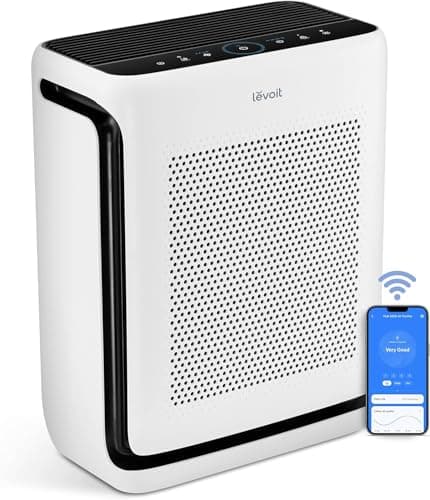
The highest CADR we carry, built around a washable pre-filter and a wide intake - the right shape for a house with animals in it, because hair loads a filter far faster than dust does.
#ad Price as of October 18, 2026, from Amazon. Prices change. How we make money.
Published specifications
| Specification | Value | Source |
|---|---|---|
| CADR | 250 CFM | Levoit published specification |
| Coverage | 388 sq ft at 4.8 air changes/hr (1,862 sq ft at 1 ACH) | Levoit published specification |
| Rated power | 50 W | Levoit published specification |
| Noise | 23-54 dB | Levoit published specification |
| Filtration | 3-stage: washable pre-filter, HEPA, activated carbon. Pet allergy, toxin absorber and smoke remover carbon filters sold for the same body | Levoit published specification |
| Dimensions | 15.6 x 8.5 x 19.8 in | Levoit published specification |
What it costs to run
About $40 a year in electricity at 12 hours a day, before filters.
50 W / 1000 x 12 hours x 365 days = 219 kWh. At 18.34 cents/kWh that is $40.16 a year at rated power, and less on the lower fan speeds. That is roughly $10 a year more than the Core 400S for 19 CFM more CADR - worth it in a house with animals, hard to justify without them.
What is good about it
- 250 CFM is the highest CADR of anything we carry, and it covers about 375 sq ft under AHAM's two-thirds rule
- The washable pre-filter is the part that matters with pets - hair is what kills HEPA filters early
- Levoit publishes coverage at both 1 ACH and 4.8 ACH, and the 388 sq ft figure lines up closely with the AHAM arithmetic
- Four different carbon filters fit the same chassis, so the unit adapts to pets, smoke or off-gassing without replacing the body
What is not
- 50 W for 250 CFM is a worse clean-air-per-watt ratio than the Core 400S manages at 38 W for 231 CFM
- We could not find a published filter replacement interval for this model, so we are not quoting one
- Levoit does not publish power draw per fan speed, so continuous-running cost cannot be computed precisely
- The pet-specific carbon filter is a separate purchase and is not always in stock - check it is available before buying the body for that reason
Who should skip this
Skip this if you have no animals and no odor problem. Without pets you are paying for a wide pre-filter and a carbon option you will not use, and the Core 400S delivers comparable clean air on 12 W less.
How it scored
- Pre-filter design for hair9.0
- Clean air per watt7.0
- Honest coverage claim9.0
- Filter economics8.0
Overall 8.0 / 10. This is our editorial score from published specifications and computed running cost. It is not a test result, and it is deliberately not marked up as a rating in this page’s structured data.
Levoit Core 400S
Living rooms and open-plan spaces
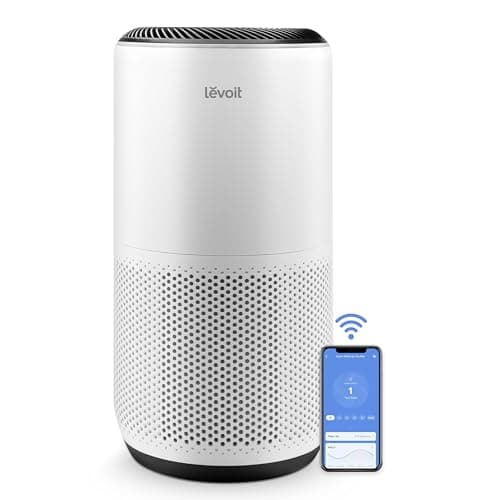
The one to buy if you want a purifier that genuinely covers a living room, and one of the few spec sheets in this bracket that publishes coverage at a useful air-change rate rather than only the flattering one.
#ad Price as of October 18, 2026, from Amazon. Prices change. How we make money.
Published specifications
| Specification | Value | Source |
|---|---|---|
| CADR | 231 CFM | Levoit published specification |
| Coverage | 358 sq ft at 4.8 air changes/hr (1,718 sq ft at 1 ACH) | Levoit published specification |
| Rated power | 38 W | Levoit published specification |
| Noise | 22-52 dB | Levoit published specification |
| Filtration | 3-stage: pre-filter, HEPA, activated carbon | Levoit published specification |
| Dimensions | 10.8 x 10.8 x 20.5 in, 11 lb | Levoit published specification |
What it costs to run
About $25-30 a year in electricity at 12 hours a day, before filters.
38 W / 1000 x 12 hours x 365 days = 166.4 kWh. At 18.34 cents/kWh that is $30.52 a year at rated power - and the unit only draws its full 38 W on the top fan speed, so a mid setting lands nearer $25. Add the replacement filter, which you should price before you buy rather than after.
What is good about it
- Levoit publishes coverage at both 1 ACH and 4.8 ACH, which is unusually straight - most brands quote only the flattering 1 ACH number
- 38 W is low for this CADR, which is what keeps the running cost down
- 22 dB on its lowest setting is quiet enough to sleep beside
- Carbon, pet-allergy and smoke-specific replacement filters are sold for the same body
What is not
- We could not find a published filter replacement interval in Levoit's specification, so we are not quoting one
- The 1,718 sq ft headline is a single air change per hour, which is not a useful rate for allergies
Who should skip this
Skip this if your room is under 200 sq ft. The Core 300S covers that at lower power and lower cost, and the extra CADR buys you nothing in a small bedroom.
How it scored
- Clean air per watt9.0
- Honest coverage claim9.5
- Quiet operation8.5
- Filter economics7.5
Overall 8.6 / 10. This is our editorial score from published specifications and computed running cost. It is not a test result, and it is deliberately not marked up as a rating in this page’s structured data.
How we ranked these
We have not tested these units. Nobody here owns one. What we did was compile each manufacturer’s published specifications, check the coverage claims against AHAM’s room-sizing rule, and compute what each one costs to run for a year at the current US average electricity price. Every figure on this page is attributed to whoever published it, and the arithmetic is shown so you can redo it.
How we rank these sets out the full method, including what would change a ranking.
Questions people ask
+−Are air purifiers safe for cats and dogs?
+−Are air purifiers safe for birds?
+−Is ozone from an air purifier harmful to animals?
+−Should I turn off the ionizer if I have pets?
+−Will an air purifier help with pet smell?
+−Where should I put a purifier in a room with a dog or cat?
+−Does pet hair ruin an air purifier?
Sources
- EPA - Guide to Air Cleaners in the Home (2nd edition)
- University of Illinois College of Veterinary Medicine - Bad for Birds: Prevent Poisoning in Avian Pets (9 April 2026)
- ASPCA - Is the Latest Home Trend Harmful to Your Pets? What You Need to Know! (essential oil diffusers, 17 January 2018)
- California Air Resources Board - List of CARB-Certified Air Cleaning Devices
- California Air Resources Board - Air Cleaners and Ozone Products
- ENERGY STAR - Certified Room Air Cleaners product database