Symptom guide
Damp House Symptoms
The reliable signals of a damp home are environmental, not medical - condensation, smell, staining, a hygrometer above 60%. Start with those, because they are the ones you can act on.
By Scooter M. · Published · Last updated
How this page is funded: the buy links below are affiliate links. If you buy through one, we earn a commission at no extra cost to you. It does not change the order of the picks or what we say about them. Full disclosure.
This page is about the environment - humidity, particles, ventilation - and what changes it. It is not medical advice and we hold no medical qualification. If symptoms are persistent, severe or getting worse, that is a question for a clinician rather than a purchase.
The short answer
Measure the house, not the symptom. The EPA associates mold exposure with allergic reactions, which can be immediate or delayed, and notes molds can trigger asthma attacks in people with asthma who are allergic to mold. It is not possible to work backwards from a cough to a cause. What you can do is put a hygrometer in the room: a reading persistently above 60% is a condition the EPA explicitly advises against, and it is fixable.
The environmental signs, in order of reliability
These are the ones worth trusting, because each is a fact about the building rather than an interpretation of how you feel.
- A hygrometer reading above 60%. This is the single most useful signal and the cheapest to obtain. The EPA’s guidance is to keep indoor humidity below 60 percent, ideally between 30 and 50 percent relative humidity. Above that band you are in conditions that support growth.
- Condensation on windows most mornings. Water is reaching a cold surface and staying there. In winter this is normal in small amounts and a problem when it pools on the sill. Whether a dehumidifier can stop it depends on your glazing as much as your humidity - the published figures are here.
- A musty smell that returns after airing. Smell is a genuinely good detector and a terrible locator. You will stop noticing your own house within minutes, which is why visitors mention it and you do not.
- Staining, blistering paint, or a tide line. Water has been present long enough to change the surface.
- Textiles that never quite dry. Towels, coats in a hall cupboard, bedding against an outside wall.
The pattern that is worth noticing
There is one observation people make that is genuinely informative, and it is a pattern rather than a symptom: things that change when you leave the building and return to it. A week away and a difference on the first night back is the sort of thing worth mentioning to a clinician, because it points at the environment rather than at you. It still is not a diagnosis - but it is the right kind of evidence, and it costs nothing to notice.
What is actually in the air of a damp house
Two things, and they need different responses. Once the groundwork here is done and an appliance is genuinely warranted, the units worth considering are in best dehumidifiers for a crawl space.
| Mold spores and fragments | The musty smell itself | |
|---|---|---|
| What it is | Particles released by growth somewhere in the building | Gases produced by that growth - a smell is a gas, not a particle |
| Does a HEPA filter catch it? | The airborne fraction, yes, while the unit runs | No. Particle filters do not remove gases |
| Does carbon help? | Not its job | It adsorbs some odor gases, and it saturates |
| What actually ends it | Removing the growth and the moisture feeding it | The same. The smell is a symptom of the growth |
This is why we are consistently unenthusiastic about buying an air purifier for a damp house. It can lower the airborne spore count in the room it is in, which is not nothing. It cannot make the wall dry. The full argument is at will an air purifier fix mold.
The order to fix it in
- Find the water. A leak, a failed gutter, a blocked airbrick, a dryer venting indoors, a bathroom with no working extractor, or simply too many people breathing in a sealed house. Until this step is done the rest is maintenance.
- Dry what is already wet, quickly. The EPA is specific about the window: if wet or damp materials or areas are dried 24-48 hours after a leak or spill happens, in most cases mold will not grow.
- Bring the humidity down and hold it there. Ventilation first where the outdoor air is drier than the indoor air; a dehumidifier where it is not, or where the space has no useful ventilation at all. The methods that do not require a purchase are in how to lower humidity.
- Clean up what grew. Note that the EPA does not recommend using a biocide such as chlorine bleach as a routine practice during mold cleanup, and points out that dead mold still needs to be physically removed because it can still cause allergic reactions.
- Only then consider filtration, and only for the airborne fraction in a room you occupy.
The measurement that changes what you buy
A hygrometer is the cheapest device on this site and the one that settles the most arguments. Put one in the affected room and one somewhere you consider normal, and compare. If the damp room reads twelve points higher than the rest of the house, you have localized the problem to that room and its ventilation. If the whole house reads above 60%, the problem is the house.
A logging sensor is worth the small premium in one specific case: when the room is fine whenever you check it and something is clearly happening overnight. Spot readings cannot show you that; a graph can. Both types are compared in air quality monitor vs hygrometer.
When to stop reading websites
If symptoms are persistent, severe or getting worse, that is a clinician’s question and not a purchasing one, and no amount of humidity data changes that. If the damp is extensive, or you suspect it involves sewage or floodwater, it is a remediation question rather than an appliance question. This site is about environments - what we can help you do is get the building back inside 30-50% and keep it there.
What we would actually do
Buy a hygrometer before anything else and leave it in the worst room for a week. Walk the outside of the building after heavy rain and look at the gutters. Check that the bathroom and kitchen extractors actually move air - hold a sheet of paper to them. Then, if the reading stays above 60% and there is no ventilation route that fixes it, size a dehumidifier properly and set it to 50%. That sequence solves most damp houses and it does not start with a purchase.
What we would buy for this
Chosen from the same registry as our roundups, on published specifications and computed running cost.
ThermoPro TP49 Hygrometer
Anyone about to buy a humidifier or a dehumidifier

An inexpensive digital hygrometer is the highest-value purchase on this entire site, because it is the one that tells you whether to buy anything else.
#ad We do not hold a current price for this product, so we do not show one. How we make money.
Published specifications
| Specification | Value | Source |
|---|---|---|
| Function | Digital temperature and relative humidity readout with a comfort indicator | ThermoPro published specification |
What is good about it
- Cheap enough to buy three and put one in the bedroom, one in the basement and one in the living room, which is what you actually want
- Gives you the reading that decides between a humidifier and a dehumidifier - a decision people routinely get backwards
What is not
- Consumer hygrometers are typically accurate to within a few percentage points, which is fine for the 30-50% question and not fine for anything precise
- No logging, so you see now rather than overnight
Who should skip this
Skip this only if you already own a hygrometer. There is no household we would tell not to measure.
How it scored
- Value for the decision it informs10.0
- Accuracy for the 30-50% question8.0
- Logging and history2.0
Overall 9.0 / 10. This is our editorial score from published specifications and computed running cost. It is not a test result, and it is deliberately not marked up as a rating in this page’s structured data.
Midea Cube 35-Pint
Basements without a floor drain
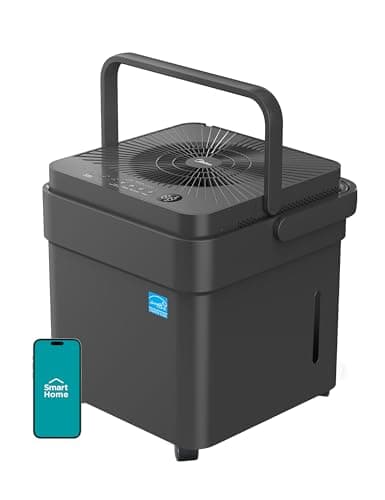
The adjustable 4.25-gallon bucket is the point. Most dehumidifiers get switched off because emptying a 2-gallon bucket twice a day is miserable; this one buys you a couple of days.
#ad Price as of October 18, 2026, from Amazon. Prices change. How we make money.
Published specifications
| Specification | Value | Source |
|---|---|---|
| Capacity | 35 pints per day | Midea published specification |
| Capacity (federal test) | 35.82 pints per day | ENERGY STAR certified products database |
| Coverage | Up to 3,500 sq ft | Midea published specification |
| Efficiency (IEF) | 2.01 L/kWh | ENERGY STAR certified products database |
| Annual energy use | 378 kWh/yr | ENERGY STAR certified products database |
| Bucket fill level | Adjustable, up to 4.25 gallons | Midea user manual |
| Fan speeds | 2 (High, Low) | Midea user manual |
| Dimensions | 14.76 x 14.57 x 14.45 in, 39.62 lb | Midea published specification |
| Certification | ENERGY STAR certified | ENERGY STAR certified products database |
What it costs to run
About $69 a year on ENERGY STAR's certified annual energy figure.
ENERGY STAR publishes 378 kWh a year for this model. At 18.34 cents/kWh that is $69.33 a year. That figure is calculated on the program's standardized test basis, not measured in your basement: a genuinely damp space where it cycles constantly will use more. Against the 50-pint Cube's 515 kWh ($94.45) it is the cheaper machine to own, which is the argument for sizing honestly rather than buying headroom.
What is good about it
- An adjustable bucket that holds up to 4.25 gallons - the difference between a unit you keep using and one you unplug in week three
- An IEF of 2.01 L/kWh removes about 18% more water per kWh than the 20-pint Cube's 1.70
- Nests down into a smaller shape for storage, which matters for an appliance you only use half the year
What is not
- The 3,500 sq ft coverage claim assumes conditions no real basement has; treat it as a ceiling, not a specification
- 35 pints is not enough for a genuinely wet basement with standing water
- Midea does not publish a rated wattage for this model, so we quote ENERGY STAR's certified annual energy figure instead
- No built-in pump on this model - without a floor drain you are either emptying the bucket or routing a gravity hose
Who should skip this
Skip this if your basement is wet rather than damp - visible water, white efflorescence on the walls, a musty smell that returns within a day of airing out. That is a drainage problem, and a 35-pint unit will run permanently and never win.
How it scored
- Tank interval10.0
- Capacity for the money8.5
- Efficiency per liter removed9.0
- Storage footprint9.0
Overall 8.7 / 10. This is our editorial score from published specifications and computed running cost. It is not a test result, and it is deliberately not marked up as a rating in this page’s structured data.
How we ranked these
We have not tested these units. Nobody here owns one. What we did was compile each manufacturer’s published specifications, check the coverage claims against AHAM’s room-sizing rule, and compute what each one costs to run for a year at the current US average electricity price. Every figure on this page is attributed to whoever published it, and the arithmetic is shown so you can redo it.
How we rank these sets out the full method, including what would change a ranking.
Questions people ask
+−Can a damp house make you ill?
The EPA states that inhaling or touching mold or mold spores may cause allergic reactions in sensitive individuals, that reactions can be immediate or delayed, and that molds can trigger asthma attacks in people with asthma who are allergic to mold. Whether a particular symptom has that cause is a question for a clinician.
+−What humidity level counts as a damp house?
The EPA advises keeping indoor humidity below 60 percent and ideally between 30 and 50 percent. A room reading persistently above 60% is in the range that supports mold growth, whether or not you can see any yet.
+−How quickly does mold grow after a leak?
The EPA’s guidance is that if wet or damp materials or areas are dried within 24 to 48 hours of a leak or spill, in most cases mold will not grow. That makes drying speed the single most important response to water indoors.
+−Should I use bleach on mold?
The EPA does not recommend using a chemical or biocide that kills mold, such as chlorine bleach, as a routine practice during mold cleanup. It also notes that dead mold still needs to be physically removed, because it can still cause allergic reactions.
+−Will a dehumidifier fix a damp house on its own?
Only if the moisture is coming from the air rather than from a defect. Where water is entering through a wall, a roof or a failed gutter, a dehumidifier runs continuously and the material stays wet. Find the water first, then hold the humidity down.