Start here
Which Device Do I Need?
Air purifier, humidifier, dehumidifier, monitor. They do four completely different jobs, and buying the wrong one is the most common mistake in this category.
By Scooter M. · Published · Last updated
How this page is funded: the buy links below are affiliate links. If you buy through one, we earn a commission at no extra cost to you. It does not change the order of the picks or what we say about them. Full disclosure.
The short answer
An air purifier removes particles from air that is already in the room. A humidifier adds moisture. A dehumidifier removes it. A monitor tells you which of the other three you need. If you do not know your home’s relative humidity right now, buy the monitor first - it is the cheapest device here and it is the only one that answers the question.
Nearly every article about this compares two devices at a time, which is why so many people end up owning the wrong one. Here is all four in a single view.
| Device | What it changes | Buy it when |
|---|---|---|
| Air purifier | Removes airborne particles - dust, pollen, dander, smoke - from air already in the room. Changes nothing about humidity. | You are reacting to something in the air, and the source is outdoors or unavoidable indoors. |
| Humidifier | Adds water vapor, raising relative humidity. | Your measured relative humidity is below about 30%, and you have static, cracked skin, or a dry cough in winter. |
| Dehumidifier | Removes water vapor, lowering relative humidity. | Your measured relative humidity is above 60%, or the room smells musty, or windows run with condensation. |
| Monitor / hygrometer | Changes nothing. Tells you the number the other three are supposed to be moving. | Always. Before any of the above. |
Start with the number, not the symptom
The reason this decision goes wrong so often is that the same complaint - a stuffy nose in the morning, a cough that will not shift, a room that feels wrong - is produced by both ends of the humidity scale. Dry air irritates the nose. Damp air grows dust mites and mold, which also irritate the nose. Two opposite problems, one symptom, and two devices that will each make the other problem worse.
The EPA’s guidance is to keep indoor relative humidity below 60 percent, and ideally between 30 and 50 percent. That single range is the whole map:
| Your reading | What it means | What to do |
|---|---|---|
| Below 30% | Too dry. This is what a heated house does to cold outside air. | A humidifier. Start at Dry Air. |
| 30-50% | The EPA's stated ideal band. If you are in here and still have symptoms, humidity is not your problem. | Look at particles instead - Allergies & Dust or Smoke & Odors. |
| 50-60% | Above the ideal band but under the ceiling. Dust mites do well here. | Bring it down before buying anything else. How to lower humidity. |
| Above 60% | Over the EPA's ceiling. Mold risk, and the reason for most musty smells. | A dehumidifier, after you find the water. Damp & Mold. |
The four questions that decide it
1. Is the problem a particle or a gas?
A HEPA filter is a mechanical sieve. It captures solid particles - dust, pollen, dander, the particulate fraction of smoke. It does essentially nothing to gases and odor molecules, which are far too small to be caught by fibers. That is what the activated carbon stage is for, and carbon capacity varies enormously between units. If your complaint is a smell, the HEPA rating is not the number you should be shopping on. See HEPA vs carbon filters.
2. Is the problem in the air, or is the air just carrying it?
This is the distinction that decides most wrong purchases. Mold spores in the air are a particle problem, and a purifier will reduce them. Mold growing in the room is a water problem, and a purifier does nothing about it at all - the colony keeps producing spores faster than the filter removes them. Same for a musty basement: the smell is airborne, but the cause is liquid. Will an air purifier fix mold? is the long version of that answer, and the honest answer is mostly no.
3. Is it seasonal?
A problem that arrives with the heating and leaves in spring is almost always dry air. A problem that arrives with the summer humidity, or after rain, is almost always damp. A problem that is constant year-round is more likely to be particles - dust, dander, or something in the building itself.
4. Is the symptom worse in one room?
Whole-house symptoms point at the heating system, the ventilation, or the outdoor air. Single-room symptoms point at that room: the basement with no drainage, the bedroom with the pets in it, the bathroom with no extractor fan. Buy for the room, not for the house - a portable unit in the right room beats a bigger one in the wrong one.
When the answer is: buy nothing
There is a version of this page on every competing site, and none of them include this section, because nobody earns a commission on it. It is still the right answer more often than you would think.
- There is standing water, a leak, or rising damp. No appliance fixes a plumbing or drainage fault. A dehumidifier running against an active leak will run permanently, cost you $200 a year, and never win.
- The bathroom or kitchen has no working extractor fan. Fixing the fan is cheaper than any dehumidifier and it removes moisture at the point it is produced rather than after it has spread through the house.
- You have never opened the windows. Ventilation is free. Fifteen minutes of cross-ventilation does more for a stuffy room than an hour of any purifier, provided the outdoor air is not the problem.
- The furnace filter has not been changed in a year. If you have forced-air heating, that filter is already a whole-house air cleaner. Changing it costs a few dollars.
- Your measured humidity is already in the 30-50% band. A humidifier or dehumidifier has nothing useful to do, and running either one will push you out of the band you are already in.
This page is about the environment - humidity, particles, ventilation - and what changes it. It is not medical advice and we hold no medical qualification. If symptoms are persistent, severe or getting worse, that is a question for a clinician rather than a purchase.
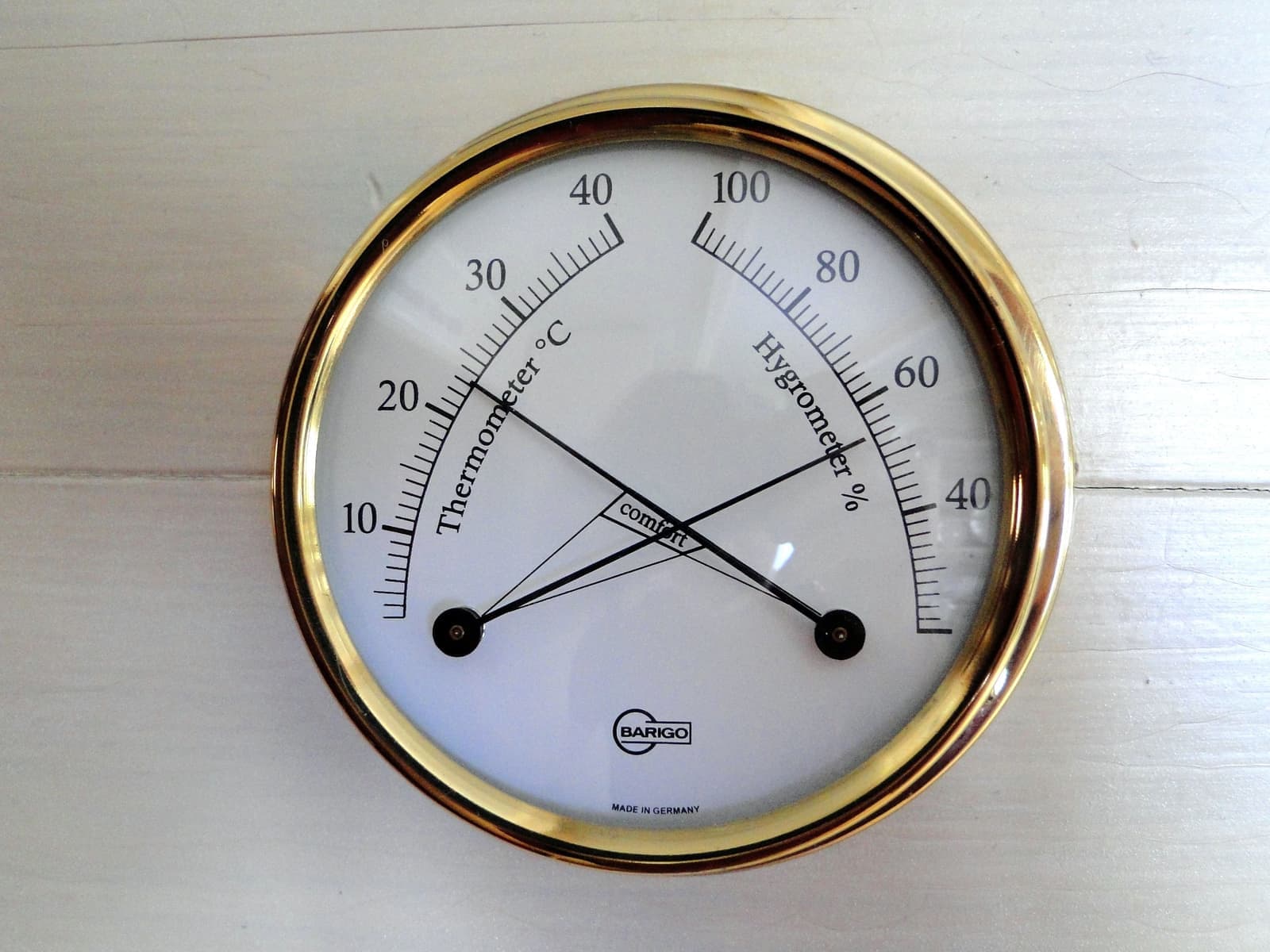
If you are going to buy one thing
Buy the measurement. The four picks below cover each device type, and only one of them tells you which of the other three you actually need - so that is the one to buy first, and it is also the cheapest.
What we would buy for this
Chosen from the same registry as our roundups, on published specifications and computed running cost.
ThermoPro TP49 Hygrometer
Anyone about to buy a humidifier or a dehumidifier
An inexpensive digital hygrometer is the highest-value purchase on this entire site, because it is the one that tells you whether to buy anything else.
#ad We do not hold a current price for this product, so we do not show one. How we make money.
Published specifications
| Specification | Value | Source |
|---|---|---|
| Function | Digital temperature and relative humidity readout with a comfort indicator | ThermoPro published specification |
What is good about it
- Cheap enough to buy three and put one in the bedroom, one in the basement and one in the living room, which is what you actually want
- Gives you the reading that decides between a humidifier and a dehumidifier - a decision people routinely get backwards
What is not
- Consumer hygrometers are typically accurate to within a few percentage points, which is fine for the 30-50% question and not fine for anything precise
- No logging, so you see now rather than overnight
Who should skip this
Skip this only if you already own a hygrometer. There is no household we would tell not to measure.
How it scored
- Value for the decision it informs10.0
- Accuracy for the 30-50% question8.0
- Logging and history2.0
Overall 9.0 / 10. This is our editorial score from published specifications and computed running cost. It is not a test result, and it is deliberately not marked up as a rating in this page’s structured data.
Levoit Core 400S
Living rooms and open-plan spaces
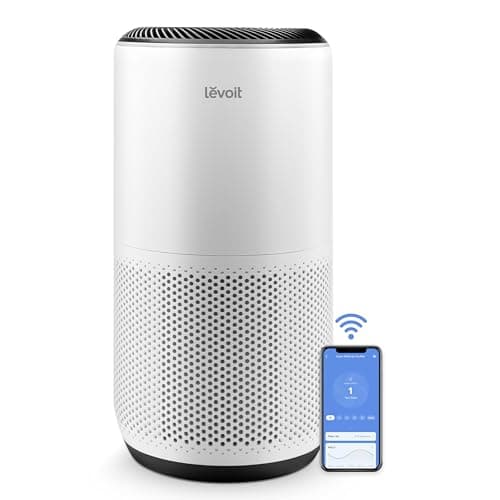
The one to buy if you want a purifier that genuinely covers a living room, and one of the few spec sheets in this bracket that publishes coverage at a useful air-change rate rather than only the flattering one.
#ad Price as of October 18, 2026, from Amazon. Prices change. How we make money.
Published specifications
| Specification | Value | Source |
|---|---|---|
| CADR | 231 CFM | Levoit published specification |
| Coverage | 358 sq ft at 4.8 air changes/hr (1,718 sq ft at 1 ACH) | Levoit published specification |
| Rated power | 38 W | Levoit published specification |
| Noise | 22-52 dB | Levoit published specification |
| Filtration | 3-stage: pre-filter, HEPA, activated carbon | Levoit published specification |
| Dimensions | 10.8 x 10.8 x 20.5 in, 11 lb | Levoit published specification |
What it costs to run
About $25-30 a year in electricity at 12 hours a day, before filters.
38 W / 1000 x 12 hours x 365 days = 166.4 kWh. At 18.34 cents/kWh that is $30.52 a year at rated power - and the unit only draws its full 38 W on the top fan speed, so a mid setting lands nearer $25. Add the replacement filter, which you should price before you buy rather than after.
What is good about it
- Levoit publishes coverage at both 1 ACH and 4.8 ACH, which is unusually straight - most brands quote only the flattering 1 ACH number
- 38 W is low for this CADR, which is what keeps the running cost down
- 22 dB on its lowest setting is quiet enough to sleep beside
- Carbon, pet-allergy and smoke-specific replacement filters are sold for the same body
What is not
- We could not find a published filter replacement interval in Levoit's specification, so we are not quoting one
- The 1,718 sq ft headline is a single air change per hour, which is not a useful rate for allergies
Who should skip this
Skip this if your room is under 200 sq ft. The Core 300S covers that at lower power and lower cost, and the extra CADR buys you nothing in a small bedroom.
How it scored
- Clean air per watt9.0
- Honest coverage claim9.5
- Quiet operation8.5
- Filter economics7.5
Overall 8.6 / 10. This is our editorial score from published specifications and computed running cost. It is not a test result, and it is deliberately not marked up as a rating in this page’s structured data.
Honeywell HCM350 Germ Free Cool Mist
Bedrooms, and anyone who has had white dust from an ultrasonic
An evaporative wick humidifier, which is the type that physically cannot over-humidify a room or spray minerals onto your furniture. That is the whole argument for it, and it is a good one.
#ad We do not hold a current price for this product, so we do not show one. How we make money.
Published specifications
| Specification | Value | Source |
|---|---|---|
| Tank capacity | 1.1 gallon | Honeywell published specification |
| Rated power | 50 W | Honeywell published specification |
| Run time | Up to 24 hours per fill | Honeywell published specification |
| Output | Up to 2 gallons of moisture per 24 hours | Honeywell published specification |
| Filter | Protec HAC-504AW antimicrobial wick filter | Honeywell published specification |
What it costs to run
About $20-22 a year in electricity across a heating season at 12 hours a day, plus wicks.
50 W / 1000 x 12 hours x 365 days = 219 kWh = $40.16 a year if run year-round. Most people run a humidifier for roughly half the year, so call it $20-22, plus replacement wicks at the manufacturer's stated interval.
What is good about it
- Evaporative design self-limits: as a room approaches saturation it simply evaporates less, so it will not push you past 50% RH the way an ultrasonic will
- No white mineral dust, because the minerals stay in the wick instead of being aerosolized into the room
- The tank is designed to come apart and be cleaned, which is the maintenance that actually matters
What is not
- There is a fan, so it is not silent the way an ultrasonic is
- The wick is a consumable - budget for it, and replace it on schedule or it becomes the thing growing mold
Who should skip this
Skip this if you want silence above all else, or if you will not buy replacement wicks. A neglected wick is worse than no humidifier at all.
How it scored
- Cannot over-humidify10.0
- No mineral dust10.0
- Quiet operation6.5
- Cleaning burden7.5
Overall 8.5 / 10. This is our editorial score from published specifications and computed running cost. It is not a test result, and it is deliberately not marked up as a rating in this page’s structured data.
Midea Cube 35-Pint
Basements without a floor drain
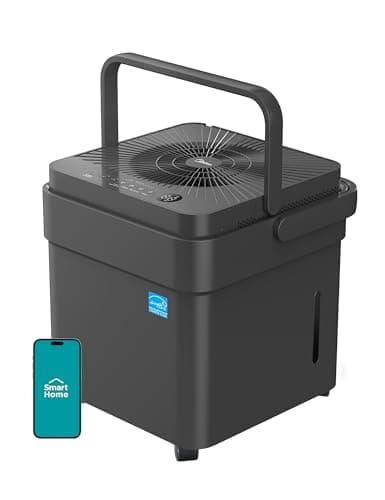
The adjustable 4.25-gallon bucket is the point. Most dehumidifiers get switched off because emptying a 2-gallon bucket twice a day is miserable; this one buys you a couple of days.
#ad Price as of October 18, 2026, from Amazon. Prices change. How we make money.
Published specifications
| Specification | Value | Source |
|---|---|---|
| Capacity | 35 pints per day | Midea published specification |
| Capacity (federal test) | 35.82 pints per day | ENERGY STAR certified products database |
| Coverage | Up to 3,500 sq ft | Midea published specification |
| Efficiency (IEF) | 2.01 L/kWh | ENERGY STAR certified products database |
| Annual energy use | 378 kWh/yr | ENERGY STAR certified products database |
| Bucket fill level | Adjustable, up to 4.25 gallons | Midea user manual |
| Fan speeds | 2 (High, Low) | Midea user manual |
| Dimensions | 14.76 x 14.57 x 14.45 in, 39.62 lb | Midea published specification |
| Certification | ENERGY STAR certified | ENERGY STAR certified products database |
What it costs to run
About $69 a year on ENERGY STAR's certified annual energy figure.
ENERGY STAR publishes 378 kWh a year for this model. At 18.34 cents/kWh that is $69.33 a year. That figure is calculated on the program's standardized test basis, not measured in your basement: a genuinely damp space where it cycles constantly will use more. Against the 50-pint Cube's 515 kWh ($94.45) it is the cheaper machine to own, which is the argument for sizing honestly rather than buying headroom.
What is good about it
- An adjustable bucket that holds up to 4.25 gallons - the difference between a unit you keep using and one you unplug in week three
- An IEF of 2.01 L/kWh removes about 18% more water per kWh than the 20-pint Cube's 1.70
- Nests down into a smaller shape for storage, which matters for an appliance you only use half the year
What is not
- The 3,500 sq ft coverage claim assumes conditions no real basement has; treat it as a ceiling, not a specification
- 35 pints is not enough for a genuinely wet basement with standing water
- Midea does not publish a rated wattage for this model, so we quote ENERGY STAR's certified annual energy figure instead
- No built-in pump on this model - without a floor drain you are either emptying the bucket or routing a gravity hose
Who should skip this
Skip this if your basement is wet rather than damp - visible water, white efflorescence on the walls, a musty smell that returns within a day of airing out. That is a drainage problem, and a 35-pint unit will run permanently and never win.
How it scored
- Tank interval10.0
- Capacity for the money8.5
- Efficiency per liter removed9.0
- Storage footprint9.0
Overall 8.7 / 10. This is our editorial score from published specifications and computed running cost. It is not a test result, and it is deliberately not marked up as a rating in this page’s structured data.
How we ranked these
We have not tested these units. Nobody here owns one. What we did was compile each manufacturer’s published specifications, check the coverage claims against AHAM’s room-sizing rule, and compute what each one costs to run for a year at the current US average electricity price. Every figure on this page is attributed to whoever published it, and the arithmetic is shown so you can redo it.
How we rank these sets out the full method, including what would change a ranking.
Questions people ask
+−Can one machine do all of this?
Combination units exist, and we would generally avoid them. A purifier wants to move a lot of air through a dense filter; a dehumidifier wants to condense water on a cold coil. Those are different mechanical problems, and units trying to do both usually do one of them poorly. Two separate devices in the rooms that need them beats one device that compromises on both.
+−Do air purifiers help with humidity?
No. An air purifier moves air through a filter. It removes particles and, depending on the carbon stage, some gases. It does not add or remove water vapor, and it will not change your hygrometer reading. If the room feels damp or dry, a purifier is the wrong device.
+−Should I get an air purifier or a humidifier for nosebleeds?
Usually a humidifier. Nosebleeds that appear in winter and stop in spring are normally dry nasal tissue rather than airborne irritants, and adding moisture addresses the cause. We cover this in full at nosebleeds and dry air. Persistent or heavy nosebleeds are a matter for a clinician, not an appliance.
+−Is a dehumidifier or an air purifier better for mold?
A dehumidifier, and it is not close. Mold needs moisture to grow; take the moisture away and the colony stops. A purifier only removes spores already floating in the air, which is useful as a second step and useless as a first one. The full argument is at will an air purifier fix mold.
+−How much does it cost to run these things?
Wildly different amounts, and it is the number nobody publishes. At the current US average residential rate of 18.34 cents per kWh, a 23 W bedroom air purifier costs about $18 a year at 12 hours a day. A 545 W dehumidifier on a humidistat in a damp basement is nearer $200. That 10x difference should influence your decision far more than a $30 gap in the purchase price.
+−Do I need one in every room?
For purifiers and humidifiers, mostly yes - they treat the room they are in, and air does not move freely between closed rooms no matter what the coverage figure on the box says. Combination units promise to collapse two of these decisions into one, at a cost we set out in air purifier and humidifier combos. For dehumidifiers, usually no: damp tends to have one source, and treating that space handles the rest. And if the question is whether a purifier earns its place at all, we work through the cost in are air purifiers worth it.