Roundup
Best Humidifiers for Large Rooms
The number on the box is not tested to anything. The number that predicts a large room is gallons per day - and by that measure the unit with the longest run time is the weakest of the three.
By Scooter M. · Published · Last updated
How this page is funded: the buy links below are affiliate links. If you buy through one, we earn a commission at no extra cost to you. It does not change the order of the picks or what we say about them. Full disclosure.
The short answer
Size on sustained output, and buy evaporative. A humidifier’s square-footage claim is the manufacturer’s own and is not measured to any external standard, unlike air purifier CADR or dehumidifier pints. What predicts a large room is how much water a unit actually puts into the air per day, which you get by dividing the published tank by the published run time. On that arithmetic one of our three picks moves about three times the water of the other two - and it is the only one we would trust with an open-plan floor.
How we judged these, before any product
We have not tested these units. Every figure below is the manufacturer’s published specification with the publisher named on the product card, and the derived figures are our arithmetic on those numbers, shown so you can redo it. Four criteria, in order:
- Sustained output, in gallons per day. Tank capacity divided by published run time. A large room is a large volume of air being continuously swapped with dry outdoor air; the unit has to out-add that exchange, and this is the only published figure that speaks to whether it can.
- Whether it can overshoot. The EPA’s guidance on home humidifiers is not to humidify above 50 percent relative humidity. An evaporative unit physically cannot, because evaporation slows as the air approaches saturation. An ultrasonic unit will keep misting unless a sensor stops it.
- Refill interval you will actually keep up with. Tank divided by sustained output. The commonest fate of a large humidifier is a cupboard in February because filling it became a chore.
- Running cost from the rated wattage, at the US average electricity price. On a warm-mist unit this is not a rounding error.
The arithmetic, on the three units
Here is the calculation that reorders this whole category. Take each manufacturer’s tank capacity and run time - both published - and divide.
| Superior 6000S | OasisMist 1000S | LV600S | |
|---|---|---|---|
| Tank | 6 gal / 22.7 L | 2.6 gal / 10 L | 1.58 gal / 6 L |
| Run time (low) | Up to 72 h | Up to 100 h | Up to 50 h |
| Sustained output | About 2.0 gal/day | About 0.63 gal/day | About 0.76 gal/day |
| Claimed coverage | 3,000 sq ft | 300-600 sq ft | 753 sq ft |
| Type | Evaporative - self-limiting | Ultrasonic cool mist, with humidity sensor | Ultrasonic warm and cool mist |
| Rated power | 30 W | 27.5 W | 280 W |
| Cost per year | About $24.10 | About $22.09 | Up to about $224.86 on warm mist |
Read the sustained-output row and the coverage row against each other. The Superior 6000S moves roughly three times the water per day of either ultrasonic unit. That is the whole reason it is the pick for a large room, and it has nothing to do with the 3,000 sq ft figure - which, as the sizing guide explains, is the maximum-output end of a dial the 72-hour run time describes the opposite end of.
The finding worth slowing down for
The OasisMist 1000S runs up to 100 hours on a fill. That is the longest run time here and the single most attractive number on its listing. But run time is tank divided by output, so a very long run time from a mid-sized tank means a low output: about 0.63 gallons a day on the low setting, which is less than the LV600S manages from a smaller tank. The feature that sells it as convenient is the same arithmetic that makes it the weakest of the three at humidifying a big space.
That does not make it a bad humidifier. It makes it a superb one-room humidifier with a refill interval of roughly a week, and a poor choice for the job this page is about. We rank it second because its humidity sensor and auto mode are a genuine answer to the ultrasonic overshoot problem, and because it is the cheapest of the three to run - but we would not put it in an open-plan downstairs.

Why a large room wants evaporative specifically
In a small closed bedroom the type of humidifier is mostly a preference. In a large room it becomes a safety margin. A large space takes a long time to reach a target, so you run the unit hard and for long periods - and an ultrasonic unit without a working sensor will keep misting straight past the EPA’s 50 percent ceiling into the condensation-and-mold end of the scale, most likely on the coldest wall.
An evaporative unit cannot do that: as the air approaches saturation it simply evaporates less. It also leaves the minerals in the wick rather than aerosolizing them, so tap water is fine and there is no white dust across a room full of furniture. The trade is a fan you can hear and a wick you replace on schedule. The full type comparison is at warm mist vs cool mist, and the water question at distilled vs tap water.
The honest limit: one unit will not do a whole house
Even the Superior 6000S is a portable unit, and a portable unit humidifies the space it can reach. With interior doors open that is a floor; with them shut it is a room. Its 3,000 sq ft claim assumes air moves freely between those rooms, which in a real house with doors it does not. If the brief is genuinely every room, the comparison you want is whole house vs portable humidifier, and the honest answer may be two mid-size units rather than one large one.
And before buying anything large, check the reading. A hygrometer costs a fraction of any unit here; if the room already sits inside the EPA’s 30-50 percent band, the symptom you are chasing has another cause, and a big humidifier will take you past 50 percent rather than fix it. The overnight figure is the one that matters, because rooms are driest in the small hours after a night of heating.
A note on the picks all being one brand
All three units here are Levoit. That is not an endorsement of the brand over others; it is a consequence of our rule that we only feature products whose exact model we can verify against a current, purchasable listing and whose specifications the manufacturer actually publishes. These were the three large-tank humidifiers that cleared both bars. We say so plainly so you can weigh it, and we would rather publish three verifiable picks than pad the list with units we cannot stand behind.
When to buy nothing at all
- The overnight reading is above 40%. Inside the EPA band, nothing to add - see are humidifiers worth it.
- The house is leaking heat and air. Sealing drafts reduces the rate at which your house replaces humid air with dry air, which is the thing every humidifier is fighting. It costs very little and it is where we would start: why is my house so dry.
- You will not keep the cleaning schedule. The EPA’s guidance is to change the water daily and clean portable units every third day. A large tank is more standing water, not less, and it does not change that cadence.
What we would actually do
Measure the room for two nights first. If it is genuinely under 30%, buy the Superior 6000S for an open floor, put it centrally rather than in a corner, set the target at 40-45% rather than as high as it goes, and budget for wicks. If the “large room” is really one big bedroom you want to refill once a week, the OasisMist is the better-fitting machine despite ranking second here. And unless you have a specific reason to want warm mist, do not pay 280 W for it.
Quick picks
Ranked on published specifications and computed running cost. Tap any row for the full write-up, including who should skip it.
| # | Product | Best for | Score | Price |
|---|---|---|---|---|
| 1 | 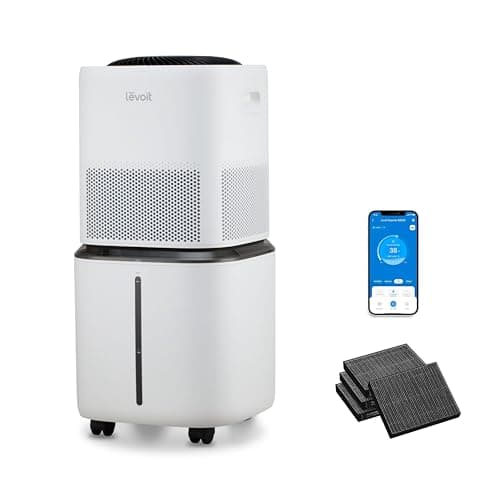 Levoit Superior 6000SWhole floors, and anyone tired of refilling | Best for large rooms | 8.6 | $249.99 - View on Amazon |
| 2 | 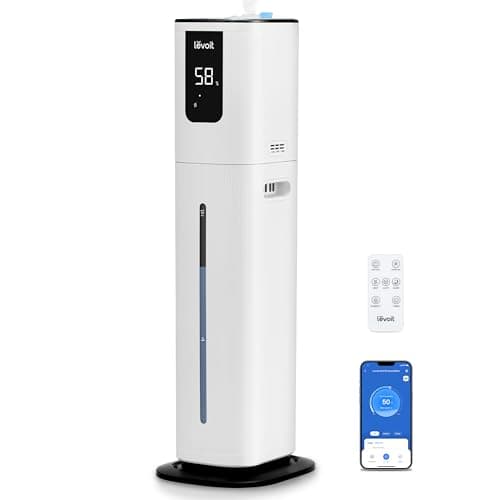 Levoit OasisMist 1000SA bedroom or office you want to refill once a week, not an open-plan floor | Longest refill interval | 7.8 | $134.99 - View on Amazon |
| 3 | 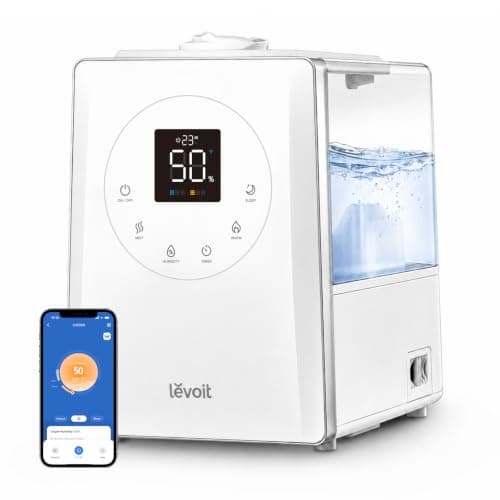 Levoit LV600S HybridPeople who want the option of warm mist | Best if you want warm mist | 7.4 | $109.00 - View on Amazon |
#1 - Best for large rooms
Levoit Superior 6000S
Whole floors, and anyone tired of refilling
A 6-gallon evaporative unit at 30 W. If you have spent a winter refilling a small humidifier twice a day, this is the one that ends that.
#ad Price as of October 18, 2026, from Amazon. Prices change. How we make money.
Published specifications
| Specification | Value | Source |
|---|---|---|
| Tank capacity | 6 gal / 22.7 L | Levoit published specification |
| Coverage | 3,000 sq ft | Levoit published specification |
| Rated power | 30 W | Levoit published specification |
| Run time | Up to 72 hours on the low fan setting | Levoit published specification |
| Max output | 1,500 mL/h | Levoit published specification |
What it costs to run
About $12-13 a year in electricity across a heating season at 12 hours a day.
30 W / 1000 x 12 hours x 365 days = 131.4 kWh = $24.10 a year run year-round, so roughly $12-13 across a six-month heating season. On any evaporative unit the filters, not the electricity, are the larger cost.
What is good about it
- 30 W against 3,000 sq ft of claimed coverage is the best power-to-output ratio of any humidifier we list
- Evaporative, so it self-limits the same way the Honeywell does - it will not flood a room
- 72 hours per fill means refilling twice a week rather than twice a day
What is not
- It is a large object and it looks like one
- The 3,000 sq ft coverage claim assumes air moves freely between those rooms, which in a real house with doors it does not
Who should skip this
Skip this if you only need one bedroom humidified. A 6-gallon tank in a 120 sq ft room is a lot of standing water to keep clean for no additional benefit.
How it scored
- Cannot over-humidify10.0
- Refill interval9.5
- Power efficiency9.5
- Cleaning burden6.5
Overall 8.6 / 10. This is our editorial score from published specifications and computed running cost. It is not a test result, and it is deliberately not marked up as a rating in this page’s structured data.
#2 - Longest refill interval
Levoit OasisMist 1000S
A bedroom or office you want to refill once a week, not an open-plan floor
A 10-liter tower that runs up to 100 hours on low. Read that carefully: the long run time comes from a low sustained output, which makes it a superb refill interval and a weak large-room humidifier.
#ad Price as of October 18, 2026, from Amazon. Prices change. How we make money.
Published specifications
| Specification | Value | Source |
|---|---|---|
| Tank capacity | 2.6 gal / 10 L | Levoit published specification |
| Coverage | 300-600 sq ft | Levoit published specification |
| Rated power | 27.5 W | Levoit published specification |
| Noise | Under 28 dB | Levoit published specification |
| Run time | Up to 100 hours on the low mist setting | Levoit published specification |
| Type | Ultrasonic, cool mist only, with a humidity sensor and auto mode | Levoit published specification |
| Dimensions | 8.4 x 10.0 x 28.7 in | Levoit published specification |
What it costs to run
About $22 a year in electricity at 12 hours a day.
27.5 W / 1000 x 12 hours x 365 days = 120.5 kWh. At 18.34 cents/kWh that is $22.09 a year at rated power, and less on the low mist setting most people would actually use. Add distilled water if your tap water is hard, which for an ultrasonic unit is the real recurring cost.
What is good about it
- 27.5 W is the lowest rated power of any humidifier we carry, so it is cheap to leave running
- A humidity sensor with auto mode means it can hold a setpoint rather than misting blindly, which partly offsets the usual ultrasonic weakness
- Under 28 dB and a tall, narrow footprint - it fits beside a bed or a desk without taking floor space
What is not
- Levoit does not publish a maximum mist output for this model, so we cannot quote one; the tank-over-run-time arithmetic (10 L over 100 h) implies only about 0.63 gallons a day on low, less than the LV600S
- Ultrasonic, so it aerosolizes whatever minerals are in the tank - the EPA's white-dust caution applies, and it wants distilled water
- The 300-600 sq ft coverage claim is not measured to any external standard and, at that sustained output, is optimistic for the upper end
Who should skip this
Skip this if you are trying to humidify a whole floor or an open-plan space. Its strength is a week between refills in one closed room; asked to fight a large, leaky volume it will run continuously and move the number very little.
How it scored
- Cannot over-humidify5.5
- Refill interval10.0
- Power efficiency9.5
- Sustained output for a large room5.0
Overall 7.8 / 10. This is our editorial score from published specifications and computed running cost. It is not a test result, and it is deliberately not marked up as a rating in this page’s structured data.
#3 - Best if you want warm mist
Levoit LV600S Hybrid
People who want the option of warm mist
The one to pick if you specifically want warm mist - but note the 280 W rated power, because that is what heating water actually costs.
#ad Price as of October 18, 2026, from Amazon. Prices change. How we make money.
Published specifications
| Specification | Value | Source |
|---|---|---|
| Tank capacity | 1.58 gal / 6 L | Levoit published specification |
| Coverage | 753 sq ft | Levoit published specification |
| Rated power | 280 W | Levoit published specification |
| Run time | Up to 50 hours | Levoit published specification |
What it costs to run
Up to $225 a year on warm mist at 12 hours a day - the most expensive thing to run on this site.
280 W / 1000 x 12 hours x 365 days = 1,226 kWh = $224.86 a year at full warm-mist draw. On cool mist it draws a small fraction of that. This number, not the feature list, is what should decide whether you actually want warm mist.
What is good about it
- Warm and cool mist in one unit, so you are not committed to one type before you know which you prefer
- 50 hours per fill is good going for a 1.58 gallon tank
What is not
- 280 W rated. Warm mist is a kettle with a fan attached - the heat is the cost, and it is roughly ten times the Superior 6000S
- Ultrasonic, so it can over-humidify a room and it will aerosolize whatever minerals are in your water
Who should skip this
Skip this if you have hard water and no intention of using distilled. Ultrasonic units put the minerals in your water onto every surface in the room as white dust.
How it scored
- Cannot over-humidify3.0
- Refill interval8.0
- Power efficiency3.0
- Flexibility9.0
Overall 7.4 / 10. This is our editorial score from published specifications and computed running cost. It is not a test result, and it is deliberately not marked up as a rating in this page’s structured data.
How we ranked these
We have not tested these units. Nobody here owns one. What we did was compile each manufacturer’s published specifications, check the coverage claims against AHAM’s room-sizing rule, and compute what each one costs to run for a year at the current US average electricity price. Every figure on this page is attributed to whoever published it, and the arithmetic is shown so you can redo it.
How we rank these sets out the full method, including what would change a ranking.
Questions people ask
+−What size humidifier do I need for a large room?
Size on sustained output - tank capacity divided by run time - rather than the square-footage claim, which is not measured to any external standard. A unit moving around 2 gallons a day will hold an open floor; one moving well under a gallon a day is a single-room machine whatever its coverage figure says.
+−Is a bigger tank better for a large room?
Only if the output is there too. A big tank with a very long run time means a low output - it is the same arithmetic. The OasisMist 1000S runs up to 100 hours from 10 liters, which is about 0.63 gallons a day; the Superior 6000S runs 72 hours from 22.7 liters, about 2 gallons a day.
+−Evaporative or ultrasonic for a large room?
Evaporative. In a large room you run the unit hard for long periods, and an evaporative unit self-limits as the air approaches saturation, so it cannot push past the EPA’s 50 percent ceiling. An ultrasonic unit needs a working sensor to stop, and aerosolizes tap-water minerals across the whole room.
+−Can one humidifier do a whole house?
A portable unit humidifies the space it can reach - a floor with the doors open, a room with them shut. Coverage claims assume free air movement between rooms. For every room, the honest options are two mid-size units or an in-duct system.
+−Why does my large humidifier not raise the humidity?
Usually because the space is larger than you think - an open door turns a room into a floor - or because the house is swapping air with cold, dry outdoor air faster than the unit can add moisture. The checklist is at still dry with a humidifier running.