Comparison
Air Scrubber vs Air Purifier
These are not two grades of the same appliance. One is built to make a work area safe to stand in while it is being torn apart; the other is built to be left running in a room you live in.
By Scooter M. · Published · Last updated
How this page is funded: the buy links below are affiliate links. If you buy through one, we earn a commission at no extra cost to you. It does not change the order of the picks or what we say about them. Full disclosure.
The short answer
Buy an air scrubber only if you are actively remediating something. Otherwise buy a purifier. A scrubber’s real advantage is not filtration quality - it is airflow and the ability to hold a sealed work area under negative pressure so contaminated air cannot escape into the rest of the house. That matters during mold work, water-damage restoration or demolition. It is also 65 dBA, draws 287.5 W, and filters to 99.95% at 0.3 microns, which is below the True HEPA standard of 99.97%. For living in, a room purifier wins on every axis that matters.
They are built for different jobs
The confusion is understandable: both pull room air through a HEPA filter and blow it back out. The difference is what else they are designed to do.
An air purifier is a recirculating appliance. It sits in an occupied room and lowers the particle concentration in that room, quietly enough that you leave it on. Its performance standard is CADR, measured by AHAM, and sizing it is arithmetic - floor area times two-thirds, as in what size air purifier do I need.
An air scrubber - the trade also calls it a negative air machine - is site equipment. It can be ducted, so instead of recirculating it can exhaust filtered air out of a sealed containment, putting that space at slightly lower pressure than its surroundings. Air then leaks into the work area rather than out of it, which is what stops mold spores or demolition dust migrating through the house. No room purifier can do that, and it is the only reason to own one.
Side by side, on published figures
| AlorAir CleanShield HEPA 550 | A typical room purifier | |
|---|---|---|
| Airflow | 270-550 CFM | Fan output not usually published |
| AHAM CADR | Not published | Published and verifiable |
| Filtration grade | 99.95% at 0.3 microns | True HEPA, 99.97% |
| Carbon stage | Real activated carbon | Coating on most units |
| Negative pressure | Yes, ductable | No |
| Noise | 65 dBA | 19-50 dB typical |
| Power draw | 287.5 W | 17-54 W typical |
| Cost to run continuously | About $462/yr | About $19-48/yr |
| Designed to live with | No | Yes |
Two rows deserve a second look. The scrubber’s filtration grade is lower than a domestic True HEPA unit, not higher - 99.95% against 99.97% at the same particle size. And it publishes no AHAM CADR, because CADR is a standard for room air cleaners and a scrubber is not one. So you cannot compare the two on clean air delivered, which is the figure that would actually settle a performance argument.
When an air scrubber is genuinely the right call
- Active mold remediation where a containment is sealed and you need air leaking in rather than out. This is the textbook case.
- Water-damage restoration - the machine is built to sit on a wet floor beside blowers and be hosed down afterwards.
- Demolition or sanding in one room of an occupied house, where the point is protecting the other rooms as much as the work area.
- A short, intense job with nobody trying to sleep nearby. 65 dBA for three days is tolerable; 65 dBA indefinitely is not.
When it is the wrong purchase
- Ongoing allergies, dust or pet dander. You need something quiet enough to run every night. That is a purifier, sized by CADR.
- A musty smell with no active remediation. A smell is a moisture symptom; the answer is finding the water and running a dehumidifier, which is the argument in musty smell in the house.
- Existing mold you are not removing. A scrubber captures airborne spores while it runs. It does not touch the growth or the moisture feeding it, exactly as a purifier does not - will an air purifier fix mold applies to both machines equally.
- Because it sounds more serious. More airflow at a lower filtration grade, no CADR to check and ten times the running cost is not an upgrade.
What we would actually do
For anything that is a living-with problem - allergies, dust, smoke, pets, cooking - buy a purifier with a published CADR and size it to the room. The quiet matters more than the airflow, because the machine only works when it is switched on and nobody leaves a 65 dBA box running in a bedroom.
If you have an actual remediation in front of you, a scrubber is the right tool and the CleanShield 550 publishes more about itself than most. Seal the containment, duct the exhaust so the room goes slightly negative, run it for the duration of the job, and then stop. Budget the electricity honestly while it runs.
And if what you are really deciding is which category of machine you need at all, start at which device do I need - a surprising share of people arriving at this question need a dehumidifier rather than either of these.
What we would buy for this
Chosen from the same registry as our roundups, on published specifications and computed running cost.
AlorAir CleanShield HEPA 550
An active remediation - water damage, mold work, renovation dust - not daily living
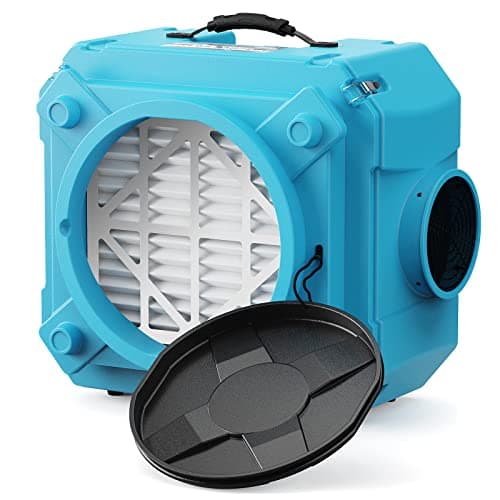
A genuine air scrubber: 550 CFM, a real carbon stage and the ability to run negative pressure on a containment. It is also 65 dBA and draws 287.5 W, which is why it belongs on a job site and not in a living room.
#ad Price as of October 18, 2026, from Amazon. Prices change. How we make money.
Published specifications
| Specification | Value | Source |
|---|---|---|
| Airflow | 270-550 CFM, variable speed | AlorAir published specification |
| Coverage | Up to 800 sq ft | AlorAir published specification |
| Filtration | 3-stage: MERV-10 pre-filter, activated carbon, HEPA | AlorAir published specification |
| Filtration efficiency | 99.95% of particles at 0.3 microns or larger | AlorAir published specification |
| Power consumption | 287.5 W | AlorAir published specification |
| Noise | 65 dBA | AlorAir published specification |
| CADR | Not published - air scrubbers are not AHAM room air cleaners | No AHAM-verified figure found |
| Negative pressure | Supported; daisy-chains with up to 2 further units | AlorAir published specification |
| Dimensions | 20.9 x 24.8 x 14.9 in | AlorAir published specification |
What it costs to run
About $462 a year if run continuously; roughly $154 at 8 hours a day.
287.5 W / 1000 x 24 hours x 365 days = 2,519 kWh = $461.89 a year at 18.34 cents/kWh. On a realistic job-site duty of 8 hours a day that is 840 kWh = $153.96. Either figure dwarfs every domestic purifier on this site, which is the clearest signal that it is not a domestic appliance.
What is good about it
- 550 CFM of airflow is more than any domestic purifier we list, and it is ducted-capable
- Can establish negative pressure on a sealed containment, which stops contaminated air leaving the work area - no room purifier does this and it is the actual reason to own one
- A real activated carbon stage alongside the HEPA, not a coating
- Daisy-chains up to two more units for larger jobs, and the housing is built to be dragged around a site
- Publishes airflow, wattage, noise and filtration efficiency - more numbers than Austin Air manages at twice the price
What is not
- 65 dBA. That is conversation-level noise, continuously. It is not habitable in a room you are living in
- 287.5 W is roughly five times a domestic purifier. Run continuously that is about $462 a year of electricity
- 99.95% at 0.3 microns is below the True HEPA 99.97% standard - the airflow is the selling point, not the filtration grade
- No AHAM CADR, so it cannot be compared with room purifiers on the one figure that would make the comparison fair
- It is a 20 x 25 in box designed to sit on a floor and be moved by a handle; there is no domestic version of this form factor
- For ordinary indoor air - pollen, dust, dander, cooking - this is the wrong tool and an expensive one
Who should skip this
Skip this unless you are actively remediating something. For everyday air quality a room purifier with a published CADR is quieter, a fifth of the running cost and better matched to the job.
How it scored
- Airflow and containment9.5
- Fit for remediation work9.5
- Fit for a home2.0
- Running cost2.0
Overall 7.5 / 10. This is our editorial score from published specifications and computed running cost. It is not a test result, and it is deliberately not marked up as a rating in this page’s structured data.
Levoit Core 400S
Living rooms and open-plan spaces
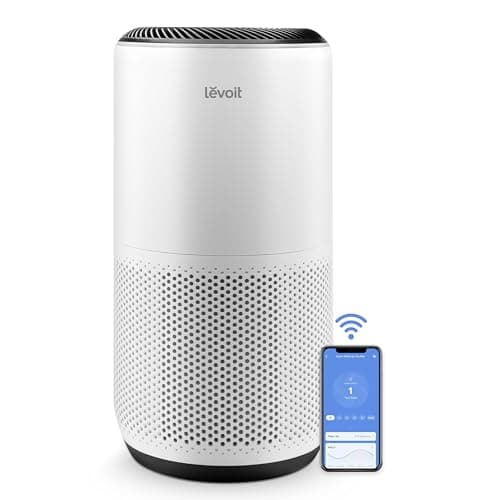
The one to buy if you want a purifier that genuinely covers a living room, and one of the few spec sheets in this bracket that publishes coverage at a useful air-change rate rather than only the flattering one.
#ad Price as of October 18, 2026, from Amazon. Prices change. How we make money.
Published specifications
| Specification | Value | Source |
|---|---|---|
| CADR | 231 CFM | Levoit published specification |
| Coverage | 358 sq ft at 4.8 air changes/hr (1,718 sq ft at 1 ACH) | Levoit published specification |
| Rated power | 38 W | Levoit published specification |
| Noise | 22-52 dB | Levoit published specification |
| Filtration | 3-stage: pre-filter, HEPA, activated carbon | Levoit published specification |
| Dimensions | 10.8 x 10.8 x 20.5 in, 11 lb | Levoit published specification |
What it costs to run
About $25-30 a year in electricity at 12 hours a day, before filters.
38 W / 1000 x 12 hours x 365 days = 166.4 kWh. At 18.34 cents/kWh that is $30.52 a year at rated power - and the unit only draws its full 38 W on the top fan speed, so a mid setting lands nearer $25. Add the replacement filter, which you should price before you buy rather than after.
What is good about it
- Levoit publishes coverage at both 1 ACH and 4.8 ACH, which is unusually straight - most brands quote only the flattering 1 ACH number
- 38 W is low for this CADR, which is what keeps the running cost down
- 22 dB on its lowest setting is quiet enough to sleep beside
- Carbon, pet-allergy and smoke-specific replacement filters are sold for the same body
What is not
- We could not find a published filter replacement interval in Levoit's specification, so we are not quoting one
- The 1,718 sq ft headline is a single air change per hour, which is not a useful rate for allergies
Who should skip this
Skip this if your room is under 200 sq ft. The Core 300S covers that at lower power and lower cost, and the extra CADR buys you nothing in a small bedroom.
How it scored
- Clean air per watt9.0
- Honest coverage claim9.5
- Quiet operation8.5
- Filter economics7.5
Overall 8.6 / 10. This is our editorial score from published specifications and computed running cost. It is not a test result, and it is deliberately not marked up as a rating in this page’s structured data.
Coway Airmega AP-1512HH Mighty
Running continuously in a medium room
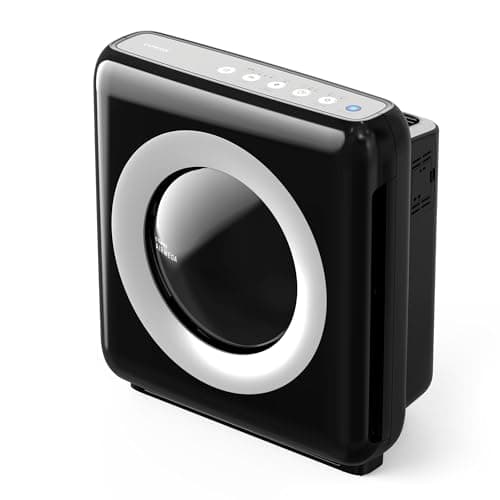
The most efficient unit here at low speed - 3.7 W on speed one - which matters enormously if you leave a purifier running all day and almost not at all if you do not.
#ad Price as of October 18, 2026, from Amazon. Prices change. How we make money.
Published specifications
| Specification | Value | Source |
|---|---|---|
| CADR (smoke) | 233 CFM | Coway published specification |
| CADR (dust) | 246 CFM | Coway published specification |
| CADR (pollen) | 240 CFM | Coway published specification |
| Coverage | 361 sq ft at 4.8 air changes/hr (1,748 sq ft at 1 ACH) | Coway published specification |
| Power draw by speed | 0.3 W standby / 3.7 W speed 1 / 8.7 W speed 2 / 75.3 W speed 3 | Coway published specification |
| Filtration | Pre-filter, odor filter, Green True HEPA, bipolar device | Coway published specification |
What it costs to run
About $6 a year running 24/7 on speed one, or $121 a year running 24/7 on speed three.
Speed 1: 3.7 W / 1000 x 24 x 365 = 32.4 kWh = $5.94 a year. Speed 3: 75.3 W / 1000 x 24 x 365 = 659.6 kWh = $120.97 a year. That twenty-fold spread is the most important number on this page, and it is why we chase per-speed figures instead of accepting a single rated wattage.
What is good about it
- Coway publishes power draw per fan speed, which almost nobody does and which is the only way to compute a real running cost
- 3.7 W on speed one is remarkable - cheaper to run continuously than most nightlights
- Coverage published at 1, 2 and 4.8 air changes per hour, so you can size it honestly
What is not
- 75.3 W on speed three is the highest draw here; how the auto mode behaves decides your bill
- The bipolar device is a stage we would rather do without; check it can be disabled
Who should skip this
Skip this if you only run a purifier for an hour or two at a time. Its whole advantage is low-speed efficiency over long hours, and short bursts on high speed give that straight back.
How it scored
- Clean air per watt9.5
- Honest coverage claim9.5
- Quiet operation8.0
- Filter economics7.5
Overall 8.7 / 10. This is our editorial score from published specifications and computed running cost. It is not a test result, and it is deliberately not marked up as a rating in this page’s structured data.
How we ranked these
We have not tested these units. Nobody here owns one. What we did was compile each manufacturer’s published specifications, check the coverage claims against AHAM’s room-sizing rule, and compute what each one costs to run for a year at the current US average electricity price. Every figure on this page is attributed to whoever published it, and the arithmetic is shown so you can redo it.
How we rank these sets out the full method, including what would change a ranking.
Questions people ask
+−What is the difference between an air scrubber and an air purifier?
A purifier recirculates air within a room and is designed to be lived with - quiet, low power, sized by AHAM CADR. A scrubber is site equipment that moves far more air and can be ducted to hold a sealed work area under negative pressure, so contaminated air cannot escape into the rest of the building. That containment ability is the real difference, not filtration quality.
+−Is an air scrubber better than an air purifier?
Not for a home. The scrubber we checked filters to 99.95% at 0.3 microns, which is below the 99.97% True HEPA standard, publishes no AHAM CADR, runs at 65 dBA and draws 287.5 W. It is better at the one thing it exists for - protecting the rest of a building during remediation work - and worse at everything a household actually needs.
+−Can I use an air scrubber in my house?
During a job, yes, and that is what they are for. As a permanent appliance, no - 65 dBA is conversation-level noise continuously, and running it around the clock would cost roughly $462 a year in electricity at the US average rate.
+−Do air scrubbers remove mold?
They capture airborne spores while running and, ducted properly, stop spores spreading out of a work area. Neither of those removes mold growth or the moisture feeding it. The growth is a cleaning job and the moisture is a dehumidifier-and-repair job; a scrubber is containment, not treatment.
+−Why do air scrubbers not have a CADR rating?
CADR is AHAM’s standard for portable room air cleaners, and a negative air machine is not marketed as one. The practical consequence is that you cannot compare a scrubber with a purifier on clean air delivered - you can only compare raw airflow, which describes the fan rather than the result.