Roundup
Best Hygrometers
The highest-value purchase on this entire site, and the only one that tells you whether to make any of the others.
By Scooter M. · Published · Last updated
How this page is funded: the buy links below are affiliate links. If you buy through one, we earn a commission at no extra cost to you. It does not change the order of the picks or what we say about them. Full disclosure.
Every other page on this site eventually says “measure first.” This is the page about the thing you measure with, and it is the cheapest recommendation we make.
Is a hygrometer the right instrument for this?
If your problem is damp, dryness, condensation, a musty smell, static shocks, or you are deciding between a humidifier and a dehumidifier - yes, and it is the only instrument that answers the question. If your problem is smoke or dust, you want a particulate monitor instead; a hygrometer is completely blind to particles.
What you actually need
There are only three decisions worth making here:
| Decision | The options | How to choose |
|---|---|---|
| Spot reading or logging? | A display you walk over and read, or a sensor that records history | Logging if your problem changes overnight or you want to prove a device is working. Spot reading if you just need to know which band you are in. |
| How many? | One, or one per problem room | At least two. The difference between the bedroom and the basement is usually the most useful number you get. |
| Standalone or app? | On-device display, or Bluetooth to a phone | App-connected if you want history and export. Standalone if you will not open an app, which is a real and common answer. |
On accuracy
Consumer hygrometers are generally accurate to within a few percentage points. That is worth knowing and it is also almost never a problem, because the decisions you are making with the reading are coarse: are you below 30, inside 30-50, or above 60? A three-point error does not change any of those answers.
Where it does matter is if you are chasing a specific setpoint in a room that sits near a threshold. In that case, two hygrometers in the same room is a cheap sanity check - if they agree, you can trust the number.
When to buy nothing at all
- You already have one. Most modern thermostats and many weather stations include a humidity readout, and it is worth checking before buying.
- Your problem is particles rather than moisture. Go to air quality monitors instead.
Quick picks
Ranked on published specifications and computed running cost. Tap any row for the full write-up, including who should skip it.
| # | Product | Best for | Score | Price |
|---|---|---|---|---|
| 1 |  ThermoPro TP49 HygrometerAnyone about to buy a humidifier or a dehumidifier ThermoPro TP49 HygrometerAnyone about to buy a humidifier or a dehumidifier | Every household | 9.0 | Check price on Amazon |
| 2 | 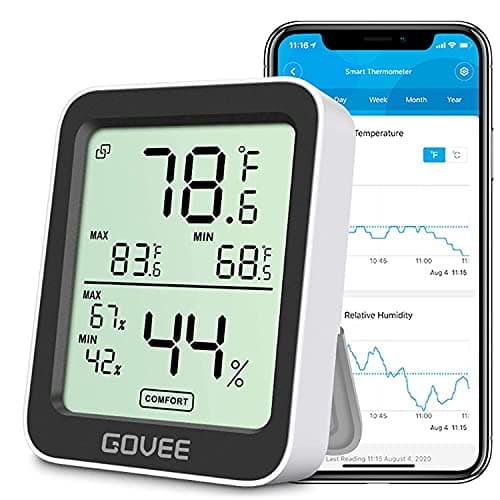 Govee H5075 Bluetooth HygrometerDiagnosing a problem that changes overnight Govee H5075 Bluetooth HygrometerDiagnosing a problem that changes overnight | Overnight logging | 8.6 | $12.99 - View on Amazon |
| 3 | Temtop M10 Air Quality MonitorWatching PM2.5 during smoke events | Particles, not humidity | 8.0 | Check price on Amazon |
#1 - Every household
ThermoPro TP49 Hygrometer
Anyone about to buy a humidifier or a dehumidifier
An inexpensive digital hygrometer is the highest-value purchase on this entire site, because it is the one that tells you whether to buy anything else.
#ad We do not hold a current price for this product, so we do not show one. How we make money.
Published specifications
| Specification | Value | Source |
|---|---|---|
| Function | Digital temperature and relative humidity readout with a comfort indicator | ThermoPro published specification |
What is good about it
- Cheap enough to buy three and put one in the bedroom, one in the basement and one in the living room, which is what you actually want
- Gives you the reading that decides between a humidifier and a dehumidifier - a decision people routinely get backwards
What is not
- Consumer hygrometers are typically accurate to within a few percentage points, which is fine for the 30-50% question and not fine for anything precise
- No logging, so you see now rather than overnight
Who should skip this
Skip this only if you already own a hygrometer. There is no household we would tell not to measure.
How it scored
- Value for the decision it informs10.0
- Accuracy for the 30-50% question8.0
- Logging and history2.0
Overall 9.0 / 10. This is our editorial score from published specifications and computed running cost. It is not a test result, and it is deliberately not marked up as a rating in this page’s structured data.
#2 - Overnight logging
Govee H5075 Bluetooth Hygrometer
Diagnosing a problem that changes overnight
The one that logs. If your problem is that the house is dry at night but fine during the day, a hygrometer you have to walk over and read will never tell you that.
#ad Price as of October 18, 2026, from Amazon. Prices change. How we make money.
Published specifications
| Specification | Value | Source |
|---|---|---|
| Function | Bluetooth temperature and humidity sensor with app-based logging and data export | Govee published specification |
What is good about it
- Logging is the feature. Overnight humidity swings are invisible to a spot reading, and they explain most morning symptoms
- Data export means you can check whether the humidifier actually changed anything, rather than assuming
What is not
- Bluetooth range is room-scale; a basement sensor will not reach a phone upstairs
- Requires an app and an account, which is a genuine cost for some people
Who should skip this
Skip this if you just want a number on a wall. The logging is the whole premium, and it is wasted if you will not look at it.
How it scored
- Logging and history9.5
- Value for the decision it informs9.0
- Range and placement freedom6.0
Overall 8.6 / 10. This is our editorial score from published specifications and computed running cost. It is not a test result, and it is deliberately not marked up as a rating in this page’s structured data.
#3 - Particles, not humidity
Temtop M10 Air Quality Monitor
Watching PM2.5 during smoke events
A particulate monitor rather than a hygrometer - it answers a different question, and it is the question you want answered during wildfire season.
#ad We do not hold a current price for this product, so we do not show one. How we make money.
Published specifications
| Specification | Value | Source |
|---|---|---|
| Measures | PM2.5 particulate and AQI; some variants add HCHO and TVOC | Temtop published specification |
What is good about it
- PM2.5 is the number that matters during a smoke event, and a monitor is the only way to tell whether closing the windows actually worked
- Small enough to move room to room, which is how you find where the smoke is getting in
What is not
- Consumer optical particle sensors drift and are not laboratory instruments; treat readings as relative rather than absolute
- It does not measure humidity, so it is not a substitute for a hygrometer
Who should skip this
Skip this if your problem is damp or dryness. It measures particles, and it will tell you nothing at all about humidity.
How it scored
- Usefulness during smoke events9.5
- Absolute accuracy6.0
- Portability9.0
Overall 8.0 / 10. This is our editorial score from published specifications and computed running cost. It is not a test result, and it is deliberately not marked up as a rating in this page’s structured data.
How we ranked these
We have not tested these units. Nobody here owns one. What we did was compile each manufacturer’s published specifications, check the coverage claims against AHAM’s room-sizing rule, and compute what each one costs to run for a year at the current US average electricity price. Every figure on this page is attributed to whoever published it, and the arithmetic is shown so you can redo it.
How we rank these sets out the full method, including what would change a ranking.
Questions people ask
+−What is the best hygrometer for a basement?
One that logs, because basement humidity swings with the weather and a spot reading on a dry day tells you nothing about a humid week. If you want a display you can read on the way past, put a cheap one on the wall too - they are inexpensive enough to do both.
+−How do I check if my hygrometer is accurate?
The salt test: a sealed bag with a small dish of damp salt should stabilize at about 75% relative humidity, and you can compare your device against that. Or more simply, put two hygrometers side by side - agreement is good evidence, and disagreement tells you at least one needs replacing.
+−Where should I put a hygrometer?
At roughly chest height, a few feet from any external wall, out of direct sun, away from vents and radiators, and in the room the problem is actually in. Give it twenty minutes after moving it before you trust the reading.
+−Analog or digital?
Digital. Analog dial hygrometers drift substantially and most need periodic recalibration that nobody does. For a few dollars more a digital one gives you a reading you can act on.
+−Do smart thermostats measure humidity?
Many do, and if yours does you already have one data point for free. The limitation is placement - it is wherever the thermostat is, which is usually a hallway rather than the bedroom or the basement where your problem lives.