Comparison
Air Purifier vs Ionizer
One removes particles from your house. The other moves them from the air onto your furniture. Both are described as cleaning the air.
By Scooter M. · Published · Last updated
How this page is funded: the buy links below are affiliate links. If you buy through one, we earn a commission at no extra cost to you. It does not change the order of the picks or what we say about them. Full disclosure.
The short answer
Buy a filter-based purifier. A HEPA filter physically captures particles and holds them, and its performance is measured under AHAM’s AC-1 standard so you can compare units. An ionizer charges particles so they clump and settle onto nearby surfaces - they leave the air but stay in the room, and some ionizing designs generate ozone as a by-product. Where a unit has an ionizing stage you can switch off, we switch it off.
| Filter (HEPA + carbon) | Ionizer | |
|---|---|---|
| Mechanism | Air is drawn through a filter; particles are physically trapped | Emits charged ions; particles gain a charge, clump, and settle |
| Where particles end up | In the filter, which you remove from the house | On floors, walls and furniture in the same room |
| Standardized measurement | Yes - CADR, under AHAM AC-1 | No comparable standard for the ionizing effect |
| Consumables | Filters, regularly | Usually none |
| Ozone | None | Some designs produce it as a by-product; CARB certification is the thing to look for |
| Noise | Fan noise proportional to CADR | Near silent |
What each one actually does
A filter-based purifier is mechanically simple: a fan moves air, a filter catches what is in it, and the captured material leaves your home when you change the filter. Because there is a measurement standard, you can compare two units honestly and size one to a room - CADR explained is the arithmetic.
An ionizer emits charged ions. Airborne particles pick up that charge, become attracted to each other and to surfaces, clump together, and fall out of the air. Measured at a sensor, the air genuinely does contain fewer suspended particles. What happened to them is that they are now on your surfaces, and they can be disturbed back into the air by movement.
Buy a filter unit if...
- You want a number you can size against your room
- You want particles out of the house rather than on the floor
- Your problem is allergies, dust, dander or smoke particulate
An ionizing stage is acceptable if...
- It is a secondary stage on a unit whose filtration you chose it for
- It can be switched off, and the unit is CARB certified
- You understand it is not what is doing the measurable work
Buy neither if...
Your problem is humidity. Neither device changes moisture in any way - which device do I need covers why this is one of the most common wrong purchases in the category.
What about UV and photocatalytic stages?
Several units add a UV lamp or a photocatalytic oxidation stage under a proprietary name. The general problem with evaluating these in a domestic purifier is contact time: air passes the stage in a fraction of a second, which is a very different situation from the sustained exposure these technologies are effective under elsewhere. We have not tested any of them and we are not going to tell you they work or do not - what we will say is that the mechanical filtration is the part with a published, comparable measurement behind it, and it is the part we would buy on. The full version of that argument, with the EPA’s own wording on plasma and photocatalytic oxidation and the ozone figures it publishes for generators, is on UV and ozone air purifiers.
What we would buy for this
Chosen from the same registry as our roundups, on published specifications and computed running cost.
Levoit Core 400S
Living rooms and open-plan spaces
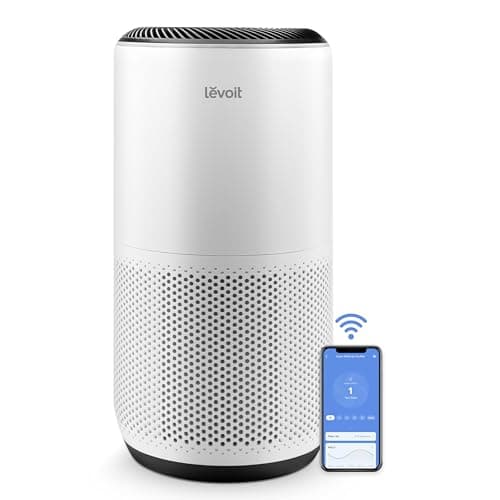
The one to buy if you want a purifier that genuinely covers a living room, and one of the few spec sheets in this bracket that publishes coverage at a useful air-change rate rather than only the flattering one.
#ad Price as of October 18, 2026, from Amazon. Prices change. How we make money.
Published specifications
| Specification | Value | Source |
|---|---|---|
| CADR | 231 CFM | Levoit published specification |
| Coverage | 358 sq ft at 4.8 air changes/hr (1,718 sq ft at 1 ACH) | Levoit published specification |
| Rated power | 38 W | Levoit published specification |
| Noise | 22-52 dB | Levoit published specification |
| Filtration | 3-stage: pre-filter, HEPA, activated carbon | Levoit published specification |
| Dimensions | 10.8 x 10.8 x 20.5 in, 11 lb | Levoit published specification |
What it costs to run
About $25-30 a year in electricity at 12 hours a day, before filters.
38 W / 1000 x 12 hours x 365 days = 166.4 kWh. At 18.34 cents/kWh that is $30.52 a year at rated power - and the unit only draws its full 38 W on the top fan speed, so a mid setting lands nearer $25. Add the replacement filter, which you should price before you buy rather than after.
What is good about it
- Levoit publishes coverage at both 1 ACH and 4.8 ACH, which is unusually straight - most brands quote only the flattering 1 ACH number
- 38 W is low for this CADR, which is what keeps the running cost down
- 22 dB on its lowest setting is quiet enough to sleep beside
- Carbon, pet-allergy and smoke-specific replacement filters are sold for the same body
What is not
- We could not find a published filter replacement interval in Levoit's specification, so we are not quoting one
- The 1,718 sq ft headline is a single air change per hour, which is not a useful rate for allergies
Who should skip this
Skip this if your room is under 200 sq ft. The Core 300S covers that at lower power and lower cost, and the extra CADR buys you nothing in a small bedroom.
How it scored
- Clean air per watt9.0
- Honest coverage claim9.5
- Quiet operation8.5
- Filter economics7.5
Overall 8.6 / 10. This is our editorial score from published specifications and computed running cost. It is not a test result, and it is deliberately not marked up as a rating in this page’s structured data.
Coway Airmega AP-1512HH Mighty
Running continuously in a medium room
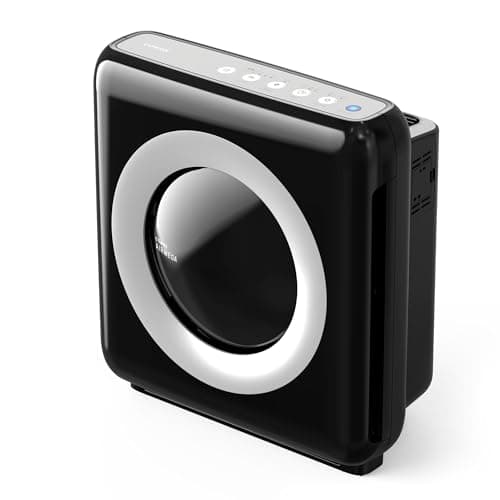
The most efficient unit here at low speed - 3.7 W on speed one - which matters enormously if you leave a purifier running all day and almost not at all if you do not.
#ad Price as of October 18, 2026, from Amazon. Prices change. How we make money.
Published specifications
| Specification | Value | Source |
|---|---|---|
| CADR (smoke) | 233 CFM | Coway published specification |
| CADR (dust) | 246 CFM | Coway published specification |
| CADR (pollen) | 240 CFM | Coway published specification |
| Coverage | 361 sq ft at 4.8 air changes/hr (1,748 sq ft at 1 ACH) | Coway published specification |
| Power draw by speed | 0.3 W standby / 3.7 W speed 1 / 8.7 W speed 2 / 75.3 W speed 3 | Coway published specification |
| Filtration | Pre-filter, odor filter, Green True HEPA, bipolar device | Coway published specification |
What it costs to run
About $6 a year running 24/7 on speed one, or $121 a year running 24/7 on speed three.
Speed 1: 3.7 W / 1000 x 24 x 365 = 32.4 kWh = $5.94 a year. Speed 3: 75.3 W / 1000 x 24 x 365 = 659.6 kWh = $120.97 a year. That twenty-fold spread is the most important number on this page, and it is why we chase per-speed figures instead of accepting a single rated wattage.
What is good about it
- Coway publishes power draw per fan speed, which almost nobody does and which is the only way to compute a real running cost
- 3.7 W on speed one is remarkable - cheaper to run continuously than most nightlights
- Coverage published at 1, 2 and 4.8 air changes per hour, so you can size it honestly
What is not
- 75.3 W on speed three is the highest draw here; how the auto mode behaves decides your bill
- The bipolar device is a stage we would rather do without; check it can be disabled
Who should skip this
Skip this if you only run a purifier for an hour or two at a time. Its whole advantage is low-speed efficiency over long hours, and short bursts on high speed give that straight back.
How it scored
- Clean air per watt9.5
- Honest coverage claim9.5
- Quiet operation8.0
- Filter economics7.5
Overall 8.7 / 10. This is our editorial score from published specifications and computed running cost. It is not a test result, and it is deliberately not marked up as a rating in this page’s structured data.
How we ranked these
We have not tested these units. Nobody here owns one. What we did was compile each manufacturer’s published specifications, check the coverage claims against AHAM’s room-sizing rule, and compute what each one costs to run for a year at the current US average electricity price. Every figure on this page is attributed to whoever published it, and the arithmetic is shown so you can redo it.
How we rank these sets out the full method, including what would change a ranking.
Questions people ask
+−Are ionizers bad for you?
That is a health question we are not qualified to answer. The environmental facts we can state: some ionizing designs generate ozone as a by-product, and California’s Air Resources Board operates a certification program for indoor air cleaners which is worth checking a unit against. Where the stage is optional we switch it off, as we do in our Coway Mighty review.
+−Do ionizers remove dust?
They remove it from the air by making it settle on surfaces. Whether that counts as removing dust depends on what you wanted - the air sensor reads lower, and you now have more to dust off.
+−Should I turn off the PlasmaWave or ionizer setting?
We would. The filtration is what has a measured CADR behind it, and switching off the ionizing stage costs you nothing measurable. If the unit is CARB certified and you prefer it on, that is a defensible choice too.
+−Is an ionizer cheaper to run?
Usually, because there is no fan doing serious work and no filters to buy. That is a genuine advantage and it is also the reason there is no CADR to compare - you are saving money on the part that does the measurable work.