Comparison
Do You Need a Smart Air Purifier?
Phone control is a convenience you will use twice. The sensor-driven auto mode behind it is the thing that decides your electricity bill, and it runs on a class of sensor we have already shown drifts.
By Scooter M. · Published · Last updated
How this page is funded: the buy links below are affiliate links. If you buy through one, we earn a commission at no extra cost to you. It does not change the order of the picks or what we say about them. Full disclosure.
The short answer
You do not need the app. You might want the auto mode - and you should know that auto mode is a spending decision rather than a convenience one. The clearest illustration in our registry is the Coway Mighty, which publishes power draw per fan speed: 3.7 W on speed one against 75.3 W on speed three. Run 24/7 that is $5.94 a year against $120.97 - a twentyfold spread decided entirely by which speed the machine chooses. So the question is not whether you want a phone app; it is whether you trust a consumer particle sensor to make that call for you. Our pick either way is the Coway Airmega AP-1512HH Mighty, because it publishes the numbers that let you reason about it at all.
What “smart” actually bundles
The word covers four separate things that get sold as one, and they are worth unbundling because only two of them change anything about the air in your house:
- Phone control. Turning it on and changing the fan speed from an app. This replaces walking across the room.
- Scheduling. Running it between set hours. A mechanical timer or a cheap smart plug does this on any unit ever made, for a small fraction of what connectivity adds to a purifier.
- A particle sensor. An optical sensor reading the air in the room. This is the actual hardware difference.
- Auto mode. The sensor driving the fan speed without you. This is the only feature that genuinely changes how the machine behaves, and it is the one worth arguing about.
Items 1 and 2 are conveniences you can replicate for the price of a plug. Item 3 is a component. Item 4 is a policy your machine is now running on your behalf, and nobody sells it to you that way.
Why auto mode is a spending decision
A purifier is one of very few appliances you deliberately leave running, so its electricity cost is not a rounding error - it is most of the cost of ownership after the filters. And the draw is wildly non-linear across fan speeds, because moving air through a dense filter gets disproportionately harder the faster you do it.
Coway is almost alone in publishing this per speed, which is why we keep returning to it as the reference case:
| Fan speed | Published draw | Cost if it ran there all year |
|---|---|---|
| Standby | 0.3 W | About $0.48 |
| Speed 1 | 3.7 W | $5.94 |
| Speed 2 | 8.7 W | About $13.98 |
| Speed 3 | 75.3 W | $120.97 |
Read the first and last rows together. Two identical machines in two identical rooms can cost $6 or $121 a year depending on nothing but which speed they sit at - and in auto mode, a sensor is choosing that for you. A sensor that over-reads keeps the fan high and quietly spends a hundred dollars a year. A sensor that under-reads leaves it on speed one through a genuinely bad air day and does less work than the dumb unit you rejected.
That is the whole case, and it cuts both ways. Auto mode is also how you avoid paying $121 a year, if what you would otherwise do is leave it on high because you cannot be bothered to think about it.
Where the app genuinely earns its place
We are not going to pretend it is worthless. There are three cases where we would actively want it, and they are narrow and specific:
- A room you are not in. A nursery, or a rental you check on. Changing the speed without opening a door matters when opening the door is the thing you are trying to avoid.
- Filter life tracking that counts runtime. Where a unit publishes no replacement interval - which is the case for the Core 400S, and we say so on every page that carries it - a runtime counter is better than a guess written on a calendar.
- Wildfire season. Being able to put every unit in the house on high from your phone when the sky turns is a real convenience, and that is a real scenario.
Outside those, the app is a thing you will configure on day one and open twice more.
When the dumb unit is the better buy
The Coway Mighty is interesting precisely because it has no app and publishes the figures anyway - and it demonstrates the general rule, which is that the smart feature set is orthogonal to the thing that decides whether a purifier is any good.
Buy the simpler unit if any of these is true:
- You will run it continuously on one speed. This is the single most common usage pattern, and auto mode has nothing to offer it. Set it, forget it, and spend the difference on the filter.
- The smart version costs meaningfully more for the same CADR. Clean air delivery rate is the specification; the app is not. If two units move the same air and one costs more for connectivity, you are paying for software with a purifier attached.
- You do not want another device on your network or another account to create. That is a legitimate preference and it costs you nothing measurable in air quality.
- The room is small and the sizing is settled. In a 150 sq ft bedroom a correctly sized unit on low is already doing the job - the sizing arithmetic does more for you than any sensor will.
What to check if you do buy smart
- Does it work without the app? The buttons on the unit should do everything. A purifier that needs a phone to change speed is a purifier that breaks when a server does.
- Is there a published CADR? Still the only specification that matters. Connectivity is never a substitute for it, and a unit selling an app instead of a CADR is telling you something.
- Is the power draw published - ideally per speed? Without it you cannot evaluate what auto mode will cost you, which is the entire point of this page.
- Does auto mode have a ceiling? Some units let you cap the maximum speed auto will use. That is the feature that turns the $121 risk into a bounded one.
- Can you switch off the display light? A pulsing air-quality LED in a bedroom is the most common complaint about smart units and it is not in any specification sheet.
Honest cons on all three units below
- Coway Mighty (no app): 75.3 W on speed three is the highest draw here, so if you do leave it on high the bill is real. It carries a bipolar stage we would rather do without and would confirm can be disabled. And without an app there is no runtime-based filter reminder.
- Levoit Core 400S (smart): we could not find a published filter replacement interval in Levoit’s specification, so we do not quote one - which is ironically the strongest argument for its own app’s runtime counter. The 1,718 sq ft headline is one air change per hour, not a usable coverage figure.
- Levoit Core 300S (smart, smaller): no verified ASIN currently resolves for this model in our registry, so its buy link is a tagged search rather than a product page. We would rather tell you that than quietly link a listing we have not confirmed.
What we would actually do
Choose the unit on CADR, carbon and published wattage, and let the app fall where it falls. If the smart version is the same price for the same air, take it - the runtime filter counter alone is worth having on a unit whose maker publishes no interval. If it costs more, buy the simpler machine, run it on a low speed continuously, and put the difference toward the replacement filter you will definitely need. Either way, do not let auto mode run unsupervised in month one: watch what speed it settles on, and check it against the cost table above before you decide it is saving you anything.
What we would buy for this
Chosen from the same registry as our roundups, on published specifications and computed running cost.
Coway Airmega AP-1512HH Mighty
Running continuously in a medium room
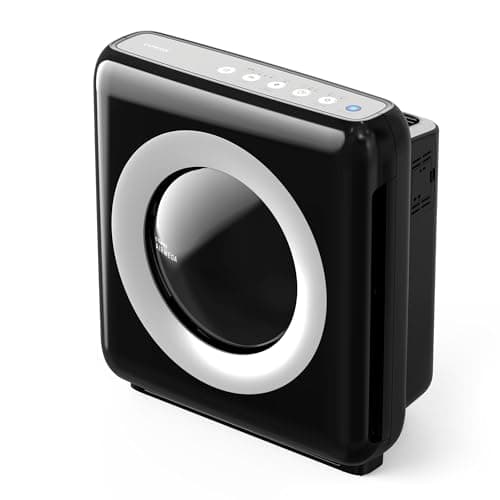
The most efficient unit here at low speed - 3.7 W on speed one - which matters enormously if you leave a purifier running all day and almost not at all if you do not.
#ad Price as of October 18, 2026, from Amazon. Prices change. How we make money.
Published specifications
| Specification | Value | Source |
|---|---|---|
| CADR (smoke) | 233 CFM | Coway published specification |
| CADR (dust) | 246 CFM | Coway published specification |
| CADR (pollen) | 240 CFM | Coway published specification |
| Coverage | 361 sq ft at 4.8 air changes/hr (1,748 sq ft at 1 ACH) | Coway published specification |
| Power draw by speed | 0.3 W standby / 3.7 W speed 1 / 8.7 W speed 2 / 75.3 W speed 3 | Coway published specification |
| Filtration | Pre-filter, odor filter, Green True HEPA, bipolar device | Coway published specification |
What it costs to run
About $6 a year running 24/7 on speed one, or $121 a year running 24/7 on speed three.
Speed 1: 3.7 W / 1000 x 24 x 365 = 32.4 kWh = $5.94 a year. Speed 3: 75.3 W / 1000 x 24 x 365 = 659.6 kWh = $120.97 a year. That twenty-fold spread is the most important number on this page, and it is why we chase per-speed figures instead of accepting a single rated wattage.
What is good about it
- Coway publishes power draw per fan speed, which almost nobody does and which is the only way to compute a real running cost
- 3.7 W on speed one is remarkable - cheaper to run continuously than most nightlights
- Coverage published at 1, 2 and 4.8 air changes per hour, so you can size it honestly
What is not
- 75.3 W on speed three is the highest draw here; how the auto mode behaves decides your bill
- The bipolar device is a stage we would rather do without; check it can be disabled
Who should skip this
Skip this if you only run a purifier for an hour or two at a time. Its whole advantage is low-speed efficiency over long hours, and short bursts on high speed give that straight back.
How it scored
- Clean air per watt9.5
- Honest coverage claim9.5
- Quiet operation8.0
- Filter economics7.5
Overall 8.7 / 10. This is our editorial score from published specifications and computed running cost. It is not a test result, and it is deliberately not marked up as a rating in this page’s structured data.
Levoit Core 400S
Living rooms and open-plan spaces
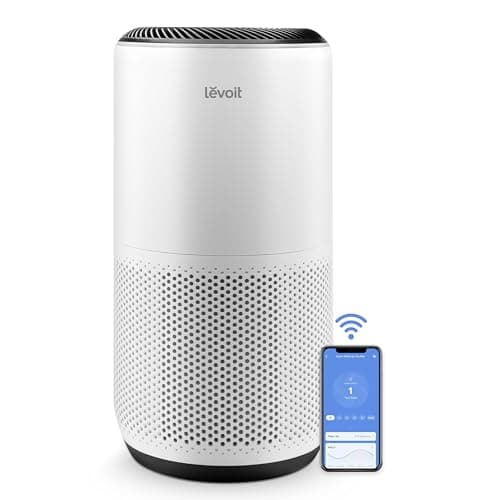
The one to buy if you want a purifier that genuinely covers a living room, and one of the few spec sheets in this bracket that publishes coverage at a useful air-change rate rather than only the flattering one.
#ad Price as of October 18, 2026, from Amazon. Prices change. How we make money.
Published specifications
| Specification | Value | Source |
|---|---|---|
| CADR | 231 CFM | Levoit published specification |
| Coverage | 358 sq ft at 4.8 air changes/hr (1,718 sq ft at 1 ACH) | Levoit published specification |
| Rated power | 38 W | Levoit published specification |
| Noise | 22-52 dB | Levoit published specification |
| Filtration | 3-stage: pre-filter, HEPA, activated carbon | Levoit published specification |
| Dimensions | 10.8 x 10.8 x 20.5 in, 11 lb | Levoit published specification |
What it costs to run
About $25-30 a year in electricity at 12 hours a day, before filters.
38 W / 1000 x 12 hours x 365 days = 166.4 kWh. At 18.34 cents/kWh that is $30.52 a year at rated power - and the unit only draws its full 38 W on the top fan speed, so a mid setting lands nearer $25. Add the replacement filter, which you should price before you buy rather than after.
What is good about it
- Levoit publishes coverage at both 1 ACH and 4.8 ACH, which is unusually straight - most brands quote only the flattering 1 ACH number
- 38 W is low for this CADR, which is what keeps the running cost down
- 22 dB on its lowest setting is quiet enough to sleep beside
- Carbon, pet-allergy and smoke-specific replacement filters are sold for the same body
What is not
- We could not find a published filter replacement interval in Levoit's specification, so we are not quoting one
- The 1,718 sq ft headline is a single air change per hour, which is not a useful rate for allergies
Who should skip this
Skip this if your room is under 200 sq ft. The Core 300S covers that at lower power and lower cost, and the extra CADR buys you nothing in a small bedroom.
How it scored
- Clean air per watt9.0
- Honest coverage claim9.5
- Quiet operation8.5
- Filter economics7.5
Overall 8.6 / 10. This is our editorial score from published specifications and computed running cost. It is not a test result, and it is deliberately not marked up as a rating in this page’s structured data.
Levoit Core 300S
Bedrooms up to about 220 sq ft

The right size for an actual bedroom. 23 W and 22 dB on low means you can run it all night without noticing it on the bill or on the pillow.
#ad We do not hold a current price for this product, so we do not show one. How we make money.
Published specifications
| Specification | Value | Source |
|---|---|---|
| CADR | 141 CFM (240 m3/h) | Levoit published specification |
| Coverage | 219 sq ft at 4.8 air changes/hr (1,051 sq ft at 1 ACH) | Levoit published specification |
| Rated power | 23 W | Levoit published specification |
| Noise | 22-50 dB | Levoit published specification |
| Filtration | 3-stage | Levoit published specification |
| Dimensions | 8.7 x 8.7 x 14.2 in, 5.95 lb | Levoit published specification |
What it costs to run
About $15-18 a year in electricity at 12 hours a day.
23 W / 1000 x 12 hours x 365 days = 100.7 kWh. At 18.34 cents/kWh that is $18.47 a year at rated power, and less on the lower fan speeds you would actually use overnight.
What is good about it
- 141 CFM clears AHAM's two-thirds rule for any room up to 211 sq ft, which covers most bedrooms
- 23 W is the lowest draw of anything we list with this much CADR
- Small enough to sit on a nightstand rather than take a corner of the floor
What is not
- Not enough for a living room - the useful 4.8 ACH figure is 219 sq ft, not the 1,051 sq ft headline
- No published filter replacement interval in the specification we could find
Who should skip this
Skip this if the room is over about 220 sq ft, or if you are trying to cover an open-plan downstairs. It will run flat out and still lose.
How it scored
- Clean air per watt9.5
- Honest coverage claim9.5
- Quiet operation9.0
- Filter economics7.5
Overall 8.8 / 10. This is our editorial score from published specifications and computed running cost. It is not a test result, and it is deliberately not marked up as a rating in this page’s structured data.
How we ranked these
We have not tested these units. Nobody here owns one. What we did was compile each manufacturer’s published specifications, check the coverage claims against AHAM’s room-sizing rule, and compute what each one costs to run for a year at the current US average electricity price. Every figure on this page is attributed to whoever published it, and the arithmetic is shown so you can redo it.
How we rank these sets out the full method, including what would change a ranking.
Questions people ask
+−Is a smart air purifier worth it?
+−Is auto mode on an air purifier accurate?
+−Do I need Wi-Fi for an air purifier to work?
+−Can I make a normal air purifier smart with a plug?
+−Does auto mode save electricity?
+−Is the air quality display on a smart purifier trustworthy?
+−What should I look for instead of smart features?
Sources
- Coway - Airmega Mighty AP-1512HH specification and filter life
- Levoit - Core 400S Smart True HEPA Air Purifier specification
- Levoit - Core 300 Series Original Filter (replacement interval)
- ENERGY STAR - Certified Room Air Cleaners product database
- U.S. Energy Information Administration - Electric Power Monthly, Table 5.6.A