Roundup
Best Air Purifiers for Dog Allergies
Dog allergen is not cat allergen. The published particle-size measurements put most airborne Can f 1 on large particles that settle, and about a fifth on the fine fraction a filter can actually hold. That gap decides how much a purifier is worth here.
By Scooter M. · Published · Last updated
How this page is funded: the buy links below are affiliate links. If you buy through one, we earn a commission at no extra cost to you. It does not change the order of the picks or what we say about them. Full disclosure.
The short answer
Buy the Levoit Vital 200S if you have a shedding dog, the Coway Airmega 350 for a large or open-plan room, and the Levoit Eleva 300X for a bedroom. But calibrate the expectation first, because the measurement is unusually clear here. Airborne dog allergen (Can f 1) was found to be predominantly associated with large particles - the largest single share, 42 to 49% of the total recovered, on particles above 9 microns - with only about 20% on particles under 5 microns. A filter works on that fine fifth. The coarse majority lands on floors, bedding and upholstery, where a purifier never touches it.
This page is about the environment - humidity, particles, ventilation - and what changes it. It is not medical advice and we hold no medical qualification. If symptoms are persistent, severe or getting worse, that is a question for a clinician rather than a purchase.
What the measurement actually says
The useful study here is Custovic and colleagues in the American Journal of Respiratory and Critical Care Medicine (1997), which sampled settled dust in 50 homes with a dog and 50 without, and sampled the air in 28 homes with dogs and 36 without. Two findings matter for a purchase decision:
- Can f 1 was predominantly associated with large particles, which averaged 42 to 49% of the total allergen recovered.
- Small particles under 5 microns also carried Can f 1, and those made up about 20% of the total airborne allergen load. The authors noted that particles of that size would be expected to remain airborne for a long period.
That second point is the entire case for buying a purifier for a dog household: there is a real, persistent, respirable fraction, and filtration is the only thing in the house that removes it from the air. The first point is the case for not expecting too much.
Where this sits against the other two allergens we cover
This site takes a different position on each of the three common indoor allergens, and the reason is the particle-size data rather than editorial preference:
| Allergen | What the measurement found | What that means for a filter |
|---|---|---|
| Cat (Fel d 1) | Roughly 75% on particles 5 microns and larger; about 25% (reported range 10-62%) on 2.5 microns and under | Filtration is the right lever - a substantial fine fraction stays suspended |
| Dog (Can f 1) | Largest single share 42-49% on particles above 9 microns; about 20% under 5 microns | Filtration helps a genuine minority fraction - worth doing, not the main lever |
| Dust mite | Heavy allergen that settles quickly and lives in bedding and carpet | Filtration is the wrong lever - see our dust mites page |
We are deliberately not ranking cat against dog on the fine fraction. The two numbers were measured in different studies at different size cut-offs - 2.5 microns for the cat work, 5 microns for the dog work - and treating them as comparable would be the kind of arithmetic that makes a page look authoritative while being wrong. What we can say is that both have a fine fraction that persists, and that our cat allergy page makes the stronger case for filtration while our dust mites page argues against it outright.
Why that changes what you should buy
Two practical consequences follow from a coarse-dominant allergen, and they point at different specifications than a pure fine-particle problem would.
The pre-filter stops being a detail. A dog puts hair and coarse dander into the air continuously, and that is exactly the fraction the measurement says dominates. All of it arrives at the first stage of the filter. A unit with a washable or vacuumable pre-filter sheds that load for the price of five minutes with a vacuum; a unit with a single sealed cartridge absorbs it into the part you pay to replace. Our general pets roundup works through the three-year cost case for that in detail.
Air changes matter more than peak CADR. Because the respirable fraction is continuously replenished while the dog is in the room, what you want is sustained turnover at a liveable noise level, not a headline number you will never run because it is too loud. Size on AHAM’s 4.8 air changes an hour and then check the decibel figure at the speed you will actually use - the sizing arithmetic is a page of its own.
How we picked these
We have not tested these machines, and we hold no medical qualification. Every figure here is published by the manufacturer or by the ENERGY STAR certified room air cleaners database, and every pick was checked for live availability before it was featured. Criteria, in order:
- A washable or vacuumable pre-filter. First criterion rather than a nice-to-have, because the allergen measurement says the coarse load is the dominant one and that load has to go somewhere.
- Enough CADR for the actual room at 4.8 air changes an hour. Not the one-air-change figure on the box, which runs four to five times higher.
- A published filter interval, so the consumable cost is computable rather than a surprise in month nine.
- Certified figures where they exist, and an admission where they do not. Two of these three picks are in the federal certified database. One is not, and that is stated below rather than glossed over.
- Purchasable today. Checked live before publishing.
The hypoallergenic breed claim does not survive measurement
This comes up constantly when people shop for a purifier, so it is worth settling with data. Vredegoor and colleagues, in the Journal of Allergy and Clinical Immunology (2012), sampled 196 dogs of breeds marketed as hypoallergenic - Labradoodle, Poodle, Spanish Waterdog and Airedale terrier - against 160 dogs of other breeds, including Labrador retrievers, in their own homes.
The coat results ran the opposite way to the marketing. Can f 1 in hair was 2.26 µg/g for the “hypoallergenic” breeds against 0.77 µg/g for the others, and in coat samples 27.04 against 12.98 µg/g - the breeds sold as the safe choice measured higher.
Two pieces of honesty about that result, because it is easy to over-read. First, the authors noted that differences between breeds were small relative to the variability within a breed - individual dogs vary more than breeds do, so this is not a reason to pick a Labrador either. Second, and most relevant to a purifier purchase, the home measurements did not follow the coat measurements: settled floor dust was lower only for Labradoodles, and no airborne differences were detected between any of the breeds. The authors’ stated conclusion is that “there is no evidence for the classification of certain dog breeds as being ‘hypoallergenic’.”
For a buyer, the practical reading is simple: size the purifier to the room and the dog you have, and do not discount the problem because of the breed on the paperwork.
Where our numbers run out
Our first pick is the one with the weakest documentation, and that should be said plainly. The Levoit Vital 200S does not appear in the ENERGY STAR certified room air cleaners database at all, so there is no certified CADR, no certified annual energy figure and no ozone measurement for it. Everything we quote for it is Levoit’s own: 250 CFM of CADR, 388 sq ft at 4.8 air changes an hour, 50 W, 23 to 54 dB.
That also means its efficiency is mediocre by the standards we normally apply. Fifty watts for 250 CFM works out around 5 CFM per watt on Levoit’s own figures - worse than the Eleva 300X’s certified 6.68, and well behind the Airmega 350. It is still our first pick for a shedding dog, because the pre-filter design is the specification that matches the allergen measurement, and because Levoit publishes the honest 388 sq ft coverage figure alongside the 1,862 sq ft marketing one. But it wins on fit, not on numbers, and we would rather say so.
The other two are certified and we can be firmer about them. The Airmega 350 is 360 CFM for 558 sq ft at 6.12 CFM per watt and 0.00 ppb ozone, with a vacuumable pre-filter ahead of its HEPA and carbon layers - it is the pick when the dog lives in an open-plan space. The Eleva 300X is 161 CFM for 250 sq ft at 6.68 CFM per watt and 0.00 ppb, and it is the cheapest of the three to run at roughly $27 a year.
Who should not buy one
Anyone whose main complaint is smell rather than allergen. Odor is a gas-phase problem and needs carbon mass, which is a different specification - our pet odor page covers it.
Anyone buying instead of vacuuming rather than as well as. Given where the measurement puts most of the allergen, a purifier bought as a substitute for dealing with soft furnishings is the wrong order of operations.
Anyone expecting one unit to cover a house. These are room appliances. The allergen is produced wherever the dog is, so the unit belongs in the room the dog and the person share most, not in a hallway.
Quick picks
Ranked on published specifications and computed running cost. Tap any row for the full write-up, including who should skip it.
| # | Product | Best for | Score | Price |
|---|---|---|---|---|
| 1 | 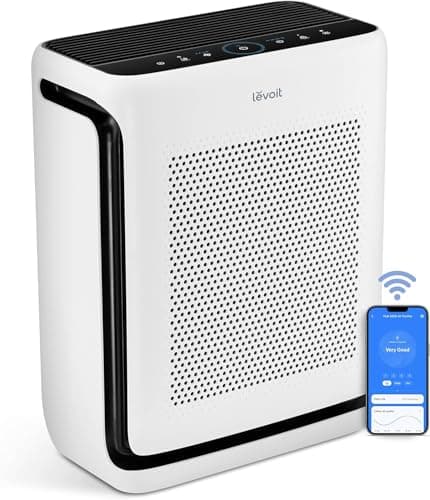 Levoit Vital 200SHomes with shedding pets | Best for a shedding dog | 8.0 | $169.99 - View on Amazon |
| 2 | 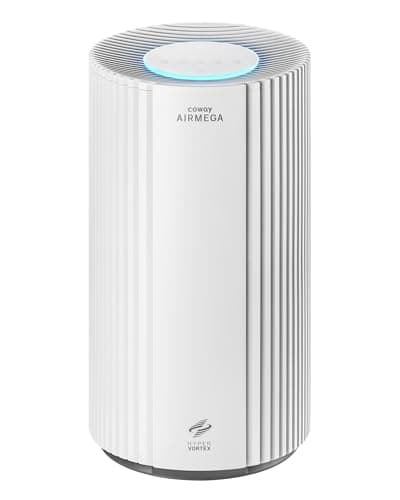 Coway Airmega 350A living room or open-plan space up to about 558 sq ft | Best for a large room | 8.4 | $339.00 - View on Amazon |
| 3 | 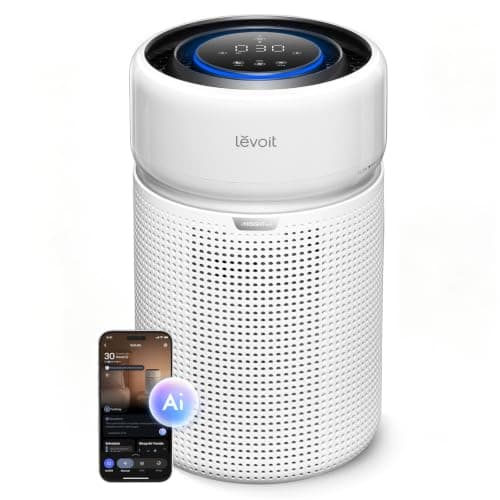 Levoit Eleva 300XA bedroom or home office up to about 250 sq ft | Best for a bedroom | 8.9 | $129.99 - View on Amazon |
#1 - Best for a shedding dog
Levoit Vital 200S
Homes with shedding pets
The highest CADR we carry, built around a washable pre-filter and a wide intake - the right shape for a house with animals in it, because hair loads a filter far faster than dust does.
#ad Price as of October 18, 2026, from Amazon. Prices change. How we make money.
Published specifications
| Specification | Value | Source |
|---|---|---|
| CADR | 250 CFM | Levoit published specification |
| Coverage | 388 sq ft at 4.8 air changes/hr (1,862 sq ft at 1 ACH) | Levoit published specification |
| Rated power | 50 W | Levoit published specification |
| Noise | 23-54 dB | Levoit published specification |
| Filtration | 3-stage: washable pre-filter, HEPA, activated carbon. Pet allergy, toxin absorber and smoke remover carbon filters sold for the same body | Levoit published specification |
| Dimensions | 15.6 x 8.5 x 19.8 in | Levoit published specification |
What it costs to run
About $40 a year in electricity at 12 hours a day, before filters.
50 W / 1000 x 12 hours x 365 days = 219 kWh. At 18.34 cents/kWh that is $40.16 a year at rated power, and less on the lower fan speeds. That is roughly $10 a year more than the Core 400S for 19 CFM more CADR - worth it in a house with animals, hard to justify without them.
What is good about it
- 250 CFM is the highest CADR of anything we carry, and it covers about 375 sq ft under AHAM's two-thirds rule
- The washable pre-filter is the part that matters with pets - hair is what kills HEPA filters early
- Levoit publishes coverage at both 1 ACH and 4.8 ACH, and the 388 sq ft figure lines up closely with the AHAM arithmetic
- Four different carbon filters fit the same chassis, so the unit adapts to pets, smoke or off-gassing without replacing the body
What is not
- 50 W for 250 CFM is a worse clean-air-per-watt ratio than the Core 400S manages at 38 W for 231 CFM
- We could not find a published filter replacement interval for this model, so we are not quoting one
- Levoit does not publish power draw per fan speed, so continuous-running cost cannot be computed precisely
- The pet-specific carbon filter is a separate purchase and is not always in stock - check it is available before buying the body for that reason
Who should skip this
Skip this if you have no animals and no odor problem. Without pets you are paying for a wide pre-filter and a carbon option you will not use, and the Core 400S delivers comparable clean air on 12 W less.
How it scored
- Pre-filter design for hair9.0
- Clean air per watt7.0
- Honest coverage claim9.0
- Filter economics8.0
Overall 8.0 / 10. This is our editorial score from published specifications and computed running cost. It is not a test result, and it is deliberately not marked up as a rating in this page’s structured data.
#2 - Best for a large room
Coway Airmega 350
A living room or open-plan space up to about 558 sq ft
The sensible Coway. 360 CFM of certified smoke CADR for a 558 sq ft room at 0.00 ppb ozone, and it beats the Airmega 400 on clean air per watt while costing roughly half as much. The headline coverage figure on the box is about five times the usable one.
#ad Price as of October 18, 2026, from Amazon. Prices change. How we make money.
Published specifications
| Specification | Value | Source |
|---|---|---|
| CADR - smoke | 352 CFM | Coway published specification |
| CADR - dust | 376 CFM | Coway published specification |
| CADR - pollen | 450 CFM | Coway published specification |
| Coverage | 2,640 sq ft at 1 air change/hr; 1,320 sq ft at 2 air changes/hr | Coway published specification |
| CADR (federal certification) - smoke / dust / pollen | 360 / 376 / 450 CFM at 558 sq ft | ENERGY STAR certified room air cleaners database |
| Clean air per watt | 6.12 CFM/W | ENERGY STAR certified room air cleaners database |
| Annual energy use | 344 kWh/yr | ENERGY STAR certified room air cleaners database |
| Ozone emissions | 0.00 ppb | ENERGY STAR certified room air cleaners database |
| Rated power | 62 W | Coway published specification |
| Noise | 21.5 to 54.7 dB(A) | Coway published specification |
| Filtration | Vacuumable pre-filter + HEPA + activated carbon, as one 3-in-1 cartridge; three variants (Fresh Starter+, Allergen+, Intense Smoke+) fit the same chassis | Coway published specification |
| Filter replacement | 1+ year on the 3-in-1 custom filter set | Coway published specification |
| Dimensions and weight | 12 x 12 x 23 in, 17.19 lb | Coway published specification |
What it costs to run
About $63 a year on ENERGY STAR's certified annual energy figure.
ENERGY STAR publishes 344 kWh a year for this model. At 18.34 cents/kWh that is $63.09 a year. Coway's own 62 W rating cross-checks it: 62 W / 1000 x 24 hours x 365 = 543 kWh at full power, so the certified figure implies it spends most of its time well below the rated draw. Per square foot covered that is 0.616 kWh a year, against the Airmega ProX at 0.375.
What is good about it
- Certified 0.00 ppb ozone, like every other certified Coway - there is no ionizing stage to switch off because there is no ionizing stage
- 6.12 CFM/W beats the more expensive Airmega 400 at 6.02, and uses 22 fewer kWh a year doing it
- 360 CFM of certified smoke CADR genuinely covers 558 sq ft at the 4.8 air changes an hour AHAM uses
- Three interchangeable 3-in-1 cartridges fit the same body, so the unit can be re-aimed at smoke or allergens without replacing it
- 21.5 dB at its lowest setting is quiet enough for a room you sleep in
- A published filter interval of a year or more, which makes the annual cost computable
What is not
- 344 kWh a year is about $63 - more than double what a Blueair of similar coverage needs, because Coway buys its zero ozone with a denser filter and a harder-working fan
- Coway's published smoke CADR (352 CFM) and the federal certification (360 CFM) disagree slightly, so two official numbers exist for the same machine
- The listing leads with 2,640 sq ft, which is the one-air-change-per-hour figure and about five times the certified 558 sq ft
- Even Coway's own second figure - 1,320 sq ft at 2 air changes - is more than double the certified coverage
- Not ENERGY STAR Most Efficient. Only 3 of Coway's 14 certified models are, and this is not one of them
- The pre-filter, HEPA and carbon are a single cartridge, so a saturated carbon layer means replacing the HEPA too
- 62 W is a lot of fan for the output compared with electrostatic designs, and the running cost reflects that
Who should skip this
Skip this if the room is under about 250 sq ft - the Airmega 50 costs a quarter as much and covers it. Skip it if annual running cost is the deciding factor, because an electrostatic design will roughly halve it, though not at 0.00 ppb ozone.
How it scored
- No ozone-producing stage10.0
- Room size covered8.5
- Clean air per watt6.0
- Honest coverage labeling4.0
Overall 8.4 / 10. This is our editorial score from published specifications and computed running cost. It is not a test result, and it is deliberately not marked up as a rating in this page’s structured data.
#3 - Best for a bedroom
Levoit Eleva 300X
A bedroom or home office up to about 250 sq ft
The best-engineered Levoit purifier you can actually buy on Amazon, and the only one in the range for which Levoit publishes a filter replacement interval. It moves less air than a Core 400S and does more with every watt.
#ad Price as of October 18, 2026, from Amazon. Prices change. How we make money.
Published specifications
| Specification | Value | Source |
|---|---|---|
| CADR - smoke, dust, pollen | 161 CFM, AHAM Verifide | Levoit published specification |
| Coverage | 250 sq ft at 4.8 air changes/hr (1,200 sq ft at 1 ACH) | Levoit published specification |
| Clean air per watt | 6.68 CFM/W | ENERGY STAR certified room air cleaners database |
| Annual energy use | 145 kWh/yr | ENERGY STAR certified room air cleaners database |
| Ozone emissions | 0.00 ppb | ENERGY STAR certified room air cleaners database |
| Rated power | Under 25.5 W | Levoit published specification |
| Noise | 20-50 dB (20 dB in Sleep Mode) | Levoit published specification |
| Filtration | 3-stage sealed HEPA with a separate activated carbon filter | Levoit published specification |
| Filter replacement | Particle filter up to 2 years; carbon filter 6-12 months | Levoit published specification |
| Fan speeds | 4 plus Auto | Levoit published specification |
| Sensor | AirSight Plus 2.0, 3-channel (PM1.0, PM2.5, PM10) | Levoit published specification |
| Dimensions and weight | 9.4 x 9.4 x 15.1 in, 9.9 lb | Levoit published specification |
What it costs to run
About $27 a year on ENERGY STAR's certified annual energy figure.
ENERGY STAR publishes 145 kWh a year for LAP-C341S, the Eleva 300X. At 18.34 cents/kWh that is $26.59 a year. The Core 400S, on the same certified basis, is 237 kWh and $43.47 - so the Eleva costs about $17 a year less to run while covering a smaller room more efficiently.
What is good about it
- 6.68 CFM of clean air per watt against the Core 400S's 5.75 - a 16% improvement in the specification that decides your bill
- 145 kWh a year, about 40% less electricity than the Core 400S, for a machine sized to a bedroom rather than a living room
- The only Levoit purifier we have found where Levoit publishes a filter replacement interval - up to 2 years on the particle filter, 6-12 months on the carbon
- A separate activated carbon filter rather than a carbon layer inside a combined cartridge, which is the arrangement that actually holds up against odors
- 20 dB in Sleep Mode is genuinely quiet enough to sleep beside, and it publishes the figure
- Certified at 0.00 ppb ozone, with no ionizing stage
- A 3-channel particle sensor at this price is unusual; most units at any price infer air quality from a single channel
What is not
- 161 CFM is a 250 sq ft machine. It is not a living-room purifier and buying it for one would be a mistake
- Newer and less reviewed than the Core line, so there is less accumulated owner feedback to draw on
- The 1,200 sq ft figure on the listing is a one-air-change-per-hour number; the usable coverage is 250 sq ft and Levoit publishes both, to its credit
- Two filters on two different schedules is more to track than one combined cartridge, even though it is the better design
- Levoit's more efficient Eleva 500X is certified at 9.26 CFM/W but we could not find it purchasable on Amazon, so the range's best unit is not the one you can buy here
Who should skip this
Skip this if the room is much over 250 sq ft - the Core 600S is the honest answer there, and no amount of running this unit longer will substitute for CADR it does not have.
How it scored
- Clean air per watt9.0
- Published specifications9.5
- Quiet operation9.5
- Room size covered6.5
Overall 8.9 / 10. This is our editorial score from published specifications and computed running cost. It is not a test result, and it is deliberately not marked up as a rating in this page’s structured data.
How we ranked these
We have not tested these units. Nobody here owns one. What we did was compile each manufacturer’s published specifications, check the coverage claims against AHAM’s room-sizing rule, and compute what each one costs to run for a year at the current US average electricity price. Every figure on this page is attributed to whoever published it, and the arithmetic is shown so you can redo it.
How we rank these sets out the full method, including what would change a ranking.
Questions people ask
+−Do air purifiers help with dog allergies?
+−Is dog allergen different from cat allergen?
+−Are any dog breeds actually hypoallergenic?
+−Does a washable pre-filter really matter for dogs?
+−What size air purifier do I need for a dog?
+−Why is the Vital 200S your top pick if it is not certified?
Sources
- Custovic et al. (1997) - Aerodynamic properties of the major dog allergen Can f 1: distribution in homes, concentration, and particle size of allergen in the air. Am J Respir Crit Care Med 155(1):94-98
- Vredegoor et al. (2012) - Can f 1 levels in hair and homes of different dog breeds: lack of evidence to describe any dog breed as hypoallergenic. J Allergy Clin Immunol 130(4):904-909
- EPA - Biological Pollutants' Impact on Indoor Air Quality
- AHAM - Tips for Choosing the Ideal Portable Room Air Cleaner
- AHAM Verifide - Air Filtration Standards (AC-1)
- ENERGY STAR - Certified Room Air Cleaners product database
- Coway - Airmega 350 specification
- Levoit - Eleva 300X Smart Air Purifier specification
- U.S. Energy Information Administration - Electric Power Monthly, Table 5.6.A