Roundup
Best Air Purifiers for Kitchen Smells
This is the one application where the HEPA filter everyone shops for is almost irrelevant, and the stage nobody reads the specification for does all the work.
By Scooter M. · Published · Last updated
How this page is funded: the buy links below are affiliate links. If you buy through one, we earn a commission at no extra cost to you. It does not change the order of the picks or what we say about them. Full disclosure.
The short answer
Use the extractor hood, and buy a purifier with a real carbon bed rather than a carbon coating. The smell of last night’s fish is a mixture of gas-phase molecules. A HEPA filter captures particles and does essentially nothing to gases, so the HEPA rating - the number every listing leads with - is not the specification that matters here. Only activated carbon adsorbs odor molecules, and how much of it the unit contains decides whether it works for months or for a fortnight.
Why cooking is a different problem from smoke
Cooking produces both particles and gases, and they need different treatment. Frying and searing throw off fine particulate, which a HEPA filter handles well. The smell - fish, curry, burnt toast, bacon at seven in the morning - is volatile organic compounds and other gas-phase molecules, and those pass through HEPA media as if it were not there.
The EPA lists cooking among the significant sources of indoor particulate matter, so a purifier is doing genuine work in a kitchen even on the particle side. But if your complaint is specifically the smell, you are shopping for carbon, and the amount of it is what separates a unit that keeps working from one that stops after a few weeks.
Carbon coating versus carbon bed
Almost every purifier claims an activated carbon stage. Two very different things hide behind that phrase. A coating is carbon powder bonded to a fabric wrap around the HEPA filter - perhaps a few grams of it. A bed is granular or pelletised carbon held in a tray or cartridge, typically an order of magnitude more.
Adsorption capacity is finite and roughly proportional to mass. A coating saturates quickly against a sustained source like daily cooking, and once saturated it does nothing - and can release what it holds as the room warms. This is the single most important distinction in the category and the one manufacturers are least keen to quantify; we go through it in activated carbon explained.
| Signal | Carbon coating | Carbon bed |
|---|---|---|
| How it is described | "activated carbon filter", "3-in-1 filter" | "carbon pellets", "granular", a stated weight |
| Weight published | Almost never | Sometimes |
| Sold separately from the HEPA | No - one combined filter | Often yes |
| Useful life against daily cooking | Weeks to a couple of months | Months |
| Cost to replace | Low, but frequent | Higher, but less often |
The practical test when comparing two units: if the carbon and the HEPA are one part with one price, it is a coating. If the carbon is a separate part with its own replacement schedule, there is meaningfully more of it.
How we judged these
- Is there a genuine carbon stage? Not a fragrance pad, not an ioniser, not a photocatalytic claim - adsorbent carbon.
- Published smoke CADR against a stated model. Smoke CADR is the closest AHAM figure to kitchen conditions, and it sizes the unit to the room.
- Can the carbon be replaced on its own? In a kitchen the carbon saturates long before the HEPA is loaded, so being able to replace just that part changes the running cost.
- Will it survive kitchen air? Grease aerosol loads a pre-filter fast, and a washable pre-filter is worth real money here.
Placement matters more here than anywhere else
In most rooms a purifier can go wherever there is a socket. In a kitchen, position changes the outcome, because you are trying to intercept a plume rather than treat a settled room.
- Not directly beside the hob. Grease aerosol will clog the pre-filter quickly and carbon saturates faster in concentrated fumes.
- In the path the smell travels - between the cooking area and the room it drifts into, which in an open-plan layout usually means near the boundary rather than in the kitchen itself.
- Running before and after, not during only. Odor molecules adsorb over time; the unit needs contact time with the air after the cooking has stopped.
- Not in a corner or under a cabinet. These units need clear intake and discharge, and a recessed spot short-circuits the airflow.
What we would actually do
Use the hood first, every time, and open a window while cooking if the weather allows. Those two cost nothing and remove more than any appliance on this page.
Then run the Coway in the room the smell escapes into, on a medium speed, from before you start cooking until an hour or so after. It has a real carbon stage and a washable pre-filter, which is the combination kitchen air punishes least. In an open-plan kitchen and living space, the Core 400S has the capacity for the larger volume. On a budget the GermGuardian will help with general kitchen stuffiness and light odors - but its carbon is a coating, and against daily frying it will saturate quickly, so buy it knowing that is the trade.
And if the smell is genuinely embedded - in soft furnishings, in paint - no purifier removes it, because it is not in the air any more. That is a cleaning job, and we cover the sequence in getting rid of smoke smell.
Quick picks
Ranked on published specifications and computed running cost. Tap any row for the full write-up, including who should skip it.
| # | Product | Best for | Score | Price |
|---|---|---|---|---|
| 1 | 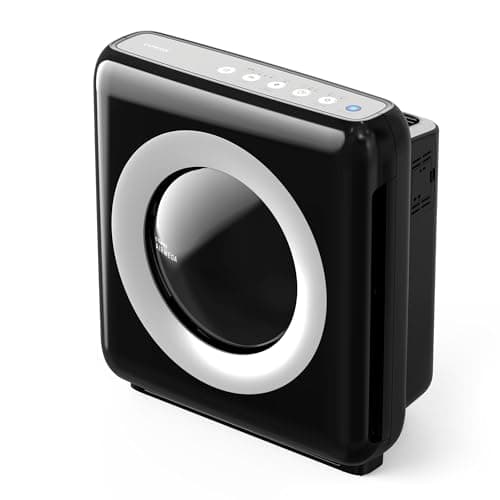 Coway Airmega AP-1512HH MightyRunning continuously in a medium room | Best overall | 8.7 | $154.98 - View on Amazon |
| 2 | 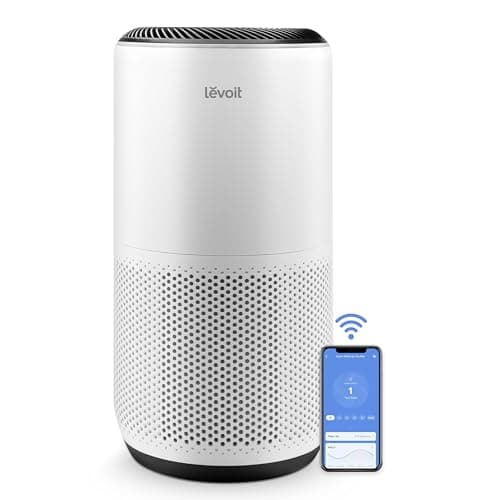 Levoit Core 400SLiving rooms and open-plan spaces | Best for an open-plan kitchen | 8.6 | $189.97 - View on Amazon |
| 3 | 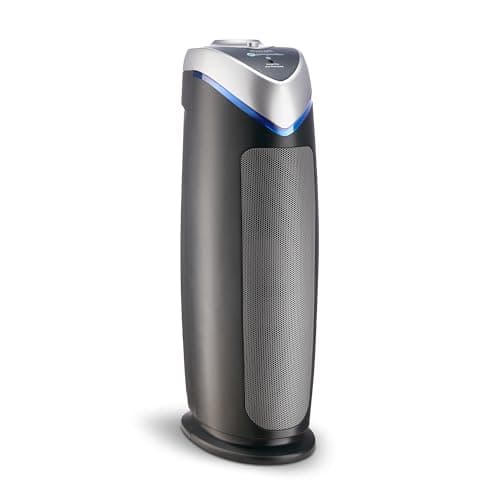 GermGuardian AC4825EA small room, a dorm or a desk-side space on a tight budget | Best on a budget | 7.6 | $80.74 - View on Amazon |
#1 - Best overall
Coway Airmega AP-1512HH Mighty
Running continuously in a medium room
The most efficient unit here at low speed - 3.7 W on speed one - which matters enormously if you leave a purifier running all day and almost not at all if you do not.
#ad Price as of October 18, 2026, from Amazon. Prices change. How we make money.
Published specifications
| Specification | Value | Source |
|---|---|---|
| CADR (smoke) | 233 CFM | Coway published specification |
| CADR (dust) | 246 CFM | Coway published specification |
| CADR (pollen) | 240 CFM | Coway published specification |
| Coverage | 361 sq ft at 4.8 air changes/hr (1,748 sq ft at 1 ACH) | Coway published specification |
| Power draw by speed | 0.3 W standby / 3.7 W speed 1 / 8.7 W speed 2 / 75.3 W speed 3 | Coway published specification |
| Filtration | Pre-filter, odor filter, Green True HEPA, bipolar device | Coway published specification |
What it costs to run
About $6 a year running 24/7 on speed one, or $121 a year running 24/7 on speed three.
Speed 1: 3.7 W / 1000 x 24 x 365 = 32.4 kWh = $5.94 a year. Speed 3: 75.3 W / 1000 x 24 x 365 = 659.6 kWh = $120.97 a year. That twenty-fold spread is the most important number on this page, and it is why we chase per-speed figures instead of accepting a single rated wattage.
What is good about it
- Coway publishes power draw per fan speed, which almost nobody does and which is the only way to compute a real running cost
- 3.7 W on speed one is remarkable - cheaper to run continuously than most nightlights
- Coverage published at 1, 2 and 4.8 air changes per hour, so you can size it honestly
What is not
- 75.3 W on speed three is the highest draw here; how the auto mode behaves decides your bill
- The bipolar device is a stage we would rather do without; check it can be disabled
Who should skip this
Skip this if you only run a purifier for an hour or two at a time. Its whole advantage is low-speed efficiency over long hours, and short bursts on high speed give that straight back.
How it scored
- Clean air per watt9.5
- Honest coverage claim9.5
- Quiet operation8.0
- Filter economics7.5
Overall 8.7 / 10. This is our editorial score from published specifications and computed running cost. It is not a test result, and it is deliberately not marked up as a rating in this page’s structured data.
#2 - Best for an open-plan kitchen
Levoit Core 400S
Living rooms and open-plan spaces
The one to buy if you want a purifier that genuinely covers a living room, and one of the few spec sheets in this bracket that publishes coverage at a useful air-change rate rather than only the flattering one.
#ad Price as of October 18, 2026, from Amazon. Prices change. How we make money.
Published specifications
| Specification | Value | Source |
|---|---|---|
| CADR | 231 CFM | Levoit published specification |
| Coverage | 358 sq ft at 4.8 air changes/hr (1,718 sq ft at 1 ACH) | Levoit published specification |
| Rated power | 38 W | Levoit published specification |
| Noise | 22-52 dB | Levoit published specification |
| Filtration | 3-stage: pre-filter, HEPA, activated carbon | Levoit published specification |
| Dimensions | 10.8 x 10.8 x 20.5 in, 11 lb | Levoit published specification |
What it costs to run
About $25-30 a year in electricity at 12 hours a day, before filters.
38 W / 1000 x 12 hours x 365 days = 166.4 kWh. At 18.34 cents/kWh that is $30.52 a year at rated power - and the unit only draws its full 38 W on the top fan speed, so a mid setting lands nearer $25. Add the replacement filter, which you should price before you buy rather than after.
What is good about it
- Levoit publishes coverage at both 1 ACH and 4.8 ACH, which is unusually straight - most brands quote only the flattering 1 ACH number
- 38 W is low for this CADR, which is what keeps the running cost down
- 22 dB on its lowest setting is quiet enough to sleep beside
- Carbon, pet-allergy and smoke-specific replacement filters are sold for the same body
What is not
- We could not find a published filter replacement interval in Levoit's specification, so we are not quoting one
- The 1,718 sq ft headline is a single air change per hour, which is not a useful rate for allergies
Who should skip this
Skip this if your room is under 200 sq ft. The Core 300S covers that at lower power and lower cost, and the extra CADR buys you nothing in a small bedroom.
How it scored
- Clean air per watt9.0
- Honest coverage claim9.5
- Quiet operation8.5
- Filter economics7.5
Overall 8.6 / 10. This is our editorial score from published specifications and computed running cost. It is not a test result, and it is deliberately not marked up as a rating in this page’s structured data.
#3 - Best on a budget
GermGuardian AC4825E
A small room, a dorm or a desk-side space on a tight budget
The cheapest air purifier we could find that publishes an AHAM-verified smoke CADR against a printed model number. That combination is rarer at this price than it should be, and it is the only reason this unit is here.
#ad Price as of October 18, 2026, from Amazon. Prices change. How we make money.
Published specifications
| Specification | Value | Source |
|---|---|---|
| CADR - smoke | 99 CFM | GermGuardian published specification |
| CADR - dust | 118 CFM | GermGuardian published specification |
| CADR - pollen | 125 CFM | GermGuardian published specification |
| Room size at the AHAM rule | About 149 sq ft | Our arithmetic from the published smoke CADR |
| Noise | 40-55 dBA | GermGuardian published specification |
| Fan speeds | 3 | GermGuardian published specification |
| Filter | True HEPA plus activated carbon, replace every 6-8 months | GermGuardian published specification |
| Dimensions and weight | 22 x 10.25 x 6.75 in, 8.55 lb | GermGuardian published specification |
What it costs to run
About $24 a year in electricity at 8 hours a day on high.
55 W / 1000 x 8 hours x 365 days = 160.6 kWh. At 18.34 cents/kWh that is $29.45 a year on high. On the low speed most people actually use it is meaningfully less; filters are the larger running cost at this price point, not electricity.
What is good about it
- Publishes all three AHAM CADR figures against the model number printed in the listing title, which most units at this price do not
- True HEPA, not HEPA-type - the distinction matters and the cheap end of this category is full of the latter
- Activated carbon stage included rather than sold as an upgrade
- 8.55 lb and 22 inches tall, so it moves between rooms without planning
What is not
- GermGuardian advertises 743 sq ft per hour. At AHAM's two-thirds smoke rule the honest figure is about 149 sq ft - a fifth of the headline
- 55 dBA on high is audible in a quiet room; this is not a unit you sleep next to on full speed
- The carbon stage is a thin coating on the filter wrap, not a deep carbon bed, so it handles light odors rather than sustained cooking or smoke
- Filters every 6-8 months is a faster cadence than the better units, and it erodes the price advantage over three years
- The UV-C lamp is a marketing feature at this air speed and we do not count it in the ranking
Who should skip this
Skip this if the room is over about 150 sq ft, if you need it silent overnight, or if the problem is cooking smoke or a smoker in the house - none of those are jobs a thin carbon coating wins.
How it scored
- Published data at the price9.0
- Clean air per dollar8.5
- Odor handling5.0
Overall 7.6 / 10. This is our editorial score from published specifications and computed running cost. It is not a test result, and it is deliberately not marked up as a rating in this page’s structured data.
How we ranked these
We have not tested these units. Nobody here owns one. What we did was compile each manufacturer’s published specifications, check the coverage claims against AHAM’s room-sizing rule, and compute what each one costs to run for a year at the current US average electricity price. Every figure on this page is attributed to whoever published it, and the arithmetic is shown so you can redo it.
How we rank these sets out the full method, including what would change a ranking.
Questions people ask
+−Do air purifiers remove cooking smells?
A purifier with a genuine activated carbon stage does reduce them; one relying on HEPA alone does not, because cooking odors are gas-phase molecules and HEPA media captures particles. How well it works over time depends on how much carbon the unit holds, since adsorption capacity is finite and roughly proportional to mass.
+−Where should I put an air purifier in a kitchen?
In the path the smell travels rather than directly beside the hob - typically at the boundary between the cooking area and the room it drifts into. Next to the hob, grease aerosol clogs the pre-filter and saturates the carbon faster, and a purifier tucked in a corner or under a cabinet cannot move enough air to matter.
+−Is an air purifier better than an extractor hood?
No. A hood vented outside removes cooking pollutants at the source, before they enter the room; a purifier can only treat air that has already dispersed. Use both, with the hood as the primary and the purifier for what escapes it - or as the answer where there is no hood, or only a recirculating one.
+−How often do I need to replace the carbon filter in a kitchen?
More often than the manufacturer’s general guidance, because daily cooking is a sustained gas load rather than an occasional one. The honest signal is the smell itself: when odors start lingering again despite the unit running, the carbon is saturated, whatever the schedule says.
+−Will an air purifier stop the smoke alarm going off when I cook?
Not reliably. Alarms respond to the concentrated plume right above the hob within seconds; a purifier treats the room over minutes. The hood, a lid, and a window are the things that solve it.
Sources
- EPA - Sources of Indoor Particulate Matter (PM)
- EPA - Volatile Organic Compounds' Impact on Indoor Air Quality
- AHAM - Tips for Choosing the Ideal Portable Room Air Cleaner
- EPA - Air Cleaners and Air Filters in the Home (Guide to Air Cleaners in the Home)
- U.S. Energy Information Administration - Electric Power Monthly, Table 5.6.A