Comparison
Levoit Core 400S vs Winix 5510
Two units within ten dollars of each other, within ten percent on clean air delivered - and separated by whether you can find out what the machine does when it is switched on.
By Scooter M. · Published · Last updated
How this page is funded: the buy links below are affiliate links. If you buy through one, we earn a commission at no extra cost to you. It does not change the order of the picks or what we say about them. Full disclosure.
The short answer
Buy the Winix 5510 if odor is the problem. Buy the Levoit Core 400S if you want to know what you are running. The Winix delivers about 10% more clean air (253 CFM smoke CADR against 231) for about ten dollars less, and it publishes a 12-month filter interval that Levoit does not publish at all. But the Core 400S is ENERGY STAR certified, which means its annual energy use and its ozone emissions are both published federal figures - 237 kWh a year and 0.00 ppb. The Winix 5510 is not certified, so neither figure exists for it, and it carries an ionizing stage Winix does not say can be switched off.
The headline numbers, and which of them you can check
Start with what each manufacturer publishes, and note the column that is half empty. The Levoit figures marked ENERGY STAR come from the federal certified room air cleaners database, which publishes clean air delivery, energy use and ozone for every certified model. The Winix figures come from Winix.
| Levoit Core 400S | Winix 5510 | |
|---|---|---|
| Smoke CADR | 231 CFM | 253 CFM |
| Dust CADR | 240 CFM | 252 CFM |
| Pollen CADR | 259 CFM | 247 CFM |
| Coverage (honest) | 358 sq ft | 392 sq ft |
| Annual energy | 237 kWh/yr (ENERGY STAR) | Not published |
| Cost per year | About $43 | Cannot be calculated |
| Clean air per watt | 5.75 CFM/W (ENERGY STAR) | Not published |
| Ozone emissions | 0.00 ppb (ENERGY STAR) | Not published |
| Ionizing stage | None | PlasmaWave |
| Filter interval | Not published by Levoit | 12 months |
| Carbon stage | Inside the combined filter | Separate AOC filter |
| Fan speeds | 3 | 5 |
| Weight | 11 lb | 13.3 lb |
On air alone the Winix wins narrowly and deserves to. A 22 CFM advantage on smoke CADR is real, it is AHAM Verifide, and it costs less. If the decision were made on the top two rows, this page would be short.
The rows that are blank, and why that matters
An air purifier is not an appliance you use. It is an appliance you leave on. Ours is a site built on the observation that running cost is the specification nobody publishes, and this comparison is the cleanest example of it we have found.
The Core 400S is in the ENERGY STAR certified room air cleaners database, so three numbers exist for it that no marketing department chose: it uses 237 kWh a year on the program’s standardized basis, it delivers 5.75 CFM of clean air per watt, and it emits 0.00 ppb of ozone. At 18.34 cents per kWh - the US average residential price - that annual figure is $43.47 a year. You can check every one of those before buying. The product card further down this page quotes a lower number, about $30 a year, and both are correct: ours is 38 W at 12 hours a day, ENERGY STAR’s is the program’s standardized annual basis. Use the certified figure when comparing two machines and ours when estimating your own bill.
The Winix 5510 is not in that database. Winix does not publish a wattage for it either. So there is no way to tell you what it costs to run, and no way for us to estimate one without inventing a number, which we will not do. That is not an accusation that it is inefficient - Winix’s certified models are respectable, between 5.59 and 6.26 CFM per watt. It is a statement that on the specification that decides three years of bills, this unit is a blank.
PlasmaWave: the stage we would switch off
The Winix’s fourth stage is PlasmaWave, an ionizing technology. Our position on ionizing stages is settled and applies here exactly as it does elsewhere on this site: we would switch it off, and we would rather own a unit that does not have one. The EPA cautions that electronic air cleaners can produce ozone, a lung irritant, and California regulates indoor air cleaners for ozone emissions for that reason.
Two honest qualifications, because the size of this effect matters. First, the amounts involved are small. Of the 243 certified room air cleaners in the federal database, 43 emit more than zero ozone and the highest figure in the whole dataset is 5 ppb. The only PlasmaWave model that is certified - the Winix T810 - measures 1.35 ppb, which is the highest of the certified Winix units but a long way from alarming.
Second, that 1.35 ppb belongs to the T810 and we are not going to attribute it to the 5510. The 5510’s emissions are unmeasured as far as any public source goes. What we can say is that Winix’s published specification for this model does not state whether PlasmaWave can be disabled - and on a unit where we would want to disable it, an unanswered question about the off switch is a mark against it. The full argument is in air purifier vs ionizer.
The Core 400S has no ionizing stage at all, and its certified ozone figure is 0.00 ppb. That is the cleanest possible answer to this question and it is the strongest single argument in the Levoit’s favor.
Filters: this one goes the other way
It would be easy to write this comparison as Levoit-transparent versus Winix-opaque. On filters it is the reverse, and we are not going to pretend otherwise.
Winix publishes a 12-month replacement interval for both the HEPA and the AOC carbon filter. Levoit publishes no replacement interval for the Core 400S filter in its specification that we could find - a gap we have noted on that product since we first listed it.
The structural difference matters more than the interval. On the Winix, the carbon is a separate AOC filter with its own part number and its own schedule. On the Core 400S, the carbon is one layer inside a single combined cartridge. As we set out in activated carbon explained, adsorption capacity is finite and roughly proportional to carbon mass, and a separately scheduled carbon stage is the reliable sign that there is more of it. If your problem is cooking, pets or smoke rather than pollen and dust, that is the row in the table that should decide this.
A note on the Winix 5500-2 and the C545
Most people searching for a Levoit-versus-Winix comparison are thinking of the 5500-2, which was Winix’s long-running recommendation-magnet. It has been discontinued in the US and Canada. The 5510 is its stated successor - Winix’s own listing describes it as the new generation of the 5500-2 with app support - which is why it is the unit on this page.
The other model people ask about is the C545. We checked it and we are not featuring it: at the time of writing it was quoted at a marked-up price with a 13-to-14 day dispatch estimate rather than normal stock. We only feature units that are genuinely purchasable now, so it is excluded rather than recommended with a caveat.
Buy the Levoit Core 400S if...
- You want the running cost knowable before you buy. It is the only one of the two with a certified annual energy figure.
- You do not want an ionizing stage in the house. Certified at 0.00 ppb, with no such stage to switch off.
- The problem is pollen and dust rather than odor - its pollen CADR is the higher of the two.
- You will move it between rooms. Two pounds lighter and a cylinder rather than a tower.
Buy the Winix 5510 if...
- Odor is the actual complaint - cooking, pets, smoke. The separately scheduled carbon filter is the better design for that and it is not close.
- The room is between about 360 and 390 sq ft, where the extra CADR genuinely buys you something.
- You want a published filter schedule so you can budget the consumables - Winix gives you one and Levoit does not.
- You want finer speed control, and will run it low: five speeds against three.
Buy neither if...
- The room is under about 200 sq ft. Both are more machine than you need and a smaller unit run on low will be quieter and cheaper - see best cheap air purifiers.
- The problem is damp, a musty smell or mold. Neither of these changes moisture, and a purifier does not fix mold.
- The room feels stuffy rather than dusty. That is ventilation, and carbon dioxide passes straight through both of these filters.
What we would actually do
For a bedroom with pollen and dust, we would buy the Core 400S. The gap in clean air delivered is about 10% and you will not perceive it; the gap in what you know about the machine is total. A certified 237 kWh a year, 5.75 CFM per watt and 0.00 ppb of ozone is the kind of information this whole site exists to surface, and paying ten dollars more for it is straightforwardly worth it.
For a kitchen-adjacent living room, a home with pets, or a smoker in the house, we would buy the Winix 5510 and accept the blanks. A separately scheduled carbon filter on a published 12-month cycle beats a carbon layer inside a combined cartridge with no stated interval, and odor is the job where that difference is felt weekly rather than theoretically.
What we would not do is choose between them on the coverage figures in the two Amazon listings, which differ by 148 sq ft in Winix’s favor on the honest numbers and by 148 sq ft on the inflated ones too - while being roughly five times too large in both cases.
What we would buy for this
Chosen from the same registry as our roundups, on published specifications and computed running cost.
Levoit Core 400S
Living rooms and open-plan spaces
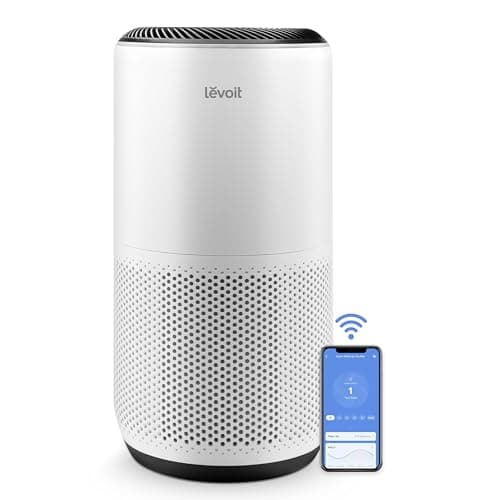
The one to buy if you want a purifier that genuinely covers a living room, and one of the few spec sheets in this bracket that publishes coverage at a useful air-change rate rather than only the flattering one.
#ad Price as of October 18, 2026, from Amazon. Prices change. How we make money.
Published specifications
| Specification | Value | Source |
|---|---|---|
| CADR | 231 CFM | Levoit published specification |
| Coverage | 358 sq ft at 4.8 air changes/hr (1,718 sq ft at 1 ACH) | Levoit published specification |
| Rated power | 38 W | Levoit published specification |
| Noise | 22-52 dB | Levoit published specification |
| Filtration | 3-stage: pre-filter, HEPA, activated carbon | Levoit published specification |
| Dimensions | 10.8 x 10.8 x 20.5 in, 11 lb | Levoit published specification |
What it costs to run
About $25-30 a year in electricity at 12 hours a day, before filters.
38 W / 1000 x 12 hours x 365 days = 166.4 kWh. At 18.34 cents/kWh that is $30.52 a year at rated power - and the unit only draws its full 38 W on the top fan speed, so a mid setting lands nearer $25. Add the replacement filter, which you should price before you buy rather than after.
What is good about it
- Levoit publishes coverage at both 1 ACH and 4.8 ACH, which is unusually straight - most brands quote only the flattering 1 ACH number
- 38 W is low for this CADR, which is what keeps the running cost down
- 22 dB on its lowest setting is quiet enough to sleep beside
- Carbon, pet-allergy and smoke-specific replacement filters are sold for the same body
What is not
- We could not find a published filter replacement interval in Levoit's specification, so we are not quoting one
- The 1,718 sq ft headline is a single air change per hour, which is not a useful rate for allergies
Who should skip this
Skip this if your room is under 200 sq ft. The Core 300S covers that at lower power and lower cost, and the extra CADR buys you nothing in a small bedroom.
How it scored
- Clean air per watt9.0
- Honest coverage claim9.5
- Quiet operation8.5
- Filter economics7.5
Overall 8.6 / 10. This is our editorial score from published specifications and computed running cost. It is not a test result, and it is deliberately not marked up as a rating in this page’s structured data.
Winix 5510
A room up to about 390 sq ft where odor control matters as much as particles
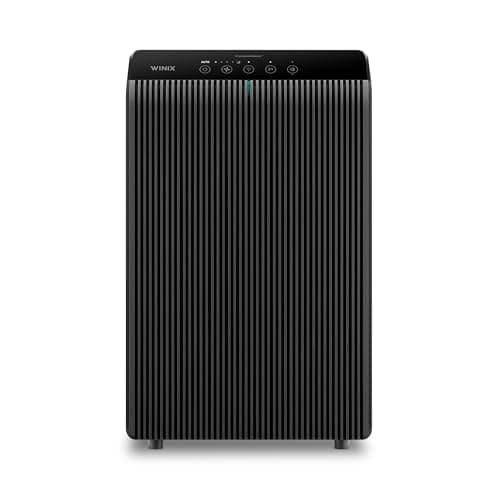
The purchasable successor to the discontinued 5500-2, and on paper the better air mover of the two units on this page. It is also the one whose running cost and ozone output you cannot look up, because Winix has not certified it with ENERGY STAR.
#ad Price as of October 18, 2026, from Amazon. Prices change. How we make money.
Published specifications
| Specification | Value | Source |
|---|---|---|
| CADR - smoke | 253 CFM | Winix published specification |
| CADR - dust | 252 CFM | Winix published specification |
| CADR - pollen | 247 CFM | Winix published specification |
| Coverage | 392 sq ft, AHAM Verifide | Winix published specification |
| Filtration | 4-stage: washable pre-filter, True HEPA, AOC carbon filter, PlasmaWave | Winix published specification |
| Filter replacement | 12 months, HEPA and AOC carbon | Winix published specification |
| Fan speeds | 5 | Winix published specification |
| Noise | 23.5 dB on the slowest speed; Winix does not publish a maximum | Winix published specification |
| Rated power | Not published by Winix, and the model is not ENERGY STAR certified | Winix published specification / ENERGY STAR certified room air cleaners database |
| Ozone emissions | Not published - see cons | ENERGY STAR certified room air cleaners database |
| Dimensions and weight | 13.59 x 8.27 x 22.17 in, 13.3 lb | Winix published specification |
What is good about it
- 253 CFM smoke CADR is about 10% more air than the Core 400S moves, for slightly less money
- Winix publishes a 12-month replacement interval for both the HEPA and the carbon filter - Levoit publishes no interval for the Core 400S at all
- The carbon is a separate AOC filter with its own part number and schedule, not a coating on the HEPA wrap, which is what actually matters for odors
- AHAM Verifide at 392 sq ft, and that figure is close to the honest two-thirds-of-CADR number rather than an inflated one
- Washable pre-filter, so the consumable stages last closer to their rated life
- Five fan speeds gives finer control than most units at this price
What is not
- Not ENERGY STAR certified, so there is no published wattage and no certified annual energy figure. On a machine designed to run continuously, that is the specification we care most about and it does not exist
- PlasmaWave is an ionizing stage, and Winix's published specification does not state whether it can be switched off on this model
- No ozone emissions figure is published for it, because that figure comes from the ENERGY STAR certification it does not have
- Winix does not publish a maximum noise level - only the 23.5 dB minimum
- Its own Amazon listing advertises 1,881 sq ft while Winix's specification sheet says 392 sq ft. Both are real numbers answering different questions, and the larger one is not a coverage figure you can use
- At 13.3 lb it is the heavier of the two, and it is a tower rather than a cylinder, so it needs wall clearance
Who should skip this
Skip this if you want to know what the machine costs to run before you buy it, or if you would rather not own an ionizing stage you cannot confirm is switchable. Both of those point to the Core 400S instead.
How it scored
- Clean air delivered9.0
- Odor handling9.0
- Published running cost2.0
- Filter transparency9.0
Overall 8.2 / 10. This is our editorial score from published specifications and computed running cost. It is not a test result, and it is deliberately not marked up as a rating in this page’s structured data.
How we ranked these
We have not tested these units. Nobody here owns one. What we did was compile each manufacturer’s published specifications, check the coverage claims against AHAM’s room-sizing rule, and compute what each one costs to run for a year at the current US average electricity price. Every figure on this page is attributed to whoever published it, and the arithmetic is shown so you can redo it.
How we rank these sets out the full method, including what would change a ranking.
Questions people ask
+−Is Levoit or Winix better?
Neither is better across the board. The Winix 5510 delivers more clean air (253 CFM smoke CADR against 231) and publishes a 12-month filter interval Levoit does not. The Levoit Core 400S is ENERGY STAR certified, so its 237 kWh a year and 0.00 ppb ozone are published federal figures, and it has no ionizing stage. Pick on odor versus transparency.
+−Does the Winix 5510 produce ozone?
No figure is published for it, because ozone emissions are reported through ENERGY STAR certification and the 5510 is not certified. Its PlasmaWave stage is an ionizing technology, and the one certified PlasmaWave model in the federal database - the Winix T810 - measures 1.35 ppb. Across all 243 certified room air cleaners the highest figure is 5 ppb, so the quantities are small; we simply cannot tell you this unit’s.
+−What replaced the Winix 5500-2?
The Winix 5510. It is discontinued in the US and Canada and Winix’s own listing describes the 5510 as the new generation of the 5500-2 with app support. If you came here looking for a 5500-2 comparison, the 5510 is the unit to compare.
+−How much does the Levoit Core 400S cost to run?
ENERGY STAR publishes 237 kWh a year for it on the program’s standardized basis. At 18.34 cents per kWh that is about $43.47 a year, before filters. That is a certified figure rather than our estimate, which is why we can quote it for this unit and not for the Winix.
+−Is the Winix 5510 big enough for a living room?
Winix publishes 392 sq ft, AHAM Verifide, and that is the figure to use - not the 1,881 sq ft on the Amazon listing, which is a one-air-change-per-hour number. For a living room over about 390 sq ft, neither unit here is large enough and you should size up.
+−Can you turn PlasmaWave off?
Winix’s published specification for the 5510 does not say. That is a real gap on a feature we would want to disable, and we are not going to assume the answer from how other models behave. If switching it off matters to you, confirm it with Winix before buying, or choose the unit with no ionizing stage at all.
Sources
- ENERGY STAR - Certified Room Air Cleaners product database
- Winix - 5510 Air Purifier specification
- AHAM Verifide - Air Filtration Standards (AC-1)
- EPA - Air Cleaners and Air Filters in the Home (Guide to Air Cleaners in the Home)
- California Air Resources Board - Air Cleaners and Ozone Products
- U.S. Energy Information Administration - Electric Power Monthly, Table 5.6.A