Guide
Distilled vs Tap Water in a Humidifier
The white film on your furniture is your tap water, aerosolized. Whether that matters depends entirely on which type of humidifier you bought.
By Scooter M. · Published · Last updated
How this page is funded: the buy links below are affiliate links. If you buy through one, we earn a commission at no extra cost to you. It does not change the order of the picks or what we say about them. Full disclosure.
The short answer
It depends on the type of humidifier, not on the water. Ultrasonic and impeller units aerosolize whatever is dissolved in the tank, which is where white dust comes from - for those, the EPA recommends distilled water or switching to an evaporative model. An evaporative wick humidifier leaves the minerals behind in the wick, so tap water is fine and the wick becomes the consumable instead. If the question is whether anything other than water can go in, the manufacturer answers that one: no, and here is why.
What white dust actually is
It is your tap water, minus the water. Municipal water carries dissolved minerals - calcium and magnesium compounds, mostly - and an ultrasonic humidifier turns the water in its tank into an aerosol without separating anything out. The water evaporates in the room and the minerals do not. They land on the nightstand, the television, the windowsill and everything else within range as a fine pale film.
The EPA has published guidance on exactly this. Its fact sheet on the use and care of home humidifiers identifies ultrasonic and impeller units as the types that produce the greatest dispersion of minerals, notes that researchers have documented these humidifiers to be very efficient at dispersing minerals in tap water into the air, and describes the white dust that may appear on surfaces as a result.
Which humidifiers care, and which do not
| Type | Does it disperse minerals? | What to fill it with |
|---|---|---|
| Ultrasonic | Yes - this is the type white dust comes from | Distilled, or a demineralization cartridge if the manufacturer offers one |
| Impeller | Yes - the EPA groups it with ultrasonic for mineral dispersal | Distilled |
| Evaporative wick | No - the minerals stay in the wick | Tap water is fine. Budget for wicks instead |
| Steam vaporizer | Boiling leaves minerals behind in the reservoir | Tap water works; expect scale in the boiling chamber |
That table is the whole decision. If you own an ultrasonic unit and white dust bothers you, your options are to buy distilled water forever or to replace the humidifier with an evaporative one. If you are still choosing, this is a good reason to choose evaporative up front - and it is one of the reasons the evaporative units score well in best humidifiers for a bedroom.
What counts as distilled, and what does not
The EPA’s guidance is specific here in a way that matters at the supermarket: it recommends bottled water labeled distilled, because distillation is the most effective method for removing minerals from water. Water labeled spring, artesian or mineral has not been treated to remove mineral content - and in the case of mineral water, rather the opposite. Filtered water from a jug filter is not distilled either; those filters are designed around taste and chlorine, not dissolved solids.
Some manufacturers sell demineralization cartridges that sit in the tank of an ultrasonic unit. The EPA mentions these as an option where the manufacturer recommends them. Treat them as a reduction rather than an elimination, and as another consumable to price before you buy.

The running cost nobody prices in
Work out what distilled water actually costs you before you commit to an ultrasonic unit, because it is a recurring cost that can exceed the electricity. Take the sustained output figure for the humidifier - tank capacity divided by published run time - and multiply by the number of days a heating season lasts in your climate. A unit that gets through roughly a gallon a day over a six-month season is around 180 gallons of distilled water. We are not going to print a price for that here, because bottled water pricing moves and varies enormously by region, but it is arithmetic worth doing at the shelf rather than discovering in March.
An evaporative unit shifts that cost onto wicks, which are a smaller and more predictable number - but they are not zero, and a wick you refuse to replace is worse than no humidifier at all.
What you should not put in a humidifier
- Essential oils, unless the manufacturer explicitly provides a tray for them. Oils degrade plastics and seals on units not designed for them, and a cracked tank is not a warranty claim you will win.
- Bleach or vinegar left in the tank during operation. Both have a place in cleaning the unit when it is empty and being rinsed. Neither belongs in water you are about to aerosolize into a bedroom.
- Salt. It appears in some ultrasonic instructions for other purposes and it is the opposite of what you want in a room - you would be deliberately adding dissolved solids to be dispersed.
- Water that has sat in the tank since yesterday. The EPA’s guidance is to change the water daily and clean portable units every third day.
This page is about the environment - humidity, particles, ventilation - and what changes it. It is not medical advice and we hold no medical qualification. If symptoms are persistent, severe or getting worse, that is a question for a clinician rather than a purchase.
What we would actually do
Buy an evaporative humidifier and fill it from the tap. It sidesteps the white dust question completely, it cannot over-humidify the room past the 50% ceiling the EPA recommends staying under, and it replaces an open-ended bottled-water habit with a predictable wick. If you already own an ultrasonic unit and like it, use distilled - properly labeled distilled, not spring - and keep to the cleaning schedule, because the scale the minerals build is the part that actually matters. Either way, the maintenance routine in humidifier mold and cleaning is the thing that keeps this device on the right side of useful.
What we would buy for this
Chosen from the same registry as our roundups, on published specifications and computed running cost.
Levoit Superior 6000S
Whole floors, and anyone tired of refilling
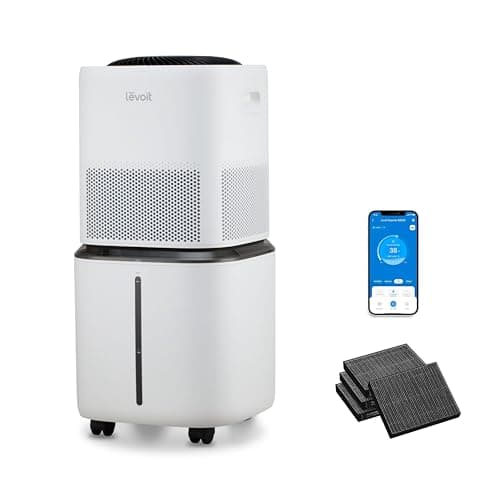
A 6-gallon evaporative unit at 30 W. If you have spent a winter refilling a small humidifier twice a day, this is the one that ends that.
#ad Price as of October 18, 2026, from Amazon. Prices change. How we make money.
Published specifications
| Specification | Value | Source |
|---|---|---|
| Tank capacity | 6 gal / 22.7 L | Levoit published specification |
| Coverage | 3,000 sq ft | Levoit published specification |
| Rated power | 30 W | Levoit published specification |
| Run time | Up to 72 hours on the low fan setting | Levoit published specification |
| Max output | 1,500 mL/h | Levoit published specification |
What it costs to run
About $12-13 a year in electricity across a heating season at 12 hours a day.
30 W / 1000 x 12 hours x 365 days = 131.4 kWh = $24.10 a year run year-round, so roughly $12-13 across a six-month heating season. On any evaporative unit the filters, not the electricity, are the larger cost.
What is good about it
- 30 W against 3,000 sq ft of claimed coverage is the best power-to-output ratio of any humidifier we list
- Evaporative, so it self-limits the same way the Honeywell does - it will not flood a room
- 72 hours per fill means refilling twice a week rather than twice a day
What is not
- It is a large object and it looks like one
- The 3,000 sq ft coverage claim assumes air moves freely between those rooms, which in a real house with doors it does not
Who should skip this
Skip this if you only need one bedroom humidified. A 6-gallon tank in a 120 sq ft room is a lot of standing water to keep clean for no additional benefit.
How it scored
- Cannot over-humidify10.0
- Refill interval9.5
- Power efficiency9.5
- Cleaning burden6.5
Overall 8.6 / 10. This is our editorial score from published specifications and computed running cost. It is not a test result, and it is deliberately not marked up as a rating in this page’s structured data.
Levoit LV600S Hybrid
People who want the option of warm mist
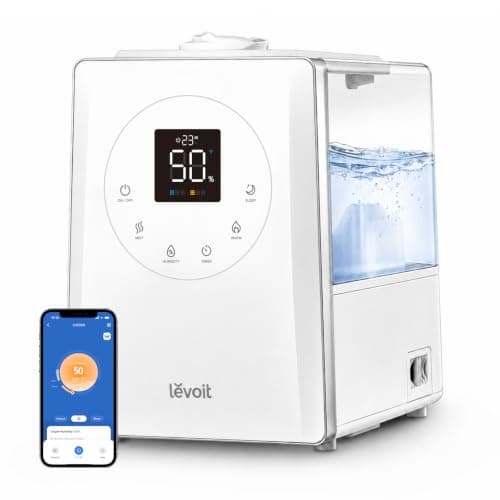
The one to pick if you specifically want warm mist - but note the 280 W rated power, because that is what heating water actually costs.
#ad Price as of October 18, 2026, from Amazon. Prices change. How we make money.
Published specifications
| Specification | Value | Source |
|---|---|---|
| Tank capacity | 1.58 gal / 6 L | Levoit published specification |
| Coverage | 753 sq ft | Levoit published specification |
| Rated power | 280 W | Levoit published specification |
| Run time | Up to 50 hours | Levoit published specification |
What it costs to run
Up to $225 a year on warm mist at 12 hours a day - the most expensive thing to run on this site.
280 W / 1000 x 12 hours x 365 days = 1,226 kWh = $224.86 a year at full warm-mist draw. On cool mist it draws a small fraction of that. This number, not the feature list, is what should decide whether you actually want warm mist.
What is good about it
- Warm and cool mist in one unit, so you are not committed to one type before you know which you prefer
- 50 hours per fill is good going for a 1.58 gallon tank
What is not
- 280 W rated. Warm mist is a kettle with a fan attached - the heat is the cost, and it is roughly ten times the Superior 6000S
- Ultrasonic, so it can over-humidify a room and it will aerosolize whatever minerals are in your water
Who should skip this
Skip this if you have hard water and no intention of using distilled. Ultrasonic units put the minerals in your water onto every surface in the room as white dust.
How it scored
- Cannot over-humidify3.0
- Refill interval8.0
- Power efficiency3.0
- Flexibility9.0
Overall 7.4 / 10. This is our editorial score from published specifications and computed running cost. It is not a test result, and it is deliberately not marked up as a rating in this page’s structured data.
How we ranked these
We have not tested these units. Nobody here owns one. What we did was compile each manufacturer’s published specifications, check the coverage claims against AHAM’s room-sizing rule, and compute what each one costs to run for a year at the current US average electricity price. Every figure on this page is attributed to whoever published it, and the arithmetic is shown so you can redo it.
How we rank these sets out the full method, including what would change a ranking.
Questions people ask
+−Do I have to use distilled water in a humidifier?
Only in the types that aerosolize the water - ultrasonic and impeller units. The EPA recommends distilled water or switching to an evaporative model for those. An evaporative wick humidifier keeps the minerals in the wick, so tap water is fine.
+−What causes white dust from a humidifier?
Dissolved minerals in tap water. An ultrasonic humidifier disperses them into the room along with the water; the water evaporates and the minerals settle on nearby surfaces as a pale film.
+−Is filtered or spring water the same as distilled?
No. The EPA notes that water labeled spring, artesian or mineral has not been treated to remove mineral content, and that distillation is the most effective method for removing minerals. A jug filter targets taste and chlorine, not dissolved solids.
+−Is white dust from a humidifier harmful?
We are not the right source for a health verdict and will not pretend otherwise. What the EPA does say is that the minerals build scale inside the unit, and that scale can be a breeding ground for microorganisms - which is the reason it gives for finding an alternative to tap water in these humidifier types.
+−Can I put essential oils in a humidifier?
Not unless the unit has a tray designed for them. Oils can attack plastics and seals on humidifiers that were not built for them, and a diffuser is a separate device that does that job properly - though it is not an air cleaner, and not a humidifier either: air purifier vs diffuser.