Symptom guide
Wildfire Smoke Indoors
During a smoke event the free steps outperform the expensive ones. Here they are in the order that matters.
By Scooter M. · Published · Last updated
How this page is funded: the buy links below are affiliate links. If you buy through one, we earn a commission at no extra cost to you. It does not change the order of the picks or what we say about them. Full disclosure.
The short answer
- Close everything and block the obvious gaps. Free, and the largest single effect.
- Turn off anything that pulls outside air in - whole-house fans, extractors.
- Set HVAC to recirculate, and check the filter.
- Filter one room properly rather than the whole house badly.
- Size that room’s purifier to AHAM’s wildfire rule - smoke CADR equal to the room’s square footage, not two-thirds.
This page is about the environment - humidity, particles, ventilation - and what changes it. It is not medical advice and we hold no medical qualification. If symptoms are persistent, severe or getting worse, that is a question for a clinician rather than a purchase.
Why sealing beats filtering
A purifier can only clean the air that is in the room. If smoke is entering continuously through gaps, the unit is running against a source rather than cleaning a fixed volume - and the arithmetic of that is unforgiving. Reducing the rate of ingress is the single most effective thing available to you, and it is also the only free one.
This is the same reason AHAM recommends a higher CADR for wildfire smoke than for ordinary indoor smoke: during a smoke event you are not cleaning a room once, you are cleaning it continuously against a leak.
The sequence, in detail
1. Close and block (free)
- Windows and exterior doors closed, obviously - but also check the ones you never open
- Fireplace damper closed
- Towel along the bottom of exterior doors, especially the one to the garage
- Trickle vents on modern windows closed
- Pet doors sealed
2. Stop pulling air in (free)
Bathroom and kitchen extractor fans exhaust indoor air, which means an equal volume of outdoor air is being drawn in somewhere to replace it. During a smoke event that is the opposite of what you want. Same for whole-house fans and window-mounted ventilators.
3. HVAC on recirculate
If you have central air with a fresh-air intake, close it and set the system to recirculate. Running the fan continuously in recirculate mode turns the furnace filter into a whole-house air cleaner. A higher-rated filter helps here - check what your system is specified for, because too restrictive a filter reduces airflow.
4. Pick one room
A single well-sealed room with adequate filtration will always outperform an attempt to treat the whole house with the same equipment. Choose the bedroom - it is where the longest continuous exposure happens - close its door, and put the capacity there.
5. Size it to the wildfire rule
AHAM’s ordinary guidance is a smoke CADR of two-thirds the room area. For wildfire smoke they recommend a smoke CADR equal to the area:
| Room | Required smoke CADR | In practice |
|---|---|---|
| 120 sq ft small bedroom | 120 CFM | One mid-range unit covers this comfortably |
| 200 sq ft bedroom | 200 CFM | One 230-CFM-class unit |
| 300 sq ft bedroom | 300 CFM | Beyond a single mid-range unit - use two |
| 500 sq ft living area | 500 CFM | Two to three units, or accept partial coverage |
Measuring whether any of it worked
This is one of the genuinely good uses for a particulate monitor. Walk it around the house during a smoke event and you will find where the air is coming in - the reading rises near the leak. Then use it to confirm the sealed room is actually holding.
Read it as a relative measurement rather than an absolute one; consumer optical sensors are good at detecting change and less good at absolute concentration - here is why.
What does not help
- Opening windows “to air the place out.” The outdoor air is the problem.
- A humidifier. It does not remove particles, and adding moisture to a closed house during a multi-day event creates a second problem.
- An undersized purifier in a large open space. The wildfire rule exists because the standard sizing is not enough here.
- Ozone generators. A different category of device with genuine safety considerations. We do not recommend them.
What we would buy for this
Chosen from the same registry as our roundups, on published specifications and computed running cost.
Temtop M10 Air Quality Monitor
Watching PM2.5 during smoke events
A particulate monitor rather than a hygrometer - it answers a different question, and it is the question you want answered during wildfire season.
#ad We do not hold a current price for this product, so we do not show one. How we make money.
Published specifications
| Specification | Value | Source |
|---|---|---|
| Measures | PM2.5 particulate and AQI; some variants add HCHO and TVOC | Temtop published specification |
What is good about it
- PM2.5 is the number that matters during a smoke event, and a monitor is the only way to tell whether closing the windows actually worked
- Small enough to move room to room, which is how you find where the smoke is getting in
What is not
- Consumer optical particle sensors drift and are not laboratory instruments; treat readings as relative rather than absolute
- It does not measure humidity, so it is not a substitute for a hygrometer
Who should skip this
Skip this if your problem is damp or dryness. It measures particles, and it will tell you nothing at all about humidity.
How it scored
- Usefulness during smoke events9.5
- Absolute accuracy6.0
- Portability9.0
Overall 8.0 / 10. This is our editorial score from published specifications and computed running cost. It is not a test result, and it is deliberately not marked up as a rating in this page’s structured data.
Coway Airmega AP-1512HH Mighty
Running continuously in a medium room
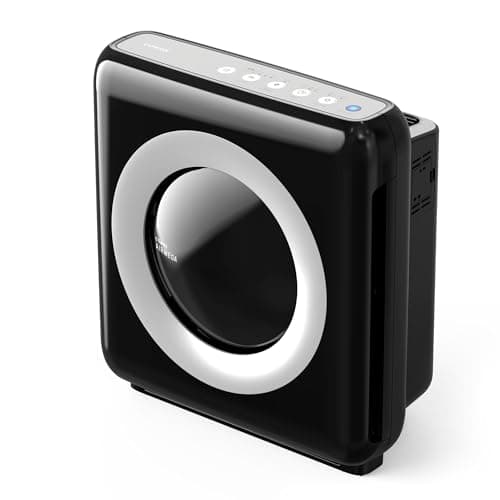
The most efficient unit here at low speed - 3.7 W on speed one - which matters enormously if you leave a purifier running all day and almost not at all if you do not.
#ad Price as of October 18, 2026, from Amazon. Prices change. How we make money.
Published specifications
| Specification | Value | Source |
|---|---|---|
| CADR (smoke) | 233 CFM | Coway published specification |
| CADR (dust) | 246 CFM | Coway published specification |
| CADR (pollen) | 240 CFM | Coway published specification |
| Coverage | 361 sq ft at 4.8 air changes/hr (1,748 sq ft at 1 ACH) | Coway published specification |
| Power draw by speed | 0.3 W standby / 3.7 W speed 1 / 8.7 W speed 2 / 75.3 W speed 3 | Coway published specification |
| Filtration | Pre-filter, odor filter, Green True HEPA, bipolar device | Coway published specification |
What it costs to run
About $6 a year running 24/7 on speed one, or $121 a year running 24/7 on speed three.
Speed 1: 3.7 W / 1000 x 24 x 365 = 32.4 kWh = $5.94 a year. Speed 3: 75.3 W / 1000 x 24 x 365 = 659.6 kWh = $120.97 a year. That twenty-fold spread is the most important number on this page, and it is why we chase per-speed figures instead of accepting a single rated wattage.
What is good about it
- Coway publishes power draw per fan speed, which almost nobody does and which is the only way to compute a real running cost
- 3.7 W on speed one is remarkable - cheaper to run continuously than most nightlights
- Coverage published at 1, 2 and 4.8 air changes per hour, so you can size it honestly
What is not
- 75.3 W on speed three is the highest draw here; how the auto mode behaves decides your bill
- The bipolar device is a stage we would rather do without; check it can be disabled
Who should skip this
Skip this if you only run a purifier for an hour or two at a time. Its whole advantage is low-speed efficiency over long hours, and short bursts on high speed give that straight back.
How it scored
- Clean air per watt9.5
- Honest coverage claim9.5
- Quiet operation8.0
- Filter economics7.5
Overall 8.7 / 10. This is our editorial score from published specifications and computed running cost. It is not a test result, and it is deliberately not marked up as a rating in this page’s structured data.
Winix 5500-2
Smoke, cooking smells and pet odors
The one with a genuine granular carbon stage rather than a carbon-dusted sheet, which is why it belongs on a smoke and odor list and why it costs more to run.
#ad We do not hold a current price for this product, so we do not show one. How we make money.
Published specifications
| Specification | Value | Source |
|---|---|---|
| CADR (smoke) | 232 CFM | AHAM-verified figure published by Winix |
| CADR (dust) | 243 CFM | AHAM-verified figure published by Winix |
| CADR (pollen) | 246 CFM | AHAM-verified figure published by Winix |
| Coverage | 360 sq ft | Winix published specification |
| Rated power | 70 W | Winix published specification |
| Filtration | 4-stage: washable pre-filter, activated carbon, True HEPA, PlasmaWave | Winix published specification |
| Certification | Energy Star, CARB certified | Winix published specification |
What it costs to run
About $56 a year in electricity at 12 hours a day, before filters.
70 W / 1000 x 12 hours x 365 days = 306.6 kWh. At 18.34 cents/kWh that is $56.23 a year. Over three years that is roughly $95 more than the Levoit Core 400S at the same hours - typically more than the price gap between the two units at purchase.
What is good about it
- AHAM-verified CADR, which means the figure was measured to the AC-1 standard rather than asserted by marketing
- A real granular carbon filter, which is what actually adsorbs gases and odors
- The washable pre-filter slows down how fast the expensive filter loads up
What is not
- 70 W is roughly double the Levoit Core 400S for a similar CADR, and you pay that difference every year
- PlasmaWave is an ionizing stage; it can be switched off, and we would switch it off
Who should skip this
Skip this if odor is not your problem. Buying for dust and pollen alone means paying a 70 W electricity premium for a carbon stage you will not use.
How it scored
- Clean air per watt6.5
- Honest coverage claim9.0
- Odor and gas removal9.5
- Filter economics8.0
Overall 8.4 / 10. This is our editorial score from published specifications and computed running cost. It is not a test result, and it is deliberately not marked up as a rating in this page’s structured data.
How we ranked these
We have not tested these units. Nobody here owns one. What we did was compile each manufacturer’s published specifications, check the coverage claims against AHAM’s room-sizing rule, and compute what each one costs to run for a year at the current US average electricity price. Every figure on this page is attributed to whoever published it, and the arithmetic is shown so you can redo it.
How we rank these sets out the full method, including what would change a ranking.
Questions people ask
+−Should I run my HVAC during wildfire smoke?
On recirculate, yes - a continuously running fan makes the furnace filter into a whole-house cleaner. With a fresh-air intake open, no. Check which your system has, because they behave very differently in this situation.
+−What is the best air quality monitor for wildfire smoke?
A portable PM2.5 monitor, because being able to carry it around is what lets you find where smoke is entering. Absolute accuracy matters less than the ability to compare one spot against another. What the PM2.5 number itself means is set out in PM2.5 explained.
+−How long should I run the purifier?
Continuously while the event lasts, and for some hours after it clears. Smoke entering while you slept does not remove itself once the outdoor air improves - the room still contains it until something filters it out.
+−Does a box fan and furnace filter actually work?
The DIY approach is widely discussed and the physics is sound - a filter in front of a fan cleans air. What we cannot give you is a CADR figure for a homemade unit, because it has not been measured to AHAM’s standard, so you cannot size a room with it. As a supplement to a rated unit it is reasonable; as the basis for a sizing decision it is guesswork.
+−Should I wear a mask indoors?
That is a health question rather than an environmental one and it is outside what we are qualified to answer. Public health agencies publish guidance during smoke events and that is the place to look.