Comparison
Warm Mist vs Cool Mist: Which Do You Need?
Three technologies, one job. The differences that matter are not the ones on the box.
By Scooter M. · Published · Last updated
How this page is funded: the buy links below are affiliate links. If you buy through one, we earn a commission at no extra cost to you. It does not change the order of the picks or what we say about them. Full disclosure.
The short answer
Buy cool evaporative unless you have a specific reason not to. It cannot over-humidify a room, it does not produce white mineral dust, and it costs a fraction of warm mist to run. Buy warm mist only if tank hygiene is your overriding concern and you accept roughly ten times the electricity cost. Buy ultrasonic only if silence matters more than everything else and you will use distilled water.
| Evaporative (cool) | Ultrasonic (cool) | Warm mist | |
|---|---|---|---|
| How it works | Fan blows air through a wet wick | Piezo disc vibrates water into a fine mist | Heating element boils water |
| Can it over-humidify? | No - evaporation self-limits as the room saturates | Yes - it keeps misting regardless of the room | Yes |
| Mineral dust? | No - minerals stay in the wick | Yes, unless you use distilled water | No - minerals stay in the boiler |
| Noise | Fan noise | Near silent | Quiet, with occasional boiling sounds |
| Typical power | 30-50 W | 20-40 W | 200-300 W |
| Running cost, 12 h/day | $24-40 a year | $16-32 a year | Up to $225 a year |
| Consumables | Wick filters | None, but distilled water | Descaling; sometimes a cartridge |
| Burn risk | None | None | Contains boiling water |
Running costs computed at the US average residential electricity price of 18.34 cents per kWh (EIA, June 2026), from each manufacturer’s published rated power. The arithmetic is on each product below.
What each one actually does
Evaporative
A fan pulls room air through a wet wick. Water leaves the wick only as fast as the air can carry it, and air near saturation carries very little - so the unit throttles itself. That single property is why we default to this type: the most common humidifier failure is not underperformance, it is quietly pushing a bedroom to 60% and creating a dust-mite problem in place of a dryness one.
Ultrasonic
A disc vibrating at ultrasonic frequency flings water off its surface as an aerosol. Silent, compact, and completely indifferent to how humid the room already is. It also aerosolizes whatever is dissolved in the water, which in a hard-water area lands on every surface in the room as a fine white powder.
Warm mist
A heating element boils water and releases the steam. The hygiene argument is genuine - boiling sterilizes the water on its way out. The cost is that boiling water is one of the most energy-intensive things a household appliance does. A 280 W rated unit at 12 hours a day is 1,226 kWh a year, which is $224.86 at the current average rate. Compare that with $24 for a 30 W evaporative unit.
Buy evaporative if...
- The unit will run unattended overnight in a bedroom
- You have hard water and no intention of buying distilled
- You want the humidity to stop on its own at the right level
Buy ultrasonic if...
- Silence genuinely outranks everything else
- You will use distilled water, or your water is very soft
- You will pair it with a humidistat so something stops it
Buy warm mist if...
- Tank hygiene is the concern that brought you here
- The running cost above is acceptable to you, having seen it
- There is no small child or pet who can reach it
Buy neither if...
Your measured humidity is already 30% or higher. No humidifier technology helps a room that is not dry, and all three will push it somewhere you do not want it. Check the reading at ideal indoor humidity first.
What we would buy for this
Chosen from the same registry as our roundups, on published specifications and computed running cost.
Honeywell HCM350 Germ Free Cool Mist
Bedrooms, and anyone who has had white dust from an ultrasonic
An evaporative wick humidifier, which is the type that physically cannot over-humidify a room or spray minerals onto your furniture. That is the whole argument for it, and it is a good one.
#ad We do not hold a current price for this product, so we do not show one. How we make money.
Published specifications
| Specification | Value | Source |
|---|---|---|
| Tank capacity | 1.1 gallon | Honeywell published specification |
| Rated power | 50 W | Honeywell published specification |
| Run time | Up to 24 hours per fill | Honeywell published specification |
| Output | Up to 2 gallons of moisture per 24 hours | Honeywell published specification |
| Filter | Protec HAC-504AW antimicrobial wick filter | Honeywell published specification |
What it costs to run
About $20-22 a year in electricity across a heating season at 12 hours a day, plus wicks.
50 W / 1000 x 12 hours x 365 days = 219 kWh = $40.16 a year if run year-round. Most people run a humidifier for roughly half the year, so call it $20-22, plus replacement wicks at the manufacturer's stated interval.
What is good about it
- Evaporative design self-limits: as a room approaches saturation it simply evaporates less, so it will not push you past 50% RH the way an ultrasonic will
- No white mineral dust, because the minerals stay in the wick instead of being aerosolized into the room
- The tank is designed to come apart and be cleaned, which is the maintenance that actually matters
What is not
- There is a fan, so it is not silent the way an ultrasonic is
- The wick is a consumable - budget for it, and replace it on schedule or it becomes the thing growing mold
Who should skip this
Skip this if you want silence above all else, or if you will not buy replacement wicks. A neglected wick is worse than no humidifier at all.
How it scored
- Cannot over-humidify10.0
- No mineral dust10.0
- Quiet operation6.5
- Cleaning burden7.5
Overall 8.5 / 10. This is our editorial score from published specifications and computed running cost. It is not a test result, and it is deliberately not marked up as a rating in this page’s structured data.
Levoit LV600S Hybrid
People who want the option of warm mist
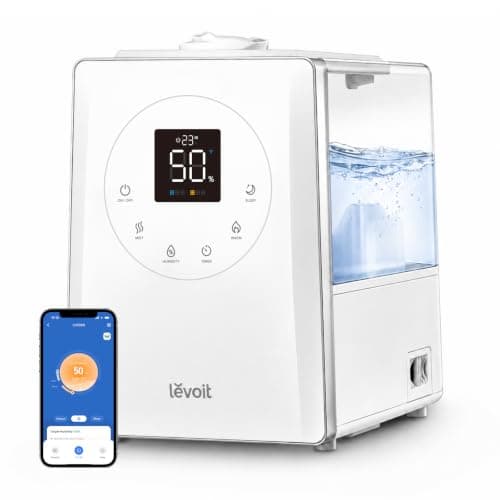
The one to pick if you specifically want warm mist - but note the 280 W rated power, because that is what heating water actually costs.
#ad Price as of October 18, 2026, from Amazon. Prices change. How we make money.
Published specifications
| Specification | Value | Source |
|---|---|---|
| Tank capacity | 1.58 gal / 6 L | Levoit published specification |
| Coverage | 753 sq ft | Levoit published specification |
| Rated power | 280 W | Levoit published specification |
| Run time | Up to 50 hours | Levoit published specification |
What it costs to run
Up to $225 a year on warm mist at 12 hours a day - the most expensive thing to run on this site.
280 W / 1000 x 12 hours x 365 days = 1,226 kWh = $224.86 a year at full warm-mist draw. On cool mist it draws a small fraction of that. This number, not the feature list, is what should decide whether you actually want warm mist.
What is good about it
- Warm and cool mist in one unit, so you are not committed to one type before you know which you prefer
- 50 hours per fill is good going for a 1.58 gallon tank
What is not
- 280 W rated. Warm mist is a kettle with a fan attached - the heat is the cost, and it is roughly ten times the Superior 6000S
- Ultrasonic, so it can over-humidify a room and it will aerosolize whatever minerals are in your water
Who should skip this
Skip this if you have hard water and no intention of using distilled. Ultrasonic units put the minerals in your water onto every surface in the room as white dust.
How it scored
- Cannot over-humidify3.0
- Refill interval8.0
- Power efficiency3.0
- Flexibility9.0
Overall 7.4 / 10. This is our editorial score from published specifications and computed running cost. It is not a test result, and it is deliberately not marked up as a rating in this page’s structured data.
Levoit Superior 6000S
Whole floors, and anyone tired of refilling
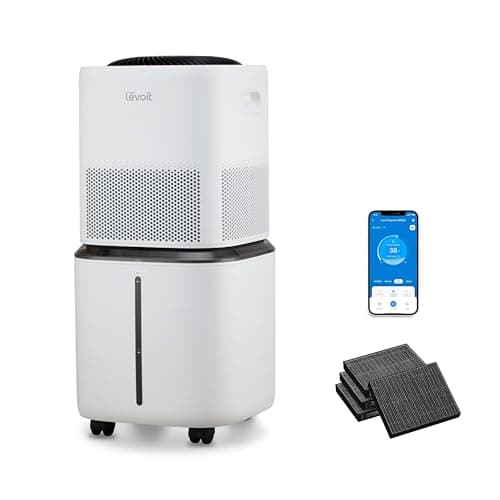
A 6-gallon evaporative unit at 30 W. If you have spent a winter refilling a small humidifier twice a day, this is the one that ends that.
#ad Price as of October 18, 2026, from Amazon. Prices change. How we make money.
Published specifications
| Specification | Value | Source |
|---|---|---|
| Tank capacity | 6 gal / 22.7 L | Levoit published specification |
| Coverage | 3,000 sq ft | Levoit published specification |
| Rated power | 30 W | Levoit published specification |
| Run time | Up to 72 hours on the low fan setting | Levoit published specification |
| Max output | 1,500 mL/h | Levoit published specification |
What it costs to run
About $12-13 a year in electricity across a heating season at 12 hours a day.
30 W / 1000 x 12 hours x 365 days = 131.4 kWh = $24.10 a year run year-round, so roughly $12-13 across a six-month heating season. On any evaporative unit the filters, not the electricity, are the larger cost.
What is good about it
- 30 W against 3,000 sq ft of claimed coverage is the best power-to-output ratio of any humidifier we list
- Evaporative, so it self-limits the same way the Honeywell does - it will not flood a room
- 72 hours per fill means refilling twice a week rather than twice a day
What is not
- It is a large object and it looks like one
- The 3,000 sq ft coverage claim assumes air moves freely between those rooms, which in a real house with doors it does not
Who should skip this
Skip this if you only need one bedroom humidified. A 6-gallon tank in a 120 sq ft room is a lot of standing water to keep clean for no additional benefit.
How it scored
- Cannot over-humidify10.0
- Refill interval9.5
- Power efficiency9.5
- Cleaning burden6.5
Overall 8.6 / 10. This is our editorial score from published specifications and computed running cost. It is not a test result, and it is deliberately not marked up as a rating in this page’s structured data.
How we ranked these
We have not tested these units. Nobody here owns one. What we did was compile each manufacturer’s published specifications, check the coverage claims against AHAM’s room-sizing rule, and compute what each one costs to run for a year at the current US average electricity price. Every figure on this page is attributed to whoever published it, and the arithmetic is shown so you can redo it.
How we rank these sets out the full method, including what would change a ranking.
Questions people ask
+−Is warm mist better for babies?
Manufacturers and pediatric bodies generally point the other way, on burn-risk grounds - a warm mist unit contains boiling water. We are not qualified to give advice about infants and will not; the environmental point stands on its own, which is that both types add the same water to the same room. The environmental constraints for that room are collected in best humidifiers for babies.
+−Does warm mist kill germs in the air?
It sterilizes the water inside the unit as it boils. It does not sterilize the room. Any claim that a humidifier disinfects the air is going well beyond what the mechanism supports.
+−What is the white dust from my humidifier?
Dissolved minerals from your tap water, aerosolized by an ultrasonic unit and settling on surfaces. It is a signature of the ultrasonic mechanism. Distilled water eliminates it; so does switching to an evaporative unit - the detail is in distilled vs tap water in a humidifier.
+−Which type is quietest?
Ultrasonic, by a clear margin, because there is no fan and no boiling. An evaporative unit is as quiet as its fan. Warm mist sits in between, with occasional bubbling.
+−Do evaporative humidifiers really cost more in filters than warm mist?
Often yes on consumables and almost always no overall. Wicks are a real recurring cost, but the electricity gap between a 30-50 W evaporative unit and a 280 W warm mist unit is roughly $180 a year at 12 hours a day, which is far more than a season of wicks.