Comparison
UV & Ozone Air Purifiers
Two extra stages, two different problems. One is an unproven add-on you are paying for; the other is a device the EPA tells you to avoid outright. Neither is the part of a purifier that does the work.
By Scooter M. · Published · Last updated
How this page is funded: the buy links below are affiliate links. If you buy through one, we earn a commission at no extra cost to you. It does not change the order of the picks or what we say about them. Full disclosure.
The short answer
Do not buy an ozone generator, and do not pay extra for a UV lamp. Buy the filtration. The EPA’s Guide to Air Cleaners in the Home instructs readers to “Avoid portable air cleaners and furnace/HVAC filters that intentionally produce ozone,” and notes that “No federal government agency has approved these devices for use in occupied spaces.” On UV and photocatalytic stages the same guide says “Research has not yet shown that other technologies such as plasma, photocatalytic oxidation” - UV light is named in that sentence - can remove gases effectively in portable residential air cleaners. Our pick is the Coway Airmega AP-1512HH Mighty: a certified, filter-first unit that publishes its power draw per fan speed. The Levoit Core 400S is the larger-room alternative. We list one unit with a UV-C lamp - the GermGuardian AC4825E - and we rank it on its published CADR, not on the lamp.
These are two different products and conflating them is the first mistake
“UV purifier” and “ozone purifier” get used interchangeably in listings, and they are not the same thing at all. Keeping them apart is the whole of the decision:
- An ozone generator is built to produce ozone deliberately and sell that as the cleaning mechanism. This is the category the EPA tells you to avoid.
- A UV-C lamp is an extra stage inside an otherwise ordinary filter unit, intended to kill microorganisms as air passes. It is not sold as an ozone producer - but EPA notes that air cleaners containing “electrostatic precipitators, ionizers, UV lights without adequate lamp coatings” “may have the potential to emit ozone.”
- Photocatalytic oxidation (PCO) pairs a UV lamp with a catalyst and aims at gases rather than microbes. It is the stage most often sold under a proprietary name.
The ionizing stage is a fourth thing again and it has its own page - air purifier vs ionizer. What all four share is that none of them is the part with a measurement standard behind it.
Ozone generators: what the EPA actually publishes
This is the clearest guidance in the whole category, and it is worth reading in the agency’s own words rather than a summary of them. On effectiveness, EPA states that at concentrations within public health standards ozone “has little potential to remove indoor air contaminants,” and that it “is not effective at removing many odor-causing chemicals.” It also does not remove airborne particles such as dust and pollen.
On health, EPA states that “When inhaled, ozone can damage the lungs,” and that “Relatively low amounts can cause chest pain, coughing, shortness of breath and throat irritation.” The concentration figures it reports are the part that makes this concrete:
| Figure | Concentration | Source as EPA describes it |
|---|---|---|
| Ozone generator on a high setting, EPA home study | 0.20 to 0.30 ppm | EPA measurement |
| Ozone generator in one test | 0.50 to 0.80 ppm | EPA describes this as "5-10 times higher than public health limits" |
| FDA limit for indoor medical devices | 0.05 ppm | Cited by EPA |
| OSHA workplace limit | 0.10 ppm averaged over 8 hours | Cited by EPA |
| NIOSH recommended ceiling | 0.10 ppm | Cited by EPA |
| EPA outdoor air quality standard | 0.08 ppm as an 8-hour average | Cited by EPA |
And there is a second-order problem that gets no attention in listings at all. EPA warns that when ozone reacts with other chemicals in the air, “the reaction can form a variety of harmful or irritating by-products.” In one carpet-chemistry experiment it reports that total airborne organic chemicals “increased rather than decreased” after ozone was introduced. So the device marketed as removing a new-carpet smell can add to the chemical load in the room.
UV-C: the contact-time problem, in one sentence
A germicidal lamp needs a certain dose to inactivate an organism, and dose is intensity multiplied by exposure time. In a portable purifier the air is past the lamp in a fraction of a second, which is the structural reason this stage underdelivers in a domestic unit compared with the sustained exposures UV is used for elsewhere.
Our position on the evidence has not changed and we are not going to overstate it in either direction: we have not tested any of these units, and the EPA guide does not make a claim about UVGI’s effectiveness against particles or microbes in homes one way or the other. What the guide does say is that research has not shown UV light, plasma or photocatalytic oxidation to remove gases effectively in portable residential air cleaners, and it does not recommend any of them.
Which leaves a simple buying rule. The filtration in a purifier has a published, comparable number behind it. The lamp does not. Pay for the number.
What to look for instead, in order
Every one of these is a published figure you can check before you pay, which is the whole difference between a specification and a feature:
- An AHAM-verified CADR for smoke, dust and pollen, against the exact model number in the listing. If a unit publishes no CADR at all, you cannot size it and you cannot compare it.
- Coverage stated at a useful air-change rate, not at one air change per hour. The two-thirds rule is on CADR explained.
- A real carbon stage with its own part number if odors or gases are your problem - a coating on the HEPA wrap is not a carbon bed. See activated carbon explained.
- Published power draw, ideally per fan speed, because a purifier is a machine you leave running.
- CARB certification, read with the UV caveat above.
- An off switch on any extra stage. Where an ionizing or UV stage is optional, you can simply switch it off and rely on the filters, which is what we would do.
The three units below, and why one of them has a lamp
We have deliberately included a unit with a UV-C lamp rather than pretending the category does not exist, because the honest position is not “never buy a purifier that has one.” It is “never pay for the lamp.”
- Coway Airmega AP-1512HH Mighty - filtration plus a bipolar stage we would rather do without and would check can be disabled. It publishes power draw per fan speed, which almost nobody does: 3.7 W on speed one against 75.3 W on speed three. That is the kind of figure a lamp will never give you.
- Levoit Core 400S - 231 CFM CADR with coverage published at both one and 4.8 air changes per hour. No UV, no ozone stage, and 38 W for the air it moves.
- GermGuardian AC4825E - this one does have a UV-C lamp, and we rank it anyway because it publishes all three AHAM CADR figures against its printed model number at the cheapest price we could verify that in. Our registry entry says the lamp “is a marketing feature at this air speed and we do not count it in the ranking,” and that is exactly how we would have you buy it: for the 99 CFM smoke CADR, with the lamp as an irrelevance you are not paying a premium for.
Honest cons, including on the units we recommend
- Coway: 75.3 W on speed three is the highest draw of the three, so how its auto mode behaves decides your bill. The bipolar device is a stage we would rather not have at all.
- Levoit Core 400S: we could not find a published filter replacement interval in Levoit’s specification, so we do not quote one - and the 1,718 sq ft headline is a single air change per hour, not a useful rate.
- GermGuardian: the advertised 743 sq ft per hour works out to about 149 sq ft at AHAM’s two-thirds smoke rule, 55 dBA on high is audible in a quiet room, the carbon is a thin coating rather than a bed, and filters run on a 6-8 month cadence that erodes the price advantage over three years.
- All three: none of them will remove a gas your carbon stage is too small for. If your problem is VOCs rather than particles, the honest answer is more carbon by weight, which is its own page.
What we would actually do
Treat UV as a feature you neither seek out nor refuse: if the unit you want on CADR, carbon and watts happens to have a lamp, buy it for the first three and ignore the fourth. Treat an ozone generator as a product to walk away from, because the agency that studies this has told you to in plain words, and the devices it measured were producing concentrations it describes as several times the public health limits. Then spend the money you did not spend on a lamp on more carbon, which is the stage that actually does something about the smell you bought the machine for.
What we would buy for this
Chosen from the same registry as our roundups, on published specifications and computed running cost.
Coway Airmega AP-1512HH Mighty
Running continuously in a medium room
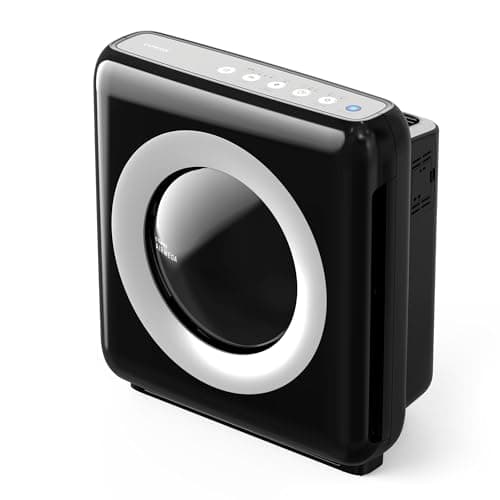
The most efficient unit here at low speed - 3.7 W on speed one - which matters enormously if you leave a purifier running all day and almost not at all if you do not.
#ad Price as of October 18, 2026, from Amazon. Prices change. How we make money.
Published specifications
| Specification | Value | Source |
|---|---|---|
| CADR (smoke) | 233 CFM | Coway published specification |
| CADR (dust) | 246 CFM | Coway published specification |
| CADR (pollen) | 240 CFM | Coway published specification |
| Coverage | 361 sq ft at 4.8 air changes/hr (1,748 sq ft at 1 ACH) | Coway published specification |
| Power draw by speed | 0.3 W standby / 3.7 W speed 1 / 8.7 W speed 2 / 75.3 W speed 3 | Coway published specification |
| Filtration | Pre-filter, odor filter, Green True HEPA, bipolar device | Coway published specification |
What it costs to run
About $6 a year running 24/7 on speed one, or $121 a year running 24/7 on speed three.
Speed 1: 3.7 W / 1000 x 24 x 365 = 32.4 kWh = $5.94 a year. Speed 3: 75.3 W / 1000 x 24 x 365 = 659.6 kWh = $120.97 a year. That twenty-fold spread is the most important number on this page, and it is why we chase per-speed figures instead of accepting a single rated wattage.
What is good about it
- Coway publishes power draw per fan speed, which almost nobody does and which is the only way to compute a real running cost
- 3.7 W on speed one is remarkable - cheaper to run continuously than most nightlights
- Coverage published at 1, 2 and 4.8 air changes per hour, so you can size it honestly
What is not
- 75.3 W on speed three is the highest draw here; how the auto mode behaves decides your bill
- The bipolar device is a stage we would rather do without; check it can be disabled
Who should skip this
Skip this if you only run a purifier for an hour or two at a time. Its whole advantage is low-speed efficiency over long hours, and short bursts on high speed give that straight back.
How it scored
- Clean air per watt9.5
- Honest coverage claim9.5
- Quiet operation8.0
- Filter economics7.5
Overall 8.7 / 10. This is our editorial score from published specifications and computed running cost. It is not a test result, and it is deliberately not marked up as a rating in this page’s structured data.
Levoit Core 400S
Living rooms and open-plan spaces
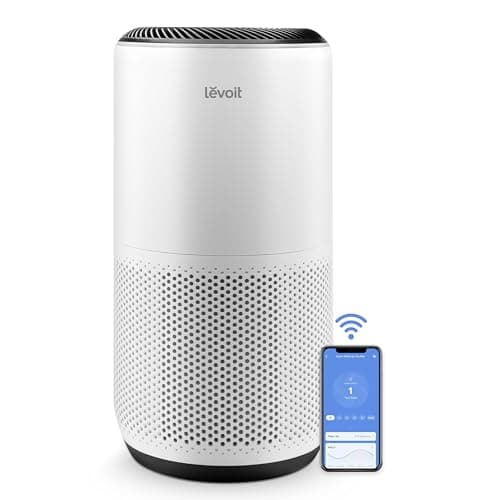
The one to buy if you want a purifier that genuinely covers a living room, and one of the few spec sheets in this bracket that publishes coverage at a useful air-change rate rather than only the flattering one.
#ad Price as of October 18, 2026, from Amazon. Prices change. How we make money.
Published specifications
| Specification | Value | Source |
|---|---|---|
| CADR | 231 CFM | Levoit published specification |
| Coverage | 358 sq ft at 4.8 air changes/hr (1,718 sq ft at 1 ACH) | Levoit published specification |
| Rated power | 38 W | Levoit published specification |
| Noise | 22-52 dB | Levoit published specification |
| Filtration | 3-stage: pre-filter, HEPA, activated carbon | Levoit published specification |
| Dimensions | 10.8 x 10.8 x 20.5 in, 11 lb | Levoit published specification |
What it costs to run
About $25-30 a year in electricity at 12 hours a day, before filters.
38 W / 1000 x 12 hours x 365 days = 166.4 kWh. At 18.34 cents/kWh that is $30.52 a year at rated power - and the unit only draws its full 38 W on the top fan speed, so a mid setting lands nearer $25. Add the replacement filter, which you should price before you buy rather than after.
What is good about it
- Levoit publishes coverage at both 1 ACH and 4.8 ACH, which is unusually straight - most brands quote only the flattering 1 ACH number
- 38 W is low for this CADR, which is what keeps the running cost down
- 22 dB on its lowest setting is quiet enough to sleep beside
- Carbon, pet-allergy and smoke-specific replacement filters are sold for the same body
What is not
- We could not find a published filter replacement interval in Levoit's specification, so we are not quoting one
- The 1,718 sq ft headline is a single air change per hour, which is not a useful rate for allergies
Who should skip this
Skip this if your room is under 200 sq ft. The Core 300S covers that at lower power and lower cost, and the extra CADR buys you nothing in a small bedroom.
How it scored
- Clean air per watt9.0
- Honest coverage claim9.5
- Quiet operation8.5
- Filter economics7.5
Overall 8.6 / 10. This is our editorial score from published specifications and computed running cost. It is not a test result, and it is deliberately not marked up as a rating in this page’s structured data.
GermGuardian AC4825E
A small room, a dorm or a desk-side space on a tight budget
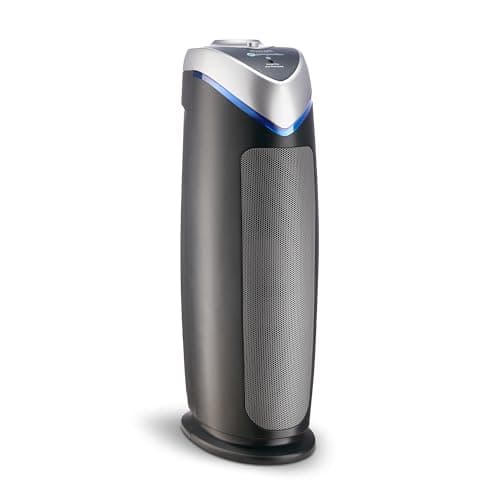
The cheapest air purifier we could find that publishes an AHAM-verified smoke CADR against a printed model number. That combination is rarer at this price than it should be, and it is the only reason this unit is here.
#ad Price as of October 18, 2026, from Amazon. Prices change. How we make money.
Published specifications
| Specification | Value | Source |
|---|---|---|
| CADR - smoke | 99 CFM | GermGuardian published specification |
| CADR - dust | 118 CFM | GermGuardian published specification |
| CADR - pollen | 125 CFM | GermGuardian published specification |
| Room size at the AHAM rule | About 149 sq ft | Our arithmetic from the published smoke CADR |
| Noise | 40-55 dBA | GermGuardian published specification |
| Fan speeds | 3 | GermGuardian published specification |
| Filter | True HEPA plus activated carbon, replace every 6-8 months | GermGuardian published specification |
| Dimensions and weight | 22 x 10.25 x 6.75 in, 8.55 lb | GermGuardian published specification |
What it costs to run
About $24 a year in electricity at 8 hours a day on high.
55 W / 1000 x 8 hours x 365 days = 160.6 kWh. At 18.34 cents/kWh that is $29.45 a year on high. On the low speed most people actually use it is meaningfully less; filters are the larger running cost at this price point, not electricity.
What is good about it
- Publishes all three AHAM CADR figures against the model number printed in the listing title, which most units at this price do not
- True HEPA, not HEPA-type - the distinction matters and the cheap end of this category is full of the latter
- Activated carbon stage included rather than sold as an upgrade
- 8.55 lb and 22 inches tall, so it moves between rooms without planning
What is not
- GermGuardian advertises 743 sq ft per hour. At AHAM's two-thirds smoke rule the honest figure is about 149 sq ft - a fifth of the headline
- 55 dBA on high is audible in a quiet room; this is not a unit you sleep next to on full speed
- The carbon stage is a thin coating on the filter wrap, not a deep carbon bed, so it handles light odors rather than sustained cooking or smoke
- Filters every 6-8 months is a faster cadence than the better units, and it erodes the price advantage over three years
- The UV-C lamp is a marketing feature at this air speed and we do not count it in the ranking
Who should skip this
Skip this if the room is over about 150 sq ft, if you need it silent overnight, or if the problem is cooking smoke or a smoker in the house - none of those are jobs a thin carbon coating wins.
How it scored
- Published data at the price9.0
- Clean air per dollar8.5
- Odor handling5.0
Overall 7.6 / 10. This is our editorial score from published specifications and computed running cost. It is not a test result, and it is deliberately not marked up as a rating in this page’s structured data.
How we ranked these
We have not tested these units. Nobody here owns one. What we did was compile each manufacturer’s published specifications, check the coverage claims against AHAM’s room-sizing rule, and compute what each one costs to run for a year at the current US average electricity price. Every figure on this page is attributed to whoever published it, and the arithmetic is shown so you can redo it.
How we rank these sets out the full method, including what would change a ranking.
Questions people ask
+−Are UV air purifiers worth it?
+−Do ozone air purifiers work?
+−Is ozone from an air purifier dangerous?
+−Does CARB certification mean a purifier produces no ozone?
+−What about photocatalytic oxidation and plasma stages?
+−Can I use an ozone machine if I leave the house while it runs?
+−My purifier has a UV light. Should I stop using it?
Sources
- EPA - Guide to Air Cleaners in the Home (2nd edition)
- EPA - Ozone Generators that are Sold as Air Cleaners
- California Air Resources Board - Air Cleaner Regulation (AB 2276), Regulation Limiting Ozone Emissions from Indoor Air Cleaners
- California Air Resources Board - List of CARB-Certified Air Cleaning Devices
- Guardian Technologies - GermGuardian AC4825 published specification
- ENERGY STAR - Certified Room Air Cleaners product database