Review
Levoit Superior 6000S Review
We have not tested this unit and we will not pretend otherwise. What we have done is read every figure Levoit publishes, work out the running cost, and establish something that applies to every humidifier review you will read: none of these numbers are certified by anybody.
By Scooter M. · Published · Last updated
How this page is funded: the buy links below are affiliate links. If you buy through one, we earn a commission at no extra cost to you. It does not change the order of the picks or what we say about them. Full disclosure.
The short answer
Buy it if you are tired of refilling. Six gallons at 30 W is the best power-to-capacity combination of any humidifier we list, it is evaporative so it cannot over-humidify a room, and 72 hours per fill turns a twice-daily chore into a twice-weekly one. Do not buy it for a single bedroom, where six gallons of standing water is cleaning work with no extra benefit. The honest caveat applies to the whole category rather than this unit: no humidifier figure on this page is verified by any third party, because no certification program covers humidifiers at all.
Before any humidifier review: none of these numbers are certified
This site ranks air purifiers and dehumidifiers on federally certified data, and it is worth being explicit that we cannot do that here. We checked, and the gap is clean:
- ENERGY STAR has no humidifier program. It publishes certified product databases for dehumidifiers - including an Integrated Energy Factor for each one - and for room air cleaners. Search its data catalog for humidifiers and there is no humidifier dataset, because the category is not covered.
- AHAM Verifide does not verify humidifiers either. Its certification programs cover room air cleaners, replacement air filters and kitchen range hoods. There is no humidifier program, so there is no humidifier equivalent of the CADR figure we lean on constantly for purifiers.
The practical consequence: for an air purifier we can take the manufacturer’s coverage claim and check it against an independent lab’s CADR measurement and AHAM’s 4.8 air changes an hour rule. For this humidifier, every number below is Levoit’s own, measured by Levoit, to Levoit’s chosen conditions. That does not make them wrong. It does mean nobody independent has checked them, and any review claiming otherwise is inventing a certification that does not exist.
What Levoit publishes
| Specification | Levoit's figure |
|---|---|
| Tank capacity | 6 gal / 22.7 L |
| Claimed coverage | 3,000 sq ft / 279 m² |
| Max moisture output | 1,500 mL/h |
| Rated power | 30 W |
| Run time | Up to 72 hours on low fan speed |
| Noise | 28 to 45 dB |
| Dimensions | 12.7 x 12.7 x 26.8 in |
| Weight | 13.2 lb |
| Filtration | Four wick filters, pre-installed |
| Wick replacement interval | not stated |
| Modes | Low and high fan, Sleep, Dry |
| Warranty | 2-year limited |
The 3,000 sq ft claim, and why it cannot be checked
Three thousand square feet is a large claim - more than most whole houses - and it is the figure we trust least on the page. Not because we think it is fabricated, but because Levoit does not state the assumptions behind it, and without them the number is unfalsifiable.
A humidifier’s real coverage depends on things no spec sheet mentions: the starting relative humidity, the target, the outdoor temperature and dewpoint, how leaky the building is, and how many times an hour the air is replaced. A unit adding 1.5 liters an hour into a tight, mild house is doing something very different from the same unit in a drafty house at 10°F. With an air purifier the industry solved this by standardizing on a measured delivery rate and a stated air-change assumption. There is no such convention here, so “3,000 sq ft” has no stated basis to check it against.
There is also a physical limit the number ignores. Moisture has to reach the rooms, and a closed door is a wall as far as humidity is concerned. A single unit in a hallway will not hold three bedrooms at target with the doors shut, whatever the box says. Treat the figure as “this is the big one in the range” rather than a room-planning tool, and size from the humidifier sizing arithmetic instead.
What it costs to run
This is where the unit is genuinely impressive, and it is the one figure we can compute rather than take on trust. At a rated 30 W:
| Usage pattern | Electricity | Cost |
|---|---|---|
| 12 hours a day, six-month heating season | 66 kWh | about $12 |
| 12 hours a day, year-round | 131 kWh | about $24 |
| Continuously, year-round | 263 kWh | about $48 |
For context, compare it with the other Levoit humidifier we carry. The LV600S Hybrid is rated at 280 W against this unit’s 30 - roughly nine times the draw - for a claimed 753 sq ft against 3,000. That is not a design flaw in the LV600S; it is what warm mist costs, because producing warm mist means boiling water and boiling water takes real power. A hybrid only draws its rated figure while the heater is actually running, so the gap in practice is smaller than nine to one, but it runs firmly in one direction. If you want the reasoning behind choosing between the two mechanisms, we have a warm mist versus cool mist comparison.
Why evaporative is the right mechanism for this job
An evaporative humidifier works by pulling air through a wet wick. The important consequence is that it is self-limiting: as a room approaches saturation, evaporation slows on its own. An ultrasonic unit has no such feedback - it will happily keep firing mist into an already-damp room until the windows run with condensation. On a 6-gallon tank that distinction matters more than it would on a small unit, because there is far more water available to get wrong.
The second advantage is that evaporative units do not produce white dust. An ultrasonic atomizes whatever is dissolved in the water, which is why mineral residue settles on furniture in hard-water areas and why the distilled versus tap water question is a live one for those machines. Here the minerals stay in the wick, which is part of why the wick needs replacing.
The cleaning burden is the trade you are actually making
Six gallons is a lot of standing water in a warm room, and the EPA’s guidance on home humidifiers is clear that the tank is the thing to stay on top of rather than an afterthought. A larger reservoir means a longer refill interval and it also means more water sitting still for longer between changes.
We rate this unit highly and we still score it lowest on cleaning burden of the metrics we track for it. If you will not keep to a cleaning routine, a smaller tank you empty often is the more honest purchase - and our page on humidifier mold and cleaning sets out what the routine actually involves before you buy, not after.
What Levoit does not publish
Two absences worth knowing, stated rather than glossed over:
- No wick replacement interval, as above, which makes the consumable cost uncomputable.
- No humidistat specification. The spec panel lists fan speeds, a Sleep mode and a Dry mode, but states nothing about a built-in humidity sensor or its accuracy. We are not claiming the unit lacks one - we are saying Levoit does not specify it, so we cannot tell you how closely it will hold a target. If holding a precise level matters to you, a separate hygrometer is the reliable answer, and our hygrometer picks cost a fraction of this machine.
Who should not buy it
Anyone humidifying one bedroom. This is a 26.8-inch, 13.2 lb object with a six-gallon reservoir. In a small room it is cleaning work and floor space for no added benefit, and the smaller units in the range do that job properly.
Anyone who wants warm mist. This unit does not produce it. That is the LV600S, at nine times the rated power.
Anyone expecting it to hold three closed rooms. The 3,000 sq ft figure assumes air moves freely, and doors mean it does not. For a genuinely open-plan floor it is the right machine; for a corridor of shut bedrooms it is one machine doing one room’s work.
What we would buy for this
Chosen from the same registry as our roundups, on published specifications and computed running cost.
Levoit Superior 6000S
Whole floors, and anyone tired of refilling
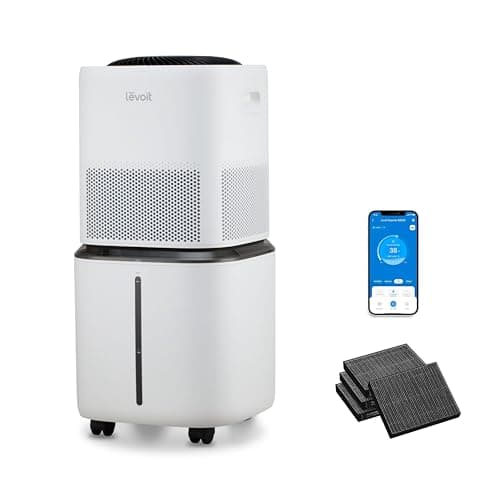
A 6-gallon evaporative unit at 30 W. If you have spent a winter refilling a small humidifier twice a day, this is the one that ends that.
#ad Price as of October 18, 2026, from Amazon. Prices change. How we make money.
Published specifications
| Specification | Value | Source |
|---|---|---|
| Tank capacity | 6 gal / 22.7 L | Levoit published specification |
| Coverage | 3,000 sq ft | Levoit published specification |
| Rated power | 30 W | Levoit published specification |
| Run time | Up to 72 hours on the low fan setting | Levoit published specification |
| Max output | 1,500 mL/h | Levoit published specification |
What it costs to run
About $12-13 a year in electricity across a heating season at 12 hours a day.
30 W / 1000 x 12 hours x 365 days = 131.4 kWh = $24.10 a year run year-round, so roughly $12-13 across a six-month heating season. On any evaporative unit the filters, not the electricity, are the larger cost.
What is good about it
- 30 W against 3,000 sq ft of claimed coverage is the best power-to-output ratio of any humidifier we list
- Evaporative, so it self-limits the same way the Honeywell does - it will not flood a room
- 72 hours per fill means refilling twice a week rather than twice a day
What is not
- It is a large object and it looks like one
- The 3,000 sq ft coverage claim assumes air moves freely between those rooms, which in a real house with doors it does not
Who should skip this
Skip this if you only need one bedroom humidified. A 6-gallon tank in a 120 sq ft room is a lot of standing water to keep clean for no additional benefit.
How it scored
- Cannot over-humidify10.0
- Refill interval9.5
- Power efficiency9.5
- Cleaning burden6.5
Overall 8.6 / 10. This is our editorial score from published specifications and computed running cost. It is not a test result, and it is deliberately not marked up as a rating in this page’s structured data.
Levoit LV600S Hybrid
People who want the option of warm mist
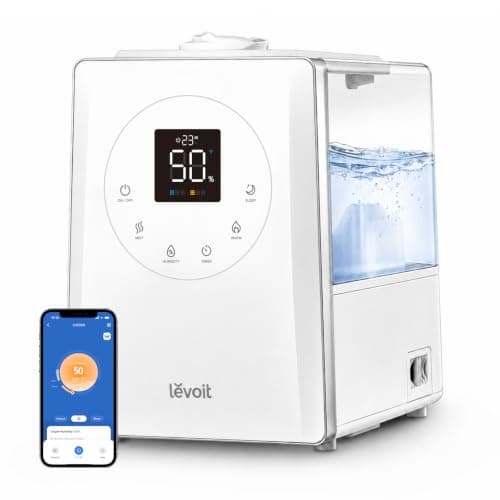
The one to pick if you specifically want warm mist - but note the 280 W rated power, because that is what heating water actually costs.
#ad Price as of October 18, 2026, from Amazon. Prices change. How we make money.
Published specifications
| Specification | Value | Source |
|---|---|---|
| Tank capacity | 1.58 gal / 6 L | Levoit published specification |
| Coverage | 753 sq ft | Levoit published specification |
| Rated power | 280 W | Levoit published specification |
| Run time | Up to 50 hours | Levoit published specification |
What it costs to run
Up to $225 a year on warm mist at 12 hours a day - the most expensive thing to run on this site.
280 W / 1000 x 12 hours x 365 days = 1,226 kWh = $224.86 a year at full warm-mist draw. On cool mist it draws a small fraction of that. This number, not the feature list, is what should decide whether you actually want warm mist.
What is good about it
- Warm and cool mist in one unit, so you are not committed to one type before you know which you prefer
- 50 hours per fill is good going for a 1.58 gallon tank
What is not
- 280 W rated. Warm mist is a kettle with a fan attached - the heat is the cost, and it is roughly ten times the Superior 6000S
- Ultrasonic, so it can over-humidify a room and it will aerosolize whatever minerals are in your water
Who should skip this
Skip this if you have hard water and no intention of using distilled. Ultrasonic units put the minerals in your water onto every surface in the room as white dust.
How it scored
- Cannot over-humidify3.0
- Refill interval8.0
- Power efficiency3.0
- Flexibility9.0
Overall 7.4 / 10. This is our editorial score from published specifications and computed running cost. It is not a test result, and it is deliberately not marked up as a rating in this page’s structured data.
How we ranked these
We have not tested these units. Nobody here owns one. What we did was compile each manufacturer’s published specifications, check the coverage claims against AHAM’s room-sizing rule, and compute what each one costs to run for a year at the current US average electricity price. Every figure on this page is attributed to whoever published it, and the arithmetic is shown so you can redo it.
How we rank these sets out the full method, including what would change a ranking.
Questions people ask
+−Is the Levoit Superior 6000S worth it?
+−Does the Superior 6000S really cover 3,000 sq ft?
+−How much does the Superior 6000S cost to run?
+−Is it certified by ENERGY STAR or AHAM?
+−Superior 6000S or LV600S?
+−Will an evaporative humidifier make white dust?
Sources
- Levoit - Superior 6000S Smart Evaporative Humidifier specification
- AHAM Verifide - certification programs (room air cleaners, air filters, range hoods)
- ENERGY STAR - Certified Dehumidifiers product database (no humidifier program exists)
- EPA - Indoor Air Facts No. 8: Use and Care of Home Humidifiers
- U.S. Energy Information Administration - Electric Power Monthly, Table 5.6.A