Comparison
Dehumidifier vs DampRid
Both remove water from air. One does it at closet scale and one at room scale, and using either at the wrong scale is why people conclude they do not work.
By Scooter M. · Published · Last updated
How this page is funded: the buy links below are affiliate links. If you buy through one, we earn a commission at no extra cost to you. It does not change the order of the picks or what we say about them. Full disclosure.
The short answer
DampRid and similar calcium chloride absorbers for sealed spaces smaller than a wardrobe. A dehumidifier for anything room-sized. A tub absorbs a few hundred milliliters before it is spent; a damp basement produces liters a day. Neither is a bad product - they are simply built for different orders of magnitude.
| Calcium chloride absorber | Compressor dehumidifier | |
|---|---|---|
| How it works | A hygroscopic salt dissolves as it absorbs water from the air | Air passes over a refrigerated coil; water condenses and drains |
| Capacity | Hundreds of milliliters, then it is spent | Tens of liters per day |
| Power | None | 300-550 W while running |
| Running cost | Refills, indefinitely | $115-200 a year in electricity |
| Noise | Silent | 47-51 dBA typical |
| Adjustable | No | Yes - humidistat setpoint |
| Right scale | Wardrobe, safe, caravan, cupboard | Room, basement, whole floor |
What each one actually does
Calcium chloride is deliquescent: it absorbs water from the air until it dissolves into a brine, which collects in the base of the tub. There is no power and no moving parts, and there is also no way to stop it or adjust it. When the salt is gone, it is gone.
A compressor dehumidifier runs a refrigeration cycle. Air is drawn over a cold coil, water condenses out of it, and the dried air is returned to the room warmed slightly by the compressor. It can run indefinitely, it can be set to a target humidity, and it can move enough water to change a room.
Buy an absorber if...
- The space is sealed and smaller than a wardrobe
- There is no power available - a boat, a caravan in winter storage, a safe
- Silence is essential
- The problem is seasonal and small enough that a refill or two covers it
Buy a dehumidifier if...
- The space is a room, and it measures above 60% relative humidity
- There is a musty smell that returns after airing out
- You want to set a target and have something hold it
- You have been through more than a couple of absorber tubs and the problem is unchanged
Buy neither if...
Water is actively entering the space. Both will run against it forever - one costing refills and one costing electricity - and neither will finish. The sequence that works is at musty smell in the house, and the free steps that often make the appliance unnecessary are at how to lower humidity.
The cost comparison over three years
For a wardrobe: absorber refills at a handful of dollars every couple of months is a small ongoing cost, and a renewable silica unit that recharges from a plug eliminates even that after the initial purchase.
For a basement: a 35-pint dehumidifier at 345 W cycling half the time is around $115 a year in electricity, so roughly $345 across three years plus the purchase. Absorbers cannot do the job at any price, so there is no comparison to make - the only real alternative is fixing the moisture source, which is why we keep pointing at it.
What we would buy for this
Chosen from the same registry as our roundups, on published specifications and computed running cost.
Eva-Dry E-333 Renewable
Safes, sealed closets, boats
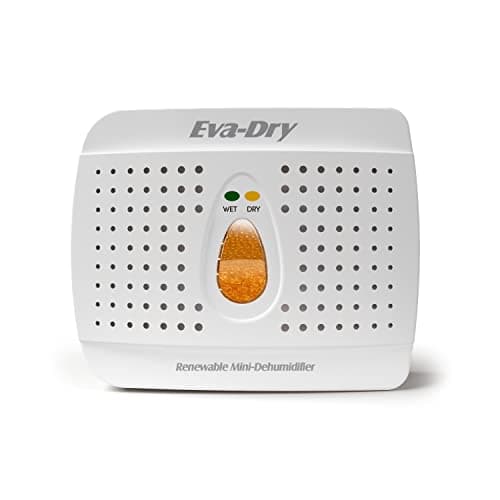
No power, no tank, no fan - a silica desiccant you plug in for a few hours to dry out and then put back. For a gun safe or a sealed closet this is often the honest answer.
#ad Price as of October 18, 2026, from Amazon. Prices change. How we make money.
Published specifications
| Specification | Value | Source |
|---|---|---|
| Type | Renewable silica gel desiccant, recharged by plugging in | Eva-Dry published specification |
What is good about it
- Zero running cost while it is working - it draws power only during the recharge cycle
- Nothing to empty, nothing to break, and no standing water to grow anything in
What is not
- Capacity is tiny; this handles a sealed cubic foot or two, not a room
- You have to remember to recharge it, and nothing reminds you
Who should skip this
Skip this for anything with a door that opens regularly. Desiccant works in sealed spaces; in a closet you open daily it never gets ahead of the moisture coming in.
How it scored
- Running cost10.0
- Fit for sealed spaces9.0
- Capacity2.0
- Maintenance burden6.0
Overall 7.2 / 10. This is our editorial score from published specifications and computed running cost. It is not a test result, and it is deliberately not marked up as a rating in this page’s structured data.
Midea Cube 35-Pint
Basements without a floor drain
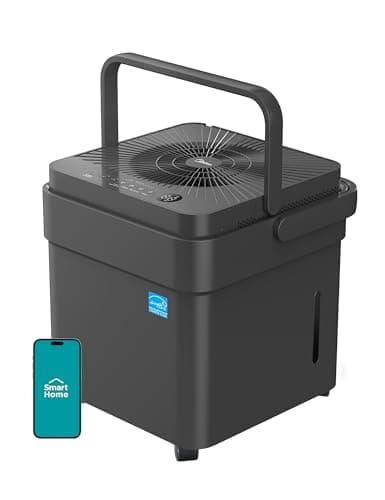
The adjustable 4.25-gallon bucket is the point. Most dehumidifiers get switched off because emptying a 2-gallon bucket twice a day is miserable; this one buys you a couple of days.
#ad Price as of October 18, 2026, from Amazon. Prices change. How we make money.
Published specifications
| Specification | Value | Source |
|---|---|---|
| Capacity | 35 pints per day | Midea published specification |
| Capacity (federal test) | 35.82 pints per day | ENERGY STAR certified products database |
| Coverage | Up to 3,500 sq ft | Midea published specification |
| Efficiency (IEF) | 2.01 L/kWh | ENERGY STAR certified products database |
| Annual energy use | 378 kWh/yr | ENERGY STAR certified products database |
| Bucket fill level | Adjustable, up to 4.25 gallons | Midea user manual |
| Fan speeds | 2 (High, Low) | Midea user manual |
| Dimensions | 14.76 x 14.57 x 14.45 in, 39.62 lb | Midea published specification |
| Certification | ENERGY STAR certified | ENERGY STAR certified products database |
What it costs to run
About $69 a year on ENERGY STAR's certified annual energy figure.
ENERGY STAR publishes 378 kWh a year for this model. At 18.34 cents/kWh that is $69.33 a year. That figure is calculated on the program's standardized test basis, not measured in your basement: a genuinely damp space where it cycles constantly will use more. Against the 50-pint Cube's 515 kWh ($94.45) it is the cheaper machine to own, which is the argument for sizing honestly rather than buying headroom.
What is good about it
- An adjustable bucket that holds up to 4.25 gallons - the difference between a unit you keep using and one you unplug in week three
- An IEF of 2.01 L/kWh removes about 18% more water per kWh than the 20-pint Cube's 1.70
- Nests down into a smaller shape for storage, which matters for an appliance you only use half the year
What is not
- The 3,500 sq ft coverage claim assumes conditions no real basement has; treat it as a ceiling, not a specification
- 35 pints is not enough for a genuinely wet basement with standing water
- Midea does not publish a rated wattage for this model, so we quote ENERGY STAR's certified annual energy figure instead
- No built-in pump on this model - without a floor drain you are either emptying the bucket or routing a gravity hose
Who should skip this
Skip this if your basement is wet rather than damp - visible water, white efflorescence on the walls, a musty smell that returns within a day of airing out. That is a drainage problem, and a 35-pint unit will run permanently and never win.
How it scored
- Tank interval10.0
- Capacity for the money8.5
- Efficiency per liter removed9.0
- Storage footprint9.0
Overall 8.7 / 10. This is our editorial score from published specifications and computed running cost. It is not a test result, and it is deliberately not marked up as a rating in this page’s structured data.
How we ranked these
We have not tested these units. Nobody here owns one. What we did was compile each manufacturer’s published specifications, check the coverage claims against AHAM’s room-sizing rule, and compute what each one costs to run for a year at the current US average electricity price. Every figure on this page is attributed to whoever published it, and the arithmetic is shown so you can redo it.
How we rank these sets out the full method, including what would change a ranking.
Questions people ask
+−How much moisture does DampRid actually absorb?
Enough to fill the collection reservoir in its own tub, which is a few hundred milliliters, over weeks in a small space. That is a real amount for a wardrobe and an irrelevant amount for a basement producing liters a day. A crawl space sits between the two and has its own rules, which we set out in best dehumidifiers for a crawl space.
+−Can I use DampRid in a basement?
You can put it there, but it will not change the humidity of the room. It will saturate and stop. If the basement reads above 60%, the honest answer is a compressor dehumidifier or better drainage - and the cheapest one that genuinely holds a room is identified in best budget dehumidifiers.
+−Is a renewable desiccant better than disposable tubs?
For anywhere you will maintain over years, yes - you recharge it from a plug instead of buying refills. For a single wardrobe over a single damp winter, the disposable tub is simpler and the cost difference is trivial. Inside a gun safe we would avoid the brine entirely, for reasons set out in gun safe dehumidifiers.
+−Do moisture absorbers stop mold?
In a sealed space they can keep humidity low enough that growth does not start. In a room they cannot, because they cannot move enough water to hold the room below the EPA’s 60% ceiling.