Comparison
HEPA vs Carbon Filters
Two completely different mechanisms doing two completely different jobs, sold in the same box and described with the same word.
By Scooter M. · Published · Last updated
How this page is funded: the buy links below are affiliate links. If you buy through one, we earn a commission at no extra cost to you. It does not change the order of the picks or what we say about them. Full disclosure.
The short answer
HEPA removes particles. Activated carbon removes gases and odors. They are not alternatives - a purifier needs both to handle smoke, which is particles and gases together. If a smell is your problem, the figure to compare is the weight of carbon in the filter, and almost nobody publishes it.
| HEPA | Activated carbon | |
|---|---|---|
| Mechanism | Mechanical - fibers physically intercept particles | Chemical - gas molecules adhere to an enormous internal surface area |
| Catches | Dust, pollen, dander, mold spores, smoke particulate | Odor molecules, VOCs, the gas fraction of smoke |
| Does nothing about | Smells, gases, VOCs | Particles |
| How it fails | Clogs. Airflow drops, performance falls gradually. | Saturates. Stops working, often with no visible sign. |
| Measured by | CADR, under AHAM's AC-1 standard | Nothing standardized. Weight of carbon is the best available proxy. |
| Typical life | 6-12 months depending on load | Often much shorter, and rarely stated |
What each one actually does
HEPA
A dense mat of fine fibers. Particles are captured by interception, impaction and diffusion - three mechanisms which between them work across a wide size range, with the hardest particles to catch sitting around 0.3 microns. This is a well-standardized, well-measured technology, and CADR gives you a directly comparable number for it (see CADR explained).
Activated carbon
Carbon processed to have an enormous internal surface area - a few grams can present a surface measured in hundreds of square meters. Gas molecules adhere to that surface and stay there. It is genuinely effective, and it has one important property: the surface fills up. Once it is saturated, the filter is inert, and unlike a clogged HEPA there is no airflow drop to tell you.
Why smoke needs both
Smoke is not one thing. It is a suspension of fine particulate and a mixture of gases and volatile organic compounds. The particulate fraction is what a HEPA filter and a CADR figure address. The gas fraction is what you smell, and it passes through HEPA untouched.
This is why a purifier can drop a particle monitor’s reading dramatically during a smoke event and the room still smells of smoke. Both observations are correct, and they are measuring different halves of the same problem.
Buy for HEPA performance if...
- Your problem is allergies, dust, pollen or dander
- You are sizing for wildfire particulate
- You want a number you can actually compare between units
Buy for carbon capacity if...
- Your problem is a smell - cooking, smoke, litter box, paint, new furniture
- Someone smokes indoors
- You are recovering a room after a fire or a renovation
Buy neither if...
The smell has a source you can remove. A carbon filter running against an active source is a consumable expense with no end - the litter box, the damp, the uncovered bin. Deal with the source and the filter has a finite job instead of an infinite one. For musty smells specifically, the source is moisture, and no filter addresses that - here is the full argument.
What about ionizers, UV and PCO?
Many units add a third stage under a proprietary name. Two things worth knowing: ionizing stages can generate ozone as a by-product, which is why California’s Air Resources Board operates a certification program for indoor air cleaners and why CARB certification is worth looking for. And where an extra stage is optional, you can simply switch it off and rely on the filters, which is what we would do. The mechanical filtration is the part with a measurement standard behind it. Which is exactly why the heavy-carbon units publish no CADR - best air purifiers for VOCs. For what the EPA and CARB actually publish about these stages, and the CARB ozone-test exemption that applies to UV units specifically, see UV and ozone air purifiers.
What we would buy for this
Chosen from the same registry as our roundups, on published specifications and computed running cost.
Winix 5500-2
Smoke, cooking smells and pet odors
The one with a genuine granular carbon stage rather than a carbon-dusted sheet, which is why it belongs on a smoke and odor list and why it costs more to run.
#ad We do not hold a current price for this product, so we do not show one. How we make money.
Published specifications
| Specification | Value | Source |
|---|---|---|
| CADR (smoke) | 232 CFM | AHAM-verified figure published by Winix |
| CADR (dust) | 243 CFM | AHAM-verified figure published by Winix |
| CADR (pollen) | 246 CFM | AHAM-verified figure published by Winix |
| Coverage | 360 sq ft | Winix published specification |
| Rated power | 70 W | Winix published specification |
| Filtration | 4-stage: washable pre-filter, activated carbon, True HEPA, PlasmaWave | Winix published specification |
| Certification | Energy Star, CARB certified | Winix published specification |
What it costs to run
About $56 a year in electricity at 12 hours a day, before filters.
70 W / 1000 x 12 hours x 365 days = 306.6 kWh. At 18.34 cents/kWh that is $56.23 a year. Over three years that is roughly $95 more than the Levoit Core 400S at the same hours - typically more than the price gap between the two units at purchase.
What is good about it
- AHAM-verified CADR, which means the figure was measured to the AC-1 standard rather than asserted by marketing
- A real granular carbon filter, which is what actually adsorbs gases and odors
- The washable pre-filter slows down how fast the expensive filter loads up
What is not
- 70 W is roughly double the Levoit Core 400S for a similar CADR, and you pay that difference every year
- PlasmaWave is an ionizing stage; it can be switched off, and we would switch it off
Who should skip this
Skip this if odor is not your problem. Buying for dust and pollen alone means paying a 70 W electricity premium for a carbon stage you will not use.
How it scored
- Clean air per watt6.5
- Honest coverage claim9.0
- Odor and gas removal9.5
- Filter economics8.0
Overall 8.4 / 10. This is our editorial score from published specifications and computed running cost. It is not a test result, and it is deliberately not marked up as a rating in this page’s structured data.
Levoit Core 400S
Living rooms and open-plan spaces
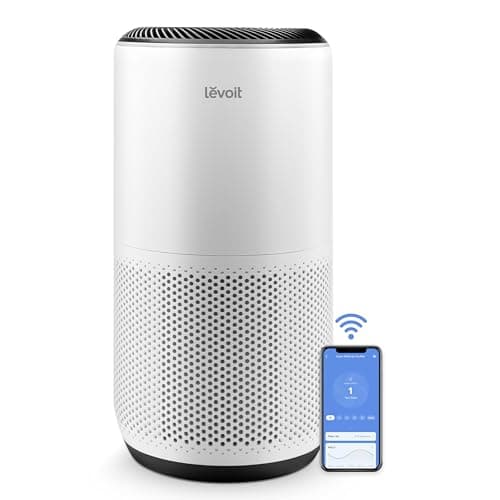
The one to buy if you want a purifier that genuinely covers a living room, and one of the few spec sheets in this bracket that publishes coverage at a useful air-change rate rather than only the flattering one.
#ad Price as of October 18, 2026, from Amazon. Prices change. How we make money.
Published specifications
| Specification | Value | Source |
|---|---|---|
| CADR | 231 CFM | Levoit published specification |
| Coverage | 358 sq ft at 4.8 air changes/hr (1,718 sq ft at 1 ACH) | Levoit published specification |
| Rated power | 38 W | Levoit published specification |
| Noise | 22-52 dB | Levoit published specification |
| Filtration | 3-stage: pre-filter, HEPA, activated carbon | Levoit published specification |
| Dimensions | 10.8 x 10.8 x 20.5 in, 11 lb | Levoit published specification |
What it costs to run
About $25-30 a year in electricity at 12 hours a day, before filters.
38 W / 1000 x 12 hours x 365 days = 166.4 kWh. At 18.34 cents/kWh that is $30.52 a year at rated power - and the unit only draws its full 38 W on the top fan speed, so a mid setting lands nearer $25. Add the replacement filter, which you should price before you buy rather than after.
What is good about it
- Levoit publishes coverage at both 1 ACH and 4.8 ACH, which is unusually straight - most brands quote only the flattering 1 ACH number
- 38 W is low for this CADR, which is what keeps the running cost down
- 22 dB on its lowest setting is quiet enough to sleep beside
- Carbon, pet-allergy and smoke-specific replacement filters are sold for the same body
What is not
- We could not find a published filter replacement interval in Levoit's specification, so we are not quoting one
- The 1,718 sq ft headline is a single air change per hour, which is not a useful rate for allergies
Who should skip this
Skip this if your room is under 200 sq ft. The Core 300S covers that at lower power and lower cost, and the extra CADR buys you nothing in a small bedroom.
How it scored
- Clean air per watt9.0
- Honest coverage claim9.5
- Quiet operation8.5
- Filter economics7.5
Overall 8.6 / 10. This is our editorial score from published specifications and computed running cost. It is not a test result, and it is deliberately not marked up as a rating in this page’s structured data.
Coway Airmega AP-1512HH Mighty
Running continuously in a medium room
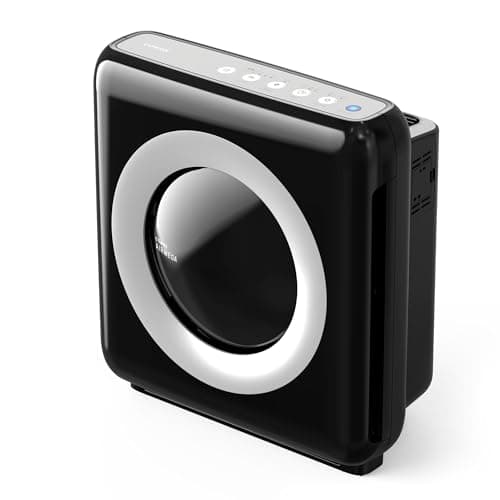
The most efficient unit here at low speed - 3.7 W on speed one - which matters enormously if you leave a purifier running all day and almost not at all if you do not.
#ad Price as of October 18, 2026, from Amazon. Prices change. How we make money.
Published specifications
| Specification | Value | Source |
|---|---|---|
| CADR (smoke) | 233 CFM | Coway published specification |
| CADR (dust) | 246 CFM | Coway published specification |
| CADR (pollen) | 240 CFM | Coway published specification |
| Coverage | 361 sq ft at 4.8 air changes/hr (1,748 sq ft at 1 ACH) | Coway published specification |
| Power draw by speed | 0.3 W standby / 3.7 W speed 1 / 8.7 W speed 2 / 75.3 W speed 3 | Coway published specification |
| Filtration | Pre-filter, odor filter, Green True HEPA, bipolar device | Coway published specification |
What it costs to run
About $6 a year running 24/7 on speed one, or $121 a year running 24/7 on speed three.
Speed 1: 3.7 W / 1000 x 24 x 365 = 32.4 kWh = $5.94 a year. Speed 3: 75.3 W / 1000 x 24 x 365 = 659.6 kWh = $120.97 a year. That twenty-fold spread is the most important number on this page, and it is why we chase per-speed figures instead of accepting a single rated wattage.
What is good about it
- Coway publishes power draw per fan speed, which almost nobody does and which is the only way to compute a real running cost
- 3.7 W on speed one is remarkable - cheaper to run continuously than most nightlights
- Coverage published at 1, 2 and 4.8 air changes per hour, so you can size it honestly
What is not
- 75.3 W on speed three is the highest draw here; how the auto mode behaves decides your bill
- The bipolar device is a stage we would rather do without; check it can be disabled
Who should skip this
Skip this if you only run a purifier for an hour or two at a time. Its whole advantage is low-speed efficiency over long hours, and short bursts on high speed give that straight back.
How it scored
- Clean air per watt9.5
- Honest coverage claim9.5
- Quiet operation8.0
- Filter economics7.5
Overall 8.7 / 10. This is our editorial score from published specifications and computed running cost. It is not a test result, and it is deliberately not marked up as a rating in this page’s structured data.
How we ranked these
We have not tested these units. Nobody here owns one. What we did was compile each manufacturer’s published specifications, check the coverage claims against AHAM’s room-sizing rule, and compute what each one costs to run for a year at the current US average electricity price. Every figure on this page is attributed to whoever published it, and the arithmetic is shown so you can redo it.
How we rank these sets out the full method, including what would change a ranking.
Questions people ask
+−Do air purifiers help with smell?
Only through their activated carbon stage, and only in proportion to how much carbon is in it. A HEPA filter does nothing for smells at all. If a unit’s carbon is a thin impregnated sheet, expect a modest and short-lived effect. A diffuser does the opposite job again - it covers a smell rather than removing it, as we set out in air purifier vs diffuser.
+−How often should I change a carbon filter?
More often than the HEPA, and the honest answer is that most manufacturers do not tell you. The practical test is your nose: when smells that were being handled start coming back, the carbon has saturated even if the filter looks fine. Why quantity decides this, and what the EPA says about gas-phase filters, is in activated carbon explained.
+−What is the difference between HEPA and True HEPA?
“True HEPA” is a marketing term rather than a separate standard, used to distinguish a filter meeting the HEPA specification from “HEPA-type” or “HEPA-like” filters that do not. We cover the distinction at HEPA filters explained.
+−Can I add a carbon filter to a HEPA-only purifier?
Sometimes - several manufacturers sell alternative filters for the same body, and Levoit does this across its Core range. Aftermarket carbon sheets exist too, and they restrict airflow, which reduces the CADR you paid for. Check what the manufacturer offers for your specific unit first, and judge the carbon stage on the criteria in activated carbon explained.
+−Is a washable pre-filter worth having?
Yes, and disproportionately so in a home with pets. Hair and large debris load a HEPA filter quickly, and a pre-filter you can vacuum keeps the expensive stage closer to its rated performance for longer.