Guide
Pet & Litter Box Odors
A purifier treats the air. The litter box is a source, and sources beat filters every time.
By Scooter M. · Published · Last updated
How this page is funded: the buy links below are affiliate links. If you buy through one, we earn a commission at no extra cost to you. It does not change the order of the picks or what we say about them. Full disclosure.
The short answer
Partly. A purifier with a substantial activated carbon stage reduces the ammonia and organic compounds a litter box releases into the air. It does not stop the box producing them, and it does nothing about odor that has settled into carpet or fabric. Carbon saturates, and against a continuous source it saturates fast - which makes this an ongoing filter cost rather than a fix.
What is actually producing the smell
Litter box odor is dominated by ammonia and sulfur-containing compounds released as waste breaks down. These are gases. A HEPA filter, which is a mechanical sieve for particles, is completely irrelevant to them - it is the activated carbon stage doing all the work, and its capacity is finite.
The other component is particulate: litter dust, and dander carried on it. That part a HEPA stage genuinely handles, and it is why a purifier near a litter box often makes a visible difference to dust on nearby surfaces even when the smell is unchanged.
What works better than a purifier
- Scoop more often. Unglamorous, free, and by a wide margin the most effective intervention. Odor production is roughly proportional to how long waste sits.
- More boxes than cats. The standard guidance is one per cat plus one. Fewer boxes means each is used more and each produces more.
- Reconsider the covered box. A hood contains the smell for you and concentrates it for the cat, and it slows drying, which increases production.
- Move the box to a ventilated space. Not a sealed closet or a windowless bathroom. Air movement removes odor at the source.
- Replace the box itself annually. Plastic scratches, and scratches hold residue that no cleaning reaches.
Beyond the litter box
General pet odor is a different problem again, and mostly a surface one. Dander, oils and saliva accumulate in carpet, upholstery and bedding, and they release continuously. A purifier addresses what is airborne at that moment; it cannot reach what is in the sofa.
For the allergen side of living with animals - dander rather than smell - see best air purifiers for pets, where the pre-filter design matters more than the carbon.
When to buy nothing
- You have not tried scooping twice a day for a week. Do that first - it costs nothing and it will tell you how much of the problem is maintenance.
- The box is in a sealed closet. Ventilation is the fix, and it is free.
- The smell is coming from the carpet rather than the air. Cleaning is the answer; filtration will not reach it.
What we would buy for this
Chosen from the same registry as our roundups, on published specifications and computed running cost.
Winix 5500-2
Smoke, cooking smells and pet odors
The one with a genuine granular carbon stage rather than a carbon-dusted sheet, which is why it belongs on a smoke and odor list and why it costs more to run.
#ad We do not hold a current price for this product, so we do not show one. How we make money.
Published specifications
| Specification | Value | Source |
|---|---|---|
| CADR (smoke) | 232 CFM | AHAM-verified figure published by Winix |
| CADR (dust) | 243 CFM | AHAM-verified figure published by Winix |
| CADR (pollen) | 246 CFM | AHAM-verified figure published by Winix |
| Coverage | 360 sq ft | Winix published specification |
| Rated power | 70 W | Winix published specification |
| Filtration | 4-stage: washable pre-filter, activated carbon, True HEPA, PlasmaWave | Winix published specification |
| Certification | Energy Star, CARB certified | Winix published specification |
What it costs to run
About $56 a year in electricity at 12 hours a day, before filters.
70 W / 1000 x 12 hours x 365 days = 306.6 kWh. At 18.34 cents/kWh that is $56.23 a year. Over three years that is roughly $95 more than the Levoit Core 400S at the same hours - typically more than the price gap between the two units at purchase.
What is good about it
- AHAM-verified CADR, which means the figure was measured to the AC-1 standard rather than asserted by marketing
- A real granular carbon filter, which is what actually adsorbs gases and odors
- The washable pre-filter slows down how fast the expensive filter loads up
What is not
- 70 W is roughly double the Levoit Core 400S for a similar CADR, and you pay that difference every year
- PlasmaWave is an ionizing stage; it can be switched off, and we would switch it off
Who should skip this
Skip this if odor is not your problem. Buying for dust and pollen alone means paying a 70 W electricity premium for a carbon stage you will not use.
How it scored
- Clean air per watt6.5
- Honest coverage claim9.0
- Odor and gas removal9.5
- Filter economics8.0
Overall 8.4 / 10. This is our editorial score from published specifications and computed running cost. It is not a test result, and it is deliberately not marked up as a rating in this page’s structured data.
Levoit Vital 200S
Homes with shedding pets
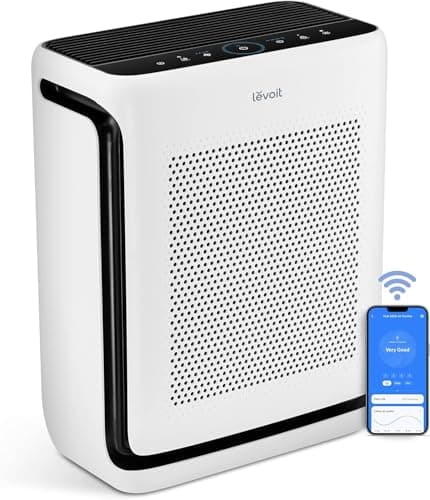
The highest CADR we carry, built around a washable pre-filter and a wide intake - the right shape for a house with animals in it, because hair loads a filter far faster than dust does.
#ad Price as of October 18, 2026, from Amazon. Prices change. How we make money.
Published specifications
| Specification | Value | Source |
|---|---|---|
| CADR | 250 CFM | Levoit published specification |
| Coverage | 388 sq ft at 4.8 air changes/hr (1,862 sq ft at 1 ACH) | Levoit published specification |
| Rated power | 50 W | Levoit published specification |
| Noise | 23-54 dB | Levoit published specification |
| Filtration | 3-stage: washable pre-filter, HEPA, activated carbon. Pet allergy, toxin absorber and smoke remover carbon filters sold for the same body | Levoit published specification |
| Dimensions | 15.6 x 8.5 x 19.8 in | Levoit published specification |
What it costs to run
About $40 a year in electricity at 12 hours a day, before filters.
50 W / 1000 x 12 hours x 365 days = 219 kWh. At 18.34 cents/kWh that is $40.16 a year at rated power, and less on the lower fan speeds. That is roughly $10 a year more than the Core 400S for 19 CFM more CADR - worth it in a house with animals, hard to justify without them.
What is good about it
- 250 CFM is the highest CADR of anything we carry, and it covers about 375 sq ft under AHAM's two-thirds rule
- The washable pre-filter is the part that matters with pets - hair is what kills HEPA filters early
- Levoit publishes coverage at both 1 ACH and 4.8 ACH, and the 388 sq ft figure lines up closely with the AHAM arithmetic
- Four different carbon filters fit the same chassis, so the unit adapts to pets, smoke or off-gassing without replacing the body
What is not
- 50 W for 250 CFM is a worse clean-air-per-watt ratio than the Core 400S manages at 38 W for 231 CFM
- We could not find a published filter replacement interval for this model, so we are not quoting one
- Levoit does not publish power draw per fan speed, so continuous-running cost cannot be computed precisely
- The pet-specific carbon filter is a separate purchase and is not always in stock - check it is available before buying the body for that reason
Who should skip this
Skip this if you have no animals and no odor problem. Without pets you are paying for a wide pre-filter and a carbon option you will not use, and the Core 400S delivers comparable clean air on 12 W less.
How it scored
- Pre-filter design for hair9.0
- Clean air per watt7.0
- Honest coverage claim9.0
- Filter economics8.0
Overall 8.0 / 10. This is our editorial score from published specifications and computed running cost. It is not a test result, and it is deliberately not marked up as a rating in this page’s structured data.
How we ranked these
We have not tested these units. Nobody here owns one. What we did was compile each manufacturer’s published specifications, check the coverage claims against AHAM’s room-sizing rule, and compute what each one costs to run for a year at the current US average electricity price. Every figure on this page is attributed to whoever published it, and the arithmetic is shown so you can redo it.
How we rank these sets out the full method, including what would change a ranking.
Questions people ask
+−Do air purifiers help with litter box smell?
Through their carbon stage, yes, partially. Through HEPA, not at all - the smell is gaseous. Expect a reduction rather than elimination, and expect to replace the carbon filter frequently because it is working against a source that never stops.
+−Do air purifiers help with pet hair?
Airborne dander and fine hair, yes. Hair on the floor and the sofa, no - that is too heavy to be airborne and a purifier never sees it. A washable pre-filter is the feature that matters in a house with pets, because hair is what loads a filter fastest.
+−Where should I put the purifier relative to the box?
Near it, but not blowing across it - you want the unit drawing odor in, not distributing it around the room. A few feet away with clear airflow to the intake is the sensible arrangement. Against a continuous emitter like a litter box, the carbon stage is the part that wears out - see activated carbon explained.
+−Will an ionizer help with pet smell?
Ionizing stages can generate ozone as a by-product, which is why California’s Air Resources Board runs a certification program for indoor air cleaners. Where the stage is optional we would switch it off and rely on the carbon, which has a straightforward mechanism behind it.