Roundup
Best Dehumidifiers With a Pump
The pump is not a performance upgrade. It is the thing that stops a working dehumidifier from being unplugged in week three, which is a different and more important problem.
By Scooter M. · Published · Last updated
How this page is funded: the buy links below are affiliate links. If you buy through one, we earn a commission at no extra cost to you. It does not change the order of the picks or what we say about them. Full disclosure.
The short answer
Buy a pump only if the water has to travel upward or sideways to get out. If there is a floor drain below the unit, a gravity hose does the same job for nothing, silently, with no component that can fail. If there is not - a finished basement, a crawl space, a room where the nearest sink is up a flight of stairs - then the pump is the single feature that decides whether the machine is still running in three months or sitting unplugged because nobody wants to carry a full bucket upstairs again.
What a pump actually does, and what it does not
Every compressor dehumidifier condenses water into a bucket. You then have three ways to get rid of it: empty the bucket by hand, let gravity carry it out through a hose, or have an internal pump push it somewhere higher. A pump adds no capacity, no efficiency and no speed. All three units on this page remove about 50 pints a day whether the pump is switched on or not.
What it changes is whether the appliance survives contact with real life. The commonest failure in this whole category is not a broken machine - it is a working machine that stopped being convenient. A 50-pint unit in a genuinely damp basement fills a 14-to-16-pint bucket in well under a day. That is a trip down the stairs, and then back up carrying two gallons of water, every single day, for the whole damp season.
How we judged these
We have not tested these machines. What we did was cross-reference what is purchasable against the ENERGY STAR certified products database, which publishes the federal test capacity, efficiency and annual energy use for every certified model. Criteria, in order:
- Is the drainage genuinely internal? Some listings describe an external condensate pump sold alongside the unit. We only counted built-in pumps.
- Can the federal data be pinned down? None of these listings prints a model number, which is normal and annoying. We only included brands where every 50-pint pump variant in the database returns the same figures, so the number holds whichever one ships.
- What does it cost to run for a season? Published annual kWh at the US average electricity price, with the arithmetic shown.
- Is it in stock? Checked live, not remembered.
The three, side by side
The striking thing about this table is how little separates them. Every mainstream 50-pint pump unit lands on an IEF of 2.01 and an annual bill within three dollars of the others. The pump is not where the differences are.
| Unit | Capacity (federal test) | IEF | Annual energy | Cost per year |
|---|---|---|---|---|
| Midea 50-Pint with Pump | 49.67-49.95 pt/day | 2.01 | 515-525 kWh | $94-96 |
| Whirlpool WHHD501PAW | 50.00 pt/day | 2.01 | 530 kWh | $97.20 |
| Hisense 50-Pint Lift-Up | 49.89-49.95 pt/day | 2.01 | 526 kWh | $96.47 |
Since running cost is effectively identical, the decision comes down to three things: the purchase price, whether you want the bucket at floor level or waist height, and how much you care that Whirlpool prints a model number you can look up and the other two do not.
The pump is also the part most likely to fail
This deserves saying plainly on a page recommending pumps. A compressor dehumidifier is a sealed refrigeration system with very little to go wrong. A condensate pump is a small motor, an impeller and a float switch, sitting in a permanently wet environment, running several times an hour for months. It is the newest, wettest, most mechanical part of the machine.
Two practical consequences. First, buy a unit where the pump is an option rather than the only drainage path - all three here still support a gravity hose and a bucket, so a dead pump degrades the machine instead of ending it. Second, run the discharge line upward as little as the layout allows. Most of these pumps are specified for lifts measured in a few metres, and the closer you work to that limit the harder the motor runs.
Sizing still matters more than drainage
It is easy to shop for the pump and forget the capacity, and capacity is what determines whether the room ever gets dry. All three units here are 50-pint machines under the federal test, which suits a basement that is genuinely damp rather than one that reads 55% in August. If your space is smaller or only mildly damp, a 20 or 35-pint unit with a gravity hose will hold it for meaningfully less money and less electricity - we set out where the line falls in what size dehumidifier do I need.
It is also worth knowing that none of these is an efficiency standout. At over 45 pints, the ENERGY STAR Most Efficient threshold is 2.20 L/kWh and all three sit at 2.01. That is not a criticism of any of them - it is a fact about the whole capacity class, which we go through in energy efficient dehumidifiers.
What we would actually do
Check for a floor drain. If there is one, buy a gravity-drained 50-pint unit and skip this page entirely - you will save money on the purchase and never think about an impeller.
If there is not one, the Midea is the cheapest route to a built-in pump from a brand whose federal data is consistent across every variant it sells, and that is what we would buy. Pay the premium for the Whirlpool if being able to look up the exact model number matters to you, and the Hisense if you will be lifting the bucket often enough that waist height is worth about eighty dollars. Whichever you choose, keep the gravity hose in the box.
Quick picks
Ranked on published specifications and computed running cost. Tap any row for the full write-up, including who should skip it.
| # | Product | Best for | Score | Price |
|---|---|---|---|---|
| 1 | 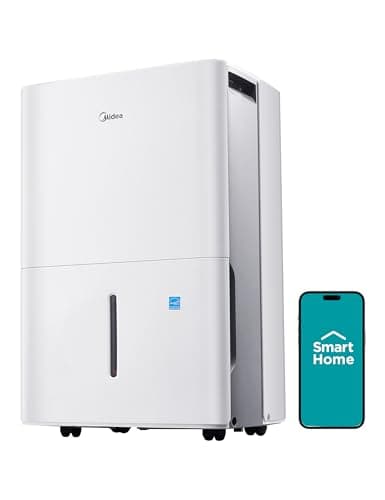 Midea 50-Pint with PumpA basement with no floor drain, where the water has to go upward | Best value pump unit | 8.3 | $243.84 - View on Amazon |
| 2 | 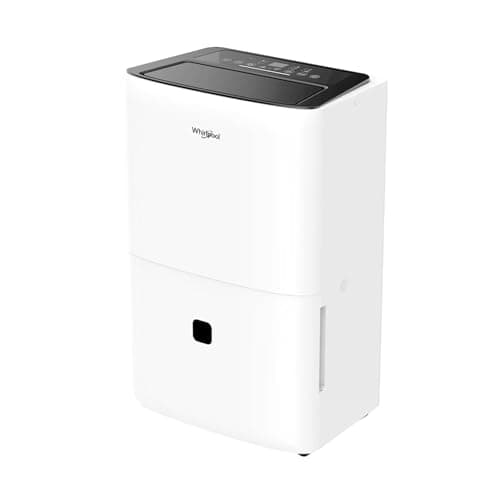 Whirlpool 50-Pint with Pump WHHD501PAWA basement that needs draining as well as drying | Best documented | 8.0 | $329.99 - View on Amazon |
| 3 | 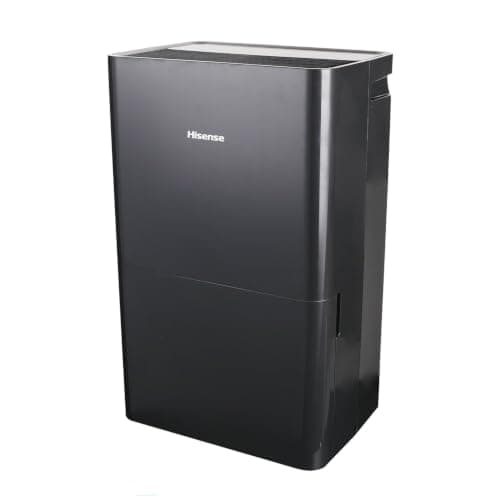 Hisense 50-Pint Lift-Up with Built-In PumpA basement where you want the bucket at waist height instead of floor level | Best bucket ergonomics | 7.9 | $308.95 - View on Amazon |
#1 - Best value pump unit
Midea 50-Pint with Pump
A basement with no floor drain, where the water has to go upward
The cheapest way to get a real internal pump from a brand that publishes its federal test data. The pump is the feature; the dehumidifier underneath it is the same competent 50-pint machine Midea sells without one.
#ad Price as of October 18, 2026, from Amazon. Prices change. How we make money.
Published specifications
| Specification | Value | Source |
|---|---|---|
| Capacity (federal test) | 49.67-49.95 pints per day | ENERGY STAR certified products database |
| Efficiency (IEF) | 2.01 L/kWh | ENERGY STAR certified products database |
| Annual energy use | 515-525 kWh/yr | ENERGY STAR certified products database |
| Coverage | Up to 4,500 sq ft | Midea published specification |
| Drainage | Built-in pump, gravity hose, or bucket | Midea published specification |
| Certification | ENERGY STAR certified (not Most Efficient) | ENERGY STAR certified products database |
What it costs to run
About $94-96 a year on ENERGY STAR's certified annual energy figures.
ENERGY STAR publishes 515 to 525 kWh a year across Midea's 50-pint pump variants. At 18.34 cents/kWh that is $94.45 to $96.29 a year. The spread between variants is under $2, so the uncertainty about which one ships does not change the number you should budget.
What is good about it
- An internal pump at the lowest price of the three pump units we could verify
- Midea publishes federal test data for every 50-pint pump variant it sells, and they are consistent: IEF 2.01 across all twelve
- Same Cube-family controls and drainage options as the model we already rate for basements, so the non-pump behavior is known
- Gravity hose and bucket both still work if you would rather not use the pump
What is not
- The Amazon listing does not print a model number, so we can only tell you the figures are identical across every Midea 50-pint pump variant in the federal database - not which one ships
- Not ENERGY STAR Most Efficient; at over 45 pints the badge needs 2.20 L/kWh and every Midea 50-pint is 2.01
- About $95 a year to run, which is the price of the capacity rather than a fault
- A pump is one more component to fail, and on any brand it is the part that fails first
Who should skip this
Skip this if there is a floor drain lower than the unit. Gravity is free, silent and cannot break; you would be paying for a pump you will never switch on.
How it scored
- Drainage you will keep using9.5
- Published data you can check8.0
- Price for the feature9.0
Overall 8.3 / 10. This is our editorial score from published specifications and computed running cost. It is not a test result, and it is deliberately not marked up as a rating in this page’s structured data.
#2 - Best documented
Whirlpool 50-Pint with Pump WHHD501PAW
A basement that needs draining as well as drying
The basement answer, with the built-in pump that makes a basement unit something you actually keep using. Its efficiency is ordinary for its class and its running cost is the highest here - that is what capacity costs.
#ad Price as of October 18, 2026, from Amazon. Prices change. How we make money.
Published specifications
| Specification | Value | Source |
|---|---|---|
| Capacity (federal test) | 50.00 pints per day | ENERGY STAR certified products database |
| Efficiency (IEF) | 2.01 L/kWh | ENERGY STAR certified products database |
| Annual energy use | 530 kWh/yr | ENERGY STAR certified products database |
| Certification | ENERGY STAR certified (not Most Efficient) | ENERGY STAR certified products database |
| Coverage | Up to 3,000 sq ft | Whirlpool published specification |
| Drainage | Built-in pump, plus a 14.8-pint bucket with auto shut-off | Whirlpool published specification |
| Fan speeds | 3 | Whirlpool published specification |
| Lowest operating temperature | 41F, with auto-defrost | Whirlpool published specification |
What it costs to run
About $97 a year on ENERGY STAR's certified annual energy figure.
ENERGY STAR publishes 530 kWh a year for WHHD501PAW. At 18.34 cents/kWh that is $97.20 a year. It is the most expensive unit here to run and it removes twice the water per day of the 25-pint model, which is the trade being made.
What is good about it
- The pump pushes water up into a sink or basin, which removes the one thing that gets basement dehumidifiers unplugged - carrying a full bucket up the stairs
- 50 pints per day under the federal test, not under a saturation figure invented for a listing
- 2.01 L/kWh matches the best IEF Midea achieves at this capacity
- Model number published, so the certified figures can be checked against the federal database
What is not
- 530 kWh a year is the highest running cost on this page by some distance - roughly double the 25-pint model
- Not Most Efficient: at over 45 pints the badge needs 2.20 L/kWh and this is 2.01
- A pump is another component that can fail, and it is the part most likely to
- Overkill for a single room, where it will short-cycle rather than run efficiently
Who should skip this
Skip this if there is a floor drain below the unit - you are paying for a pump you will never switch on, and a gravity-drained model does the same job for less. Skip it entirely for a bedroom.
How it scored
- Capacity for a real basement9.5
- Drainage you will keep using9.5
- Running cost6.0
Overall 8.0 / 10. This is our editorial score from published specifications and computed running cost. It is not a test result, and it is deliberately not marked up as a rating in this page’s structured data.
#3 - Best bucket ergonomics
Hisense 50-Pint Lift-Up with Built-In Pump
A basement where you want the bucket at waist height instead of floor level
The most consistent federal data of any pump unit we checked - every Hisense 50-pint pump model in the database returns exactly the same efficiency and annual energy. It is also the most expensive of the three.
#ad Price as of October 18, 2026, from Amazon. Prices change. How we make money.
Published specifications
| Specification | Value | Source |
|---|---|---|
| Capacity (federal test) | 49.89-49.95 pints per day | ENERGY STAR certified products database |
| Efficiency (IEF) | 2.01 L/kWh | ENERGY STAR certified products database |
| Annual energy use | 526 kWh/yr | ENERGY STAR certified products database |
| Drainage | Built-in pump, plus a lift-up bucket | Hisense published specification |
| Certification | ENERGY STAR certified (not Most Efficient) | ENERGY STAR certified products database |
What it costs to run
About $96 a year on ENERGY STAR's certified annual energy figure.
ENERGY STAR publishes 526 kWh a year for every Hisense 50-pint pump model. At 18.34 cents/kWh that is $96.47 a year.
What is good about it
- All ten Hisense 50-pint pump models in the federal database return the same 526 kWh/yr and the same 2.01 L/kWh, so the figure holds whichever variant arrives
- The lift-up bucket is a genuine ergonomic difference - you are not bending to floor level with a full container
- Pump, hose and bucket drainage all available on one unit
What is not
- The most expensive of the three verified pump units by a clear margin, for the same 2.01 L/kWh everyone else manages
- 526 kWh/yr is the joint-highest running cost in this group at about $96 a year
- Not ENERGY STAR Most Efficient - no 50-pint unit from any mainstream brand is
- Like every listing in this category, no model number in the Amazon title
Who should skip this
Skip this if price matters more than the bucket height. The Midea does the same job for around eighty dollars less and the federal figures are within 2%.
How it scored
- Drainage you will keep using9.5
- Consistency of published data9.5
- Value for money6.5
Overall 7.9 / 10. This is our editorial score from published specifications and computed running cost. It is not a test result, and it is deliberately not marked up as a rating in this page’s structured data.
How we ranked these
We have not tested these units. Nobody here owns one. What we did was compile each manufacturer’s published specifications, check the coverage claims against AHAM’s room-sizing rule, and compute what each one costs to run for a year at the current US average electricity price. Every figure on this page is attributed to whoever published it, and the arithmetic is shown so you can redo it.
How we rank these sets out the full method, including what would change a ranking.
Questions people ask
+−Do I need a dehumidifier with a pump?
Only if the water cannot leave by gravity. If there is a floor drain, a sink or an outside wall lower than the unit, a plain hose does the job with no motor to fail. A pump earns its price in a finished basement, a crawl space, or anywhere the nearest drain is upstairs - which is precisely where people give up and unplug the machine.
+−How high can a dehumidifier pump push water?
It depends on the unit, and it is the specification to check before you buy, because the height you need is fixed by your building. Work the discharge line with as little vertical lift as the layout allows: the closer you operate to the stated maximum, the harder the pump works and the shorter its life.
+−Does a pump make the dehumidifier less efficient?
Not meaningfully. ENERGY STAR’s certified annual energy figures for 50-pint pump models - 515 to 530 kWh a year across the three brands here - sit in the same range as their gravity-drained siblings. The pump runs in short bursts; the compressor runs for hours.
+−Can I add a pump to a dehumidifier that does not have one?
Yes - external condensate pumps exist and sit under the drain outlet. It is a legitimate route if you already own a good gravity unit. We have not tested any, so we do not recommend a specific one here, and we did not count external pumps as qualifying for this page.
+−Is a 50-pint dehumidifier with a pump overkill for a bedroom?
Almost certainly. A bedroom rarely needs 50 pints a day, and an oversized unit short-cycles rather than running efficiently. A bedroom also usually has somewhere accessible to empty a bucket. Both points push towards a smaller, cheaper, gravity-drained machine.