Comparison
Whole House vs Portable Humidifier
One is an appliance. The other is a building modification. The right answer depends on how many rooms are actually dry.
By Scooter M. · Published · Last updated
How this page is funded: the buy links below are affiliate links. If you buy through one, we earn a commission at no extra cost to you. It does not change the order of the picks or what we say about them. Full disclosure.
The short answer
Buy portable if one or two rooms are dry. Buy whole-house only if you have forced-air heating, the whole house measures below 30%, and you are prepared for an installed appliance plumbed into your water supply. Most people asking this question have a bedroom problem, and a bedroom problem does not justify a furnace modification. A combination purifier-humidifier is the other shortcut people reach for, and it has its own trade-off - air purifier and humidifier combos.
| Whole-house (furnace-mounted) | Portable | |
|---|---|---|
| Coverage | Every room the ductwork reaches - but only when the furnace fan runs | The room it is in, with the door closed |
| Installation | Cut into the ductwork, plumbed to a water line, wired to the furnace control | Take it out of the box |
| Refilling | Never - it is plumbed in | Daily to weekly depending on tank size |
| Maintenance | Annual pad replacement; a leak is a leak inside your house | Daily empty, weekly clean, seasonal wick |
| Control | One humidistat for the whole house | Per-room, which is often what you actually want |
| Requires forced-air heating | Yes | No - works with any heating type |
| Cost shape | Higher up front including installation, low ongoing | Low up front, ongoing wicks |
What each one actually does
A whole-house humidifier sits in the supply ductwork and adds moisture to air the furnace is already moving. That dependency is the catch nobody mentions: it can only humidify while the furnace fan is running. In a well-insulated house on a mild day, the furnace may run very little, and the humidifier does correspondingly little. Some installations run the fan continuously to compensate, which has its own energy cost.
A portable humidifier treats the air in the room it occupies. Its weakness is the mirror image: it will not meaningfully humidify the room next door with the door shut. Its strength is that a bedroom problem is solved in the bedroom, at bedroom cost.
Buy whole-house if...
- You have forced-air heating already - without ducts this is not an option
- You have measured multiple rooms and they are all below 30%
- Refilling tanks is the thing that has defeated you before
- You are comfortable with an appliance plumbed into a water line above your living space
Buy portable if...
- The problem is one or two rooms, which it usually is
- You have radiators, baseboard, or heat pumps without ducted supply
- You rent, or you do not want to modify the building
- You want to be able to stop, move it, or change your mind
Buy neither if...
The house measures 30% or above. Whole-house humidification of a house that is not dry is an expensive route to condensation inside your walls, which is a far worse problem than the one you started with. Measure every room you are worried about before spending anything - a hygrometer in each costs less than an hour of a plumber’s time.
What we would buy for this
Chosen from the same registry as our roundups, on published specifications and computed running cost.
Levoit Superior 6000S
Whole floors, and anyone tired of refilling
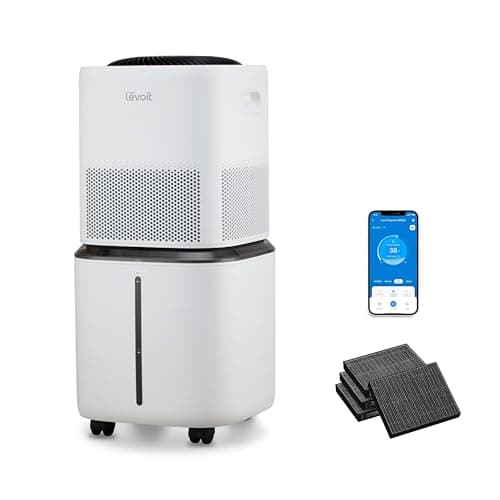
A 6-gallon evaporative unit at 30 W. If you have spent a winter refilling a small humidifier twice a day, this is the one that ends that.
#ad Price as of October 18, 2026, from Amazon. Prices change. How we make money.
Published specifications
| Specification | Value | Source |
|---|---|---|
| Tank capacity | 6 gal / 22.7 L | Levoit published specification |
| Coverage | 3,000 sq ft | Levoit published specification |
| Rated power | 30 W | Levoit published specification |
| Run time | Up to 72 hours on the low fan setting | Levoit published specification |
| Max output | 1,500 mL/h | Levoit published specification |
What it costs to run
About $12-13 a year in electricity across a heating season at 12 hours a day.
30 W / 1000 x 12 hours x 365 days = 131.4 kWh = $24.10 a year run year-round, so roughly $12-13 across a six-month heating season. On any evaporative unit the filters, not the electricity, are the larger cost.
What is good about it
- 30 W against 3,000 sq ft of claimed coverage is the best power-to-output ratio of any humidifier we list
- Evaporative, so it self-limits the same way the Honeywell does - it will not flood a room
- 72 hours per fill means refilling twice a week rather than twice a day
What is not
- It is a large object and it looks like one
- The 3,000 sq ft coverage claim assumes air moves freely between those rooms, which in a real house with doors it does not
Who should skip this
Skip this if you only need one bedroom humidified. A 6-gallon tank in a 120 sq ft room is a lot of standing water to keep clean for no additional benefit.
How it scored
- Cannot over-humidify10.0
- Refill interval9.5
- Power efficiency9.5
- Cleaning burden6.5
Overall 8.6 / 10. This is our editorial score from published specifications and computed running cost. It is not a test result, and it is deliberately not marked up as a rating in this page’s structured data.
Honeywell HCM350 Germ Free Cool Mist
Bedrooms, and anyone who has had white dust from an ultrasonic
An evaporative wick humidifier, which is the type that physically cannot over-humidify a room or spray minerals onto your furniture. That is the whole argument for it, and it is a good one.
#ad We do not hold a current price for this product, so we do not show one. How we make money.
Published specifications
| Specification | Value | Source |
|---|---|---|
| Tank capacity | 1.1 gallon | Honeywell published specification |
| Rated power | 50 W | Honeywell published specification |
| Run time | Up to 24 hours per fill | Honeywell published specification |
| Output | Up to 2 gallons of moisture per 24 hours | Honeywell published specification |
| Filter | Protec HAC-504AW antimicrobial wick filter | Honeywell published specification |
What it costs to run
About $20-22 a year in electricity across a heating season at 12 hours a day, plus wicks.
50 W / 1000 x 12 hours x 365 days = 219 kWh = $40.16 a year if run year-round. Most people run a humidifier for roughly half the year, so call it $20-22, plus replacement wicks at the manufacturer's stated interval.
What is good about it
- Evaporative design self-limits: as a room approaches saturation it simply evaporates less, so it will not push you past 50% RH the way an ultrasonic will
- No white mineral dust, because the minerals stay in the wick instead of being aerosolized into the room
- The tank is designed to come apart and be cleaned, which is the maintenance that actually matters
What is not
- There is a fan, so it is not silent the way an ultrasonic is
- The wick is a consumable - budget for it, and replace it on schedule or it becomes the thing growing mold
Who should skip this
Skip this if you want silence above all else, or if you will not buy replacement wicks. A neglected wick is worse than no humidifier at all.
How it scored
- Cannot over-humidify10.0
- No mineral dust10.0
- Quiet operation6.5
- Cleaning burden7.5
Overall 8.5 / 10. This is our editorial score from published specifications and computed running cost. It is not a test result, and it is deliberately not marked up as a rating in this page’s structured data.
How we ranked these
We have not tested these units. Nobody here owns one. What we did was compile each manufacturer’s published specifications, check the coverage claims against AHAM’s room-sizing rule, and compute what each one costs to run for a year at the current US average electricity price. Every figure on this page is attributed to whoever published it, and the arithmetic is shown so you can redo it.
How we rank these sets out the full method, including what would change a ranking.
Questions people ask
+−Can I fit a whole-house humidifier myself?
It involves cutting into ductwork, tapping a potable water line and wiring into the furnace control. Local codes frequently govern the water connection specifically. We would not treat this as a DIY job and we are not going to pretend otherwise to make the purchase seem easier.
+−Do whole-house humidifiers cause mold in ducts?
They can, if they are set too high or left running when the furnace is not. The mechanism is the same as anywhere else: moisture that does not dry within 24-48 hours, which is the window the EPA gives. A correctly set humidistat and annual maintenance is what prevents it.
+−Which is cheaper to run?
Whole-house, per unit of moisture, because the fan is already running for heating. But it humidifies rooms you may not care about, so total consumption is higher. A 30 W portable in one bedroom is around $12-13 across a heating season - genuinely small.
+−How many portable humidifiers do I need for a whole house?
Roughly one per closed-door space you actually care about. If that number is climbing past three or four, the whole-house option starts to make sense on convenience grounds - assuming you have the ductwork for it. Size each portable unit on output rather than its coverage claim: what size humidifier do I need.