Roundup
Best Budget Dehumidifiers
The cheap end of this category is not a cheaper version of the same machine. It is a different machine, for a different job, and the listings rarely say so.
By Scooter M. · Published · Last updated
How this page is funded: the buy links below are affiliate links. If you buy through one, we earn a commission at no extra cost to you. It does not change the order of the picks or what we say about them. Full disclosure.
The short answer
Below roughly fifty dollars you are not buying a dehumidifier. You are buying a desiccant absorber or a thermoelectric unit - both genuinely useful in a wardrobe, a safe or a caravan, and neither capable of holding a room. The cheapest thing that will actually bring a bedroom under 60% is a small compressor unit, and that is a different price bracket. Knowing which of the three you need is the whole of this page.
The three tiers, and what each one physically does
| Tier | Technology | What it will do | What it will not do |
|---|---|---|---|
| Renewable desiccant | Silica gel, no power while working | Hold dampness down in a safe, a wardrobe or a glovebox; recharge in an outlet and reuse | Anything room-sized. There is no fan and no collection of any volume |
| Thermoelectric mini | Peltier plate, no compressor | Manage a wardrobe, an ensuite corner or an RV, near-silently | Work well in a cold room, or dehumidify an actual bedroom |
| Small compressor | Refrigeration coil, like a fridge | Hold a real bedroom or a small basement under 60% | Come in at pocket-money prices - this is where budget ends |
How we judged these
Budget roundups usually rank on price and pretend the products are comparable. These three are not comparable, so we ranked them on honesty of fit instead: what is the cheapest thing that genuinely does your job? Criteria, in order:
- Does it match the space? A wardrobe, a room and a basement are three different problems and only one tier answers each.
- What does it cost to keep running? A desiccant unit costs nothing but your attention. A compressor unit is a real electrical load for months.
- Will it still be in use in six months? The commonest failure in this category is a unit that gets unplugged because emptying it is tedious.
- Published specifications, not inferred ones. Where a manufacturer does not publish a figure we say so rather than estimating.
Where the cheap tiers genuinely win
This is not a page arguing you should spend more. There are jobs where the expensive machine is the wrong answer and the cheap one is exactly right:
- A gun safe or a document box. A renewable desiccant unit needs no power, no drainage and no socket inside the safe. A compressor unit cannot even be fitted.
- A caravan or boat left standing. No power available for months at a time - desiccant is the only thing that works.
- A wardrobe against a cold external wall. Thermoelectric, silent, and sized to the volume.
- An ensuite that stays damp after showers. Fix the extractor first, then a mini unit is a reasonable supplement.
The trap at the bottom of the listings
Cheap units are frequently sold with a coverage claim in square feet that belongs to a compressor machine - a mini rated for "1,500 sq ft" is describing something other than its ability to hold that space below 60%. The physical tell is the collection tank: a unit with a 17-ounce reservoir is not removing pints per day, whatever the listing says.
The related trap is temperature. Thermoelectric units lose effectiveness sharply as a room gets colder, and an unheated basement in autumn is precisely the situation people buy them for. That is the one job they are worst at.
When to buy nothing at all
If liquid water is arriving - standing water, efflorescence on masonry, damp returning within a day of drying - then no tier here helps and the cheapest unit is as useless as the most expensive one. That is a drainage repair. And if the reading is already inside 30-50%, the moisture problem you are chasing is a surface temperature or ventilation problem instead.
What we would actually do
Decide the volume before the budget. For a safe or a caravan, buy the desiccant unit and recharge it - it is the cheapest genuinely useful purchase in this category. For a wardrobe, the thermoelectric mini. For an actual bedroom, accept that budget means a small compressor unit rather than a mini, buy about 20 pints of capacity, and set it to 50%. Buying a mini for a room is the one choice here that wastes the money entirely.
Quick picks
Ranked on published specifications and computed running cost. Tap any row for the full write-up, including who should skip it.
| # | Product | Best for | Score | Price |
|---|---|---|---|---|
| 1 | 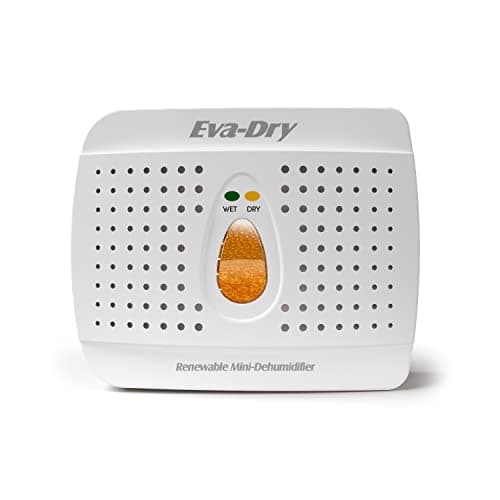 Eva-Dry E-333 RenewableSafes, sealed closets, boats | Cheapest useful purchase | 7.2 | $14.97 - View on Amazon |
| 2 | 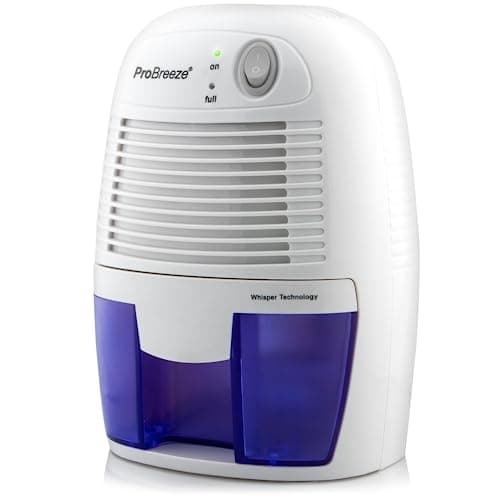 Pro Breeze Mini DehumidifierClosets, gun safes, small bathrooms, RVs | Best small-space unit | 7.6 | $43.99 - View on Amazon |
| 3 | 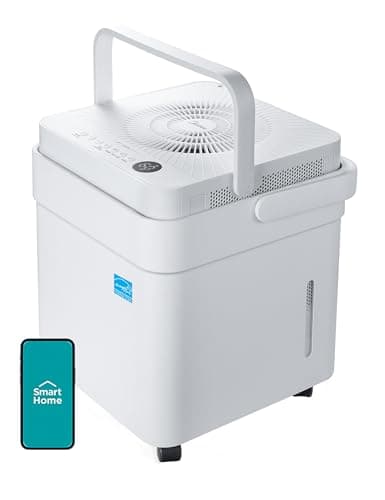 Midea Cube 20-PintBedrooms and single rooms up to about 1,500 sq ft | Cheapest that holds a room | 8.3 | $199.00 - View on Amazon |
#1 - Cheapest useful purchase
Eva-Dry E-333 Renewable
Safes, sealed closets, boats
No power, no tank, no fan - a silica desiccant you plug in for a few hours to dry out and then put back. For a gun safe or a sealed closet this is often the honest answer.
#ad Price as of October 18, 2026, from Amazon. Prices change. How we make money.
Published specifications
| Specification | Value | Source |
|---|---|---|
| Type | Renewable silica gel desiccant, recharged by plugging in | Eva-Dry published specification |
What is good about it
- Zero running cost while it is working - it draws power only during the recharge cycle
- Nothing to empty, nothing to break, and no standing water to grow anything in
What is not
- Capacity is tiny; this handles a sealed cubic foot or two, not a room
- You have to remember to recharge it, and nothing reminds you
Who should skip this
Skip this for anything with a door that opens regularly. Desiccant works in sealed spaces; in a closet you open daily it never gets ahead of the moisture coming in.
How it scored
- Running cost10.0
- Fit for sealed spaces9.0
- Capacity2.0
- Maintenance burden6.0
Overall 7.2 / 10. This is our editorial score from published specifications and computed running cost. It is not a test result, and it is deliberately not marked up as a rating in this page’s structured data.
#2 - Best small-space unit
Pro Breeze Mini Dehumidifier
Closets, gun safes, small bathrooms, RVs
A thermoelectric unit, not a compressor. That means it is quiet and small and it will not touch a basement - but in a closet or an RV it is exactly right.
#ad Price as of October 18, 2026, from Amazon. Prices change. How we make money.
Published specifications
| Specification | Value | Source |
|---|---|---|
| Type | Thermoelectric (Peltier), not a compressor | Pro Breeze published specification |
What is good about it
- Near-silent, because there is no compressor to cycle
- Small enough to sit inside a wardrobe or under a sink
What is not
- Thermoelectric units lose effectiveness sharply in cold rooms, which is exactly what an unheated basement is
- Capacity is a fraction of any compressor unit - this manages dampness, it does not dehumidify a room
Who should skip this
Skip this for any room-sized job. If you are searching for a basement dehumidifier, this is not it, no matter how many roundups file it under that heading.
How it scored
- Fit for small enclosed spaces9.0
- Quiet operation9.5
- Capacity3.5
- Cold-room performance3.0
Overall 7.6 / 10. This is our editorial score from published specifications and computed running cost. It is not a test result, and it is deliberately not marked up as a rating in this page’s structured data.
#3 - Cheapest that holds a room
Midea Cube 20-Pint
Bedrooms and single rooms up to about 1,500 sq ft
The smaller Cube, and the right size for a bedroom. Most people buying a bedroom dehumidifier buy far too much capacity and then run it on a setting that never cycles down.
#ad Price as of October 18, 2026, from Amazon. Prices change. How we make money.
Published specifications
| Specification | Value | Source |
|---|---|---|
| Capacity | 20 pints per day | Midea published specification |
| Capacity (federal test) | 20.16 pints per day | ENERGY STAR certified products database |
| Coverage | Up to 1,500 sq ft | Midea published specification |
| Efficiency (IEF) | 1.70 L/kWh | ENERGY STAR certified products database |
| Annual energy use | 249 kWh/yr | ENERGY STAR certified products database |
| Bucket fill level | Adjustable, up to 3 gallons | Midea user manual |
| Fan speeds | 2 (High, Low) | Midea user manual |
| Certification | ENERGY STAR certified | ENERGY STAR certified products database |
What it costs to run
About $46 a year on ENERGY STAR's certified annual energy figure.
ENERGY STAR publishes 249 kWh a year for this model. At 18.34 cents/kWh that is $45.67 a year. That figure is calculated on the program's standardized test basis, not measured in your room: a damp space where it cycles constantly will use more, a mildly damp one on a 50% setpoint less.
What is good about it
- 20 pints is the capacity a single closed bedroom actually calls for, so the compressor cycles off instead of running flat out
- The nested/extended body stores smaller than it runs, which matters for a machine you only want out for half the year
- ENERGY STAR certified, with the lowest annual energy figure of the three Cube sizes
What is not
- The least efficient Cube per unit of water removed: an IEF of 1.70 L/kWh against 2.01 for the 35 and 50-pint models
- Midea does not publish a rated wattage or a noise figure for this model, so we quote ENERGY STAR's certified annual energy figure instead of a wattage
- 1,500 sq ft is a coverage ceiling measured under favorable conditions, not a promise about a damp bedroom
- A compressor unit still makes compressor noise; if silence matters more than capacity, this is the wrong category
Who should skip this
Skip this if the room is a closet, a safe or a caravan - that is a job for a desiccant or thermoelectric unit, not a compressor. And skip it for a genuinely wet basement, where 20 pints will run continuously and never win.
How it scored
- Right-sized for one room9.5
- Efficiency per liter removed7.0
- Storage and handling9.0
Overall 8.3 / 10. This is our editorial score from published specifications and computed running cost. It is not a test result, and it is deliberately not marked up as a rating in this page’s structured data.
How we ranked these
We have not tested these units. Nobody here owns one. What we did was compile each manufacturer’s published specifications, check the coverage claims against AHAM’s room-sizing rule, and compute what each one costs to run for a year at the current US average electricity price. Every figure on this page is attributed to whoever published it, and the arithmetic is shown so you can redo it.
How we rank these sets out the full method, including what would change a ranking.
Questions people ask
+−What is the cheapest dehumidifier that actually works?
It depends entirely on the space. For a safe or a wardrobe, a renewable desiccant unit works and costs very little. For a real bedroom, the cheapest thing that holds the room is a small compressor unit of around 20 pints - minis will not do it.
+−Do cheap mini dehumidifiers work?
In an enclosed space, yes. In a room, no. They are thermoelectric or desiccant rather than compressor units, and they also lose effectiveness as the room gets colder - which is usually when you want them.
+−Why do cheap dehumidifiers claim big coverage areas?
Because coverage claims are not held to a capacity standard the way pints per day are. The physical tell is the tank: a 17-ounce reservoir is not removing pints per day whatever the listing says.
+−Is a desiccant absorber better than a mini dehumidifier?
For a space with no power - a safe, a stored caravan - yes, because it needs none. For a wardrobe with a socket nearby, a thermoelectric mini moves more moisture. They are both small-space devices.
+−Should I buy two cheap units instead of one good one?
Not for a single room. Two minis in one bedroom still do not add up to a compressor unit, because the limit is the technology rather than the count.