Roundup
Energy Efficient Dehumidifiers
Every dehumidifier on Amazon says ENERGY STAR. One in five certified models is actually efficient, the federal database says which, and almost nobody looks.
By Scooter M. · Published · Last updated
How this page is funded: the buy links below are affiliate links. If you buy through one, we earn a commission at no extra cost to you. It does not change the order of the picks or what we say about them. Full disclosure.
The short answer
ENERGY STAR certification tells you almost nothing about whether a dehumidifier is efficient. There are 550 certified models. Only 113 of the 526 portable ones - 21% - meet the stricter ENERGY STAR Most Efficient criteria, and every listing on the market uses the same four words in its title. The number that separates them is published free, for every model, in a federal database: IEF, in liters of water removed per kilowatt-hour. This page is what that database says when you read all of it.
The one specification that matters, and where to find it
A dehumidifier is a refrigeration machine that runs for months at a time. Its purchase price is a one-off; its electricity bill is not. The specification that governs that bill is the Integrated Energy Factor (IEF) - liters of water removed per kilowatt-hour of electricity consumed. Higher is better. A unit at 2.01 L/kWh removes about 18% more water per unit of electricity than one at 1.70.
Manufacturers rarely put IEF on the box and Amazon listings essentially never do. But every certified model is in the ENERGY STAR certified products database with its IEF, its federal-test capacity and its annual energy use in kWh - and you can look up any model number in it before you buy. That database is the entire basis of this page. We pulled all 550 rows.
The badge is graded on a curve, and nobody explains that
Here is the trap. A 25-pint unit with an IEF of 1.85 carries the Most Efficient badge. A 32-pint unit with an IEF of 2.15 - measurably better at converting electricity into dry air - does not. That is not an error. The Most Efficient thresholds are set within capacity class, so IEF numbers are only comparable between units of similar size. We worked the thresholds out from the certified data itself:
| Capacity class | Models that are Most Efficient | Lowest IEF that earned it | Highest IEF that did not |
|---|---|---|---|
| 25 pints and under | 104 | 1.85 | 1.84 |
| 26 to 35 pints | 0 of 38 | none | 2.15 |
| 36 to 45 pints | 3 | 2.21 | 2.08 |
| Over 45 pints | 6 | 2.20 | 2.10 |
Two things fall out of that table. First, in the 25-pint class the line is razor thin: 1.85 earns the badge and 1.84 misses it, a difference of well under one percent that decides whether a sticker goes on the box.
Second, and more usefully: there is no ENERGY STAR Most Efficient dehumidifier in the 26-to-35 pint class at all. Thirty-eight certified models, the best of them at 2.15 L/kWh, and not one qualifies. If you have been searching for an efficient 30-pint or 32-pint dehumidifier and coming up empty, that is why. It is not you.
How we picked these
We have not tested these machines. We do not own them and we have no lab. What we did instead was cross-reference the federal certification data against what is actually purchasable, and the criteria are, in order:
- Is the certified figure real and attributable? Every IEF and kWh figure here comes from the ENERGY STAR certified products database against a specific model number. Nothing is inferred from a nameplate wattage.
- Can we prove the listing is that model? This eliminated more candidates than anything else. If the retail listing does not state a model number we cannot match, the certificate is unverifiable and the product is not recommended.
- Is it purchasable right now? Checked against live listing data, not memory.
- Does the efficiency actually matter at that capacity? An efficient machine too small for the room runs continuously and never reaches setpoint, which costs more than an ordinary machine that cycles.
What the four actually cost to run
Annual energy use below is ENERGY STAR’s published figure for that exact model number. The dollar column is that figure multiplied by 18.34 cents per kWh, the US average residential electricity price. The arithmetic is deliberately visible so you can redo it with your own rate.
| Model | Capacity (federal test) | IEF | Annual energy | Cost per year | Most Efficient |
|---|---|---|---|---|---|
| Whirlpool WHAD251AW | 24.84 pt/day | 1.85 | 283 kWh | $51.90 | Yes |
| Whirlpool WHAD321AW | 32.46 pt/day | 2.01 | 343 kWh | $62.91 | No |
| Whirlpool WHHD501PAW | 50.00 pt/day | 2.01 | 530 kWh | $97.20 | No |
| Midea Cube 20 | 20.16 pt/day | 1.70 | 249 kWh | $45.67 | No |
| Midea Cube 35 | 35.82 pt/day | 2.01 | 378 kWh | $69.33 | No |
| Midea Cube 50 | 49.67 pt/day | 2.01 | 515 kWh | $94.45 | No |
Note what that table does not show: a neat relationship between the badge and the bill. The cheapest unit to run is the Midea Cube 20, at about $46 a year - and it has the worst IEF of anything listed. It is cheap to run because it is small, not because it is efficient. The only Most Efficient unit here costs $6 a year more.
Efficiency and a low bill are two different questions
This is the distinction that makes most “energy efficient dehumidifier” advice useless. There are two questions and they have different answers:
- “Which unit uses the least electricity?” Almost always the smallest one that can hold your space. Capacity drives consumption far harder than efficiency does - the 50-pint Whirlpool costs roughly twice as much a year to run as the 25-pint, and they share a brand and a control panel.
- “Which unit wastes the least electricity?” That is IEF, and that is what the badge is about.
Buying the smallest unit is the right instinct only up to the point where it can keep up. Below that point it runs continuously, never reaches setpoint and quietly costs more than the larger machine that cycles off. Getting that line right is the whole of what size dehumidifier do I need, and it matters more to your bill than any badge on this page.
The efficiency list is full of brands that do not exist
Sort the certified portable models by IEF and the top of the table is almost entirely names you have never heard of. That is worth understanding before you buy one, because the federal data explains exactly what is going on.
Twelve portable model numbers in the database are certified under more than one brand name. The most striking is model AS-CSJ72XK-5WT-OL - 25.00 pints/day, IEF 2.04, 257 kWh a year, Most Efficient. It appears in the database thirteen times, under thirteen different brand names: CONCETTA, DUMOS, Gianna, IULULU, JIOABL, KMFurnila, NEWBULIG, OLIXIS, SMUG, SUMELL, Sweetcrispy, ZUNMOS and edx. All thirteen list the same ENERGY STAR partner: Zhejiang Hengjian Home Furnishing Co., Ltd. The same thirteen brands also share two further model numbers between them.
This is not fraud and the certification is real - it is one genuinely efficient machine sold under thirteen storefronts. But it does mean that comparing four of those “different” dehumidifiers on Amazon is comparing one dehumidifier four times, and that whichever brand you pick, the after-sales relationship is with a storefront rather than a manufacturer. We do not recommend them here because their listings carry no model number, so there is no way to confirm the unit that arrives is the certified one.
The pint number on the listing is not the pint number on the certificate
In 2019 the Department of Energy changed how portable dehumidifiers are tested. Under the current federal test method they are rated at 65°F rather than 80°F, to better reflect a basement. There is less moisture in cooler air, so rated capacities fell across the board - ENERGY STAR says so directly.
Retail listings did not follow. Waykar tops the Most Efficient table with several entries, and the highest capacity Waykar has certified with ENERGY STAR is 50.00 pints per day. Its Amazon listings advertise 80-pint and 150-pint units. We could not find, on the listings themselves, what test conditions produce the larger figure, so we are not going to guess at one - but a “150 pint” dehumidifier and a federally-rated 50-pint dehumidifier can be the same machine described two ways.
The practical consequence: when you compare capacities, compare federal-test figures or compare listing figures, and never mix the two. Every capacity in the table above is the federal one.
Where the Midea Cube lands
The Midea Cube is the unit this site has recommended most often and the one most recommended across the category generally. It is worth being straight about where it sits here: none of Midea’s 47 certified rows is Most Efficient. Its IEF range is 1.70 to 2.08, and the 35 and 50-pint models at 2.01 are respectable without being remarkable.
That does not make it a bad buy, and we have not changed our view of it in the Cube review. It is bought for its adjustable bucket, its nesting body and its drainage, and those are real advantages that no efficiency figure captures. But if your reason for buying is specifically the electricity bill, the Cube is not the answer to that question and its listing implies otherwise by saying “Energy star” in the title.
What we would actually do
Buy a hygrometer first. If the room reads inside 30-50%, every unit on this page is solving a problem you do not have, and the cheapest possible running cost is zero. We make that case at length in is a dehumidifier worth it.
If it genuinely is damp: size the unit to the space first and treat efficiency as the tie-breaker between two units that both fit, never as the reason to buy a smaller one. For a single room, the WHAD251AW is the only Most Efficient portable we could tie to a purchasable listing, and it was down to one unit in stock when we checked - if it is gone, the 32-pint model is a better machine than its missing badge suggests. For a basement, capacity and a pump will save you more than any IEF difference, because the dehumidifier that gets unplugged after three weeks of carrying buckets upstairs has an efficiency of zero.
And whatever you are looking at, search its model number in the ENERGY STAR certified products database before you buy. It takes about thirty seconds and it is the only place the real number is written down.
Quick picks
Ranked on published specifications and computed running cost. Tap any row for the full write-up, including who should skip it.
| # | Product | Best for | Score | Price |
|---|---|---|---|---|
| 1 | 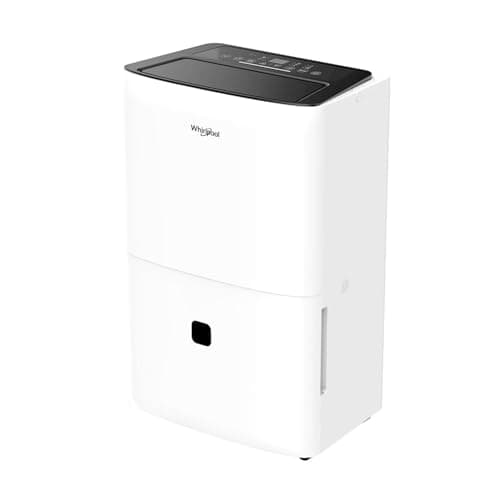 Whirlpool 25-Pint WHAD251AWA single damp room where the electricity bill is the deciding factor | Only verified Most Efficient pick | 8.4 | $229.99 - View on Amazon |
| 2 | 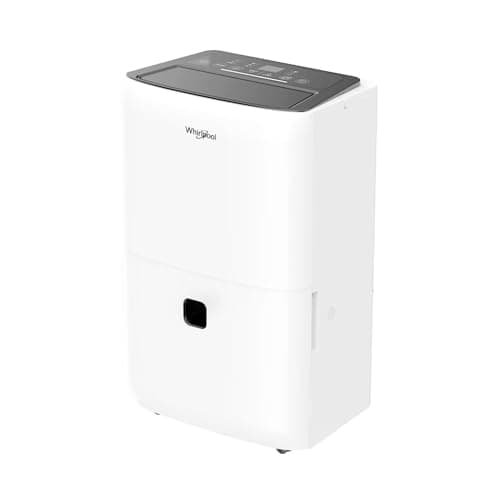 Whirlpool 32-Pint WHAD321AWA large room or a small, mildly damp basement | Best mid-size | 8.1 | $249.99 - View on Amazon |
| 3 | 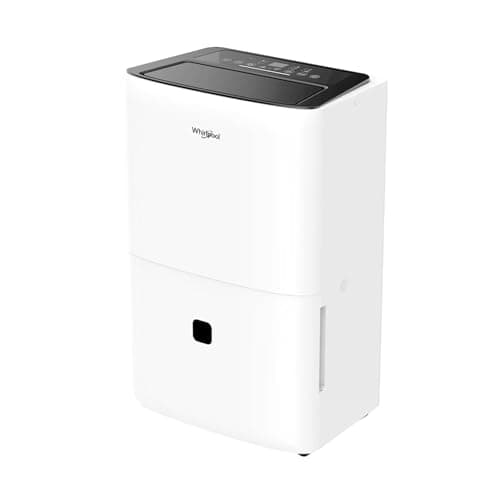 Whirlpool 50-Pint with Pump WHHD501PAWA basement that needs draining as well as drying | Best for a basement | 8.0 | $329.99 - View on Amazon |
| 4 | 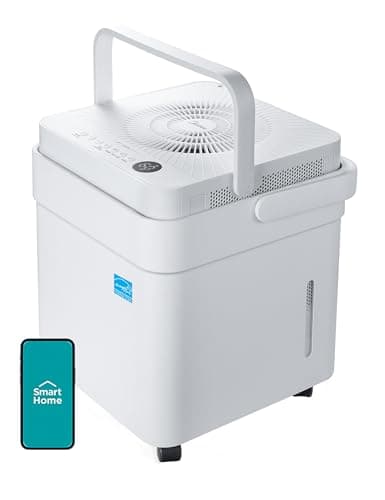 Midea Cube 20-PintBedrooms and single rooms up to about 1,500 sq ft | Lowest annual bill | 8.3 | $199.00 - View on Amazon |
#1 - Only verified Most Efficient pick
Whirlpool 25-Pint WHAD251AW
A single damp room where the electricity bill is the deciding factor
The only ENERGY STAR Most Efficient portable dehumidifier we could tie to a specific, purchasable listing. Everything else at the top of the federal efficiency table is sold under a brand name that does not appear on any certificate.
#ad Price as of October 18, 2026, from Amazon. Prices change. How we make money.
Published specifications
| Specification | Value | Source |
|---|---|---|
| Capacity (federal test) | 24.84 pints per day | ENERGY STAR certified products database |
| Efficiency (IEF) | 1.85 L/kWh | ENERGY STAR certified products database |
| Annual energy use | 283 kWh/yr | ENERGY STAR certified products database |
| Certification | ENERGY STAR Most Efficient | ENERGY STAR certified products database |
| Humidistat range | 35-80% | Whirlpool published specification |
| Fan speeds | 3 | Whirlpool published specification |
| Lowest operating temperature | 41F, with auto-defrost | Whirlpool published specification |
| Noise | As low as 45 dBA | Whirlpool published specification |
What it costs to run
About $52 a year on ENERGY STAR's certified annual energy figure.
ENERGY STAR publishes 283 kWh a year for WHAD251AW. At 18.34 cents/kWh that is $51.90 a year. That is the program's standardized test basis, not your room: a continuously damp space will cost more and a mildly damp one on a 50% setpoint less.
What is good about it
- Carries the ENERGY STAR Most Efficient designation, which only 113 of 526 certified portable models do
- At 1.85 L/kWh it clears the Most Efficient line for its capacity class by the narrowest possible margin - the highest IEF that failed in the same class is 1.84
- 283 kWh a year is a published federal figure for this exact model number, not a wattage we inferred from a nameplate
- The model number is printed in the retail listings, so the certificate can actually be checked before you buy
What is not
- Stock was down to a single unit at our last check, so this is the pick most likely to be unavailable by the time you read it
- 25 pints is a one-room capacity. It is the wrong machine for a wet basement and will run continuously without winning
- Retailers contradict each other on coverage - Best Buy lists 1,500 sq ft and Lowe's 1,501-3,000 sq ft for the same model number - so we do not quote a coverage figure at all
- No pump. Continuous drainage needs a hose and a floor drain below the unit
- More expensive than a higher-capacity Midea Cube that removes more water per hour, just less efficiently
Who should skip this
Skip this if the space is a basement, a crawl space or anything above a single room - capacity beats efficiency the moment the unit can no longer keep up, and a machine that never reaches setpoint is not saving anyone money. Also skip it if you need a pump.
How it scored
- Measured efficiency for its class9.5
- Certification you can verify9.5
- Availability5.0
Overall 8.4 / 10. This is our editorial score from published specifications and computed running cost. It is not a test result, and it is deliberately not marked up as a rating in this page’s structured data.
#2 - Best mid-size
Whirlpool 32-Pint WHAD321AW
A large room or a small, mildly damp basement
An IEF of 2.01 that earns no badge, because nothing in the 26-35 pint class does. If you need this much capacity, this is close to the ceiling of what the federal database says is available.
#ad Price as of October 18, 2026, from Amazon. Prices change. How we make money.
Published specifications
| Specification | Value | Source |
|---|---|---|
| Capacity (federal test) | 32.46 pints per day | ENERGY STAR certified products database |
| Efficiency (IEF) | 2.01 L/kWh | ENERGY STAR certified products database |
| Annual energy use | 343 kWh/yr | ENERGY STAR certified products database |
| Certification | ENERGY STAR certified (not Most Efficient - no model in its class is) | ENERGY STAR certified products database |
| Humidistat range | 35-80% | Whirlpool published specification |
| Fan speeds | 3 | Whirlpool published specification |
| Lowest operating temperature | 41F, with auto-defrost | Whirlpool published specification |
| Noise | As low as 45 dBA | Whirlpool published specification |
What it costs to run
About $63 a year on ENERGY STAR's certified annual energy figure.
ENERGY STAR publishes 343 kWh a year for WHAD321AW. At 18.34 cents/kWh that is $62.91 a year - about $11 a year more than the 25-pint model, for a unit that removes roughly a third more water per day.
What is good about it
- 2.01 L/kWh is better than either 25-pint Whirlpool and better than every Midea Cube under 35 pints
- The 26-35 pint class has no Most Efficient model at all, so the badge is not a thing this unit could have won
- 343 kWh a year is only 60 kWh more than the 25-pint model for 31% more water removed per day
- Model number published in retail listings, so the certificate is checkable
What is not
- No Most Efficient badge, which on a shelf next to a 25-pint unit that has one reads as the worse machine - it is not
- IEF cannot be compared across capacity classes, and nothing on the box explains that
- No pump, so continuous drainage needs gravity and a floor drain
- 32 pints is an awkward size: too much for a bedroom, not enough for a genuinely wet basement
Who should skip this
Skip this if you are buying on badge alone - you will be talked out of it by a smaller unit with a sticker. Also skip it if the space is properly wet rather than damp, where a 50-pint unit with a pump is the honest answer.
How it scored
- Measured efficiency for its class9.0
- Capacity per dollar of running cost8.5
- Clarity of what you are buying7.0
Overall 8.1 / 10. This is our editorial score from published specifications and computed running cost. It is not a test result, and it is deliberately not marked up as a rating in this page’s structured data.
#3 - Best for a basement
Whirlpool 50-Pint with Pump WHHD501PAW
A basement that needs draining as well as drying
The basement answer, with the built-in pump that makes a basement unit something you actually keep using. Its efficiency is ordinary for its class and its running cost is the highest here - that is what capacity costs.
#ad Price as of October 18, 2026, from Amazon. Prices change. How we make money.
Published specifications
| Specification | Value | Source |
|---|---|---|
| Capacity (federal test) | 50.00 pints per day | ENERGY STAR certified products database |
| Efficiency (IEF) | 2.01 L/kWh | ENERGY STAR certified products database |
| Annual energy use | 530 kWh/yr | ENERGY STAR certified products database |
| Certification | ENERGY STAR certified (not Most Efficient) | ENERGY STAR certified products database |
| Coverage | Up to 3,000 sq ft | Whirlpool published specification |
| Drainage | Built-in pump, plus a 14.8-pint bucket with auto shut-off | Whirlpool published specification |
| Fan speeds | 3 | Whirlpool published specification |
| Lowest operating temperature | 41F, with auto-defrost | Whirlpool published specification |
What it costs to run
About $97 a year on ENERGY STAR's certified annual energy figure.
ENERGY STAR publishes 530 kWh a year for WHHD501PAW. At 18.34 cents/kWh that is $97.20 a year. It is the most expensive unit here to run and it removes twice the water per day of the 25-pint model, which is the trade being made.
What is good about it
- The pump pushes water up into a sink or basin, which removes the one thing that gets basement dehumidifiers unplugged - carrying a full bucket up the stairs
- 50 pints per day under the federal test, not under a saturation figure invented for a listing
- 2.01 L/kWh matches the best IEF Midea achieves at this capacity
- Model number published, so the certified figures can be checked against the federal database
What is not
- 530 kWh a year is the highest running cost on this page by some distance - roughly double the 25-pint model
- Not Most Efficient: at over 45 pints the badge needs 2.20 L/kWh and this is 2.01
- A pump is another component that can fail, and it is the part most likely to
- Overkill for a single room, where it will short-cycle rather than run efficiently
Who should skip this
Skip this if there is a floor drain below the unit - you are paying for a pump you will never switch on, and a gravity-drained model does the same job for less. Skip it entirely for a bedroom.
How it scored
- Capacity for a real basement9.5
- Drainage you will keep using9.5
- Running cost6.0
Overall 8.0 / 10. This is our editorial score from published specifications and computed running cost. It is not a test result, and it is deliberately not marked up as a rating in this page’s structured data.
#4 - Lowest annual bill
Midea Cube 20-Pint
Bedrooms and single rooms up to about 1,500 sq ft
The smaller Cube, and the right size for a bedroom. Most people buying a bedroom dehumidifier buy far too much capacity and then run it on a setting that never cycles down.
#ad Price as of October 18, 2026, from Amazon. Prices change. How we make money.
Published specifications
| Specification | Value | Source |
|---|---|---|
| Capacity | 20 pints per day | Midea published specification |
| Capacity (federal test) | 20.16 pints per day | ENERGY STAR certified products database |
| Coverage | Up to 1,500 sq ft | Midea published specification |
| Efficiency (IEF) | 1.70 L/kWh | ENERGY STAR certified products database |
| Annual energy use | 249 kWh/yr | ENERGY STAR certified products database |
| Bucket fill level | Adjustable, up to 3 gallons | Midea user manual |
| Fan speeds | 2 (High, Low) | Midea user manual |
| Certification | ENERGY STAR certified | ENERGY STAR certified products database |
What it costs to run
About $46 a year on ENERGY STAR's certified annual energy figure.
ENERGY STAR publishes 249 kWh a year for this model. At 18.34 cents/kWh that is $45.67 a year. That figure is calculated on the program's standardized test basis, not measured in your room: a damp space where it cycles constantly will use more, a mildly damp one on a 50% setpoint less.
What is good about it
- 20 pints is the capacity a single closed bedroom actually calls for, so the compressor cycles off instead of running flat out
- The nested/extended body stores smaller than it runs, which matters for a machine you only want out for half the year
- ENERGY STAR certified, with the lowest annual energy figure of the three Cube sizes
What is not
- The least efficient Cube per unit of water removed: an IEF of 1.70 L/kWh against 2.01 for the 35 and 50-pint models
- Midea does not publish a rated wattage or a noise figure for this model, so we quote ENERGY STAR's certified annual energy figure instead of a wattage
- 1,500 sq ft is a coverage ceiling measured under favorable conditions, not a promise about a damp bedroom
- A compressor unit still makes compressor noise; if silence matters more than capacity, this is the wrong category
Who should skip this
Skip this if the room is a closet, a safe or a caravan - that is a job for a desiccant or thermoelectric unit, not a compressor. And skip it for a genuinely wet basement, where 20 pints will run continuously and never win.
How it scored
- Right-sized for one room9.5
- Efficiency per liter removed7.0
- Storage and handling9.0
Overall 8.3 / 10. This is our editorial score from published specifications and computed running cost. It is not a test result, and it is deliberately not marked up as a rating in this page’s structured data.
How we ranked these
We have not tested these units. Nobody here owns one. What we did was compile each manufacturer’s published specifications, check the coverage claims against AHAM’s room-sizing rule, and compute what each one costs to run for a year at the current US average electricity price. Every figure on this page is attributed to whoever published it, and the arithmetic is shown so you can redo it.
How we rank these sets out the full method, including what would change a ranking.
Questions people ask
+−Do dehumidifiers use a lot of electricity?
More than most people expect, and the range is wide. ENERGY STAR’s published annual figures for the models on this page run from 249 kWh a year for a 20-pint unit to 530 kWh for a 50-pint with a pump - about $46 to $97 a year at 18.34 cents/kWh. Capacity drives that figure far harder than efficiency does. It is a genuine year-round appliance load, comparable to a second refrigerator at the larger sizes.
+−What is a good IEF for a dehumidifier?
It depends entirely on capacity, which is the part nobody mentions. In the certified database, 1.85 L/kWh is enough to earn the Most Efficient designation at 25 pints and under, while at over 45 pints it takes 2.20 and at 36-45 pints it takes 2.21. In the 26-35 pint class no model qualifies at any IEF. So compare IEF only between units of similar capacity.
+−Is an ENERGY STAR dehumidifier actually efficient?
It has cleared a minimum standard, which is not the same thing. Of 526 certified portable models, 113 - about one in five - carry the stricter ENERGY STAR Most Efficient designation. The remaining 413 are all entitled to say “ENERGY STAR certified” in their listing title, and they do.
+−Why is there no efficient 30-pint dehumidifier?
Because none exists as of this month’s certified data. The 26-35 pint class contains 38 certified models and not one meets the Most Efficient criteria; the best of them reaches 2.15 L/kWh. If you need that capacity, you are choosing among certified-but-not-Most-Efficient models by definition, and a 2.01 unit is close to the practical ceiling of what is widely available.
+−Why do Amazon dehumidifiers advertise 150 pints when the certificate says 50?
The federal test method rates portable dehumidifiers at 65°F, down from 80°F before 2019, because a basement is cool - and cooler air holds less water to remove, so rated capacities fell. Listing figures often come from warmer, wetter conditions instead. The listings we checked do not state what conditions they used, so we cannot tell you the exact basis - only that the two numbers are not measuring the same thing and should never be compared directly.
+−Does running a dehumidifier on a lower setting save money?
Yes, in the sense that a higher humidity setpoint means the compressor runs less. The EPA recommends keeping indoor relative humidity below 60%, ideally 30-50%. Setting 50% rather than 40% in a damp room can cut compressor run time substantially while still sitting inside the recommended band - and run time, not the badge on the box, is what your bill is actually made of.
Sources
- ENERGY STAR - Certified Dehumidifiers product database
- ENERGY STAR - Most Efficient
- ENERGY STAR - Dehumidifier Testing and Capacity
- 10 CFR Part 430 Subpart B Appendix X1 - Uniform Test Method for Measuring the Energy Consumption of Dehumidifiers
- EPA - A Brief Guide to Mold, Moisture and Your Home
- U.S. Energy Information Administration - Electric Power Monthly, Table 5.6.A