Comparison
Washable vs Replaceable Filters
The washable part is almost never the part you pay for. Knowing which stage is which is the difference between a lower filter bill and a purifier that has quietly stopped working.
By Scooter M. · Published · Last updated
How this page is funded: the buy links below are affiliate links. If you buy through one, we earn a commission at no extra cost to you. It does not change the order of the picks or what we say about them. Full disclosure.
The short answer
No true HEPA filter is washable. What washes on a home air purifier is the pre-filter, and on a few models the carbon stage as well. That is genuinely worth having, because a clean pre-filter is what makes the expensive filter last - but it is not the same as never buying a filter again. The units advertised as needing no filters at all are a different technology entirely, and we would not buy one.
What the word washable is attached to
A room purifier has three or four stages stacked into a cylinder or a slab, and the product listing usually talks about them as though they were one filter. They are not one filter. They do different jobs, they wear out on different schedules, and they have completely different relationships with water.
When a listing says washable filter, it is almost always describing the first stage - the coarse screen on the outside. The stage doing the work you bought the machine for sits behind it, and that one you replace.
| Stage | Washable? | Why |
|---|---|---|
| Pre-filter | Usually yes | A coarse mesh or fabric screen catching hair, lint and the larger dust. Nothing microscopic depends on its structure, so rinsing it does no harm. |
| Activated carbon | Model-dependent | Winix sells the AOC carbon stage on the 5500-2 as washable. Levoit says plainly not to wash its carbon layer. This one is settled by the manual for your unit, not by a rule. |
| True HEPA | Never | Every manufacturer here tells you not to, and none of them publish an efficiency figure for a filter that has been through a sink. You would be running a filter with no rating. |
| Ionizing or bipolar stage | Nothing to wash | It captures nothing in media, so there is no loaded part to clean. It is also the stage we would switch off where the unit allows it. |
Why a true HEPA filter cannot be washed
HEPA is an efficiency standard, not a material - 99.97% of particles at 0.3 microns, which is the hardest size to catch. That number belongs to a specific piece of media in a specific condition, and it is the entire reason the filter costs what it costs. Manufacturers are unusually direct on the point. Levoit’s own filter guidance tells owners not to wash the main or activated carbon filter, because doing so can damage their structure and reduce effectiveness.
The part that matters to a buyer is not the physics, it is the accounting. Nobody publishes a tested efficiency for a washed HEPA filter, so once it has been through the sink you no longer know what the machine is doing. A purifier whose rating you cannot state is not cheaper to own than one you replace on schedule - it is a purifier you have stopped measuring. If you want the standards themselves, we set them out at HEPA filters explained.
The one design where the filter really is washable
There is a category that delivers on the promise. An electrostatic precipitator charges particles and collects them on a series of flat metal plates - the EPA describes exactly that arrangement in its guide to air cleaners - and those plates slide out and wash. There is no media to buy, ever. On paper it is the answer to this entire page.
We still would not buy one, for two reasons the EPA itself raises. The first is ozone: the agency cautions that electronic air cleaners can produce ozone, a lung irritant, in amounts that vary between models. The second is that the cleaning is not optional the way a filter change is - a loaded plate collects less, so a neglected precipitator degrades quietly instead of lighting up a filter warning. We go through the whole trade at air purifier vs ionizer.
What a washable pre-filter actually saves you
It does not remove the filter bill. It slows the bill down, and that is a real and underrated benefit. Hair, lint and coarse dust are what physically load a pleated filter, and a screen you rinse every few weeks intercepts most of it. In a house with a shedding animal that is the difference between a filter reaching its rated life and one that does not, which is the same point we make in best air purifiers for pets.
The stage with the shortest honest life is the carbon one. The EPA’s guide to air cleaners warns that the useful lifetime of gas-phase filters can be short, because the material becomes overloaded, and that when full there is concern such filters may release trapped pollutants back into the air. Washing a carbon filter that the manufacturer says is washable rinses dust off it. Whether it restores adsorption capacity is a separate question, and none of these manufacturers publish a figure for it - so we would treat a washed carbon filter as cleaned rather than renewed, and still replace it on the schedule in the manual.
Three units, and what each one costs you in parts
These are the three purifiers in our registry that sit at different points on this question. Every figure below is the manufacturer’s published one; the parts-per-year line is our arithmetic on those figures, shown so you can redo it.
| Winix 5500-2 | Coway AP-1512HH Mighty | Levoit Core 300S | |
|---|---|---|---|
| What washes | The fine mesh pre-filter and the AOC carbon filter - Winix sells the carbon stage itself as washable | The pre-filter, which Coway describes as removable and washable | Nothing. Levoit says not to wash the main or carbon filter |
| What you buy | Filter H (116130), sold by Winix as a one-year set: one True HEPA filter plus one washable AOC carbon filter | Deodorization filter, 6-month life; Green True HEPA filter, 1-year life | The Core 300 series 3-in-1 filter - pre-filter, HEPA and carbon in a single part |
| Parts per year | 1 set | 3 parts - two deodorization filters plus one HEPA | 1.5 to 2 filters. Levoit recommends replacing every 6 to 8 months |
| What washing changes | Keeps two stages clean between annual sets; it neither shortens nor lengthens the HEPA change | Protects both of the parts you buy, which is where the saving is | No washing at all - vacuuming the pre-filter surface is the whole maintenance routine |
Read that table the way a buyer should. The unit with the most washable parts is not the cheapest to keep running, and the one with nothing washable is not the most expensive. The Winix asks for one set a year. The Coway has the most usable washable pre-filter of the three and still asks for three parts a year, because it splits carbon and HEPA into separate components with different lives. Washability and running cost are two different questions and they do not line up.
The third-party filter question
Compatible filters from other brands are cheaper and are sold for every model here. The honest position is that we cannot tell you they are equivalent: the manufacturers do not warrant them, and we have not found published efficiency testing for the third-party parts. That is not an accusation, it is an absence of data. What you are trading is a known rating for an unknown one - the same trade as washing a HEPA filter, made at a lower price.
How to wash the parts that do wash
- Cool water, and nothing else unless the manual specifically permits a detergent. The parts that wash are screens; they need dislodging, not dissolving.
- Dry it completely before it goes back in. A damp screen in a dark plastic box is the same setup that produces a smelly humidifier tank, and it is the one way a maintenance routine can make your air worse rather than better.
- Go by appearance, not by the calendar. A pre-filter in a house with a dog and a pre-filter in a one-person apartment do not load at the same rate. When you can see the mat of hair on it, it is due.
- Vacuum where washing is not allowed. Levoit’s guidance is to clean the outer pre-filter surface rather than wet the assembly, which is the right routine for any all-in-one filter.
Buy for washable filters if...
- You have pets, or someone in the house has long hair - this is where a rinsable pre-filter earns its keep
- The purifier will live somewhere dusty: a workshop, a busy hallway, a room that gets vacuumed often
- You would rather do a two-minute job every few weeks than remember an annual purchase
Do not let it decide the purchase if...
- You are comparing on running cost - parts per year and wattage decide that, and washability appears in neither
- The unit’s appeal is that it has no replaceable filter at all, which usually means it is not a filter machine
- You are buying for smoke or odor, where the carbon stage is consumable by design and the EPA’s overloading warning applies directly
What we would actually do
Choose the unit on CADR against the room and on published wattage, exactly as we do in best air purifiers for allergies. Then, before paying, look up the genuine replacement part, count how many of them a year the manual asks for, and add that to the sum. Treat a washable pre-filter as a welcome way to protect that part rather than as a reason to pick one machine over another - and treat any purifier promising you will never buy a filter as a claim to check, not a saving to bank.
What we would buy for this
Chosen from the same registry as our roundups, on published specifications and computed running cost.
Winix 5500-2
Smoke, cooking smells and pet odors
The one with a genuine granular carbon stage rather than a carbon-dusted sheet, which is why it belongs on a smoke and odor list and why it costs more to run.
#ad We do not hold a current price for this product, so we do not show one. How we make money.
Published specifications
| Specification | Value | Source |
|---|---|---|
| CADR (smoke) | 232 CFM | AHAM-verified figure published by Winix |
| CADR (dust) | 243 CFM | AHAM-verified figure published by Winix |
| CADR (pollen) | 246 CFM | AHAM-verified figure published by Winix |
| Coverage | 360 sq ft | Winix published specification |
| Rated power | 70 W | Winix published specification |
| Filtration | 4-stage: washable pre-filter, activated carbon, True HEPA, PlasmaWave | Winix published specification |
| Certification | Energy Star, CARB certified | Winix published specification |
What it costs to run
About $56 a year in electricity at 12 hours a day, before filters.
70 W / 1000 x 12 hours x 365 days = 306.6 kWh. At 18.34 cents/kWh that is $56.23 a year. Over three years that is roughly $95 more than the Levoit Core 400S at the same hours - typically more than the price gap between the two units at purchase.
What is good about it
- AHAM-verified CADR, which means the figure was measured to the AC-1 standard rather than asserted by marketing
- A real granular carbon filter, which is what actually adsorbs gases and odors
- The washable pre-filter slows down how fast the expensive filter loads up
What is not
- 70 W is roughly double the Levoit Core 400S for a similar CADR, and you pay that difference every year
- PlasmaWave is an ionizing stage; it can be switched off, and we would switch it off
Who should skip this
Skip this if odor is not your problem. Buying for dust and pollen alone means paying a 70 W electricity premium for a carbon stage you will not use.
How it scored
- Clean air per watt6.5
- Honest coverage claim9.0
- Odor and gas removal9.5
- Filter economics8.0
Overall 8.4 / 10. This is our editorial score from published specifications and computed running cost. It is not a test result, and it is deliberately not marked up as a rating in this page’s structured data.
Coway Airmega AP-1512HH Mighty
Running continuously in a medium room
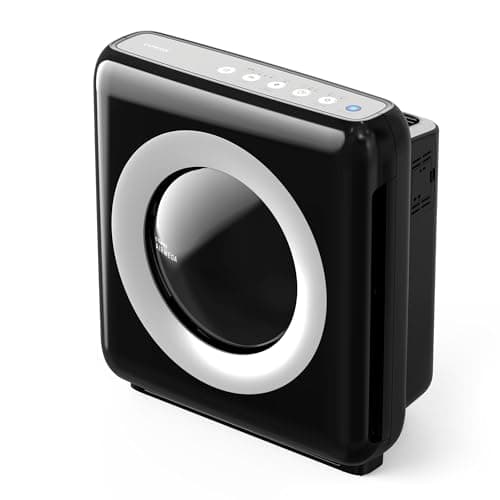
The most efficient unit here at low speed - 3.7 W on speed one - which matters enormously if you leave a purifier running all day and almost not at all if you do not.
#ad Price as of October 18, 2026, from Amazon. Prices change. How we make money.
Published specifications
| Specification | Value | Source |
|---|---|---|
| CADR (smoke) | 233 CFM | Coway published specification |
| CADR (dust) | 246 CFM | Coway published specification |
| CADR (pollen) | 240 CFM | Coway published specification |
| Coverage | 361 sq ft at 4.8 air changes/hr (1,748 sq ft at 1 ACH) | Coway published specification |
| Power draw by speed | 0.3 W standby / 3.7 W speed 1 / 8.7 W speed 2 / 75.3 W speed 3 | Coway published specification |
| Filtration | Pre-filter, odor filter, Green True HEPA, bipolar device | Coway published specification |
What it costs to run
About $6 a year running 24/7 on speed one, or $121 a year running 24/7 on speed three.
Speed 1: 3.7 W / 1000 x 24 x 365 = 32.4 kWh = $5.94 a year. Speed 3: 75.3 W / 1000 x 24 x 365 = 659.6 kWh = $120.97 a year. That twenty-fold spread is the most important number on this page, and it is why we chase per-speed figures instead of accepting a single rated wattage.
What is good about it
- Coway publishes power draw per fan speed, which almost nobody does and which is the only way to compute a real running cost
- 3.7 W on speed one is remarkable - cheaper to run continuously than most nightlights
- Coverage published at 1, 2 and 4.8 air changes per hour, so you can size it honestly
What is not
- 75.3 W on speed three is the highest draw here; how the auto mode behaves decides your bill
- The bipolar device is a stage we would rather do without; check it can be disabled
Who should skip this
Skip this if you only run a purifier for an hour or two at a time. Its whole advantage is low-speed efficiency over long hours, and short bursts on high speed give that straight back.
How it scored
- Clean air per watt9.5
- Honest coverage claim9.5
- Quiet operation8.0
- Filter economics7.5
Overall 8.7 / 10. This is our editorial score from published specifications and computed running cost. It is not a test result, and it is deliberately not marked up as a rating in this page’s structured data.
Levoit Core 300S
Bedrooms up to about 220 sq ft
The right size for an actual bedroom. 23 W and 22 dB on low means you can run it all night without noticing it on the bill or on the pillow.
#ad We do not hold a current price for this product, so we do not show one. How we make money.
Published specifications
| Specification | Value | Source |
|---|---|---|
| CADR | 141 CFM (240 m3/h) | Levoit published specification |
| Coverage | 219 sq ft at 4.8 air changes/hr (1,051 sq ft at 1 ACH) | Levoit published specification |
| Rated power | 23 W | Levoit published specification |
| Noise | 22-50 dB | Levoit published specification |
| Filtration | 3-stage | Levoit published specification |
| Dimensions | 8.7 x 8.7 x 14.2 in, 5.95 lb | Levoit published specification |
What it costs to run
About $15-18 a year in electricity at 12 hours a day.
23 W / 1000 x 12 hours x 365 days = 100.7 kWh. At 18.34 cents/kWh that is $18.47 a year at rated power, and less on the lower fan speeds you would actually use overnight.
What is good about it
- 141 CFM clears AHAM's two-thirds rule for any room up to 211 sq ft, which covers most bedrooms
- 23 W is the lowest draw of anything we list with this much CADR
- Small enough to sit on a nightstand rather than take a corner of the floor
What is not
- Not enough for a living room - the useful 4.8 ACH figure is 219 sq ft, not the 1,051 sq ft headline
- No published filter replacement interval in the specification we could find
Who should skip this
Skip this if the room is over about 220 sq ft, or if you are trying to cover an open-plan downstairs. It will run flat out and still lose.
How it scored
- Clean air per watt9.5
- Honest coverage claim9.5
- Quiet operation9.0
- Filter economics7.5
Overall 8.8 / 10. This is our editorial score from published specifications and computed running cost. It is not a test result, and it is deliberately not marked up as a rating in this page’s structured data.
How we ranked these
We have not tested these units. Nobody here owns one. What we did was compile each manufacturer’s published specifications, check the coverage claims against AHAM’s room-sizing rule, and compute what each one costs to run for a year at the current US average electricity price. Every figure on this page is attributed to whoever published it, and the arithmetic is shown so you can redo it.
How we rank these sets out the full method, including what would change a ranking.
Questions people ask
+−Can you wash a HEPA filter?
No. Manufacturers instruct against it - Levoit’s own guidance says not to wash the main or activated carbon filter because it can damage their structure and reduce effectiveness. There is also no published efficiency figure for a washed HEPA filter, so afterwards you cannot state what the purifier is removing.
+−Do air purifiers with washable filters save money?
A washable pre-filter saves money indirectly, by keeping hair and coarse dust out of the filter you do pay for. It does not remove the replacement cost. The figure that decides your annual bill is how many genuine parts a year the manual calls for, which on the three units here is one, three, and roughly two respectively.
+−Is a permanent filter air purifier worth it?
Ask what its published efficiency is, and at what particle size, before you ask about the washing. Permanent and lifetime usually describe a rigid mesh rather than pleated HEPA media, and HEPA-type is a resemblance claim with no standard behind it. The labels are explained at HEPA filters explained.
+−How often should I wash the pre-filter?
When you can see it loaded, which in a house with a shedding animal is every couple of weeks and in a quiet apartment may be every couple of months. Then dry it completely before it goes back into the unit.
+−Can I vacuum a HEPA filter instead of washing it?
Vacuuming the outer pre-filter surface is what Levoit recommends and is safe. Taking a vacuum nozzle to the pleated HEPA media itself is not something any manufacturer here endorses, and it carries the same problem as washing: no published figure for what the filter does afterwards. The opposite approach is a sealed cartridge rated for five years, which trades the washable pre-filter away entirely - Levoit vs Shark.
+−Are third-party replacement filters as good?
We cannot say that they are. The manufacturers do not warrant them and we have not found published efficiency testing for the compatible parts, so the honest description is a known rating traded for an unknown one at a lower price.
Sources
- Levoit - Air Purifier Filters Guide: Types, Lifespan & Maintenance
- Levoit - Core 300 Series Original Filter (replacement interval)
- Coway - Airmega Mighty AP-1512HH specification and filter life
- EPA - Air Cleaners and Air Filters in the Home (Guide to Air Cleaners in the Home)
- AHAM Verifide - Air Filtration Standards (AC-1)