Sizing guide
What Size Air Purifier Do I Need?
There is a one-line answer, it comes from AHAM rather than from a manufacturer, and it will usually tell you that the unit you were about to buy is too small.
By Scooter M. · Published · Last updated
How this page is funded: the buy links below are affiliate links. If you buy through one, we earn a commission at no extra cost to you. It does not change the order of the picks or what we say about them. Full disclosure.
The short answer
Take the room’s floor area in square feet and multiply by two-thirds. That is the smoke CADR, in CFM, the purifier needs. A 180 sq ft bedroom needs about 120 CFM. AHAM’s own published example is 132 CFM for a 200 sq ft room. Ignore the coverage figure on the box - it is normally quoted at one air change per hour and is about five times more generous than this rule. For wildfire smoke, AHAM recommends going further: a smoke CADR equal to the square footage.
Why you size on CADR and not on the box
CADR - Clean Air Delivery Rate - is the volume of genuinely clean air a purifier delivers per minute, measured under the AHAM AC-1 standard. It is published as three numbers, for smoke, dust and pollen, because the three particle sizes behave differently. Smoke is the smallest and hardest, which is why it is the one to size on: a machine that handles smoke handles the rest.
The number on the packaging is something else. “Covers 1,500 sq ft” almost always means the unit can nominally turn over the air in that space once an hour. One air change an hour is not enough to hold a particle concentration down, because particles keep arriving. The rate the industry treats as meaningful is about 4.8 air changes an hour, and at that rate the honest coverage is roughly a fifth of the headline. Same machine, same physics, different question being answered - the full arithmetic is in CADR explained.
The table
| Room | Floor area | Smoke CADR needed | For wildfire smoke |
|---|---|---|---|
| Small bedroom, study, dorm | 100 sq ft | About 67 CFM | 100 CFM |
| Average bedroom | 150 sq ft | About 100 CFM | 150 CFM |
| Large bedroom, small lounge | 200 sq ft | About 133 CFM | 200 CFM |
| Living room | 300 sq ft | About 200 CFM | 300 CFM |
| Large or open-plan living room | 400 sq ft | About 267 CFM | 400 CFM |
| Open-plan kitchen and living space | 600 sq ft | About 400 CFM | 600 CFM |
Bigger, then slower - the trick that actually works
Every CADR figure is measured at the unit’s highest fan speed, and almost nobody lives with a purifier on its highest fan speed. It is loud. So the effective CADR in a real house is the one at the setting you can tolerate overnight, which might be a third of the rated figure.
The practical answer is to deliberately oversize. Buy a unit rated well above the two-thirds figure and run it on low continuously. You get the airflow you need, at a noise level you will actually leave switched on, and the filter lasts longer because it is loaded more gently. A correctly sized unit run flat out will be switched off within a week; an oversized one run quietly will still be running in March.
Three sizing mistakes that cost money
- Sizing on the coverage claim. The commonest error by a wide margin, and it leads to buying a machine about a fifth of the size the room needs.
- Sizing on the pollen CADR because it is the biggest number. Manufacturers lead with the highest of the three. Size on smoke; it is the hardest particle and the conservative figure.
- Buying several small units instead of one correct one. Two 100 CFM purifiers in a 300 sq ft room are not a 200 CFM purifier - they compete for the same air, cost two filter subscriptions and make twice the noise. One properly sized unit with the door shut beats them.
When the room is simply too big
Sometimes the arithmetic returns a number no portable unit will reach. A 600 sq ft open-plan space needs about 400 CFM of smoke CADR, which is at the top of what portable machines deliver and expensive when they do.
At that point there are three honest options and only one of them involves buying a bigger purifier. You can shut a door and treat a smaller volume - free, and the most effective change available. You can filter the room you actually sleep in rather than the one you pass through. Or you can look at whether whole-house filtration on an existing HVAC system is the better investment, which we compare in whole house vs portable.
What we would actually do
Measure the floor area, multiply by two-thirds, then shop only for units whose published smoke CADR exceeds that number - ideally by half again, so you can run it slowly. If a listing does not publish a smoke CADR at all, that tells you something, and what it tells you is not good.
Then close the door. It is the only free variable in the whole calculation, and it changes the answer more than any purchase on this page.
What we would buy for this
Chosen from the same registry as our roundups, on published specifications and computed running cost.
Levoit Core 400S
Living rooms and open-plan spaces
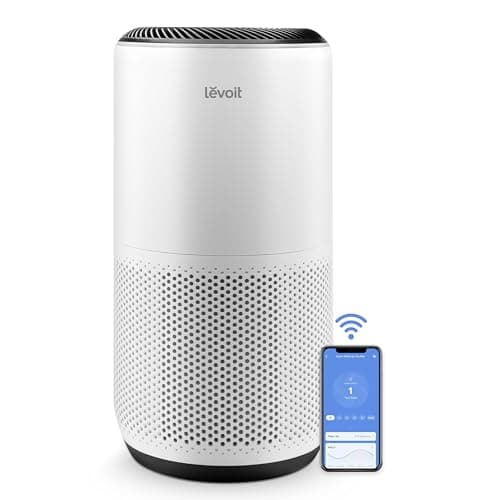
The one to buy if you want a purifier that genuinely covers a living room, and one of the few spec sheets in this bracket that publishes coverage at a useful air-change rate rather than only the flattering one.
#ad Price as of October 18, 2026, from Amazon. Prices change. How we make money.
Published specifications
| Specification | Value | Source |
|---|---|---|
| CADR | 231 CFM | Levoit published specification |
| Coverage | 358 sq ft at 4.8 air changes/hr (1,718 sq ft at 1 ACH) | Levoit published specification |
| Rated power | 38 W | Levoit published specification |
| Noise | 22-52 dB | Levoit published specification |
| Filtration | 3-stage: pre-filter, HEPA, activated carbon | Levoit published specification |
| Dimensions | 10.8 x 10.8 x 20.5 in, 11 lb | Levoit published specification |
What it costs to run
About $25-30 a year in electricity at 12 hours a day, before filters.
38 W / 1000 x 12 hours x 365 days = 166.4 kWh. At 18.34 cents/kWh that is $30.52 a year at rated power - and the unit only draws its full 38 W on the top fan speed, so a mid setting lands nearer $25. Add the replacement filter, which you should price before you buy rather than after.
What is good about it
- Levoit publishes coverage at both 1 ACH and 4.8 ACH, which is unusually straight - most brands quote only the flattering 1 ACH number
- 38 W is low for this CADR, which is what keeps the running cost down
- 22 dB on its lowest setting is quiet enough to sleep beside
- Carbon, pet-allergy and smoke-specific replacement filters are sold for the same body
What is not
- We could not find a published filter replacement interval in Levoit's specification, so we are not quoting one
- The 1,718 sq ft headline is a single air change per hour, which is not a useful rate for allergies
Who should skip this
Skip this if your room is under 200 sq ft. The Core 300S covers that at lower power and lower cost, and the extra CADR buys you nothing in a small bedroom.
How it scored
- Clean air per watt9.0
- Honest coverage claim9.5
- Quiet operation8.5
- Filter economics7.5
Overall 8.6 / 10. This is our editorial score from published specifications and computed running cost. It is not a test result, and it is deliberately not marked up as a rating in this page’s structured data.
Levoit Vital 200S
Homes with shedding pets
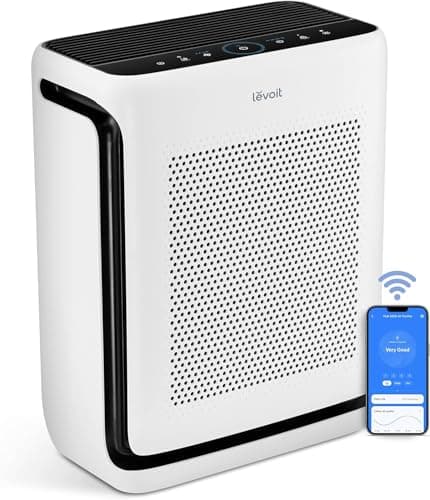
The highest CADR we carry, built around a washable pre-filter and a wide intake - the right shape for a house with animals in it, because hair loads a filter far faster than dust does.
#ad Price as of October 18, 2026, from Amazon. Prices change. How we make money.
Published specifications
| Specification | Value | Source |
|---|---|---|
| CADR | 250 CFM | Levoit published specification |
| Coverage | 388 sq ft at 4.8 air changes/hr (1,862 sq ft at 1 ACH) | Levoit published specification |
| Rated power | 50 W | Levoit published specification |
| Noise | 23-54 dB | Levoit published specification |
| Filtration | 3-stage: washable pre-filter, HEPA, activated carbon. Pet allergy, toxin absorber and smoke remover carbon filters sold for the same body | Levoit published specification |
| Dimensions | 15.6 x 8.5 x 19.8 in | Levoit published specification |
What it costs to run
About $40 a year in electricity at 12 hours a day, before filters.
50 W / 1000 x 12 hours x 365 days = 219 kWh. At 18.34 cents/kWh that is $40.16 a year at rated power, and less on the lower fan speeds. That is roughly $10 a year more than the Core 400S for 19 CFM more CADR - worth it in a house with animals, hard to justify without them.
What is good about it
- 250 CFM is the highest CADR of anything we carry, and it covers about 375 sq ft under AHAM's two-thirds rule
- The washable pre-filter is the part that matters with pets - hair is what kills HEPA filters early
- Levoit publishes coverage at both 1 ACH and 4.8 ACH, and the 388 sq ft figure lines up closely with the AHAM arithmetic
- Four different carbon filters fit the same chassis, so the unit adapts to pets, smoke or off-gassing without replacing the body
What is not
- 50 W for 250 CFM is a worse clean-air-per-watt ratio than the Core 400S manages at 38 W for 231 CFM
- We could not find a published filter replacement interval for this model, so we are not quoting one
- Levoit does not publish power draw per fan speed, so continuous-running cost cannot be computed precisely
- The pet-specific carbon filter is a separate purchase and is not always in stock - check it is available before buying the body for that reason
Who should skip this
Skip this if you have no animals and no odor problem. Without pets you are paying for a wide pre-filter and a carbon option you will not use, and the Core 400S delivers comparable clean air on 12 W less.
How it scored
- Pre-filter design for hair9.0
- Clean air per watt7.0
- Honest coverage claim9.0
- Filter economics8.0
Overall 8.0 / 10. This is our editorial score from published specifications and computed running cost. It is not a test result, and it is deliberately not marked up as a rating in this page’s structured data.
GermGuardian AC4825E
A small room, a dorm or a desk-side space on a tight budget
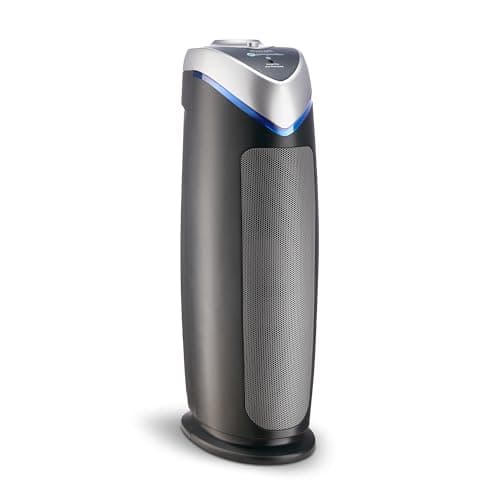
The cheapest air purifier we could find that publishes an AHAM-verified smoke CADR against a printed model number. That combination is rarer at this price than it should be, and it is the only reason this unit is here.
#ad Price as of October 18, 2026, from Amazon. Prices change. How we make money.
Published specifications
| Specification | Value | Source |
|---|---|---|
| CADR - smoke | 99 CFM | GermGuardian published specification |
| CADR - dust | 118 CFM | GermGuardian published specification |
| CADR - pollen | 125 CFM | GermGuardian published specification |
| Room size at the AHAM rule | About 149 sq ft | Our arithmetic from the published smoke CADR |
| Noise | 40-55 dBA | GermGuardian published specification |
| Fan speeds | 3 | GermGuardian published specification |
| Filter | True HEPA plus activated carbon, replace every 6-8 months | GermGuardian published specification |
| Dimensions and weight | 22 x 10.25 x 6.75 in, 8.55 lb | GermGuardian published specification |
What it costs to run
About $24 a year in electricity at 8 hours a day on high.
55 W / 1000 x 8 hours x 365 days = 160.6 kWh. At 18.34 cents/kWh that is $29.45 a year on high. On the low speed most people actually use it is meaningfully less; filters are the larger running cost at this price point, not electricity.
What is good about it
- Publishes all three AHAM CADR figures against the model number printed in the listing title, which most units at this price do not
- True HEPA, not HEPA-type - the distinction matters and the cheap end of this category is full of the latter
- Activated carbon stage included rather than sold as an upgrade
- 8.55 lb and 22 inches tall, so it moves between rooms without planning
What is not
- GermGuardian advertises 743 sq ft per hour. At AHAM's two-thirds smoke rule the honest figure is about 149 sq ft - a fifth of the headline
- 55 dBA on high is audible in a quiet room; this is not a unit you sleep next to on full speed
- The carbon stage is a thin coating on the filter wrap, not a deep carbon bed, so it handles light odors rather than sustained cooking or smoke
- Filters every 6-8 months is a faster cadence than the better units, and it erodes the price advantage over three years
- The UV-C lamp is a marketing feature at this air speed and we do not count it in the ranking
Who should skip this
Skip this if the room is over about 150 sq ft, if you need it silent overnight, or if the problem is cooking smoke or a smoker in the house - none of those are jobs a thin carbon coating wins.
How it scored
- Published data at the price9.0
- Clean air per dollar8.5
- Odor handling5.0
Overall 7.6 / 10. This is our editorial score from published specifications and computed running cost. It is not a test result, and it is deliberately not marked up as a rating in this page’s structured data.
How we ranked these
We have not tested these units. Nobody here owns one. What we did was compile each manufacturer’s published specifications, check the coverage claims against AHAM’s room-sizing rule, and compute what each one costs to run for a year at the current US average electricity price. Every figure on this page is attributed to whoever published it, and the arithmetic is shown so you can redo it.
How we rank these sets out the full method, including what would change a ranking.
Questions people ask
+−How do I calculate what size air purifier I need?
Multiply the room’s floor area in square feet by two-thirds. The result is the smoke CADR, in CFM, you should be shopping for. A 150 sq ft bedroom needs about 100 CFM. AHAM publishes 132 CFM for a 200 sq ft room as its worked example.
+−Why is the coverage on the box so much bigger than the CADR suggests?
Because it is usually quoted at one air change per hour, while meaningful particle reduction needs roughly 4.8. One air change an hour lets the concentration climb back between changes. The honest coverage is typically about a fifth of the headline figure.
+−Is it better to buy an air purifier that is too big?
Yes, within reason. An oversized unit can be run on a low, quiet speed and still deliver the airflow the room needs, which means it stays switched on. An exactly-sized unit has to run at maximum, where it is loudest, and tends to get turned off.
+−What size air purifier do I need for wildfire smoke?
More than the usual rule. AHAM recommends a smoke CADR equal to the room’s square footage for wildfire conditions, rather than two-thirds of it - so a 200 sq ft room wants 200 CFM. Smoke events are intense, prolonged, and happen when you cannot open a window.
+−Do air purifier CADR ratings account for ceiling height?
The two-thirds rule assumes a standard 8 ft ceiling. A 10 ft ceiling means about 25% more air in the same floor area, so add roughly that to the CADR figure. Vaulted or double-height rooms need substantially more than the floor area alone implies.