Guide
Will a Dehumidifier Stop Condensation on My Windows?
Your windows are the coldest surface in the house, which makes them the first place the air gives up its moisture. Whether an appliance can fix that depends on a number most guides never mention: how many panes of glass you have.
By Scooter M. · Published · Last updated
How this page is funded: the buy links below are affiliate links. If you buy through one, we earn a commission at no extra cost to you. It does not change the order of the picks or what we say about them. Full disclosure.
The short answer
A dehumidifier stops window condensation when the indoor humidity is the thing that is too high - and it cannot stop it when the glass is simply too cold. Those are two different situations and the published numbers separate them cleanly. With double glazing at 20°F outside you can carry around 53% indoor relative humidity before the glass wets; with single glazing in the same weather the figure is about 24%. So: if your windows run wet at 60% indoor humidity, a dehumidifier is the right purchase and the Midea Cube 35 is our pick for a bedroom or living floor. If they run wet at 30% through single panes, no appliance will fix it at a humidity you would want to live in, and the money belongs on the window. A logging hygrometer is how you find out which you have, and it costs less than one wasted weekend.
Condensation is a surface temperature event, not an air event
Air can hold a certain amount of water vapor at a given temperature, and less of it as it gets colder. Cool a parcel of air far enough and it reaches its dew point, at which the vapor it is carrying starts condensing out as liquid. Inside a heated house in winter the coldest thing in the room is almost always the window, so the window is where that happens first. The National Research Council of Canada’s building digest on the subject states it plainly: condensation “occurs on inside window surfaces whenever surface temperature falls below the dew-point temperature of the room.”
That single sentence is why two houses at the same humidity can behave completely differently. The humidity sets the dew point; the window sets the surface temperature. You only get dry glass when the second number stays above the first, and you can move either one.
The published table almost nobody quotes
The NRC digest works the arithmetic out for you and gives the maximum indoor relative humidity you can carry at 70°F indoors without condensing on the glass. We have reproduced the figures for a 15 mph wind, which is the realistic case - wind strips heat off the outer pane and makes the inner surface colder:
| Outdoor temperature | Single glazing | Double glazing | Triple glazing |
|---|---|---|---|
| 40°F | 44% | 68% | 78% |
| 20°F | 24% | 53% | 68% |
| 0°F | 12% | 41% | 57% |
| -20°F | 6% | 32% | 49% |
| -40°F | 2% | 23% | 41% |
Look at the single-glazing column and the whole question answers itself. At 0°F outside, a single-glazed window condenses above 12% indoor relative humidity. Nobody lives at 12%, and no dehumidifier on this site will take an occupied room there - which means that in a cold snap, wet single glazing is not a humidity fault you can buy your way out of. It is the window.
Now look at the double-glazing row for 20°F: 53%. If your windows are double glazed and wetting at 20°F outside, your indoor humidity is above about 53% and that is squarely a dehumidifier’s job - and it is also above the 50% ceiling of the EPA’s ideal band, so you have a second reason to bring it down.
Which situation you are in: the two-minute test
Put a hygrometer in the room with the wet windows and read it in the morning, when both the humidity peak and the cold are at their worst. Then:
| Morning reading in that room | What it means | What to buy |
|---|---|---|
| Above 60% | Above the EPA's stated ceiling for indoor air regardless of the windows. The moisture is the problem. | A dehumidifier, sized on published pint capacity |
| 50 to 60% | In the EPA's acceptable range but above what double glazing carries in a hard freeze. Borderline. | Ventilation and source control first; a dehumidifier if the reading will not come down |
| 40 to 50% | Correct humidity. If the glass is still wet, the glass is the limiting factor. | Nothing from us. Window insulation, a thermal blind, or glazing |
| Below 40% and still wet | Single glazing, a failed sealed unit, or a cold spot. No humidity target will fix this. | Window repair or replacement - not an appliance |
Where the moisture is coming from in the first place
A dehumidifier treats the symptom efficiently, and it is worth knowing what it is competing with. In an occupied house the moisture is mostly produced indoors: showering, cooking, drying laundry on a rack, and the occupants themselves. Removing the source is free and permanent, and the appliance only has to handle what is left. Our how to lower humidity without a dehumidifier page is the order to work through: run the extractor long enough, stop drying clothes indoors, and keep interior doors to the wet rooms shut.
The one that catches people is ventilation direction. Opening a window helps only when the outdoor air genuinely holds less moisture than the indoor air, which in a cold snap it almost always does - cold air cannot carry much. In humid summer weather the same action makes the room wetter. That is also the reason summer condensation appears on the outside of a well-insulated window, which looks alarming and means nothing is wrong.
Why morning bedrooms are the worst case
Almost every report of window condensation is about a bedroom at dawn, and the physics stacks up against that room specifically. A sleeping adult adds moisture to the air all night in a space with the door shut and the heating down. The air cools, so its relative humidity climbs even though the amount of water in it has barely changed, and it meets glass that has had eight hours to get cold. Three effects, one window.
Which is why the practical fix in a bedroom is often not a bigger machine but a quieter one running at a sensible setpoint overnight - the subject of our bedroom dehumidifiers page. Set the humidistat to 50% and let it cycle. A unit set to the bottom of its range will run all night to chase a number you do not need.
Why this matters beyond the windowsill
Wet glass is cosmetic. What it is reporting is not. The EPA recommends keeping indoor relative humidity below 60 percent, ideally between 30 and 50 percent, precisely because sustained moisture on cold surfaces is what mold grows on - and the window is only the surface you can see. The same conditions exist behind furniture on external walls, in closed wardrobes and in corners of the room that never get airflow. Our musty smell page is what happens when this goes unaddressed for a season.
What a dehumidifier will not do
- It cannot warm your glass. Everything in the single-glazing column of that table stays true no matter what appliance you run.
- It cannot beat a failed sealed unit. Moisture between the panes means the seal has gone and the cavity is drawing in outdoor air. That is a glazing repair; the room humidity is irrelevant to it.
- It will not help with outside-surface condensation in summer, which is a sign the window is working well rather than badly.
- It loses capacity in the cold, which is the exact weather you want it in. A compressor unit removes noticeably less water in a cold room and can frost its coil - look for a stated low-temperature operation figure or auto-defrost before putting one in an unheated space.
- It will not fix a draft that is chilling one pane. A cold spot is a surface-temperature problem wearing a humidity costume.
What we would actually do
Count the panes, then read the room. Double or triple glazing plus a morning reading above 55% is the case where a dehumidifier simply works, and it is the most common case in a modern house with a family in it. Single glazing plus a reading in the 40s is the case where buying one is a way of spending money on the wrong component - secondary glazing, an insulating blind or a thermal film will do more for the glass than any appliance can, and you can confirm that for the price of a hygrometer before committing to either.
What we would buy for this
Chosen from the same registry as our roundups, on published specifications and computed running cost.
Midea Cube 35-Pint
Basements without a floor drain
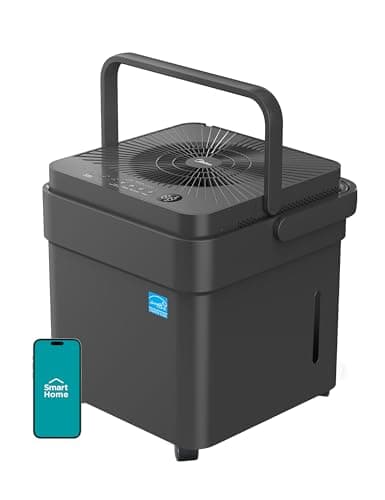
The adjustable 4.25-gallon bucket is the point. Most dehumidifiers get switched off because emptying a 2-gallon bucket twice a day is miserable; this one buys you a couple of days.
#ad Price as of October 18, 2026, from Amazon. Prices change. How we make money.
Published specifications
| Specification | Value | Source |
|---|---|---|
| Capacity | 35 pints per day | Midea published specification |
| Capacity (federal test) | 35.82 pints per day | ENERGY STAR certified products database |
| Coverage | Up to 3,500 sq ft | Midea published specification |
| Efficiency (IEF) | 2.01 L/kWh | ENERGY STAR certified products database |
| Annual energy use | 378 kWh/yr | ENERGY STAR certified products database |
| Bucket fill level | Adjustable, up to 4.25 gallons | Midea user manual |
| Fan speeds | 2 (High, Low) | Midea user manual |
| Dimensions | 14.76 x 14.57 x 14.45 in, 39.62 lb | Midea published specification |
| Certification | ENERGY STAR certified | ENERGY STAR certified products database |
What it costs to run
About $69 a year on ENERGY STAR's certified annual energy figure.
ENERGY STAR publishes 378 kWh a year for this model. At 18.34 cents/kWh that is $69.33 a year. That figure is calculated on the program's standardized test basis, not measured in your basement: a genuinely damp space where it cycles constantly will use more. Against the 50-pint Cube's 515 kWh ($94.45) it is the cheaper machine to own, which is the argument for sizing honestly rather than buying headroom.
What is good about it
- An adjustable bucket that holds up to 4.25 gallons - the difference between a unit you keep using and one you unplug in week three
- An IEF of 2.01 L/kWh removes about 18% more water per kWh than the 20-pint Cube's 1.70
- Nests down into a smaller shape for storage, which matters for an appliance you only use half the year
What is not
- The 3,500 sq ft coverage claim assumes conditions no real basement has; treat it as a ceiling, not a specification
- 35 pints is not enough for a genuinely wet basement with standing water
- Midea does not publish a rated wattage for this model, so we quote ENERGY STAR's certified annual energy figure instead
- No built-in pump on this model - without a floor drain you are either emptying the bucket or routing a gravity hose
Who should skip this
Skip this if your basement is wet rather than damp - visible water, white efflorescence on the walls, a musty smell that returns within a day of airing out. That is a drainage problem, and a 35-pint unit will run permanently and never win.
How it scored
- Tank interval10.0
- Capacity for the money8.5
- Efficiency per liter removed9.0
- Storage footprint9.0
Overall 8.7 / 10. This is our editorial score from published specifications and computed running cost. It is not a test result, and it is deliberately not marked up as a rating in this page’s structured data.
Govee H5075 Bluetooth Hygrometer
Diagnosing a problem that changes overnight
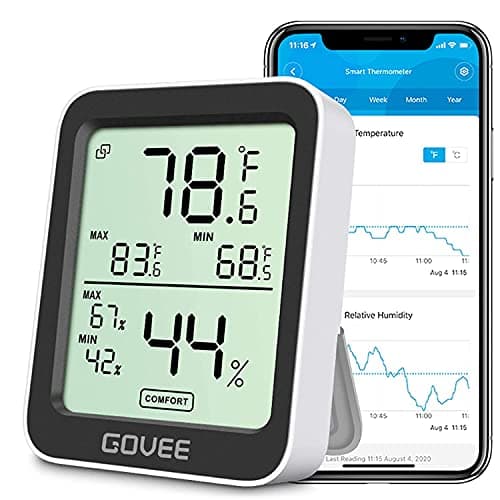
The one that logs. If your problem is that the house is dry at night but fine during the day, a hygrometer you have to walk over and read will never tell you that.
#ad Price as of October 18, 2026, from Amazon. Prices change. How we make money.
Published specifications
| Specification | Value | Source |
|---|---|---|
| Function | Bluetooth temperature and humidity sensor with app-based logging and data export | Govee published specification |
What is good about it
- Logging is the feature. Overnight humidity swings are invisible to a spot reading, and they explain most morning symptoms
- Data export means you can check whether the humidifier actually changed anything, rather than assuming
What is not
- Bluetooth range is room-scale; a basement sensor will not reach a phone upstairs
- Requires an app and an account, which is a genuine cost for some people
Who should skip this
Skip this if you just want a number on a wall. The logging is the whole premium, and it is wasted if you will not look at it.
How it scored
- Logging and history9.5
- Value for the decision it informs9.0
- Range and placement freedom6.0
Overall 8.6 / 10. This is our editorial score from published specifications and computed running cost. It is not a test result, and it is deliberately not marked up as a rating in this page’s structured data.
Frigidaire FFAD5033W1 50-Pint
Wet basements that need real capacity
A conventional 50-pint unit that publishes its Integrated Energy Factor, which is the one dehumidifier figure that actually predicts your bill.
#ad We do not hold a current price for this product, so we do not show one. How we make money.
Published specifications
| Specification | Value | Source |
|---|---|---|
| Capacity | 50 pints per day | Frigidaire published specification |
| Rated power | 545 W at 120 V | Frigidaire published specification |
| Integrated Energy Factor | 1.8 L/kWh | Frigidaire published specification |
| Bucket capacity | 2.1 gallons | Frigidaire published specification |
| Humidity setpoint range | 35% to 85% RH | Frigidaire published specification |
| Noise | 47 / 49 / 51 dBA by fan speed | Frigidaire published specification |
| Certification | Energy Star rated | Frigidaire published specification |
| Continuous drain | Yes | Frigidaire published specification |
What it costs to run
About $180-200 a year on a humidistat - and far less if you fix the water first.
545 W / 1000 x 10 hours x 365 days = 1,989 kWh = $364.79 a year at continuous duty. In practice a dehumidifier on a humidistat cycles rather than running flat out, so a realistic damp-basement figure is roughly half that, $180-200. Either way it dwarfs every purifier on this site, which is exactly why finding the water source matters more than choosing the unit.
What is good about it
- Publishes an Integrated Energy Factor of 1.8 L/kWh, which lets you compute cost per liter removed instead of guessing
- Continuous drain means you never empty a bucket, which is the single reason most dehumidifiers end up unplugged
- A 35% RH floor on the setpoint is low enough for a genuinely damp basement
What is not
- 545 W is a real load - a dehumidifier is by far the most expensive appliance discussed on this site
- 41 lb and nearly 25 inches tall; this is not a discreet object
Who should skip this
Skip this if your damp problem is one closet or one bathroom. A 50-pint compressor unit in a closet is enormously more machine than the job needs.
How it scored
- Capacity for the money9.0
- Published efficiency data9.5
- Set-and-forget drainage9.0
- Running cost6.0
Overall 8.5 / 10. This is our editorial score from published specifications and computed running cost. It is not a test result, and it is deliberately not marked up as a rating in this page’s structured data.
How we ranked these
We have not tested these units. Nobody here owns one. What we did was compile each manufacturer’s published specifications, check the coverage claims against AHAM’s room-sizing rule, and compute what each one costs to run for a year at the current US average electricity price. Every figure on this page is attributed to whoever published it, and the arithmetic is shown so you can redo it.
How we rank these sets out the full method, including what would change a ranking.
Questions people ask
+−Will a dehumidifier stop condensation on windows?
+−What humidity level stops window condensation?
+−Why do my windows have condensation every morning but not in the day?
+−Should I buy a dehumidifier or new windows?
+−Is condensation between the panes the same problem?
+−Does opening the window help or make it worse?
+−Will a dehumidifier work in a cold, unheated room?
Sources
- National Research Council Canada, Canadian Building Digest CBD-4 - Condensation on Inside Window Surfaces (A. G. Wilson, 1960)
- EPA - A Brief Guide to Mold, Moisture and Your Home
- EPA - Mold Course Chapter 2: Why and Where Mold Grows
- ENERGY STAR - Dehumidifiers
- U.S. Energy Information Administration - Electric Power Monthly, Table 5.6.A