Roundup
Best Dehumidifiers for a Crawl Space
A crawl space is the one place where buying the dehumidifier first is most likely to waste your money - and where, once the groundwork is done, the right unit does real work.
By Scooter M. · Published · Last updated
How this page is funded: the buy links below are affiliate links. If you buy through one, we earn a commission at no extra cost to you. It does not change the order of the picks or what we say about them. Full disclosure.
The short answer
If the crawl space has bare earth and no vapor barrier, buy the plastic before you buy the appliance. Ground moisture evaporating into an enclosed space is a continuous supply, and a dehumidifier set against it runs permanently and still loses. Once the ground is sealed, a dehumidifier becomes the right tool - and down there it needs to drain without anyone crawling in to empty a bucket, which makes a pump or a gravity fall non-negotiable rather than a preference.
Why the order matters so much here
The EPA’s guidance on moisture is consistent: control the source before you treat the symptom. In most rooms that is advice. In a crawl space it is the difference between an appliance that works and one that runs all year and never reaches setpoint.
Bare soil in an enclosed space releases water vapor continuously. A sheet of polyethylene over that soil does not remove humidity, but it removes the supply, and the amount of water your dehumidifier then has to deal with drops to what leaks in through vents and gaps. We go through the sequence - barrier, then vents, then appliance - in crawl space and garage humidity, and that page is the prerequisite for this one, not an alternative to it.
How we judged these
Same method as the rest of the site: published specifications only, federal test data from the ENERGY STAR certified products database, and live availability checks. The crawl-space-specific criteria, in order:
- Can it drain unattended, permanently? Anything that relies on someone emptying a bucket is disqualified. Nobody crawls under a house daily.
- Will it work at crawl-space temperatures? Compressor units lose performance as air cools and can frost their coils. Auto-defrost is the minimum.
- Is the capacity matched to a sealed space, not a swamp? If it needs more than a 50-pint unit after the barrier is down, you have a water problem, not a humidity problem.
- Published federal efficiency data. It runs for months out of sight, so the annual kWh figure is the one that matters.
The three, and why drainage decides between them
| Unit | Drainage | Capacity (federal test) | Annual energy | Cost per year |
|---|---|---|---|---|
| Midea 50-Pint with Pump | Internal pump, hose or bucket | 49.67-49.95 pt/day | 515-525 kWh | $94-96 |
| Whirlpool WHHD501PAW | Internal pump, hose or bucket | 50.00 pt/day | 530 kWh | $97.20 |
| Midea Cube 50 | Gravity hose or bucket only | 49.67 pt/day | 515 kWh | $94.45 |
The Cube 50 is on this list only for the crawl space that has somewhere lower for water to go. Where the ground falls away or there is a drain, gravity is the better engineering answer: no motor, no impeller, nothing to check on. Where it does not - and in most crawl spaces it does not - you need one of the pump units, and the full argument for that is on best dehumidifiers with a pump.
The cold problem nobody mentions in the listings
A crawl space in spring or autumn can sit well below the temperature a portable dehumidifier is happy at. Compressor units condense water on a cold coil; as the ambient air gets colder, that coil approaches freezing and frost forms, at which point the machine is spending its energy making ice rather than removing water. Auto-defrost cycles handle this, but a defrost cycle is time not spent dehumidifying.
Practically: expect a portable unit to underperform its rating in a cold crawl space, do not read that as a faulty machine, and do not try to fix it by buying more capacity. Manufacturers of these units typically specify a minimum operating temperature around 41F, and below that you are outside what the product is designed for regardless of size.
What we would actually do
In order, and stopping as soon as the readings come good: put a hygrometer down there for a week. Lay a ground vapor barrier if there is bare earth. Deal with any standing water or obvious leak, because no appliance beats liquid water arriving. Then, and only then, fit a 50-pint unit with a pump, run the discharge somewhere sensible, set it to 50%, and check the reading rather than the machine.
The reason to keep that order is money. The barrier is the cheapest item on the list and does the most work. The dehumidifier is the most expensive and, on bare soil, does the least.
Quick picks
Ranked on published specifications and computed running cost. Tap any row for the full write-up, including who should skip it.
| # | Product | Best for | Score | Price |
|---|---|---|---|---|
| 1 | 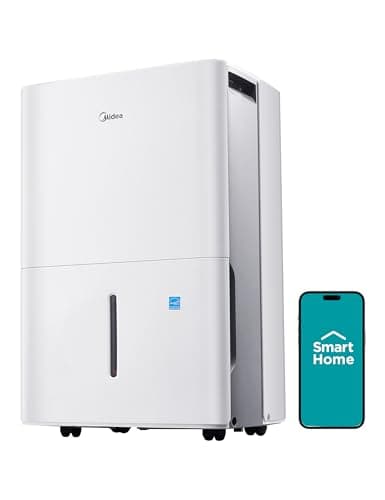 Midea 50-Pint with PumpA basement with no floor drain, where the water has to go upward | Best for most crawl spaces | 8.3 | $243.84 - View on Amazon |
| 2 | 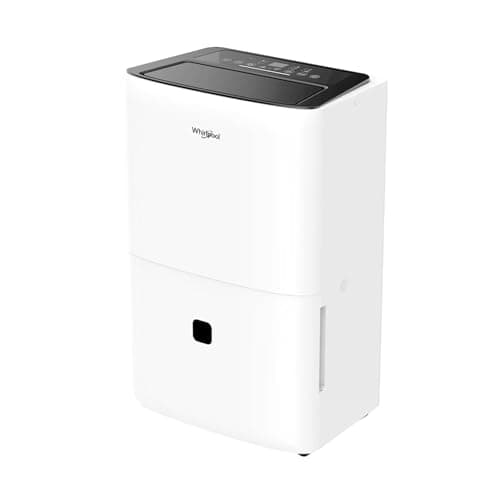 Whirlpool 50-Pint with Pump WHHD501PAWA basement that needs draining as well as drying | Best documented | 8.0 | $329.99 - View on Amazon |
| 3 | 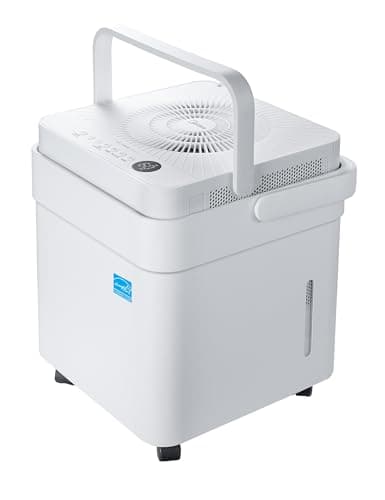 Midea Cube 50-PintLarge basements and spaces that stay damp all summer | Best if you have a drain | 8.2 | $241.59 - View on Amazon |
#1 - Best for most crawl spaces
Midea 50-Pint with Pump
A basement with no floor drain, where the water has to go upward
The cheapest way to get a real internal pump from a brand that publishes its federal test data. The pump is the feature; the dehumidifier underneath it is the same competent 50-pint machine Midea sells without one.
#ad Price as of October 18, 2026, from Amazon. Prices change. How we make money.
Published specifications
| Specification | Value | Source |
|---|---|---|
| Capacity (federal test) | 49.67-49.95 pints per day | ENERGY STAR certified products database |
| Efficiency (IEF) | 2.01 L/kWh | ENERGY STAR certified products database |
| Annual energy use | 515-525 kWh/yr | ENERGY STAR certified products database |
| Coverage | Up to 4,500 sq ft | Midea published specification |
| Drainage | Built-in pump, gravity hose, or bucket | Midea published specification |
| Certification | ENERGY STAR certified (not Most Efficient) | ENERGY STAR certified products database |
What it costs to run
About $94-96 a year on ENERGY STAR's certified annual energy figures.
ENERGY STAR publishes 515 to 525 kWh a year across Midea's 50-pint pump variants. At 18.34 cents/kWh that is $94.45 to $96.29 a year. The spread between variants is under $2, so the uncertainty about which one ships does not change the number you should budget.
What is good about it
- An internal pump at the lowest price of the three pump units we could verify
- Midea publishes federal test data for every 50-pint pump variant it sells, and they are consistent: IEF 2.01 across all twelve
- Same Cube-family controls and drainage options as the model we already rate for basements, so the non-pump behavior is known
- Gravity hose and bucket both still work if you would rather not use the pump
What is not
- The Amazon listing does not print a model number, so we can only tell you the figures are identical across every Midea 50-pint pump variant in the federal database - not which one ships
- Not ENERGY STAR Most Efficient; at over 45 pints the badge needs 2.20 L/kWh and every Midea 50-pint is 2.01
- About $95 a year to run, which is the price of the capacity rather than a fault
- A pump is one more component to fail, and on any brand it is the part that fails first
Who should skip this
Skip this if there is a floor drain lower than the unit. Gravity is free, silent and cannot break; you would be paying for a pump you will never switch on.
How it scored
- Drainage you will keep using9.5
- Published data you can check8.0
- Price for the feature9.0
Overall 8.3 / 10. This is our editorial score from published specifications and computed running cost. It is not a test result, and it is deliberately not marked up as a rating in this page’s structured data.
#2 - Best documented
Whirlpool 50-Pint with Pump WHHD501PAW
A basement that needs draining as well as drying
The basement answer, with the built-in pump that makes a basement unit something you actually keep using. Its efficiency is ordinary for its class and its running cost is the highest here - that is what capacity costs.
#ad Price as of October 18, 2026, from Amazon. Prices change. How we make money.
Published specifications
| Specification | Value | Source |
|---|---|---|
| Capacity (federal test) | 50.00 pints per day | ENERGY STAR certified products database |
| Efficiency (IEF) | 2.01 L/kWh | ENERGY STAR certified products database |
| Annual energy use | 530 kWh/yr | ENERGY STAR certified products database |
| Certification | ENERGY STAR certified (not Most Efficient) | ENERGY STAR certified products database |
| Coverage | Up to 3,000 sq ft | Whirlpool published specification |
| Drainage | Built-in pump, plus a 14.8-pint bucket with auto shut-off | Whirlpool published specification |
| Fan speeds | 3 | Whirlpool published specification |
| Lowest operating temperature | 41F, with auto-defrost | Whirlpool published specification |
What it costs to run
About $97 a year on ENERGY STAR's certified annual energy figure.
ENERGY STAR publishes 530 kWh a year for WHHD501PAW. At 18.34 cents/kWh that is $97.20 a year. It is the most expensive unit here to run and it removes twice the water per day of the 25-pint model, which is the trade being made.
What is good about it
- The pump pushes water up into a sink or basin, which removes the one thing that gets basement dehumidifiers unplugged - carrying a full bucket up the stairs
- 50 pints per day under the federal test, not under a saturation figure invented for a listing
- 2.01 L/kWh matches the best IEF Midea achieves at this capacity
- Model number published, so the certified figures can be checked against the federal database
What is not
- 530 kWh a year is the highest running cost on this page by some distance - roughly double the 25-pint model
- Not Most Efficient: at over 45 pints the badge needs 2.20 L/kWh and this is 2.01
- A pump is another component that can fail, and it is the part most likely to
- Overkill for a single room, where it will short-cycle rather than run efficiently
Who should skip this
Skip this if there is a floor drain below the unit - you are paying for a pump you will never switch on, and a gravity-drained model does the same job for less. Skip it entirely for a bedroom.
How it scored
- Capacity for a real basement9.5
- Drainage you will keep using9.5
- Running cost6.0
Overall 8.0 / 10. This is our editorial score from published specifications and computed running cost. It is not a test result, and it is deliberately not marked up as a rating in this page’s structured data.
#3 - Best if you have a drain
Midea Cube 50-Pint
Large basements and spaces that stay damp all summer
The same body as the 35 with more capacity. Worth it for a large or genuinely damp basement; wasted money and electricity in a space the 35 already handles.
#ad Price as of October 18, 2026, from Amazon. Prices change. How we make money.
Published specifications
| Specification | Value | Source |
|---|---|---|
| Capacity | 50 pints per day | Midea published specification |
| Capacity (federal test) | 49.67 pints per day | ENERGY STAR certified products database |
| Coverage | Up to 4,500 sq ft | Midea published specification |
| Efficiency (IEF) | 2.01 L/kWh | ENERGY STAR certified products database |
| Annual energy use | 515 kWh/yr | ENERGY STAR certified products database |
| Bucket fill level | Adjustable, up to 4.25 gallons | Midea user manual |
| Fan speeds | 2 (High, Low) | Midea user manual |
| Dimensions | 14.45 x 14.76 x 14.57 in, 41.54 lb | Midea published specification |
| Certification | ENERGY STAR certified | ENERGY STAR certified products database |
What it costs to run
About $94 a year on ENERGY STAR's certified annual energy figure.
ENERGY STAR publishes 515 kWh a year for this model. At 18.34 cents/kWh that is $94.45 a year, against $69.33 for the 35-pint Cube. That is calculated on the program's standardized test basis rather than measured in your basement; a very damp space will push it higher.
What is good about it
- Same 2.01 L/kWh efficiency as the 35-pint Cube, so the extra capacity does not cost you efficiency - only total consumption
- Near-identical footprint to the 35 for roughly 40% more water removed per day
- The same adjustable 4.25-gallon bucket, which matters more at 50 pints because it fills faster
What is not
- 515 kWh a year against the 35's 378 - about $25 more a year, which only buys you something if the space genuinely needs it
- The bucket is the same size as the 35's, so at full capacity it fills faster and you empty it more often
- No built-in pump on this model; a separate pump version exists, so check which one you are buying
- Midea does not publish a rated wattage for this model, so we quote ENERGY STAR's certified annual energy figure instead
Who should skip this
Skip this if the 35-pint Cube covers your space. The extra capacity is only useful in a large or persistently damp basement; anywhere else it is $25 a year of electricity for headroom you will not use. And skip it for a wet basement with liquid water arriving - that is a drainage repair.
How it scored
- Capacity for large spaces9.5
- Efficiency per liter removed9.0
- Bucket interval at full load7.0
- Running cost7.0
Overall 8.2 / 10. This is our editorial score from published specifications and computed running cost. It is not a test result, and it is deliberately not marked up as a rating in this page’s structured data.
How we ranked these
We have not tested these units. Nobody here owns one. What we did was compile each manufacturer’s published specifications, check the coverage claims against AHAM’s room-sizing rule, and compute what each one costs to run for a year at the current US average electricity price. Every figure on this page is attributed to whoever published it, and the arithmetic is shown so you can redo it.
How we rank these sets out the full method, including what would change a ranking.
Questions people ask
+−What size dehumidifier do I need for a crawl space?
After a vapor barrier is down, a 50-pint unit under the federal test covers most residential crawl spaces. Before one is down, no size is enough - the soil is a continuous source and the machine is bailing. If a 50-pint unit cannot hold a sealed crawl space, the problem is liquid water getting in, not capacity.
+−Can I use a normal portable dehumidifier in a crawl space?
Yes, provided it can drain without anyone attending it and the space stays above the unit’s minimum operating temperature, typically around 41F. Purpose-built crawl-space units exist and are built for low temperatures and constant duty; they also cost several times as much, which is only worth it once the cheap fixes are done.
+−Should I close crawl space vents if I run a dehumidifier?
An appliance dehumidifying a space that is open to outdoor air is working against the weather, so sealing matters. But vent strategy interacts with local climate and building code, and getting it wrong can move a moisture problem rather than solve it. This is the point to ask someone who can see the building.
+−What humidity should a crawl space be kept at?
The EPA recommends keeping indoor relative humidity below 60%, and ideally in the 30-50% band. A crawl space held under 60% is not growing mold on its joists, which is the point of the exercise.