Guide
Will a Humidifier Help Dry Eyes?
This is one of the few symptoms on this site where an eye-health authority recommends the appliance by name. It is still only half the problem, and the other half is free to fix.
By Scooter M. · Published · Last updated
How this page is funded: the buy links below are affiliate links. If you buy through one, we earn a commission at no extra cost to you. It does not change the order of the picks or what we say about them. Full disclosure.
The short answer
Yes, in winter, and this is not our opinion: the American Academy of Ophthalmology’s own self-care guidance for dry eye says “Stay away from very warm rooms. In the winter, add moisture to the air with a humidifier.” It lists a very dry climate, smoke and wind among the causes of dry eye, and screen use - because it reduces blinking - as another. So an appliance addresses one of those four. Our pick for a bedroom is the Honeywell HCM350, because an evaporative unit cannot overshoot the healthy band; measure the room with a hygrometer first, because if it already reads 40% the humidifier is not where your problem is.
What the eye-health authority actually says
Most of this site is built on environmental publications - EPA, ENERGY STAR, AHAM - because that is where indoor-air facts live. Dry eye is unusual in that a clinical body names the appliance directly in its patient guidance, so it is worth quoting rather than paraphrasing. From the AAO’s page on dry eye, under self-care:
- “Stay away from very warm rooms. In the winter, add moisture to the air with a humidifier.”
- It also suggests putting “a pan of water near your heater or radiator.”
- “Protect your eyes from drying wind by wearing wrap-around glasses outside.”
- “Try not to use a hair dryer, if possible.”
And among the causes it lists: “Being in smoke, wind or a very dry climate,” and “Looking at a computer screen for a long time, reading and other activities that reduce blinking.”
Read that list as a whole and the shape of the problem becomes clear. Three of the four self-care items are about air moving across the eye or air that is too dry. That is an environmental problem, and it is the part a humidifier can act on. The screen-and-blinking item is not, and no appliance will touch it.
This page is about the environment - humidity, particles, ventilation - and what changes it. It is not medical advice and we hold no medical qualification. If symptoms are persistent, severe or getting worse, that is a question for a clinician rather than a purchase.
Measure first, because this symptom has a threshold
The AAO’s advice is seasonal - “in the winter” - and that is the clue. It is pointing at the months when an indoor relative humidity that was fine in October has collapsed into the teens. If your house is already inside the EPA’s recommended band of 30 to 50% relative humidity, a humidifier is not the lever to pull, and you would be buying it to fix a number that is already correct.
So read the room you are actually in when the symptom is worst - which for most people is either the bedroom overnight or the desk during the working day - and act on that:
| Reading in that room | What it means | What to do |
|---|---|---|
| Under 30% | Below the recommended band, and consistent with the dry conditions the AAO names. A humidifier has real work to do here | Buy one, sized to that room rather than the house |
| 30 to 40% | Inside the band but at the low end. Worth lifting in winter, and free fixes may be enough | Seal drafts; add a humidifier if the number will not move |
| 40 to 50% | Correct humidity. The air is not your limiting factor - look at airflow across the eye and screen time instead | Buy nothing from us. The free fixes below |
| Above 50% | Adding more moisture would create a damp problem and cannot help this symptom | Lower it instead |
The free half of the fix, which we would do first
Three of these cost nothing and two of them come straight out of the AAO’s own list. We would work through them before buying a machine, and keep doing them afterwards:
- Stop air blowing across your face. A desk fan, a car vent aimed at the windscreen, a ceiling fan over the bed, a hair dryer. Moving air accelerates evaporation from any wet surface, which is the entire mechanism behind our dry skin page as well. The AAO names wind and hair dryers for the same reason.
- Deal with the screen, not the room. The AAO lists activities that reduce blinking as a cause. A humidifier does not change your blink rate, and this is the single most common reason a humidifier disappoints someone who bought it for this.
- Lower the room temperature slightly. “Stay away from very warm rooms” is doing double duty: a cooler room at the same absolute moisture content has a higher relative humidity, so turning the thermostat down a degree raises the humidity for free. That is the same physics that made the house dry in the first place, running backwards.
- Seal the drafts. Every cubic foot of cold air you pull in has to be heated, and heating it is what dries it. Drafty houses are dry houses.
Which unit, for the room you are actually in
Two different rooms, two different answers, and the mistake is buying one machine and expecting it to serve both.
For a bedroom - where the exposure is seven or eight unbroken hours - we would choose an evaporative wick unit. It self-limits, so it cannot push a closed room past the top of the healthy band while you sleep, and the minerals in the water stay in the wick rather than landing on every surface as white dust. The trade is a fan you can hear. The alternatives are compared on best humidifiers for a bedroom.
For a desk, the thing that matters is a long refill interval and silence, because you are next to it all day and you will not tolerate either refilling it at lunchtime or hearing it under a call. A large ultrasonic tower does that well - and because it is ultrasonic, use distilled water or accept the dust on your keyboard.
In both cases, size on output rather than on the square footage on the box. The method is on what size humidifier do I need, and the short version is that a small unit in a closed bedroom frequently beats a large one fighting an open-plan floor.
The ceiling on what this can do
We should be straight about the limits, because dry eye is a condition with multiple causes and only some of them are in the air:
- It does not change your blink rate. The screen-related cause the AAO names is untouched by any appliance.
- It is seasonal in most climates. The AAO’s advice says “in the winter” - and in a humid summer the same machine is the wrong one to be running.
- It is not a treatment. We report what a clinical body recommends for the environment; anything about your eyes themselves belongs with an eye-care professional, and persistent symptoms are a reason to see one.
- A dirty humidifier is a worse trade. Running an uncleaned tank in the room you sleep in is its own problem - the cleaning routine is not optional, and if you will not do it, do the free fixes instead.
- Overshooting backfires. Above the top of the band you have traded a dry-air problem for a dust-mite and mold problem, which has its own effects on eyes and airways. The band is a band at both ends.
What we would actually do
Put a hygrometer where you sit and where you sleep, and spend a week finding out which of the two rooms is actually dry. Then do the free things - get the fan off your face, drop the thermostat a degree, seal the obvious drafts - and only then buy a humidifier for the room that still reads under 30%. The AAO recommends the appliance, and we think that is a good reason to own one. It is not a good reason to own one in a house that already reads 45%.
What we would buy for this
Chosen from the same registry as our roundups, on published specifications and computed running cost.
Honeywell HCM350 Germ Free Cool Mist
Bedrooms, and anyone who has had white dust from an ultrasonic
An evaporative wick humidifier, which is the type that physically cannot over-humidify a room or spray minerals onto your furniture. That is the whole argument for it, and it is a good one.
#ad We do not hold a current price for this product, so we do not show one. How we make money.
Published specifications
| Specification | Value | Source |
|---|---|---|
| Tank capacity | 1.1 gallon | Honeywell published specification |
| Rated power | 50 W | Honeywell published specification |
| Run time | Up to 24 hours per fill | Honeywell published specification |
| Output | Up to 2 gallons of moisture per 24 hours | Honeywell published specification |
| Filter | Protec HAC-504AW antimicrobial wick filter | Honeywell published specification |
What it costs to run
About $20-22 a year in electricity across a heating season at 12 hours a day, plus wicks.
50 W / 1000 x 12 hours x 365 days = 219 kWh = $40.16 a year if run year-round. Most people run a humidifier for roughly half the year, so call it $20-22, plus replacement wicks at the manufacturer's stated interval.
What is good about it
- Evaporative design self-limits: as a room approaches saturation it simply evaporates less, so it will not push you past 50% RH the way an ultrasonic will
- No white mineral dust, because the minerals stay in the wick instead of being aerosolized into the room
- The tank is designed to come apart and be cleaned, which is the maintenance that actually matters
What is not
- There is a fan, so it is not silent the way an ultrasonic is
- The wick is a consumable - budget for it, and replace it on schedule or it becomes the thing growing mold
Who should skip this
Skip this if you want silence above all else, or if you will not buy replacement wicks. A neglected wick is worse than no humidifier at all.
How it scored
- Cannot over-humidify10.0
- No mineral dust10.0
- Quiet operation6.5
- Cleaning burden7.5
Overall 8.5 / 10. This is our editorial score from published specifications and computed running cost. It is not a test result, and it is deliberately not marked up as a rating in this page’s structured data.
Govee H5075 Bluetooth Hygrometer
Diagnosing a problem that changes overnight
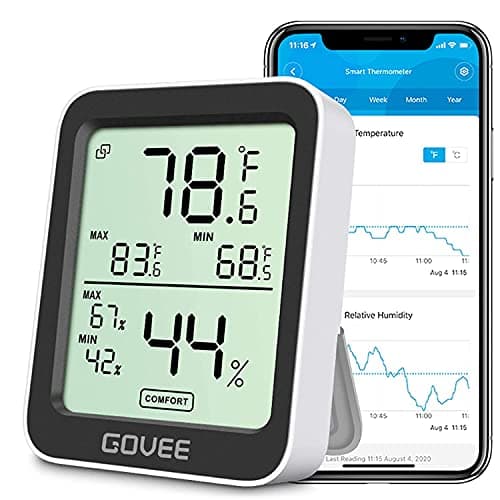
The one that logs. If your problem is that the house is dry at night but fine during the day, a hygrometer you have to walk over and read will never tell you that.
#ad Price as of October 18, 2026, from Amazon. Prices change. How we make money.
Published specifications
| Specification | Value | Source |
|---|---|---|
| Function | Bluetooth temperature and humidity sensor with app-based logging and data export | Govee published specification |
What is good about it
- Logging is the feature. Overnight humidity swings are invisible to a spot reading, and they explain most morning symptoms
- Data export means you can check whether the humidifier actually changed anything, rather than assuming
What is not
- Bluetooth range is room-scale; a basement sensor will not reach a phone upstairs
- Requires an app and an account, which is a genuine cost for some people
Who should skip this
Skip this if you just want a number on a wall. The logging is the whole premium, and it is wasted if you will not look at it.
How it scored
- Logging and history9.5
- Value for the decision it informs9.0
- Range and placement freedom6.0
Overall 8.6 / 10. This is our editorial score from published specifications and computed running cost. It is not a test result, and it is deliberately not marked up as a rating in this page’s structured data.
Levoit OasisMist 1000S
A bedroom or office you want to refill once a week, not an open-plan floor
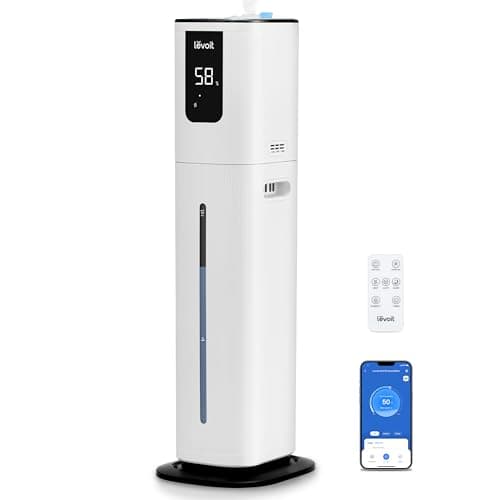
A 10-liter tower that runs up to 100 hours on low. Read that carefully: the long run time comes from a low sustained output, which makes it a superb refill interval and a weak large-room humidifier.
#ad Price as of October 18, 2026, from Amazon. Prices change. How we make money.
Published specifications
| Specification | Value | Source |
|---|---|---|
| Tank capacity | 2.6 gal / 10 L | Levoit published specification |
| Coverage | 300-600 sq ft | Levoit published specification |
| Rated power | 27.5 W | Levoit published specification |
| Noise | Under 28 dB | Levoit published specification |
| Run time | Up to 100 hours on the low mist setting | Levoit published specification |
| Type | Ultrasonic, cool mist only, with a humidity sensor and auto mode | Levoit published specification |
| Dimensions | 8.4 x 10.0 x 28.7 in | Levoit published specification |
What it costs to run
About $22 a year in electricity at 12 hours a day.
27.5 W / 1000 x 12 hours x 365 days = 120.5 kWh. At 18.34 cents/kWh that is $22.09 a year at rated power, and less on the low mist setting most people would actually use. Add distilled water if your tap water is hard, which for an ultrasonic unit is the real recurring cost.
What is good about it
- 27.5 W is the lowest rated power of any humidifier we carry, so it is cheap to leave running
- A humidity sensor with auto mode means it can hold a setpoint rather than misting blindly, which partly offsets the usual ultrasonic weakness
- Under 28 dB and a tall, narrow footprint - it fits beside a bed or a desk without taking floor space
What is not
- Levoit does not publish a maximum mist output for this model, so we cannot quote one; the tank-over-run-time arithmetic (10 L over 100 h) implies only about 0.63 gallons a day on low, less than the LV600S
- Ultrasonic, so it aerosolizes whatever minerals are in the tank - the EPA's white-dust caution applies, and it wants distilled water
- The 300-600 sq ft coverage claim is not measured to any external standard and, at that sustained output, is optimistic for the upper end
Who should skip this
Skip this if you are trying to humidify a whole floor or an open-plan space. Its strength is a week between refills in one closed room; asked to fight a large, leaky volume it will run continuously and move the number very little.
How it scored
- Cannot over-humidify5.5
- Refill interval10.0
- Power efficiency9.5
- Sustained output for a large room5.0
Overall 7.8 / 10. This is our editorial score from published specifications and computed running cost. It is not a test result, and it is deliberately not marked up as a rating in this page’s structured data.
How we ranked these
We have not tested these units. Nobody here owns one. What we did was compile each manufacturer’s published specifications, check the coverage claims against AHAM’s room-sizing rule, and compute what each one costs to run for a year at the current US average electricity price. Every figure on this page is attributed to whoever published it, and the arithmetic is shown so you can redo it.
How we rank these sets out the full method, including what would change a ranking.