Guide
Activated Carbon Explained
Carbon is the only stage in a purifier that treats gases. It is also the stage manufacturers are vaguest about, because the honest spec would be a weight and almost nobody publishes one.
By Scooter M. · Published · Last updated
How this page is funded: the buy links below are affiliate links. If you buy through one, we earn a commission at no extra cost to you. It does not change the order of the picks or what we say about them. Full disclosure.
The short answer
Quantity is the specification, and it is usually missing. Carbon works by adsorption - gas molecules stick to an enormous internal surface area until that surface is full. More carbon means more capacity and a longer useful life, which is why a thin carbon-coated mesh and a tray of granular pellets behave completely differently despite carrying the same name on the box. If a listing does not tell you which one you are getting, assume the thin one.
Adsorption, not filtration
A HEPA filter is a physical sieve for particles. Carbon is not doing that at all. Gas molecules adhere to the surface of the carbon and stay there - adsorption, with a d, meaning stuck to the surface rather than soaked into the bulk. Activated carbon is processed specifically to maximize that surface: the useful area is inside a maze of pores rather than on the outside of the granule.
Two consequences follow directly, and they explain almost everything people find confusing about odor filters.
- Capacity is finite. When the surface is occupied, the filter stops working. It does not look different, it does not clog, and there is no light on the unit for it.
- Contact time matters. Air rushing past a thin layer gives molecules little opportunity to land. The same air moving slowly through a deep bed of granules gives them a great deal.
The three things sold as an activated carbon filter
| What it is | How to recognize it | What to expect |
|---|---|---|
| Carbon-coated mesh or fabric | A thin dark sheet, often bonded to the pre-filter. Weighs almost nothing | Takes the edge off a mild smell for a few weeks. Not a smoke solution |
| Carbon-impregnated pleats | Part of a combined filter cartridge, sold as 3-in-1 or similar | Better. Still limited by how much carbon fits alongside the HEPA media |
| Granular or pelletized carbon bed | A separate, noticeably heavy filter. Sometimes rattles | The only version that handles sustained smoke or cooking odor |
You can very often tell which you have by picking the filter up. Carbon is dense; a real bed of it has obvious weight, and a coated sheet does not. That crude test is more informative than most spec sheets, which is a poor state of affairs but a true one.
Why nobody publishes the number
The specification that would settle this is the weight of carbon in the filter, and it is almost never published. We looked for it on the units we carry and could not find a manufacturer-stated carbon mass for any of them, so we are not going to quote one - not an estimate, not a figure from a review site, not a number inferred from filter dimensions.
What manufacturers do publish is the structure of the filtration stack, and that is genuinely useful. Winix specifies the 5500-2 as a four-stage system with a washable pre-filter, an activated carbon stage, True HEPA and PlasmaWave, and sells the carbon stage as a distinct, separately washable component rather than as a coating on something else. Coway specifies the AP-1512HH Mighty as a pre-filter, a deodorization filter, a Green True HEPA filter and a bipolar device, with the deodorization filter given its own six-month life against the HEPA filter’s one year. In both cases the carbon stage being a separate part with its own replacement schedule tells you something real about how much of it there is.
The replacement schedule is the tell
Here is a shortcut that works better than reading marketing copy. Look at how the manufacturer schedules the carbon stage relative to the HEPA stage.
- Carbon replaced more often than HEPA - as on the Coway, where the deodorization filter has a six-month life against the HEPA filter’s twelve - means the manufacturer expects it to saturate first. That is an honest schedule and a sign the carbon is being taken seriously as a consumable.
- Carbon and HEPA replaced together in one cartridge means you cannot respond to saturation independently. If your problem is odor, you may be replacing a perfectly good HEPA filter to renew the carbon.
- No carbon replacement schedule at all is the least encouraging answer, and it usually accompanies the coated-mesh version.
Can you recharge or wash carbon?
Where a manufacturer says a carbon stage is washable, washing it removes dust from the surface, which is worth doing. Whether it restores adsorption capacity is a different question and one no manufacturer here publishes a figure for, so we treat a washed carbon filter as cleaned rather than renewed and still replace it on schedule. The general principle is the same one we set out in washable vs replaceable filters.
Baking carbon in an oven to reactivate it is a suggestion that circulates online. We would not: industrial reactivation uses temperatures and controlled atmospheres a domestic oven does not reach, and the failure mode involves heating a saturated filter full of adsorbed organic compounds in the room where you cook.
What carbon will not do
- Remove particles. That is the HEPA stage’s job. A carbon-only device is not an air purifier in the sense most people mean - the split is set out in HEPA vs carbon filters.
- Fix a source. The EPA’s position on indoor air is that eliminating or reducing individual sources of pollution is usually the most effective way to improve it, and that for most home problems source control is the most effective solution. Carbon is the third strategy, after source control and ventilation - not the first.
- Work at any useful rate on a room it is undersized for. Contact time is part of the mechanism, and a small unit run flat out in a large room gives the air less of it, not more.
- Signal its own exhaustion. There is no visual cue. If odors start returning, the carbon is the first thing to suspect.
How to buy for odor specifically
- Look for a carbon stage listed as a separate replaceable part with its own interval, not as a coating on the pre-filter.
- Check the price and availability of that part before you buy the machine. On an odor problem it is the consumable you will be buying most often.
- Size on CADR against the room as usual - carbon does not change the sizing arithmetic, and a unit too small for the space will disappoint you on both counts. The rule is in CADR explained.
- Be honest about the source. A litter box, a smoker in the house or a gas hob is a continuous emitter, and a continuous emitter will saturate any quantity of carbon on a schedule.
What we would actually do
Deal with the source and the ventilation first, because the EPA is right that they are the effective interventions and carbon is the expensive one. Then, if a real residual odor remains, buy a purifier with a genuinely separate carbon stage and budget for replacing it more often than the HEPA filter. Our picks for that specific job are in best air purifiers for smoke. And if the smell is musty rather than smoky, stop - that is moisture, and no amount of carbon addresses it.
What we would buy for this
Chosen from the same registry as our roundups, on published specifications and computed running cost.
Winix 5500-2
Smoke, cooking smells and pet odors
The one with a genuine granular carbon stage rather than a carbon-dusted sheet, which is why it belongs on a smoke and odor list and why it costs more to run.
#ad We do not hold a current price for this product, so we do not show one. How we make money.
Published specifications
| Specification | Value | Source |
|---|---|---|
| CADR (smoke) | 232 CFM | AHAM-verified figure published by Winix |
| CADR (dust) | 243 CFM | AHAM-verified figure published by Winix |
| CADR (pollen) | 246 CFM | AHAM-verified figure published by Winix |
| Coverage | 360 sq ft | Winix published specification |
| Rated power | 70 W | Winix published specification |
| Filtration | 4-stage: washable pre-filter, activated carbon, True HEPA, PlasmaWave | Winix published specification |
| Certification | Energy Star, CARB certified | Winix published specification |
What it costs to run
About $56 a year in electricity at 12 hours a day, before filters.
70 W / 1000 x 12 hours x 365 days = 306.6 kWh. At 18.34 cents/kWh that is $56.23 a year. Over three years that is roughly $95 more than the Levoit Core 400S at the same hours - typically more than the price gap between the two units at purchase.
What is good about it
- AHAM-verified CADR, which means the figure was measured to the AC-1 standard rather than asserted by marketing
- A real granular carbon filter, which is what actually adsorbs gases and odors
- The washable pre-filter slows down how fast the expensive filter loads up
What is not
- 70 W is roughly double the Levoit Core 400S for a similar CADR, and you pay that difference every year
- PlasmaWave is an ionizing stage; it can be switched off, and we would switch it off
Who should skip this
Skip this if odor is not your problem. Buying for dust and pollen alone means paying a 70 W electricity premium for a carbon stage you will not use.
How it scored
- Clean air per watt6.5
- Honest coverage claim9.0
- Odor and gas removal9.5
- Filter economics8.0
Overall 8.4 / 10. This is our editorial score from published specifications and computed running cost. It is not a test result, and it is deliberately not marked up as a rating in this page’s structured data.
Coway Airmega AP-1512HH Mighty
Running continuously in a medium room
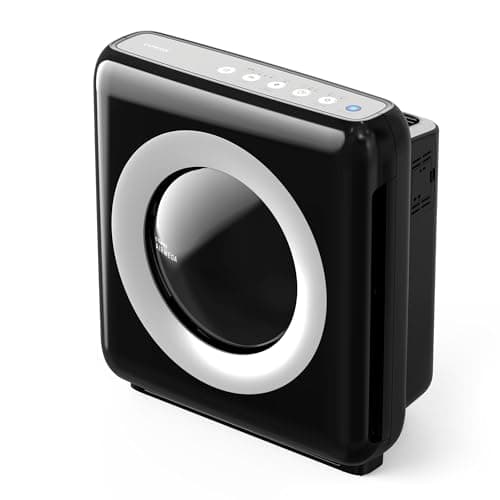
The most efficient unit here at low speed - 3.7 W on speed one - which matters enormously if you leave a purifier running all day and almost not at all if you do not.
#ad Price as of October 18, 2026, from Amazon. Prices change. How we make money.
Published specifications
| Specification | Value | Source |
|---|---|---|
| CADR (smoke) | 233 CFM | Coway published specification |
| CADR (dust) | 246 CFM | Coway published specification |
| CADR (pollen) | 240 CFM | Coway published specification |
| Coverage | 361 sq ft at 4.8 air changes/hr (1,748 sq ft at 1 ACH) | Coway published specification |
| Power draw by speed | 0.3 W standby / 3.7 W speed 1 / 8.7 W speed 2 / 75.3 W speed 3 | Coway published specification |
| Filtration | Pre-filter, odor filter, Green True HEPA, bipolar device | Coway published specification |
What it costs to run
About $6 a year running 24/7 on speed one, or $121 a year running 24/7 on speed three.
Speed 1: 3.7 W / 1000 x 24 x 365 = 32.4 kWh = $5.94 a year. Speed 3: 75.3 W / 1000 x 24 x 365 = 659.6 kWh = $120.97 a year. That twenty-fold spread is the most important number on this page, and it is why we chase per-speed figures instead of accepting a single rated wattage.
What is good about it
- Coway publishes power draw per fan speed, which almost nobody does and which is the only way to compute a real running cost
- 3.7 W on speed one is remarkable - cheaper to run continuously than most nightlights
- Coverage published at 1, 2 and 4.8 air changes per hour, so you can size it honestly
What is not
- 75.3 W on speed three is the highest draw here; how the auto mode behaves decides your bill
- The bipolar device is a stage we would rather do without; check it can be disabled
Who should skip this
Skip this if you only run a purifier for an hour or two at a time. Its whole advantage is low-speed efficiency over long hours, and short bursts on high speed give that straight back.
How it scored
- Clean air per watt9.5
- Honest coverage claim9.5
- Quiet operation8.0
- Filter economics7.5
Overall 8.7 / 10. This is our editorial score from published specifications and computed running cost. It is not a test result, and it is deliberately not marked up as a rating in this page’s structured data.
How we ranked these
We have not tested these units. Nobody here owns one. What we did was compile each manufacturer’s published specifications, check the coverage claims against AHAM’s room-sizing rule, and compute what each one costs to run for a year at the current US average electricity price. Every figure on this page is attributed to whoever published it, and the arithmetic is shown so you can redo it.
How we rank these sets out the full method, including what would change a ranking.
Questions people ask
+−How much activated carbon does an air purifier need?
More than a coated mesh provides, and the specific weight is almost never published - we could not find a manufacturer-stated carbon mass for any unit we carry, so we do not quote one. The practical signal is whether the carbon is a separate, heavy filter with its own replacement interval.
+−How long does an activated carbon filter last?
It depends on the quantity of carbon and how much gas it is asked to handle. The EPA notes that gas-phase filter lifetimes can be short because the material becomes overloaded. Where a manufacturer publishes an interval - Coway gives its deodorization filter a six-month life - use that.
+−Can you wash or recharge an activated carbon filter?
Washing, where the manufacturer says it is washable, removes surface dust. Whether it restores adsorption capacity is not something any of these manufacturers publish a figure for. We would not try to reactivate one in a domestic oven.
+−Does activated carbon remove dust and pollen?
No. Carbon adsorbs gases; particles are the HEPA stage’s job. A purifier needs both if you have both problems, which is why almost every unit worth buying stacks them in series. How much carbon is enough, by weight rather than by mention, is in best air purifiers for VOCs.
+−Why has my purifier stopped removing smells?
Most likely the carbon has saturated. It gives no visual warning and there is no indicator light for it, so returning odor with unchanged particle performance is the symptom to watch for. A unit that schedules its carbon separately makes this easier to stay ahead of - Coway Mighty review. Cooking is the most relentless version of this problem and has its own page - best air purifiers for kitchen smells.