Roundup
Best Air Purifiers for 3D Printing
A desktop printer is a point source you can put in a box, which makes this one of the few air quality problems where the cheapest fixes are also the most effective.
By Scooter M. · Published · Last updated
How this page is funded: the buy links below are affiliate links. If you buy through one, we earn a commission at no extra cost to you. It does not change the order of the picks or what we say about them. Full disclosure.
The short answer
Change filament and enclose the printer before you buy anything. Peer-reviewed measurements of desktop printers found ABS emitting ultrafine particles at roughly 1.9 x 10^11 per minute against about 2.0 x 10^10 for PLA - and particle concentrations 33 to 38 times higher with ABS. The same work found a single print in a large, well-ventilated office did not meaningfully raise concentrations, while the same print in a small unventilated room was readily detectable. Filament choice and enclosure-plus-ventilation are the levers. A purifier is what you add afterwards, and it needs real carbon because the other half of the problem is a gas.
What a printer actually emits
Two different pollutants come off a hot nozzle, and they need different responses.
Ultrafine particles - under 100 nanometres - form as the melted polymer cools. These are far below the 0.3 micron size that filter ratings are quoted at, which sounds alarming but is not: filtration efficiency actually rises again below roughly 0.1 micron because very small particles are captured by diffusion rather than interception. The practical point is that no manufacturer publishes a figure for performance at 50 nanometres, so smoke CADR - measured over roughly 0.09 to 1.0 microns - is the closest published proxy and the number to size on.
Volatile organic compounds - and these are the part a HEPA filter does nothing about. The measured dominant compound from ABS is styrene, at roughly 10 to 110 micrograms per minute and accounting for more than half of total VOC emitted. PLA is far gentler, emitting mostly lactide at around 4 to 5 micrograms per minute, with methyl methacrylate the predominant compound at about 37% of its total VOC.
| PLA | ABS | |
|---|---|---|
| Ultrafine particle emission rate | ~2.0 x 10^10 /min | ~1.9 x 10^11 /min |
| Relative particle concentration | Baseline | 33-38x higher |
| Dominant VOC | Lactide | Styrene |
| Dominant VOC emission rate | ~4-5 ug/min | ~10-110 ug/min |
| Share of total VOC | MMA about 37% | Styrene over 50% |
The gap between those columns is larger than the gap between any two purifiers on this page. If your prints do not specifically need ABS, switching filament is a bigger intervention than anything you can buy - and it is cheaper than a filter.
How we judged these
- A real carbon stage. Styrene is a gas. A unit without meaningful carbon addresses half the problem, and for ABS the less important half.
- Published smoke CADR. The closest published proxy for fine-particle performance, and the only way to size the unit to the print room.
- Carbon replaceable on its own schedule. A print farm running ABS is a continuous gas source, and the carbon will saturate long before the HEPA loads.
- Quiet enough to sit beside a printer you listen to. Many people run prints overnight in a room they sleep near.
Sizing a print room
Floor area times two-thirds gives the smoke CADR, as everywhere else on this site. Two adjustments are specific to this case.
First, size on the room, not the printer. The emission is concentrated but it disperses into the whole volume, and a desk-sized purifier pointed at the printer is treating a small bubble while the room fills. Second, oversize deliberately if prints run for hours, so you can run the unit on a low speed continuously - CADR is measured at maximum fan speed and a long print is a long exposure. The full table is in what size air purifier do I need.
Why these three
The Medify MA-40 is the balanced pick: a certified 245 CFM smoke CADR covering 380 sq ft, an active carbon composite layer, certified 0.00 ppb ozone and a published 261 kWh a year. It is the only one of the three with a federally certified figure for every one of those. Its 46 dBA minimum is the real drawback if the printer is near a bed.
The Winix 5510 is the pick if you print ABS routinely. Its carbon is a separate AOC filter on a published 12-month schedule rather than a layer inside a combined cartridge, which is the arrangement that holds up against a recurring styrene load - the reasoning is in activated carbon explained. It also moves the most air of the three at 253 CFM. The trade is that Winix publishes no wattage for it and it is not ENERGY STAR certified, so its running cost is unknowable.
The Levoit Eleva 300X suits a small, dedicated print room up to about 250 sq ft. It is the most efficient of the three at 6.68 CFM per watt and 145 kWh a year, drops to 20 dB in sleep mode for overnight prints, and publishes a two-year particle filter life. Its carbon is the smallest of the three, so it is the PLA choice rather than the ABS one.
What a purifier will not fix
- A printer in a small sealed room. If the room is tiny and unventilated, the published measurements say that is the dominant variable. Open something.
- The smell during printing. Carbon reduces it over minutes; the plume above a hot nozzle is immediate. An enclosure addresses it at source.
- Post-processing with solvents. Acetone smoothing is a solvent-vapor job for ventilation, not a filter.
- Choosing ABS anyway. No purifier recovers the 33-to-38-fold difference. Filtration reduces concentration; it does not reduce emission.
What we would actually do
Print PLA unless the part genuinely needs ABS. That single decision does more than everything else on this page combined, and it costs nothing.
Enclose the printer and vent the enclosure outdoors if the room allows it. Then put a unit rated above the two-thirds figure for the room in there, running continuously on low through the print and for an hour after, and choose it for its carbon if ABS is in regular use. Do not put the printer in a bedroom, and do not expect a purifier to make a small sealed room behave like a ventilated one.
Quick picks
Ranked on published specifications and computed running cost. Tap any row for the full write-up, including who should skip it.
| # | Product | Best for | Score | Price |
|---|---|---|---|---|
| 1 | 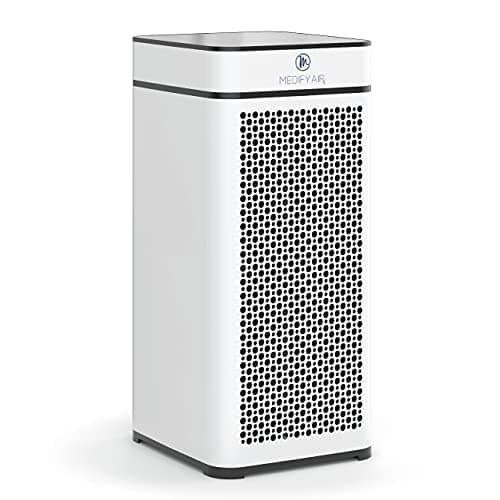 Medify MA-40A room up to about 380 sq ft where you want carbon as well as particle filtration | Best overall | 8.1 | $212.99 - View on Amazon |
| 2 | 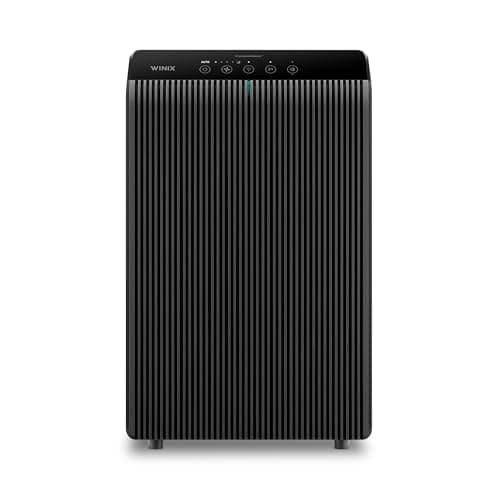 Winix 5510A room up to about 390 sq ft where odor control matters as much as particles | Best carbon for ABS | 8.2 | $179.99 - View on Amazon |
| 3 | 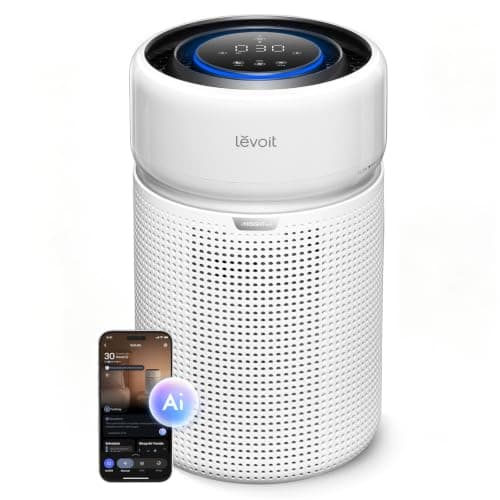 Levoit Eleva 300XA bedroom or home office up to about 250 sq ft | Best for a small print room | 8.9 | $129.99 - View on Amazon |
#1 - Best overall
Medify MA-40
A room up to about 380 sq ft where you want carbon as well as particle filtration
A capable mid-price unit with a real carbon composite stage and a federal certification you can check - which is useful, because Medify's own CADR claim and the certified figure do not agree.
#ad Price as of October 18, 2026, from Amazon. Prices change. How we make money.
Published specifications
| Specification | Value | Source |
|---|---|---|
| CADR - smoke (federal certification) | 245 CFM | ENERGY STAR certified room air cleaners database |
| CADR (manufacturer claim) | 330 - see cons | Medify published specification |
| Coverage | 380 sq ft | ENERGY STAR certified room air cleaners database |
| Clean air per watt | 5.53 CFM/W | ENERGY STAR certified room air cleaners database |
| Annual energy use | 261 kWh/yr | ENERGY STAR certified room air cleaners database |
| Ozone emissions | 0.00 ppb | ENERGY STAR certified room air cleaners database |
| Rated power | 54 W | Medify published specification |
| Noise | 46-66 dBA | Medify published specification |
| Filtration | 3-layer: pre-filter, H13 True HEPA, active carbon composite | Medify published specification |
| Filter life | 3,000 hours | Medify published specification |
| Dimensions and weight | 22 x 9.9 x 10.9 in, 15.6 lb | Medify published specification |
What it costs to run
About $48 a year on ENERGY STAR's certified annual energy figure.
ENERGY STAR publishes 261 kWh a year for the MA-40. At 18.34 cents/kWh that is $47.87 a year. Medify's own 54 W rating cross-checks it at 12 hours a day: 54 / 1000 x 12 x 365 = 237 kWh = $43.37, so the two figures agree closely. Filters at 3,000 hours are the larger running cost.
What is good about it
- ENERGY STAR certified, so its clean air per watt (5.53), annual energy (261 kWh) and ozone (0.00 ppb) are all independently published
- H13 media and an active carbon composite layer rather than carbon dust on the filter wrap
- Certified at 0.00 ppb ozone despite shipping with a switchable ionizer feature
- A published 3,000-hour filter life, which converts to a budgetable annual cost - many competitors publish nothing
- 245 CFM of certified smoke CADR covers a genuine 380 sq ft living room
What is not
- Medify advertises a CADR of 330 and some retailers list 380, while the federal certification for the MA-40 reports 245 smoke CADR. Size the room on 245
- Its Amazon listing claims 1,793 sq ft in one hour - a one-air-change figure, about 4.7 times the certified 380 sq ft coverage
- 46 dBA is its minimum, not a whisper setting. This is a noticeably louder unit at low speed than a Levoit or Blueair of similar size
- It includes an ionizer. We would leave it off, and a unit without one is a cleaner answer
- 5.53 CFM/W is mid-pack - the Blueair units we list are 8.84 and 9.59 for comparable rooms
- 3,000 hours is about four months of continuous running, so the filter cadence is faster than the 9-to-12 months better units manage
Who should skip this
Skip this if you need quiet - 46 dBA minimum rules it out of a bedroom for light sleepers. Skip it too if you want the efficiency leader rather than the carbon.
How it scored
- Carbon stage8.0
- Certified data available9.0
- Honesty of claimed CADR5.0
- Quiet operation5.0
Overall 8.1 / 10. This is our editorial score from published specifications and computed running cost. It is not a test result, and it is deliberately not marked up as a rating in this page’s structured data.
#2 - Best carbon for ABS
Winix 5510
A room up to about 390 sq ft where odor control matters as much as particles
The purchasable successor to the discontinued 5500-2, and on paper the better air mover of the two units on this page. It is also the one whose running cost and ozone output you cannot look up, because Winix has not certified it with ENERGY STAR.
#ad Price as of October 18, 2026, from Amazon. Prices change. How we make money.
Published specifications
| Specification | Value | Source |
|---|---|---|
| CADR - smoke | 253 CFM | Winix published specification |
| CADR - dust | 252 CFM | Winix published specification |
| CADR - pollen | 247 CFM | Winix published specification |
| Coverage | 392 sq ft, AHAM Verifide | Winix published specification |
| Filtration | 4-stage: washable pre-filter, True HEPA, AOC carbon filter, PlasmaWave | Winix published specification |
| Filter replacement | 12 months, HEPA and AOC carbon | Winix published specification |
| Fan speeds | 5 | Winix published specification |
| Noise | 23.5 dB on the slowest speed; Winix does not publish a maximum | Winix published specification |
| Rated power | Not published by Winix, and the model is not ENERGY STAR certified | Winix published specification / ENERGY STAR certified room air cleaners database |
| Ozone emissions | Not published - see cons | ENERGY STAR certified room air cleaners database |
| Dimensions and weight | 13.59 x 8.27 x 22.17 in, 13.3 lb | Winix published specification |
What is good about it
- 253 CFM smoke CADR is about 10% more air than the Core 400S moves, for slightly less money
- Winix publishes a 12-month replacement interval for both the HEPA and the carbon filter - Levoit publishes no interval for the Core 400S at all
- The carbon is a separate AOC filter with its own part number and schedule, not a coating on the HEPA wrap, which is what actually matters for odors
- AHAM Verifide at 392 sq ft, and that figure is close to the honest two-thirds-of-CADR number rather than an inflated one
- Washable pre-filter, so the consumable stages last closer to their rated life
- Five fan speeds gives finer control than most units at this price
What is not
- Not ENERGY STAR certified, so there is no published wattage and no certified annual energy figure. On a machine designed to run continuously, that is the specification we care most about and it does not exist
- PlasmaWave is an ionizing stage, and Winix's published specification does not state whether it can be switched off on this model
- No ozone emissions figure is published for it, because that figure comes from the ENERGY STAR certification it does not have
- Winix does not publish a maximum noise level - only the 23.5 dB minimum
- Its own Amazon listing advertises 1,881 sq ft while Winix's specification sheet says 392 sq ft. Both are real numbers answering different questions, and the larger one is not a coverage figure you can use
- At 13.3 lb it is the heavier of the two, and it is a tower rather than a cylinder, so it needs wall clearance
Who should skip this
Skip this if you want to know what the machine costs to run before you buy it, or if you would rather not own an ionizing stage you cannot confirm is switchable. Both of those point to the Core 400S instead.
How it scored
- Clean air delivered9.0
- Odor handling9.0
- Published running cost2.0
- Filter transparency9.0
Overall 8.2 / 10. This is our editorial score from published specifications and computed running cost. It is not a test result, and it is deliberately not marked up as a rating in this page’s structured data.
#3 - Best for a small print room
Levoit Eleva 300X
A bedroom or home office up to about 250 sq ft
The best-engineered Levoit purifier you can actually buy on Amazon, and the only one in the range for which Levoit publishes a filter replacement interval. It moves less air than a Core 400S and does more with every watt.
#ad Price as of October 18, 2026, from Amazon. Prices change. How we make money.
Published specifications
| Specification | Value | Source |
|---|---|---|
| CADR - smoke, dust, pollen | 161 CFM, AHAM Verifide | Levoit published specification |
| Coverage | 250 sq ft at 4.8 air changes/hr (1,200 sq ft at 1 ACH) | Levoit published specification |
| Clean air per watt | 6.68 CFM/W | ENERGY STAR certified room air cleaners database |
| Annual energy use | 145 kWh/yr | ENERGY STAR certified room air cleaners database |
| Ozone emissions | 0.00 ppb | ENERGY STAR certified room air cleaners database |
| Rated power | Under 25.5 W | Levoit published specification |
| Noise | 20-50 dB (20 dB in Sleep Mode) | Levoit published specification |
| Filtration | 3-stage sealed HEPA with a separate activated carbon filter | Levoit published specification |
| Filter replacement | Particle filter up to 2 years; carbon filter 6-12 months | Levoit published specification |
| Fan speeds | 4 plus Auto | Levoit published specification |
| Sensor | AirSight Plus 2.0, 3-channel (PM1.0, PM2.5, PM10) | Levoit published specification |
| Dimensions and weight | 9.4 x 9.4 x 15.1 in, 9.9 lb | Levoit published specification |
What it costs to run
About $27 a year on ENERGY STAR's certified annual energy figure.
ENERGY STAR publishes 145 kWh a year for LAP-C341S, the Eleva 300X. At 18.34 cents/kWh that is $26.59 a year. The Core 400S, on the same certified basis, is 237 kWh and $43.47 - so the Eleva costs about $17 a year less to run while covering a smaller room more efficiently.
What is good about it
- 6.68 CFM of clean air per watt against the Core 400S's 5.75 - a 16% improvement in the specification that decides your bill
- 145 kWh a year, about 40% less electricity than the Core 400S, for a machine sized to a bedroom rather than a living room
- The only Levoit purifier we have found where Levoit publishes a filter replacement interval - up to 2 years on the particle filter, 6-12 months on the carbon
- A separate activated carbon filter rather than a carbon layer inside a combined cartridge, which is the arrangement that actually holds up against odors
- 20 dB in Sleep Mode is genuinely quiet enough to sleep beside, and it publishes the figure
- Certified at 0.00 ppb ozone, with no ionizing stage
- A 3-channel particle sensor at this price is unusual; most units at any price infer air quality from a single channel
What is not
- 161 CFM is a 250 sq ft machine. It is not a living-room purifier and buying it for one would be a mistake
- Newer and less reviewed than the Core line, so there is less accumulated owner feedback to draw on
- The 1,200 sq ft figure on the listing is a one-air-change-per-hour number; the usable coverage is 250 sq ft and Levoit publishes both, to its credit
- Two filters on two different schedules is more to track than one combined cartridge, even though it is the better design
- Levoit's more efficient Eleva 500X is certified at 9.26 CFM/W but we could not find it purchasable on Amazon, so the range's best unit is not the one you can buy here
Who should skip this
Skip this if the room is much over 250 sq ft - the Core 600S is the honest answer there, and no amount of running this unit longer will substitute for CADR it does not have.
How it scored
- Clean air per watt9.0
- Published specifications9.5
- Quiet operation9.5
- Room size covered6.5
Overall 8.9 / 10. This is our editorial score from published specifications and computed running cost. It is not a test result, and it is deliberately not marked up as a rating in this page’s structured data.
How we ranked these
We have not tested these units. Nobody here owns one. What we did was compile each manufacturer’s published specifications, check the coverage claims against AHAM’s room-sizing rule, and compute what each one costs to run for a year at the current US average electricity price. Every figure on this page is attributed to whoever published it, and the arithmetic is shown so you can redo it.
How we rank these sets out the full method, including what would change a ranking.
Questions people ask
+−Do I need an air purifier for 3D printing?
It helps, but it is the third intervention rather than the first. Published measurements show ABS emitting 33 to 38 times the particle concentration of PLA, and the same single print being undetectable in a large ventilated office while readily detectable in a small unventilated room. Filament choice and enclosure-plus-ventilation are the big levers; a purifier reduces what is left.
+−Is PLA safer than ABS for indoor printing?
It emits substantially less. Measured ultrafine particle emission rates were roughly 2.0 x 10^10 per minute for PLA against about 1.9 x 10^11 for ABS, and the dominant VOC from ABS is styrene at around 10 to 110 micrograms a minute compared with lactide from PLA at about 4 to 5. We are describing emissions, not health outcomes - the latter is not an appliance question.
+−Can a HEPA filter catch 3D printer ultrafine particles?
Better than the size numbers suggest. Ultrafine particles are under 100 nanometres, well below the 0.3 micron size filters are rated at, but efficiency rises again at that scale because very small particles are captured by diffusion. The catch is that nobody publishes a figure for performance at 50 nanometres, so smoke CADR is the closest published proxy - and HEPA does nothing at all for the styrene.
+−What size air purifier do I need for a print room?
Size on the room, not the printer: floor area times two-thirds gives the smoke CADR. Add margin if prints run for hours, because CADR is measured at maximum fan speed and you will want to run the unit quietly and continuously. A desk-sized unit aimed at the printer treats a bubble of air while the rest of the room fills.
+−Should I enclose my 3D printer?
If you can, yes - it is the second-best lever after filament choice and it is close to free. A printer is a point source, so an enclosure captures emissions where they are concentrated instead of treating the whole room afterwards. Venting the enclosure outdoors is better still.
+−Does a resin printer need the same purifier?
Not necessarily, and we are not going to pretend the figures transfer. Resin printing does not melt thermoplastic, so the ultrafine particle data above does not apply; the concern is uncured resin and solvent vapor, particularly during washing and curing. That is primarily a ventilation and handling question.