Symptom guide
Musty Smell in the House
Air freshener is the most popular response and the least effective one. The smell is a symptom of something wet.
By Scooter M. · Published · Last updated
How this page is funded: the buy links below are affiliate links. If you buy through one, we earn a commission at no extra cost to you. It does not change the order of the picks or what we say about them. Full disclosure.
The short answer
- Find the water source and stop it.
- Dry the wet material within 24 to 48 hours.
- Bring relative humidity below 60%, ideally to 30-50%.
- Remove or clean whatever has already grown.
- Only now, filter the residual air.
Doing these in a different order is why the smell keeps coming back.
How to tell where it is coming from
Musty smells are produced by microbial growth on damp material. So the question is not “what smells” but “what is wet.” Work through the likely candidates in order of how often they turn out to be the answer:
| Where | What is usually wet | The check |
|---|---|---|
| Basement or crawl space | Groundwater through the floor or walls; condensation on cold masonry in summer | Tape a square of plastic sheet to the floor for 24 hours. Moisture underneath means it is coming through the slab; moisture on top means it is condensing out of the air. |
| Bathroom | No working extractor fan, so every shower stays in the room | Does the mirror stay fogged for more than 15 minutes after a shower? |
| Under a sink or behind an appliance | A slow leak on a supply line or a waste trap | Dry paper towel taped under the joint overnight. |
| A closet or wardrobe against an external wall | Condensation on a cold wall with no air movement behind stored clothes | Is the wall cold to the touch and the closet always shut? |
| The whole house, worse in summer | Warm humid air meeting anything cooler than it | A hygrometer reading above 60%. |
| Front-loading washing machine | Water trapped in the door seal and detergent drawer | Pull back the seal and look at the underside of it. |
There is one more locator worth knowing about, and it walks. Silverfish and booklice are moisture-dependent species, so finding them tells you where the damp is before a smell does - the published humidity each one needs is here.
What actually works, in order
1. Stop the water (free to expensive, always first)
Everything after this is management. A dehumidifier running against an active leak works permanently and never finishes - a 545 W unit doing that costs around $200 a year in electricity at the current average rate, forever, for a problem that has a fix.
2. Dry it fast (free)
The EPA’s guidance is that wet materials must be dried within 24 to 48 hours to avoid mold growth. Fans, open doors, and heat where you have it. Speed matters more than equipment here.
3. Ventilate (free)
If outdoor air is drier than indoor air, opening windows is the fastest and cheapest dehumidifier you own. The important caveat: in humid summer weather it does the opposite, which is why people who air out a basement in August find it smells worse afterwards. Check the outdoor dew point, not the temperature.
4. Dehumidify (a running cost, and worth it in a basement)
Below 60% relative humidity, per the EPA, is the ceiling. In a basement that usually means a compressor dehumidifier on a humidistat. What size dehumidifier you need covers the sizing, and how to lower humidity covers the free options first.
5. Remove the growth
Cleaning hard surfaces, and removing porous material that has been wet long enough to be colonized - carpet underlay, cardboard, drywall in bad cases. Porous material that has grown mold generally cannot be cleaned, only replaced.
6. Filter what is left
A purifier with a real activated carbon stage will reduce the residual smell in the air. It is genuinely the last step, and it does not substitute for any of the five above - here is why in full.
When it is not what you think
- A smell only when the heating runs points at ductwork or the unit itself rather than the room.
- A smell only when a tap runs is usually a dry trap or the drain, not the air.
- A basement that smells musty with no visible mold is normal and does not mean you are imagining it. Growth is frequently behind, under or inside things.
- A sudden new smell after heavy rain is groundwater, and that is a drainage question rather than an appliance question.
This page is about the environment - humidity, particles, ventilation - and what changes it. It is not medical advice and we hold no medical qualification. If symptoms are persistent, severe or getting worse, that is a question for a clinician rather than a purchase.
What we would buy for this
Chosen from the same registry as our roundups, on published specifications and computed running cost.
ThermoPro TP49 Hygrometer
Anyone about to buy a humidifier or a dehumidifier

An inexpensive digital hygrometer is the highest-value purchase on this entire site, because it is the one that tells you whether to buy anything else.
#ad We do not hold a current price for this product, so we do not show one. How we make money.
Published specifications
| Specification | Value | Source |
|---|---|---|
| Function | Digital temperature and relative humidity readout with a comfort indicator | ThermoPro published specification |
What is good about it
- Cheap enough to buy three and put one in the bedroom, one in the basement and one in the living room, which is what you actually want
- Gives you the reading that decides between a humidifier and a dehumidifier - a decision people routinely get backwards
What is not
- Consumer hygrometers are typically accurate to within a few percentage points, which is fine for the 30-50% question and not fine for anything precise
- No logging, so you see now rather than overnight
Who should skip this
Skip this only if you already own a hygrometer. There is no household we would tell not to measure.
How it scored
- Value for the decision it informs10.0
- Accuracy for the 30-50% question8.0
- Logging and history2.0
Overall 9.0 / 10. This is our editorial score from published specifications and computed running cost. It is not a test result, and it is deliberately not marked up as a rating in this page’s structured data.
Midea Cube 35-Pint
Basements without a floor drain
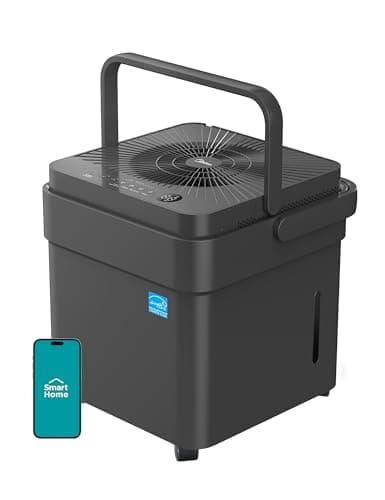
The adjustable 4.25-gallon bucket is the point. Most dehumidifiers get switched off because emptying a 2-gallon bucket twice a day is miserable; this one buys you a couple of days.
#ad Price as of October 18, 2026, from Amazon. Prices change. How we make money.
Published specifications
| Specification | Value | Source |
|---|---|---|
| Capacity | 35 pints per day | Midea published specification |
| Capacity (federal test) | 35.82 pints per day | ENERGY STAR certified products database |
| Coverage | Up to 3,500 sq ft | Midea published specification |
| Efficiency (IEF) | 2.01 L/kWh | ENERGY STAR certified products database |
| Annual energy use | 378 kWh/yr | ENERGY STAR certified products database |
| Bucket fill level | Adjustable, up to 4.25 gallons | Midea user manual |
| Fan speeds | 2 (High, Low) | Midea user manual |
| Dimensions | 14.76 x 14.57 x 14.45 in, 39.62 lb | Midea published specification |
| Certification | ENERGY STAR certified | ENERGY STAR certified products database |
What it costs to run
About $69 a year on ENERGY STAR's certified annual energy figure.
ENERGY STAR publishes 378 kWh a year for this model. At 18.34 cents/kWh that is $69.33 a year. That figure is calculated on the program's standardized test basis, not measured in your basement: a genuinely damp space where it cycles constantly will use more. Against the 50-pint Cube's 515 kWh ($94.45) it is the cheaper machine to own, which is the argument for sizing honestly rather than buying headroom.
What is good about it
- An adjustable bucket that holds up to 4.25 gallons - the difference between a unit you keep using and one you unplug in week three
- An IEF of 2.01 L/kWh removes about 18% more water per kWh than the 20-pint Cube's 1.70
- Nests down into a smaller shape for storage, which matters for an appliance you only use half the year
What is not
- The 3,500 sq ft coverage claim assumes conditions no real basement has; treat it as a ceiling, not a specification
- 35 pints is not enough for a genuinely wet basement with standing water
- Midea does not publish a rated wattage for this model, so we quote ENERGY STAR's certified annual energy figure instead
- No built-in pump on this model - without a floor drain you are either emptying the bucket or routing a gravity hose
Who should skip this
Skip this if your basement is wet rather than damp - visible water, white efflorescence on the walls, a musty smell that returns within a day of airing out. That is a drainage problem, and a 35-pint unit will run permanently and never win.
How it scored
- Tank interval10.0
- Capacity for the money8.5
- Efficiency per liter removed9.0
- Storage footprint9.0
Overall 8.7 / 10. This is our editorial score from published specifications and computed running cost. It is not a test result, and it is deliberately not marked up as a rating in this page’s structured data.
Winix 5500-2
Smoke, cooking smells and pet odors

The one with a genuine granular carbon stage rather than a carbon-dusted sheet, which is why it belongs on a smoke and odor list and why it costs more to run.
#ad We do not hold a current price for this product, so we do not show one. How we make money.
Published specifications
| Specification | Value | Source |
|---|---|---|
| CADR (smoke) | 232 CFM | AHAM-verified figure published by Winix |
| CADR (dust) | 243 CFM | AHAM-verified figure published by Winix |
| CADR (pollen) | 246 CFM | AHAM-verified figure published by Winix |
| Coverage | 360 sq ft | Winix published specification |
| Rated power | 70 W | Winix published specification |
| Filtration | 4-stage: washable pre-filter, activated carbon, True HEPA, PlasmaWave | Winix published specification |
| Certification | Energy Star, CARB certified | Winix published specification |
What it costs to run
About $56 a year in electricity at 12 hours a day, before filters.
70 W / 1000 x 12 hours x 365 days = 306.6 kWh. At 18.34 cents/kWh that is $56.23 a year. Over three years that is roughly $95 more than the Levoit Core 400S at the same hours - typically more than the price gap between the two units at purchase.
What is good about it
- AHAM-verified CADR, which means the figure was measured to the AC-1 standard rather than asserted by marketing
- A real granular carbon filter, which is what actually adsorbs gases and odors
- The washable pre-filter slows down how fast the expensive filter loads up
What is not
- 70 W is roughly double the Levoit Core 400S for a similar CADR, and you pay that difference every year
- PlasmaWave is an ionizing stage; it can be switched off, and we would switch it off
Who should skip this
Skip this if odor is not your problem. Buying for dust and pollen alone means paying a 70 W electricity premium for a carbon stage you will not use.
How it scored
- Clean air per watt6.5
- Honest coverage claim9.0
- Odor and gas removal9.5
- Filter economics8.0
Overall 8.4 / 10. This is our editorial score from published specifications and computed running cost. It is not a test result, and it is deliberately not marked up as a rating in this page’s structured data.
How we ranked these
We have not tested these units. Nobody here owns one. What we did was compile each manufacturer’s published specifications, check the coverage claims against AHAM’s room-sizing rule, and compute what each one costs to run for a year at the current US average electricity price. Every figure on this page is attributed to whoever published it, and the arithmetic is shown so you can redo it.
How we rank these sets out the full method, including what would change a ranking.
Questions people ask
+−How do I get rid of a musty smell in the house fast?
Fast and permanent are different questions. Fast: ventilate hard if the outdoor air is drier, and run fans on anything damp. Permanent: find the water. Anything that masks the smell without changing the moisture is buying you hours.
+−How do I get rid of a musty smell in a closet?
Closets against external walls go musty because still air plus a cold surface equals condensation. Take everything out, let it dry, leave the door ajar or fit a vent, and pull stored items a few inches off the wall. A small desiccant unit can help in a genuinely sealed closet - though in one you open daily it never gets ahead.
+−Why does my basement smell musty but I cannot see mold?
Because growth is usually not on the surfaces you can see - it is behind shelving, under stored cardboard, inside wall cavities, or under the slab. The smell is the evidence. Measure the humidity: above 60% tells you the conditions are there whether or not you have found the colony - and that reading is also what decides whether a machine is justified: is a dehumidifier worth it.
+−Does a dehumidifier get rid of a musty smell?
It removes the conditions that produce it, so over weeks the smell fades as growth stops and existing material dries. It is not an air freshener and it will not work overnight. If the smell disappears within an hour of switching something on, that something was masking it. If you are weighing site equipment for an actual remediation, we compare the two classes in air scrubber vs air purifier.
+−Is a musty smell dangerous?
That is a health question and we are not qualified to answer it. What we can say is that a musty smell reliably indicates excess moisture and microbial growth, that the EPA advises keeping indoor humidity below 60%, and that concerns about health effects belong with a clinician rather than with a review site. What the EPA does and does not state is collected at damp house symptoms.