Roundup
Best Air Quality Monitors
A particulate monitor tells you about smoke and dust. A hygrometer tells you about damp and dryness. Buying the wrong one is buying a device that cannot see your problem.
By Scooter M. · Published · Last updated
How this page is funded: the buy links below are affiliate links. If you buy through one, we earn a commission at no extra cost to you. It does not change the order of the picks or what we say about them. Full disclosure.
Before the picks: the distinction that decides which of these devices can even detect your problem.
Is an air quality monitor the right instrument for this?
“Air quality monitor” is used for two quite different devices, and neither measures what the other does:
| Instrument | Measures | Answers | Cannot see |
|---|---|---|---|
| Particulate monitor (PM2.5) | Airborne particle concentration, sometimes VOCs and CO2 | Is there smoke or dust in this room? Did closing the windows work? | Humidity - so it is blind to damp and dryness entirely |
| Hygrometer | Relative humidity and temperature | Am I above 60% or below 30%? Do I need a humidifier or a dehumidifier? | Particles - so it is blind to smoke and dust entirely |
For most of the problems this site covers - musty smells, winter dryness, condensation, dust mites - the hygrometer is the instrument you need and it costs a fraction as much. The particulate monitor earns its place during wildfire season, in a house with a smoker, or where you want to see whether an air purifier is doing anything measurable. Full comparison at monitor vs hygrometer.
What specification actually matters
- Does it log? The single most useful feature. A spot reading catches one moment; most air problems vary over a day. Without history you cannot tell whether anything you changed helped.
- What does it actually measure? Many monitors that display a single “air quality” score are deriving it from one sensor. Look for the actual measured quantities.
- Can you export the data? Being able to look at last night is what turns a gadget into a diagnostic tool.
- Consumer sensors drift. Optical particle sensors are not laboratory instruments. Read them as relative - is this higher or lower than an hour ago - rather than as absolute truth. We go into this at are cheap air quality monitors accurate.
When to buy nothing at all
- You want to know about damp or dryness, and you were about to buy a PM2.5 monitor. Buy a hygrometer instead, for a tenth of the money.
- You already know what the problem is and what fixes it. A monitor is diagnostic; if the diagnosis is settled, spend the money on the fix.
- You want the monitor to make the air better. It will not - it measures.
Quick picks
Ranked on published specifications and computed running cost. Tap any row for the full write-up, including who should skip it.
| # | Product | Best for | Score | Price |
|---|---|---|---|---|
| 1 |  Temtop M10 Air Quality MonitorWatching PM2.5 during smoke events Temtop M10 Air Quality MonitorWatching PM2.5 during smoke events | Particulate and smoke | 8.0 | Check price on Amazon |
| 2 | 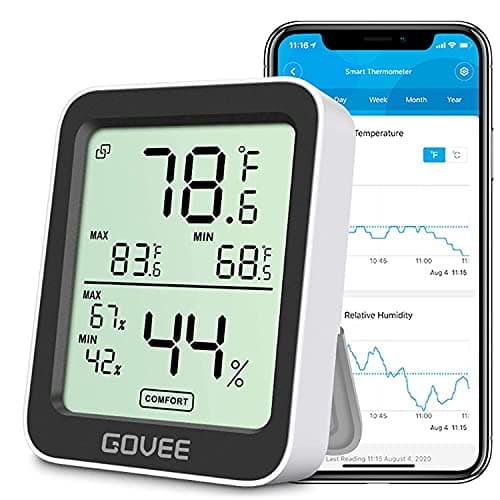 Govee H5075 Bluetooth HygrometerDiagnosing a problem that changes overnight Govee H5075 Bluetooth HygrometerDiagnosing a problem that changes overnight | Humidity with logging | 8.6 | $12.99 - View on Amazon |
| 3 | ThermoPro TP49 HygrometerAnyone about to buy a humidifier or a dehumidifier | Cheapest useful reading | 9.0 | Check price on Amazon |
| 4 | 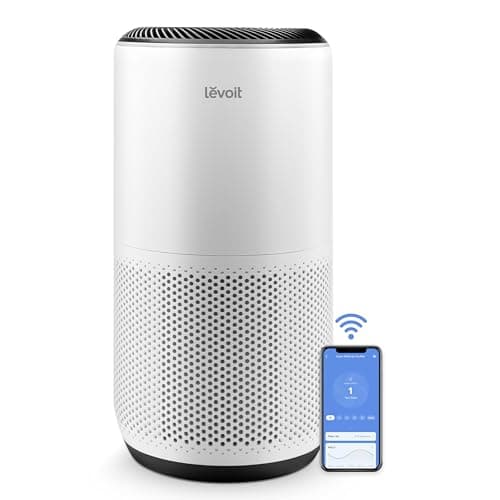 Levoit Core 400SLiving rooms and open-plan spaces Levoit Core 400SLiving rooms and open-plan spaces | Acting on the reading | 8.6 | $189.97 - View on Amazon |
#1 - Particulate and smoke
Temtop M10 Air Quality Monitor
Watching PM2.5 during smoke events
A particulate monitor rather than a hygrometer - it answers a different question, and it is the question you want answered during wildfire season.
#ad We do not hold a current price for this product, so we do not show one. How we make money.
Published specifications
| Specification | Value | Source |
|---|---|---|
| Measures | PM2.5 particulate and AQI; some variants add HCHO and TVOC | Temtop published specification |
What is good about it
- PM2.5 is the number that matters during a smoke event, and a monitor is the only way to tell whether closing the windows actually worked
- Small enough to move room to room, which is how you find where the smoke is getting in
What is not
- Consumer optical particle sensors drift and are not laboratory instruments; treat readings as relative rather than absolute
- It does not measure humidity, so it is not a substitute for a hygrometer
Who should skip this
Skip this if your problem is damp or dryness. It measures particles, and it will tell you nothing at all about humidity.
How it scored
- Usefulness during smoke events9.5
- Absolute accuracy6.0
- Portability9.0
Overall 8.0 / 10. This is our editorial score from published specifications and computed running cost. It is not a test result, and it is deliberately not marked up as a rating in this page’s structured data.
#2 - Humidity with logging
Govee H5075 Bluetooth Hygrometer
Diagnosing a problem that changes overnight
The one that logs. If your problem is that the house is dry at night but fine during the day, a hygrometer you have to walk over and read will never tell you that.
#ad Price as of October 18, 2026, from Amazon. Prices change. How we make money.
Published specifications
| Specification | Value | Source |
|---|---|---|
| Function | Bluetooth temperature and humidity sensor with app-based logging and data export | Govee published specification |
What is good about it
- Logging is the feature. Overnight humidity swings are invisible to a spot reading, and they explain most morning symptoms
- Data export means you can check whether the humidifier actually changed anything, rather than assuming
What is not
- Bluetooth range is room-scale; a basement sensor will not reach a phone upstairs
- Requires an app and an account, which is a genuine cost for some people
Who should skip this
Skip this if you just want a number on a wall. The logging is the whole premium, and it is wasted if you will not look at it.
How it scored
- Logging and history9.5
- Value for the decision it informs9.0
- Range and placement freedom6.0
Overall 8.6 / 10. This is our editorial score from published specifications and computed running cost. It is not a test result, and it is deliberately not marked up as a rating in this page’s structured data.
#3 - Cheapest useful reading
ThermoPro TP49 Hygrometer
Anyone about to buy a humidifier or a dehumidifier
An inexpensive digital hygrometer is the highest-value purchase on this entire site, because it is the one that tells you whether to buy anything else.
#ad We do not hold a current price for this product, so we do not show one. How we make money.
Published specifications
| Specification | Value | Source |
|---|---|---|
| Function | Digital temperature and relative humidity readout with a comfort indicator | ThermoPro published specification |
What is good about it
- Cheap enough to buy three and put one in the bedroom, one in the basement and one in the living room, which is what you actually want
- Gives you the reading that decides between a humidifier and a dehumidifier - a decision people routinely get backwards
What is not
- Consumer hygrometers are typically accurate to within a few percentage points, which is fine for the 30-50% question and not fine for anything precise
- No logging, so you see now rather than overnight
Who should skip this
Skip this only if you already own a hygrometer. There is no household we would tell not to measure.
How it scored
- Value for the decision it informs10.0
- Accuracy for the 30-50% question8.0
- Logging and history2.0
Overall 9.0 / 10. This is our editorial score from published specifications and computed running cost. It is not a test result, and it is deliberately not marked up as a rating in this page’s structured data.
#4 - Acting on the reading
Levoit Core 400S
Living rooms and open-plan spaces
The one to buy if you want a purifier that genuinely covers a living room, and one of the few spec sheets in this bracket that publishes coverage at a useful air-change rate rather than only the flattering one.
#ad Price as of October 18, 2026, from Amazon. Prices change. How we make money.
Published specifications
| Specification | Value | Source |
|---|---|---|
| CADR | 231 CFM | Levoit published specification |
| Coverage | 358 sq ft at 4.8 air changes/hr (1,718 sq ft at 1 ACH) | Levoit published specification |
| Rated power | 38 W | Levoit published specification |
| Noise | 22-52 dB | Levoit published specification |
| Filtration | 3-stage: pre-filter, HEPA, activated carbon | Levoit published specification |
| Dimensions | 10.8 x 10.8 x 20.5 in, 11 lb | Levoit published specification |
What it costs to run
About $25-30 a year in electricity at 12 hours a day, before filters.
38 W / 1000 x 12 hours x 365 days = 166.4 kWh. At 18.34 cents/kWh that is $30.52 a year at rated power - and the unit only draws its full 38 W on the top fan speed, so a mid setting lands nearer $25. Add the replacement filter, which you should price before you buy rather than after.
What is good about it
- Levoit publishes coverage at both 1 ACH and 4.8 ACH, which is unusually straight - most brands quote only the flattering 1 ACH number
- 38 W is low for this CADR, which is what keeps the running cost down
- 22 dB on its lowest setting is quiet enough to sleep beside
- Carbon, pet-allergy and smoke-specific replacement filters are sold for the same body
What is not
- We could not find a published filter replacement interval in Levoit's specification, so we are not quoting one
- The 1,718 sq ft headline is a single air change per hour, which is not a useful rate for allergies
Who should skip this
Skip this if your room is under 200 sq ft. The Core 300S covers that at lower power and lower cost, and the extra CADR buys you nothing in a small bedroom.
How it scored
- Clean air per watt9.0
- Honest coverage claim9.5
- Quiet operation8.5
- Filter economics7.5
Overall 8.6 / 10. This is our editorial score from published specifications and computed running cost. It is not a test result, and it is deliberately not marked up as a rating in this page’s structured data.
How we ranked these
We have not tested these units. Nobody here owns one. What we did was compile each manufacturer’s published specifications, check the coverage claims against AHAM’s room-sizing rule, and compute what each one costs to run for a year at the current US average electricity price. Every figure on this page is attributed to whoever published it, and the arithmetic is shown so you can redo it.
How we rank these sets out the full method, including what would change a ranking.
Questions people ask
+−How do I monitor air quality at home?
Decide which question you are asking first. For damp, dryness or condensation, a hygrometer in each problem room. For smoke, dust or wildfire season, a PM2.5 monitor you can move between rooms. Very few households need both, and most who think they need the second actually need the first.
+−What is a good PM2.5 reading indoors?
Lower is better and there is no household threshold we can give you honestly - outdoor air quality standards are set by regulators for outdoor exposure and do not translate cleanly to a bedroom. The genuinely useful use of a consumer monitor is comparative: what is it now against an hour ago, and did closing the windows change it. What the number itself measures, and how the AQI categories map onto it, is in PM2.5 explained.
+−Do air quality monitors detect mold?
No. Consumer monitors measure particle mass in size bands; they do not identify what the particles are, and mold spores are not distinguished from dust. For a mold problem the useful instrument is a hygrometer, because moisture is the condition mold depends on - and the same goes for home test kits, as we set out in mold test kits vs air monitors.
+−Will a monitor tell me if my air purifier is working?
Yes, and that is one of the better reasons to own one. Put the monitor across the room from the purifier, note the reading, run the purifier, and watch. If nothing changes over an hour, the unit is undersized for the room or the source is inside the room and continuous.
+−Do I need a monitor with CO2?
CO2 is a decent proxy for how well a room is ventilated, which is genuinely useful in a bedroom or a home office. It is not an air-cleanliness measure and no purifier removes it - the only fix for high CO2 is fresh air. The same is largely true of the TVOC channel some monitors add, which we cover in VOCs and off-gassing.