Roundup
Best Dehumidifiers for Bedrooms
The most common bedroom dehumidifier mistake is buying basement capacity. An oversized unit hits its target, shuts off, and leaves you with a machine that cycles all night.
By Scooter M. · Published · Last updated
How this page is funded: the buy links below are affiliate links. If you buy through one, we earn a commission at no extra cost to you. It does not change the order of the picks or what we say about them. Full disclosure.
The short answer
Measure first, then buy about 20 pints - not 50. The EPA recommends keeping indoor humidity below 60 percent and ideally between 30 and 50 percent, and a single closed bedroom is a small volume that reaches that target with modest capacity. What actually decides whether a bedroom dehumidifier stays in use is noise and how often you empty it, not pints per day.
How we judged these, before any product
We have not tested these units; every figure below is the manufacturer’s published specification with the publisher named on the card. Four criteria, in order:
- Capacity matched to one room. Roughly 20-22 pints per 500 sq ft for a damp space, stepping up for wetter conditions. A bedroom is almost never a 50-pint problem.
- Noise, because you sleep there. Every compressor dehumidifier makes compressor noise. This is the category’s real constraint in a bedroom and the reason so many end up in the hallway.
- Tank size versus how often you will empty it. A bedroom rarely has a floor drain, so the bucket is the limiting factor on whether the machine keeps getting used.
- Published running cost. Where a manufacturer publishes a wattage we compute the annual cost and show the working. Where it does not, we say so rather than estimating.
Why oversizing backfires in a bedroom
In a basement, extra capacity mostly costs you money. In a bedroom it costs you sleep. An oversized compressor unit pulls the room to its setpoint quickly, shuts off, drifts back up, and starts again - so instead of a steady low hum you get a cycle of starts and stops through the night, which is far more noticeable than continuous running.
The sizing arithmetic is the same one we use everywhere on this site, and it is in what size dehumidifier do I need. For one closed bedroom the answer is almost always the smallest compressor unit that will hold the target.
| Capacity | Coverage | What it is for | |
|---|---|---|---|
| Midea Cube 20-Pint | 20 pints/day | Up to 1,500 sq ft | One closed bedroom - the right default |
| Midea Cube 35-Pint | 35 pints/day | Up to 3,500 sq ft | A large or genuinely damp bedroom, or a bedroom plus landing |
| Pro Breeze Mini | Thermoelectric, not a compressor | 215 sq ft claimed | A wardrobe or an ensuite - not a room |
The third pick is not a room dehumidifier, and we are ranking it anyway
The Pro Breeze Mini is thermoelectric rather than compressor-driven. It is near-silent because there is no compressor to cycle, which makes it sound perfect for a bedroom - and it manages dampness in a wardrobe or a small ensuite rather than dehumidifying a room. It also loses effectiveness sharply as the room gets colder, which is exactly when you want it.
We include it because plenty of people searching for a bedroom dehumidifier actually have a damp wardrobe or a corner problem, and for that job it is the honest answer. For the room itself it is not.

Where bedroom moisture actually comes from
- You. Two people breathing in a closed room overnight put a measurable amount of water into the air. This is the source nobody lists.
- Drying laundry indoors, which is the largest avoidable source in most homes.
- A cold external wall or window, where warm moist air condenses. That is a surface temperature problem more than a humidity problem.
- An ensuite with a weak or missing extractor. Free fixes come first - how to lower humidity.
When to buy nothing at all
If the reading is already inside 30-50%, or if water is arriving through the structure rather than the air. A dehumidifier runs forever against a leak and never wins; the EPA’s guidance is that wet materials dried within 24-48 hours mostly will not grow mold, which is a drying-speed instruction rather than a permanent appliance one. Find the water first.
What we would actually do
Put a hygrometer in the room for a week and look at the overnight figure. If it sits above 60%, stop drying laundry in there, check the extractor, and then buy about 20 pints of capacity rather than the 50-pint unit the listings push. Set it to 50% and leave it - a unit holding a steady target runs less and cycles less than one chasing an aggressive one.
Quick picks
Ranked on published specifications and computed running cost. Tap any row for the full write-up, including who should skip it.
| # | Product | Best for | Score | Price |
|---|---|---|---|---|
| 1 | 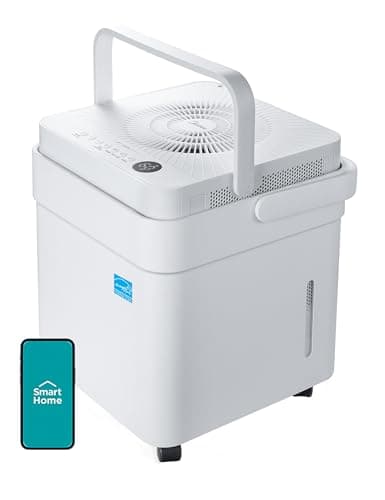 Midea Cube 20-PintBedrooms and single rooms up to about 1,500 sq ft | Best for bedrooms | 8.3 | $199.00 - View on Amazon |
| 2 | 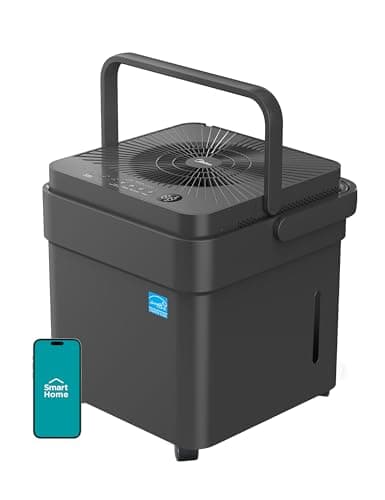 Midea Cube 35-PintBasements without a floor drain | Best for a large or damp bedroom | 8.7 | $211.10 - View on Amazon |
| 3 | 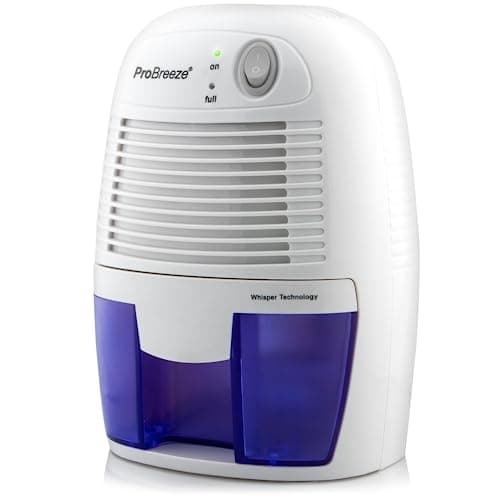 Pro Breeze Mini DehumidifierClosets, gun safes, small bathrooms, RVs | Best for a wardrobe, not a room | 7.6 | $43.99 - View on Amazon |
#1 - Best for bedrooms
Midea Cube 20-Pint
Bedrooms and single rooms up to about 1,500 sq ft
The smaller Cube, and the right size for a bedroom. Most people buying a bedroom dehumidifier buy far too much capacity and then run it on a setting that never cycles down.
#ad Price as of October 18, 2026, from Amazon. Prices change. How we make money.
Published specifications
| Specification | Value | Source |
|---|---|---|
| Capacity | 20 pints per day | Midea published specification |
| Capacity (federal test) | 20.16 pints per day | ENERGY STAR certified products database |
| Coverage | Up to 1,500 sq ft | Midea published specification |
| Efficiency (IEF) | 1.70 L/kWh | ENERGY STAR certified products database |
| Annual energy use | 249 kWh/yr | ENERGY STAR certified products database |
| Bucket fill level | Adjustable, up to 3 gallons | Midea user manual |
| Fan speeds | 2 (High, Low) | Midea user manual |
| Certification | ENERGY STAR certified | ENERGY STAR certified products database |
What it costs to run
About $46 a year on ENERGY STAR's certified annual energy figure.
ENERGY STAR publishes 249 kWh a year for this model. At 18.34 cents/kWh that is $45.67 a year. That figure is calculated on the program's standardized test basis, not measured in your room: a damp space where it cycles constantly will use more, a mildly damp one on a 50% setpoint less.
What is good about it
- 20 pints is the capacity a single closed bedroom actually calls for, so the compressor cycles off instead of running flat out
- The nested/extended body stores smaller than it runs, which matters for a machine you only want out for half the year
- ENERGY STAR certified, with the lowest annual energy figure of the three Cube sizes
What is not
- The least efficient Cube per unit of water removed: an IEF of 1.70 L/kWh against 2.01 for the 35 and 50-pint models
- Midea does not publish a rated wattage or a noise figure for this model, so we quote ENERGY STAR's certified annual energy figure instead of a wattage
- 1,500 sq ft is a coverage ceiling measured under favorable conditions, not a promise about a damp bedroom
- A compressor unit still makes compressor noise; if silence matters more than capacity, this is the wrong category
Who should skip this
Skip this if the room is a closet, a safe or a caravan - that is a job for a desiccant or thermoelectric unit, not a compressor. And skip it for a genuinely wet basement, where 20 pints will run continuously and never win.
How it scored
- Right-sized for one room9.5
- Efficiency per liter removed7.0
- Storage and handling9.0
Overall 8.3 / 10. This is our editorial score from published specifications and computed running cost. It is not a test result, and it is deliberately not marked up as a rating in this page’s structured data.
#2 - Best for a large or damp bedroom
Midea Cube 35-Pint
Basements without a floor drain
The adjustable 4.25-gallon bucket is the point. Most dehumidifiers get switched off because emptying a 2-gallon bucket twice a day is miserable; this one buys you a couple of days.
#ad Price as of October 18, 2026, from Amazon. Prices change. How we make money.
Published specifications
| Specification | Value | Source |
|---|---|---|
| Capacity | 35 pints per day | Midea published specification |
| Capacity (federal test) | 35.82 pints per day | ENERGY STAR certified products database |
| Coverage | Up to 3,500 sq ft | Midea published specification |
| Efficiency (IEF) | 2.01 L/kWh | ENERGY STAR certified products database |
| Annual energy use | 378 kWh/yr | ENERGY STAR certified products database |
| Bucket fill level | Adjustable, up to 4.25 gallons | Midea user manual |
| Fan speeds | 2 (High, Low) | Midea user manual |
| Dimensions | 14.76 x 14.57 x 14.45 in, 39.62 lb | Midea published specification |
| Certification | ENERGY STAR certified | ENERGY STAR certified products database |
What it costs to run
About $69 a year on ENERGY STAR's certified annual energy figure.
ENERGY STAR publishes 378 kWh a year for this model. At 18.34 cents/kWh that is $69.33 a year. That figure is calculated on the program's standardized test basis, not measured in your basement: a genuinely damp space where it cycles constantly will use more. Against the 50-pint Cube's 515 kWh ($94.45) it is the cheaper machine to own, which is the argument for sizing honestly rather than buying headroom.
What is good about it
- An adjustable bucket that holds up to 4.25 gallons - the difference between a unit you keep using and one you unplug in week three
- An IEF of 2.01 L/kWh removes about 18% more water per kWh than the 20-pint Cube's 1.70
- Nests down into a smaller shape for storage, which matters for an appliance you only use half the year
What is not
- The 3,500 sq ft coverage claim assumes conditions no real basement has; treat it as a ceiling, not a specification
- 35 pints is not enough for a genuinely wet basement with standing water
- Midea does not publish a rated wattage for this model, so we quote ENERGY STAR's certified annual energy figure instead
- No built-in pump on this model - without a floor drain you are either emptying the bucket or routing a gravity hose
Who should skip this
Skip this if your basement is wet rather than damp - visible water, white efflorescence on the walls, a musty smell that returns within a day of airing out. That is a drainage problem, and a 35-pint unit will run permanently and never win.
How it scored
- Tank interval10.0
- Capacity for the money8.5
- Efficiency per liter removed9.0
- Storage footprint9.0
Overall 8.7 / 10. This is our editorial score from published specifications and computed running cost. It is not a test result, and it is deliberately not marked up as a rating in this page’s structured data.
#3 - Best for a wardrobe, not a room
Pro Breeze Mini Dehumidifier
Closets, gun safes, small bathrooms, RVs
A thermoelectric unit, not a compressor. That means it is quiet and small and it will not touch a basement - but in a closet or an RV it is exactly right.
#ad Price as of October 18, 2026, from Amazon. Prices change. How we make money.
Published specifications
| Specification | Value | Source |
|---|---|---|
| Type | Thermoelectric (Peltier), not a compressor | Pro Breeze published specification |
What is good about it
- Near-silent, because there is no compressor to cycle
- Small enough to sit inside a wardrobe or under a sink
What is not
- Thermoelectric units lose effectiveness sharply in cold rooms, which is exactly what an unheated basement is
- Capacity is a fraction of any compressor unit - this manages dampness, it does not dehumidify a room
Who should skip this
Skip this for any room-sized job. If you are searching for a basement dehumidifier, this is not it, no matter how many roundups file it under that heading.
How it scored
- Fit for small enclosed spaces9.0
- Quiet operation9.5
- Capacity3.5
- Cold-room performance3.0
Overall 7.6 / 10. This is our editorial score from published specifications and computed running cost. It is not a test result, and it is deliberately not marked up as a rating in this page’s structured data.
How we ranked these
We have not tested these units. Nobody here owns one. What we did was compile each manufacturer’s published specifications, check the coverage claims against AHAM’s room-sizing rule, and compute what each one costs to run for a year at the current US average electricity price. Every figure on this page is attributed to whoever published it, and the arithmetic is shown so you can redo it.
How we rank these sets out the full method, including what would change a ranking.
Questions people ask
+−What size dehumidifier do I need for a bedroom?
Roughly 20 pints for a normal damp bedroom - about 20-22 pints per 500 sq ft, stepping up for wetter conditions. How the 20, 35 and 50-pint sizes of one range compare on certified efficiency and running cost is in our Midea Cube dehumidifier review. Buying 50-pint basement capacity for one room mostly buys you compressor cycling through the night.
+−Are dehumidifiers too noisy for a bedroom?
Every compressor unit makes compressor noise, and that is the category’s real bedroom constraint. A correctly sized unit holding a steady target cycles less than an oversized one, which is usually more tolerable than a larger machine starting and stopping.
+−What humidity should a bedroom be?
The EPA recommends below 60 percent and ideally 30-50 percent. Setting a dehumidifier to 50% is a sensible default that leaves margin without making the machine run constantly.
+−Will a mini dehumidifier work in a bedroom?
For a wardrobe or an ensuite corner, yes. For the room itself, no - thermoelectric units manage dampness in a small enclosed space and lose effectiveness as the room gets colder, which is when you want them most.
+−Should I run it all night or during the day?
Whichever keeps the reading steady. Running while you are out avoids the noise question entirely and still holds the room down, provided the door stays shut.