Roundup
Best Air Purifiers for Asthma
One specification decides this category before CADR gets a say. The EPA states that ozone can worsen asthma, and the federal database publishes an ozone figure for every certified purifier - so we start by throwing out everything above zero.
By Scooter M. · Published · Last updated
How this page is funded: the buy links below are affiliate links. If you buy through one, we earn a commission at no extra cost to you. It does not change the order of the picks or what we say about them. Full disclosure.
The short answer
Buy the Levoit Eleva 300X for a bedroom, the Medify MA-40 if you need a real carbon stage, and the Levoit Core 600S for a large room - but check the model code on the 600S before you buy it. All three certify at 0.00 ppb ozone in the federal database, which is the one specification we will not compromise on here: the EPA states that ozone “may also worsen chronic respiratory diseases such as asthma.” Of the 247 room air cleaners in that database, a zero-ozone model exists at every room size from 53 to 894 sq ft, so there is no size at which you are forced to accept a purifier that emits any. Read the next section first, though, because the EPA is equally clear that filtration is a supplement and not the main lever.
This page is about the environment - humidity, particles, ventilation - and what changes it. It is not medical advice and we hold no medical qualification. If symptoms are persistent, severe or getting worse, that is a question for a clinician rather than a purchase.
What the EPA actually says about air cleaners
Before any product: the agency whose data this page is built on does not think a purifier is the answer on its own. The EPA’s guide to air cleaners in the home states that “portable air cleaners and HVAC filters can reduce indoor air pollution; however, they cannot remove all pollutants from the air,” and that “the most effective ways to improve your indoor air are to reduce or remove the sources of pollutants and to ventilate with clean outdoor air.” Filtration is described as “an effective supplement” to those two things.
That ordering is the honest frame for this page. A purifier that moves the right amount of air through the right filter is a worthwhile third step. It is not a substitute for finding what is in the room and removing it, and anyone selling you one as a first step is selling, not advising. If the trigger in your house is damp, a dehumidifier is the device; if it is a humidity level that suits dust mites, that is a measurement problem before it is a purchase. Both have their own pages, linked at the end.
Why ozone is the criterion that decides this category
Some air cleaners deliberately generate ozone, and some produce it as a by-product of an ionizing stage. The EPA’s page on ozone generators sold as air cleaners is blunt about the consequence: “When inhaled, ozone can damage the lungs. Relatively low amounts can cause chest pain, coughing, shortness of breath and throat irritation,” and “ozone may also worsen chronic respiratory diseases such as asthma and compromise the ability of the body to fight respiratory infections.” It adds that “healthy people, as well as those with respiratory difficulty, can experience breathing problems when exposed to ozone.”
The useful part is that this is measured rather than guessed. ENERGY STAR certification publishes an ozone emissions figure in parts per billion for every certified room air cleaner, so you can filter the market on it. That is what the table below does.
| Room | Certified model (0.00 ppb) | Smoke CADR | CFM per watt | kWh/yr |
|---|---|---|---|---|
| 53 sq ft | Levoit Core Mini (LAP-C161-WUS) | 34 CFM | 4.86 | 42 |
| 132 sq ft | Levoit LAP-B851S | 85 CFM | 5.86 | 90 |
| 183 sq ft | Coway AP-0823E | 118 CFM | 5.41 | 128 |
| 250 sq ft | Levoit Eleva 300X (LAP-C341S) | 161 CFM | 6.68 | 145 |
| 380 sq ft | Medify MA-40 | 245 CFM | 5.53 | 261 |
| 467 sq ft | Levoit Eleva 500X (LAP-C511S) | 301 CFM | 9.26 | 194 |
| 606 sq ft | Levoit Core 600S (LAP-C601S-WUS) | 391 CFM | 5.93 | 387 |
| 640 sq ft | Coway AP-3018B | 413 CFM | 10.33 | 235 |
| 894 sq ft | Coway Airmega ProX | 577 CFM | 10.30 | 335 |
Two things are worth reading off that table. The first is that zero ozone costs you nothing in capability - the 894 sq ft Coway does 577 CFM at 10.30 CFM per watt and still reports 0.00 ppb, which is better on both axes than plenty of units that do emit some. The second is that Coway certifies its entire range at 0.00 ppb: every one of the 38 Coway and Airmega rows in the database reports zero. If brand-level simplicity is what you want, that is the brand - we rank its whole certified range in our Coway roundup.
How we picked these
We have not tested these machines, and we hold no medical qualification. Every figure here is published by the manufacturer or by the ENERGY STAR certified room air cleaners database, and every pick was checked for live availability before it was featured. Criteria, in order:
- Certified 0.00 ppb ozone. A hard filter, not a tiebreaker. Anything above zero was removed from consideration regardless of how good the rest of its numbers were - which is why the most efficient purifiers we know of do not appear here.
- Real CADR for the actual room. An undersized purifier is the most common way this purchase fails. We sized on AHAM CADR at 4.8 air changes an hour, not on a listing’s headline square footage.
- A genuine carbon stage where gases matter. A particle filter does nothing to a gas. If the concern includes cooking fumes or off-gassing rather than only dust and dander, that needs carbon mass, and most combined cartridges carry very little.
- A published filter interval. Without one, annual cost is not computable, and a purifier with a saturated filter is furniture.
- Purchasable today. Checked live. This removed the best-engineered zero-ozone Levoit in the database, the Eleva 500X, which is in the table and is not a pick.
Our own top allergies pick cannot appear on this page
We rank the Coway AP-1512HH first for allergies, and it is not a pick here. The reason is worth stating plainly: the AP-1512HH is not in the ENERGY STAR certified database at all. We searched it by model number and there are zero matching rows. No certification means no published ozone figure, no certified CADR and no certified annual energy for that unit.
That is not a claim that it emits ozone. It almost certainly does not - every other Coway model in the database reports 0.00 ppb, so the brand’s engineering clearly does not rely on an ionizing stage. It is a claim about what we can prove. On a page whose first criterion is a certified zero, a unit with no certification cannot be ranked, and we would rather hold that line against our own recommendation than quietly make an exception for it.
The Levoit variant trap, which matters more here than anywhere else
This is the single most practical warning on the page. Levoit certifies some models twice, under two variant codes, and the two variants do not always report the same ozone figure:
| Model | Variant code | Room | Ozone |
|---|---|---|---|
| Core 600S | LAP-C601S-WUS | 606 sq ft | 0.00 ppb |
| Core 600S | LAP-C601S-WUSR | 611 sq ft | 2.00 ppb |
| Core 400S | Core 400S | 358 sq ft | 0.00 ppb |
| Core 400S | LAP-C401S-WUSR | 363 sq ft | 1.00 ppb |
Eight of Levoit’s ten certified entries report 0.00 ppb, and the two that do not are both the -WUSR variant of a model whose other variant is zero. We have listed the Core 600S as the large-room pick on the strength of the LAP-C601S-WUS figure, and if the exact ozone number is your reason for buying, check the model code in the listing before ordering rather than after. If a listing will not tell you which variant it ships, the Eleva 300X is certified zero with no variant ambiguity at all - it simply covers a smaller room.
What a purifier will not do
Three honest limits, because the EPA’s “cannot remove all pollutants” deserves specifics.
It does not change humidity, and humidity is what decides whether dust mites thrive. If the concern is mites rather than airborne particles, a purifier is the wrong first purchase - our dust mites in the bedroom page and the ideal indoor humidity page cover the lever that actually moves.
A HEPA stage does nothing to gases. HEPA is a mechanical particle filter; gas-phase pollutants pass straight through it. That is why the carbon stage is a criterion above, and why the MA-40 is on this list despite being the least efficient of our three picks on clean air per watt.
An ionizer is not a feature to add here. Any device whose cleaning mechanism involves charging the air is the category the EPA’s ozone page is written about. We have a separate air purifier versus ionizer comparison if you want that argument in full; for this page it is enough to say that an ionizing stage is the one thing we screened the entire market to avoid.
Quick picks
Ranked on published specifications and computed running cost. Tap any row for the full write-up, including who should skip it.
| # | Product | Best for | Score | Price |
|---|---|---|---|---|
| 1 | 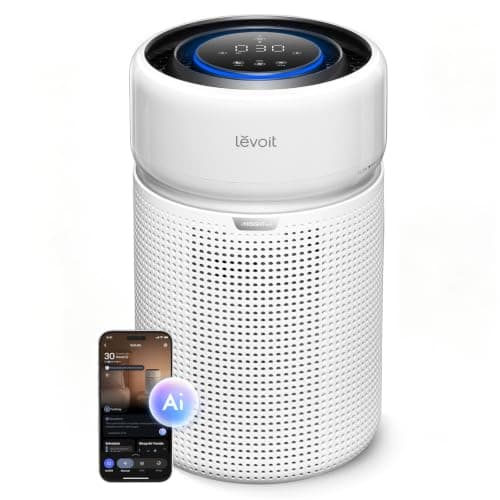 Levoit Eleva 300XA bedroom or home office up to about 250 sq ft | Best for a bedroom | 8.9 | $129.99 - View on Amazon |
| 2 | 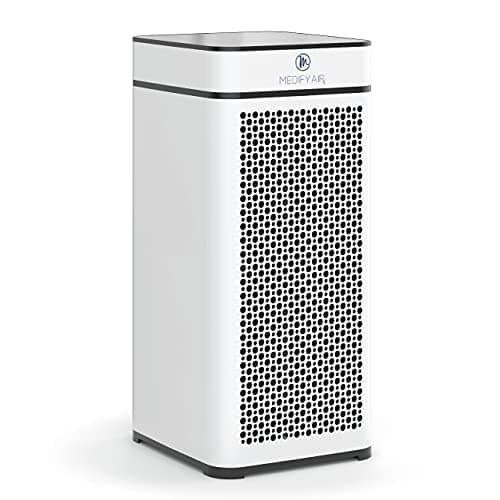 Medify MA-40A room up to about 380 sq ft where you want carbon as well as particle filtration | Best with a carbon stage | 8.1 | $212.99 - View on Amazon |
| 3 | 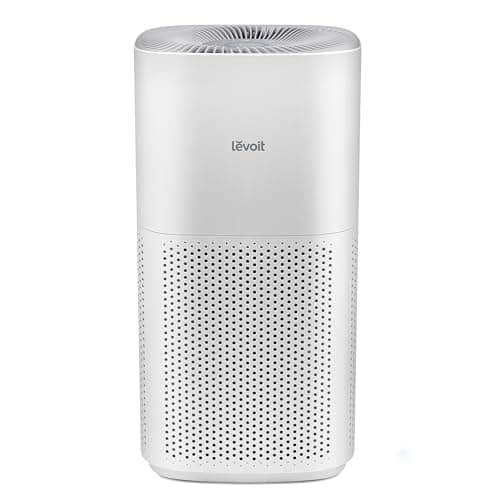 Levoit Core 600S-PA living room or open-plan space up to about 600 sq ft | Best for a large room | 8.3 | $269.99 - View on Amazon |
#1 - Best for a bedroom
Levoit Eleva 300X
A bedroom or home office up to about 250 sq ft
The best-engineered Levoit purifier you can actually buy on Amazon, and the only one in the range for which Levoit publishes a filter replacement interval. It moves less air than a Core 400S and does more with every watt.
#ad Price as of October 18, 2026, from Amazon. Prices change. How we make money.
Published specifications
| Specification | Value | Source |
|---|---|---|
| CADR - smoke, dust, pollen | 161 CFM, AHAM Verifide | Levoit published specification |
| Coverage | 250 sq ft at 4.8 air changes/hr (1,200 sq ft at 1 ACH) | Levoit published specification |
| Clean air per watt | 6.68 CFM/W | ENERGY STAR certified room air cleaners database |
| Annual energy use | 145 kWh/yr | ENERGY STAR certified room air cleaners database |
| Ozone emissions | 0.00 ppb | ENERGY STAR certified room air cleaners database |
| Rated power | Under 25.5 W | Levoit published specification |
| Noise | 20-50 dB (20 dB in Sleep Mode) | Levoit published specification |
| Filtration | 3-stage sealed HEPA with a separate activated carbon filter | Levoit published specification |
| Filter replacement | Particle filter up to 2 years; carbon filter 6-12 months | Levoit published specification |
| Fan speeds | 4 plus Auto | Levoit published specification |
| Sensor | AirSight Plus 2.0, 3-channel (PM1.0, PM2.5, PM10) | Levoit published specification |
| Dimensions and weight | 9.4 x 9.4 x 15.1 in, 9.9 lb | Levoit published specification |
What it costs to run
About $27 a year on ENERGY STAR's certified annual energy figure.
ENERGY STAR publishes 145 kWh a year for LAP-C341S, the Eleva 300X. At 18.34 cents/kWh that is $26.59 a year. The Core 400S, on the same certified basis, is 237 kWh and $43.47 - so the Eleva costs about $17 a year less to run while covering a smaller room more efficiently.
What is good about it
- 6.68 CFM of clean air per watt against the Core 400S's 5.75 - a 16% improvement in the specification that decides your bill
- 145 kWh a year, about 40% less electricity than the Core 400S, for a machine sized to a bedroom rather than a living room
- The only Levoit purifier we have found where Levoit publishes a filter replacement interval - up to 2 years on the particle filter, 6-12 months on the carbon
- A separate activated carbon filter rather than a carbon layer inside a combined cartridge, which is the arrangement that actually holds up against odors
- 20 dB in Sleep Mode is genuinely quiet enough to sleep beside, and it publishes the figure
- Certified at 0.00 ppb ozone, with no ionizing stage
- A 3-channel particle sensor at this price is unusual; most units at any price infer air quality from a single channel
What is not
- 161 CFM is a 250 sq ft machine. It is not a living-room purifier and buying it for one would be a mistake
- Newer and less reviewed than the Core line, so there is less accumulated owner feedback to draw on
- The 1,200 sq ft figure on the listing is a one-air-change-per-hour number; the usable coverage is 250 sq ft and Levoit publishes both, to its credit
- Two filters on two different schedules is more to track than one combined cartridge, even though it is the better design
- Levoit's more efficient Eleva 500X is certified at 9.26 CFM/W but we could not find it purchasable on Amazon, so the range's best unit is not the one you can buy here
Who should skip this
Skip this if the room is much over 250 sq ft - the Core 600S is the honest answer there, and no amount of running this unit longer will substitute for CADR it does not have.
How it scored
- Clean air per watt9.0
- Published specifications9.5
- Quiet operation9.5
- Room size covered6.5
Overall 8.9 / 10. This is our editorial score from published specifications and computed running cost. It is not a test result, and it is deliberately not marked up as a rating in this page’s structured data.
#2 - Best with a carbon stage
Medify MA-40
A room up to about 380 sq ft where you want carbon as well as particle filtration
A capable mid-price unit with a real carbon composite stage and a federal certification you can check - which is useful, because Medify's own CADR claim and the certified figure do not agree.
#ad Price as of October 18, 2026, from Amazon. Prices change. How we make money.
Published specifications
| Specification | Value | Source |
|---|---|---|
| CADR - smoke (federal certification) | 245 CFM | ENERGY STAR certified room air cleaners database |
| CADR (manufacturer claim) | 330 - see cons | Medify published specification |
| Coverage | 380 sq ft | ENERGY STAR certified room air cleaners database |
| Clean air per watt | 5.53 CFM/W | ENERGY STAR certified room air cleaners database |
| Annual energy use | 261 kWh/yr | ENERGY STAR certified room air cleaners database |
| Ozone emissions | 0.00 ppb | ENERGY STAR certified room air cleaners database |
| Rated power | 54 W | Medify published specification |
| Noise | 46-66 dBA | Medify published specification |
| Filtration | 3-layer: pre-filter, H13 True HEPA, active carbon composite | Medify published specification |
| Filter life | 3,000 hours | Medify published specification |
| Dimensions and weight | 22 x 9.9 x 10.9 in, 15.6 lb | Medify published specification |
What it costs to run
About $48 a year on ENERGY STAR's certified annual energy figure.
ENERGY STAR publishes 261 kWh a year for the MA-40. At 18.34 cents/kWh that is $47.87 a year. Medify's own 54 W rating cross-checks it at 12 hours a day: 54 / 1000 x 12 x 365 = 237 kWh = $43.37, so the two figures agree closely. Filters at 3,000 hours are the larger running cost.
What is good about it
- ENERGY STAR certified, so its clean air per watt (5.53), annual energy (261 kWh) and ozone (0.00 ppb) are all independently published
- H13 media and an active carbon composite layer rather than carbon dust on the filter wrap
- Certified at 0.00 ppb ozone despite shipping with a switchable ionizer feature
- A published 3,000-hour filter life, which converts to a budgetable annual cost - many competitors publish nothing
- 245 CFM of certified smoke CADR covers a genuine 380 sq ft living room
What is not
- Medify advertises a CADR of 330 and some retailers list 380, while the federal certification for the MA-40 reports 245 smoke CADR. Size the room on 245
- Its Amazon listing claims 1,793 sq ft in one hour - a one-air-change figure, about 4.7 times the certified 380 sq ft coverage
- 46 dBA is its minimum, not a whisper setting. This is a noticeably louder unit at low speed than a Levoit or Blueair of similar size
- It includes an ionizer. We would leave it off, and a unit without one is a cleaner answer
- 5.53 CFM/W is mid-pack - the Blueair units we list are 8.84 and 9.59 for comparable rooms
- 3,000 hours is about four months of continuous running, so the filter cadence is faster than the 9-to-12 months better units manage
Who should skip this
Skip this if you need quiet - 46 dBA minimum rules it out of a bedroom for light sleepers. Skip it too if you want the efficiency leader rather than the carbon.
How it scored
- Carbon stage8.0
- Certified data available9.0
- Honesty of claimed CADR5.0
- Quiet operation5.0
Overall 8.1 / 10. This is our editorial score from published specifications and computed running cost. It is not a test result, and it is deliberately not marked up as a rating in this page’s structured data.
#3 - Best for a large room
Levoit Core 600S-P
A living room or open-plan space up to about 600 sq ft
The right Levoit for a genuinely large room, and the only one in the range with the CADR to hold an open-plan space. Its efficiency is middling for the brand and its filter interval is unpublished, same as the Core 400S.
#ad Price as of October 18, 2026, from Amazon. Prices change. How we make money.
Published specifications
| Specification | Value | Source |
|---|---|---|
| CADR | 391 CFM | Levoit published specification |
| Coverage | 606 sq ft at 4.8 air changes/hr (2,909 sq ft at 1 ACH) | Levoit published specification |
| CADR (federal test) - smoke / dust / pollen | 391 / 398 / 436 CFM | ENERGY STAR certified room air cleaners database |
| Clean air per watt | 5.93 CFM/W | ENERGY STAR certified room air cleaners database |
| Annual energy use | 387 kWh/yr | ENERGY STAR certified room air cleaners database |
| Ozone emissions | 0.00 ppb on the LAP-C601S-WUS variant; 2.00 ppb on LAP-C601S-WUSR | ENERGY STAR certified room air cleaners database |
| Rated power | 49 W | Levoit published specification |
| Noise | 26-55 dB | Levoit published specification |
| Filtration | 3-stage: pre-filter, main filter, activated carbon | Levoit published specification |
| Filter replacement | Not published by Levoit - see cons | Levoit published specification |
| Dimensions and weight | 12.3 x 12.3 x 23.6 in, 13.7 lb | Levoit published specification |
What it costs to run
About $71 a year on ENERGY STAR's certified annual energy figure.
ENERGY STAR publishes 387 kWh a year for LAP-C601S. At 18.34 cents/kWh that is $70.98 a year. Levoit's own 49 W rating cross-checks it: 49 W / 1000 x 24 hours x 365 = 429 kWh at full power, so the certified figure implies it spends most of its time below maximum, which is what you would expect on Auto.
What is good about it
- 391 CFM of CADR is the most air any purchasable Levoit moves, and it is what an open-plan room actually needs
- Levoit publishes both the honest coverage (606 sq ft at 4.8 air changes) and the headline figure (2,909 sq ft at 1 ACH), which most of the category does not
- The federal certified CADR of 391 CFM matches Levoit's own published figure exactly - the claim survives independent testing
- 5.93 CFM/W is slightly better than the Core 400S despite moving 69% more air
- Published 49 W rated power, so the running cost can be computed two independent ways
What is not
- 387 kWh a year is the highest running cost of any Levoit purifier we list - about $71 a year, which is the price of the capacity
- Levoit does not publish a filter replacement interval for it, so the annual filter cost cannot be computed before you buy - the same gap as the Core 400S
- 5.93 CFM/W is mid-pack for the brand: Levoit's Eleva 500X is certified at 9.26 and its own Eleva 300X at 6.68
- The two certified Core 600S variants report different ozone figures - 0.00 and 2.00 ppb - and the listing does not state which one ships
- 13.7 lb and nearly two feet tall; this is a piece of furniture, not something you move between rooms
Who should skip this
Skip this for a bedroom. 391 CFM in a 150 sq ft room means running it on its lowest speed permanently and paying for capacity you cannot use; the Eleva 300X is both cheaper to buy and cheaper to run.
How it scored
- Capacity for a large room9.5
- Clean air per watt7.0
- Published specifications7.5
- Running cost6.0
Overall 8.3 / 10. This is our editorial score from published specifications and computed running cost. It is not a test result, and it is deliberately not marked up as a rating in this page’s structured data.
How we ranked these
We have not tested these units. Nobody here owns one. What we did was compile each manufacturer’s published specifications, check the coverage claims against AHAM’s room-sizing rule, and compute what each one costs to run for a year at the current US average electricity price. Every figure on this page is attributed to whoever published it, and the arithmetic is shown so you can redo it.
How we rank these sets out the full method, including what would change a ranking.
Questions people ask
+−What is the best air purifier for asthma?
+−Do air purifiers produce ozone?
+−Will an air purifier stop asthma symptoms?
+−Is HEPA enough, or do I need carbon as well?
+−Does the Levoit Core 600S emit ozone or not?
+−Why are the most energy-efficient purifiers not on this list?
Sources
- EPA - Air Cleaners and Air Filters in the Home (Guide to Air Cleaners in the Home)
- EPA - Ozone Generators that are Sold as Air Cleaners
- ENERGY STAR - Certified Room Air Cleaners product database
- California Air Resources Board - Air Cleaners and Ozone Products
- AHAM Verifide - Air Filtration Standards (AC-1)
- Levoit - Eleva 300X Smart Air Purifier specification
- U.S. Energy Information Administration - Electric Power Monthly, Table 5.6.A