Roundup
Best Humidifiers for Babies
In a nursery the safety constraints do the choosing, not the feature list. Two of them rule out most of what gets marketed for this room.
By Scooter M. · Published · Last updated
How this page is funded: the buy links below are affiliate links. If you buy through one, we earn a commission at no extra cost to you. It does not change the order of the picks or what we say about them. Full disclosure.
This page is about the environment - humidity, particles, ventilation - and what changes it. It is not medical advice and we hold no medical qualification. If symptoms are persistent, severe or getting worse, that is a question for a clinician rather than a purchase.
The short answer
Buy evaporative, and buy the cleaning schedule with it. Two published EPA rules decide this room. First: do not humidify to indoor relative humidity levels exceeding 50 percent - and an evaporative unit physically cannot push past saturation the way an ultrasonic one can. Second: change the water daily and clean portable humidifiers every third day, because a neglected tank is a worse outcome than a dry room.
How we judged these, before any product
We are not a medical source and this page does not give medical advice - if a baby has a persistent cough or breathing difficulty, that is a question for a clinician rather than an appliance. What we can do is apply the published environmental guidance and the manufacturers’ own specifications. Four criteria, in order:
- Can it overshoot 50%? The EPA’s instruction is explicit, and an ultrasonic unit with no feedback will keep misting into an already-saturated room. Evaporative units self-limit - as the air approaches saturation they simply evaporate less.
- Does it aerosolize what is in the tank? The EPA identifies ultrasonic and impeller units as very efficient at dispersing tap-water minerals into the air. Evaporative units leave the minerals in the wick.
- Is it realistic to clean every third day? A design you cannot get your hand inside will not be cleaned on that schedule, whatever you intend.
- Is there hot water in a room with a child in it? A warm-mist unit boils its water. That is a hygiene advantage and a burn consideration, and it is the reason our second pick carries a caveat rather than a recommendation.
The cleaning schedule is the whole product
More than any specification, this is what decides whether a nursery humidifier is a good idea. The EPA’s guidance on home humidifiers is to change the water daily and clean portable units every third day, and it notes that breathing mist containing pollutants from a dirty tank has been implicated in a certain type of lung inflammation. It also warns that mineral scale can be a breeding ground for microorganisms.
Read plainly: a humidifier you will not clean on that schedule is worse than no humidifier. If that sounds like more maintenance than you will realistically do at three in the morning, the honest recommendation is to skip the device and address the dryness another way. Our full routine is at humidifier mold and cleaning.
Why evaporative wins this room specifically
| Can it exceed 50% RH? | Does it disperse tank minerals? | |
|---|---|---|
| Evaporative (wick) | No - it self-limits as the air approaches saturation | No - minerals stay in the wick, which becomes the consumable |
| Ultrasonic | Yes - no feedback loop, it mists regardless | Yes - the EPA names it as a very efficient mineral disperser |
| Warm mist | Yes | Boiling leaves minerals in the reservoir, but there is hot water in the room |
That table is most of the decision. The type comparison in full, including the running-cost differences, is at warm mist vs cool mist.
Sizing, and the refill question
A nursery is a small closed room, so output is rarely the constraint - refill frequency is. Divide the published tank capacity by the published run time to get sustained output, then divide the tank by that to get your refill interval. A 6-gallon tank running about 2 gallons a day is roughly a three-day interval; a 1.58-gallon tank is closer to two. The full method is at what size humidifier do I need.
One caution specific to this room: a larger tank means longer between refills, but it does not change the EPA’s cleaning cadence. You still empty and scrub on schedule regardless of how much water is left.

Where to put it
- Not next to the crib. You are humidifying a room, not a child, and a unit close to bedding damps the bedding.
- Off the floor, away from walls and furniture, so the output disperses rather than settling on one cold surface.
- Cable where it cannot be reached or tripped over. Obvious, and worth writing down anyway.
- With a hygrometer across the room, not beside the unit - a sensor in the mist plume reads the plume and not the room.
When to buy nothing at all
If the room reads inside 30-50%, or if you will not keep the cleaning schedule. Adding moisture above the EPA’s 50% ceiling trades a dryness problem for a condensation and mold one, and in a child’s room that is a bad trade. If the concern is airborne particles rather than dry air, the relevant page is air purifiers for baby nurseries.
What we would actually do
Measure the room for two nights first. If it is genuinely below 30%, buy an evaporative unit, fill it from the tap, target 40-45% rather than as high as the dial goes, and put the cleaning on a calendar rather than on good intentions. Skip warm mist unless you have a specific reason for it and somewhere safe to put it.
Quick picks
Ranked on published specifications and computed running cost. Tap any row for the full write-up, including who should skip it.
| # | Product | Best for | Score | Price |
|---|---|---|---|---|
| 1 | 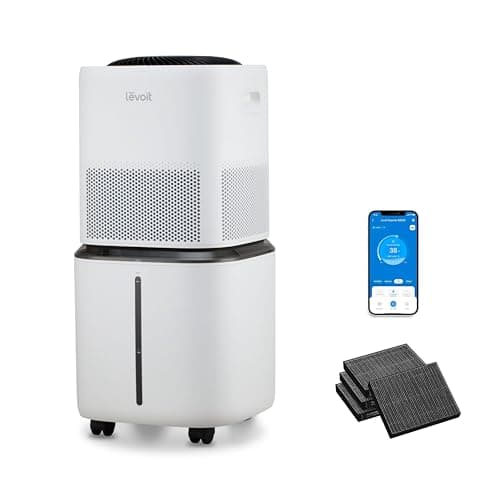 Levoit Superior 6000SWhole floors, and anyone tired of refilling | Best for a nursery | 8.6 | $249.99 - View on Amazon |
| 2 | 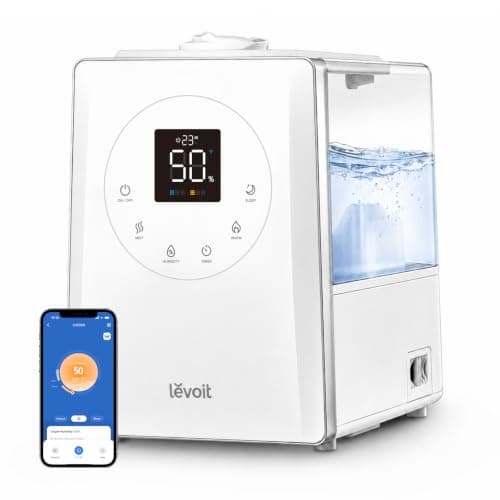 Levoit LV600S HybridPeople who want the option of warm mist | Best if you want warm mist | 7.4 | $109.00 - View on Amazon |
#1 - Best for a nursery
Levoit Superior 6000S
Whole floors, and anyone tired of refilling
A 6-gallon evaporative unit at 30 W. If you have spent a winter refilling a small humidifier twice a day, this is the one that ends that.
#ad Price as of October 18, 2026, from Amazon. Prices change. How we make money.
Published specifications
| Specification | Value | Source |
|---|---|---|
| Tank capacity | 6 gal / 22.7 L | Levoit published specification |
| Coverage | 3,000 sq ft | Levoit published specification |
| Rated power | 30 W | Levoit published specification |
| Run time | Up to 72 hours on the low fan setting | Levoit published specification |
| Max output | 1,500 mL/h | Levoit published specification |
What it costs to run
About $12-13 a year in electricity across a heating season at 12 hours a day.
30 W / 1000 x 12 hours x 365 days = 131.4 kWh = $24.10 a year run year-round, so roughly $12-13 across a six-month heating season. On any evaporative unit the filters, not the electricity, are the larger cost.
What is good about it
- 30 W against 3,000 sq ft of claimed coverage is the best power-to-output ratio of any humidifier we list
- Evaporative, so it self-limits the same way the Honeywell does - it will not flood a room
- 72 hours per fill means refilling twice a week rather than twice a day
What is not
- It is a large object and it looks like one
- The 3,000 sq ft coverage claim assumes air moves freely between those rooms, which in a real house with doors it does not
Who should skip this
Skip this if you only need one bedroom humidified. A 6-gallon tank in a 120 sq ft room is a lot of standing water to keep clean for no additional benefit.
How it scored
- Cannot over-humidify10.0
- Refill interval9.5
- Power efficiency9.5
- Cleaning burden6.5
Overall 8.6 / 10. This is our editorial score from published specifications and computed running cost. It is not a test result, and it is deliberately not marked up as a rating in this page’s structured data.
#2 - Best if you want warm mist
Levoit LV600S Hybrid
People who want the option of warm mist
The one to pick if you specifically want warm mist - but note the 280 W rated power, because that is what heating water actually costs.
#ad Price as of October 18, 2026, from Amazon. Prices change. How we make money.
Published specifications
| Specification | Value | Source |
|---|---|---|
| Tank capacity | 1.58 gal / 6 L | Levoit published specification |
| Coverage | 753 sq ft | Levoit published specification |
| Rated power | 280 W | Levoit published specification |
| Run time | Up to 50 hours | Levoit published specification |
What it costs to run
Up to $225 a year on warm mist at 12 hours a day - the most expensive thing to run on this site.
280 W / 1000 x 12 hours x 365 days = 1,226 kWh = $224.86 a year at full warm-mist draw. On cool mist it draws a small fraction of that. This number, not the feature list, is what should decide whether you actually want warm mist.
What is good about it
- Warm and cool mist in one unit, so you are not committed to one type before you know which you prefer
- 50 hours per fill is good going for a 1.58 gallon tank
What is not
- 280 W rated. Warm mist is a kettle with a fan attached - the heat is the cost, and it is roughly ten times the Superior 6000S
- Ultrasonic, so it can over-humidify a room and it will aerosolize whatever minerals are in your water
Who should skip this
Skip this if you have hard water and no intention of using distilled. Ultrasonic units put the minerals in your water onto every surface in the room as white dust.
How it scored
- Cannot over-humidify3.0
- Refill interval8.0
- Power efficiency3.0
- Flexibility9.0
Overall 7.4 / 10. This is our editorial score from published specifications and computed running cost. It is not a test result, and it is deliberately not marked up as a rating in this page’s structured data.
How we ranked these
We have not tested these units. Nobody here owns one. What we did was compile each manufacturer’s published specifications, check the coverage claims against AHAM’s room-sizing rule, and compute what each one costs to run for a year at the current US average electricity price. Every figure on this page is attributed to whoever published it, and the arithmetic is shown so you can redo it.
How we rank these sets out the full method, including what would change a ranking.
Questions people ask
+−What humidity should a baby's room be?
The EPA recommends 30-50 percent relative humidity indoors and specifically advises not humidifying above 50 percent. Targeting 40-45% leaves margin without pushing toward condensation.
+−Is warm mist or cool mist better for a baby?
We would use cool evaporative mist, because it cannot overshoot the EPA’s 50% ceiling and it does not put hot water in a room with a child. Warm mist has a genuine hygiene advantage from boiling, which is a trade rather than a clear win.
+−How often should I clean a nursery humidifier?
The EPA’s guidance is to change the water daily and clean portable humidifiers every third day. A unit that will not get that treatment is worse than no humidifier.
+−Do I need distilled water in a baby's humidifier?
For an ultrasonic unit, the EPA recommends distilled water or switching to an evaporative model, because ultrasonic units disperse tap-water minerals into the air. An evaporative unit keeps the minerals in the wick, so tap water is fine.
+−Where should the humidifier go in a nursery?
Off the floor, away from the crib and away from soft furnishings, with the cable out of reach. Put the hygrometer across the room rather than next to the unit, or you will be measuring the mist instead of the room.