Sizing guide
What Size Dehumidifier Do I Need?
Two numbers: how big the space is, and how wet it is. Everything else on the box is marketing.
By Scooter M. · Published · Last updated
How this page is funded: the buy links below are affiliate links. If you buy through one, we earn a commission at no extra cost to you. It does not change the order of the picks or what we say about them. Full disclosure.
The short answer
For a damp space with a musty smell, allow roughly 20-22 pints per 500 sq ft, and step up a size for every level of wetness beyond that. A 1,000 sq ft damp basement wants 25-30 pints; the same basement with visible moisture wants 35-40. Do not buy the largest unit “to be safe” - an oversized dehumidifier short-cycles and costs more to run for the same result.
The table
Built from published manufacturer sizing conventions, which classify spaces by how wet they are rather than by area alone. “Pints” means pints of water removed per 24 hours under the manufacturer’s test conditions - your real-world figure will be lower in a cold room.
| Area | Damp - musty smell only | Very damp - damp spots on walls or floor | Wet - visible moisture, sweating walls |
|---|---|---|---|
| 300 sq ft | 20 pints | 20 pints | 22-25 pints |
| 500 sq ft | 20-22 pints | 25 pints | 30 pints |
| 800 sq ft | 25 pints | 30 pints | 35 pints |
| 1,000 sq ft | 25-30 pints | 35 pints | 40 pints |
| 1,200 sq ft | 30-35 pints | 40 pints | 45-50 pints |
| 1,500 sq ft | 35-40 pints | 45 pints | 50 pints |
| 2,000 sq ft | 45-50 pints | 50 pints | 50 pints plus a second unit |
Why bigger is not safer
This is the part every sizing guide leaves out. A dehumidifier that is substantially oversized for its space hits the humidistat setpoint quickly, shuts off, and restarts a short while later. Compressors are least efficient in the moments after they start, so a unit that short-cycles does the same amount of work while spending more of its running time in its least efficient state.
The arithmetic makes the point directly. At the US average of 18.34 cents per kWh:
- 35-pint unit at 345 W, cycling roughly half the time over 10 hours a day: 345 / 1000 x 5 x 365 = 630 kWh = $115 a year.
- 50-pint unit at 545 W in the same space, hitting setpoint faster and cycling one-third of the time: 545 / 1000 x 3.3 x 365 = 656 kWh = $120 a year.
Almost identical running cost, for a bigger, heavier, more expensive unit doing a job the smaller one was already doing - plus a bucket that fills faster. Buy headroom only when the space genuinely needs it.
What the coverage claim on the box is not telling you
Dehumidifier coverage figures - “up to 3,500 sq ft” and similar - assume a specific temperature and humidity that your basement does not have. Capacity ratings themselves are measured at test conditions warmer than most basements, and a compressor unit removes noticeably less water in a cold room.
Treat the sq ft claim as a ceiling and the pint rating as an optimistic maximum. The table above already builds that in.
Special cases
- Cold rooms below about 60°F. Compressor units lose capacity and can frost their coils. Look for a unit that advertises low-temperature operation or auto-defrost, and be skeptical of thermoelectric units entirely.
- Closets, safes and small sealed spaces. Pints are the wrong unit here. Use a desiccant, and see best small dehumidifiers.
- Crawl spaces. Different problem again - usually a ground vapor barrier before any appliance. See crawl space and garage humidity.
- Whole houses. If several floors read above 60%, the answer is usually ventilation and air conditioning rather than a portable dehumidifier per room.
What we would buy for this
Chosen from the same registry as our roundups, on published specifications and computed running cost.
Midea Cube 35-Pint
Basements without a floor drain
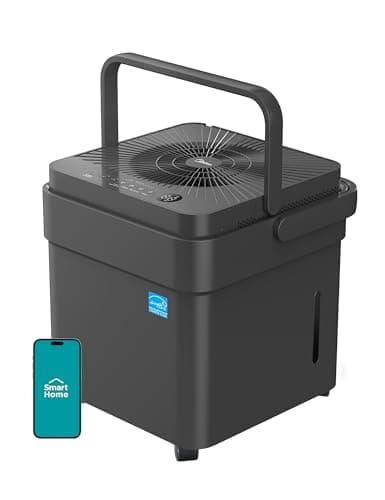
The adjustable 4.25-gallon bucket is the point. Most dehumidifiers get switched off because emptying a 2-gallon bucket twice a day is miserable; this one buys you a couple of days.
#ad Price as of October 18, 2026, from Amazon. Prices change. How we make money.
Published specifications
| Specification | Value | Source |
|---|---|---|
| Capacity | 35 pints per day | Midea published specification |
| Capacity (federal test) | 35.82 pints per day | ENERGY STAR certified products database |
| Coverage | Up to 3,500 sq ft | Midea published specification |
| Efficiency (IEF) | 2.01 L/kWh | ENERGY STAR certified products database |
| Annual energy use | 378 kWh/yr | ENERGY STAR certified products database |
| Bucket fill level | Adjustable, up to 4.25 gallons | Midea user manual |
| Fan speeds | 2 (High, Low) | Midea user manual |
| Dimensions | 14.76 x 14.57 x 14.45 in, 39.62 lb | Midea published specification |
| Certification | ENERGY STAR certified | ENERGY STAR certified products database |
What it costs to run
About $69 a year on ENERGY STAR's certified annual energy figure.
ENERGY STAR publishes 378 kWh a year for this model. At 18.34 cents/kWh that is $69.33 a year. That figure is calculated on the program's standardized test basis, not measured in your basement: a genuinely damp space where it cycles constantly will use more. Against the 50-pint Cube's 515 kWh ($94.45) it is the cheaper machine to own, which is the argument for sizing honestly rather than buying headroom.
What is good about it
- An adjustable bucket that holds up to 4.25 gallons - the difference between a unit you keep using and one you unplug in week three
- An IEF of 2.01 L/kWh removes about 18% more water per kWh than the 20-pint Cube's 1.70
- Nests down into a smaller shape for storage, which matters for an appliance you only use half the year
What is not
- The 3,500 sq ft coverage claim assumes conditions no real basement has; treat it as a ceiling, not a specification
- 35 pints is not enough for a genuinely wet basement with standing water
- Midea does not publish a rated wattage for this model, so we quote ENERGY STAR's certified annual energy figure instead
- No built-in pump on this model - without a floor drain you are either emptying the bucket or routing a gravity hose
Who should skip this
Skip this if your basement is wet rather than damp - visible water, white efflorescence on the walls, a musty smell that returns within a day of airing out. That is a drainage problem, and a 35-pint unit will run permanently and never win.
How it scored
- Tank interval10.0
- Capacity for the money8.5
- Efficiency per liter removed9.0
- Storage footprint9.0
Overall 8.7 / 10. This is our editorial score from published specifications and computed running cost. It is not a test result, and it is deliberately not marked up as a rating in this page’s structured data.
Frigidaire FFAD5033W1 50-Pint
Wet basements that need real capacity
A conventional 50-pint unit that publishes its Integrated Energy Factor, which is the one dehumidifier figure that actually predicts your bill.
#ad We do not hold a current price for this product, so we do not show one. How we make money.
Published specifications
| Specification | Value | Source |
|---|---|---|
| Capacity | 50 pints per day | Frigidaire published specification |
| Rated power | 545 W at 120 V | Frigidaire published specification |
| Integrated Energy Factor | 1.8 L/kWh | Frigidaire published specification |
| Bucket capacity | 2.1 gallons | Frigidaire published specification |
| Humidity setpoint range | 35% to 85% RH | Frigidaire published specification |
| Noise | 47 / 49 / 51 dBA by fan speed | Frigidaire published specification |
| Certification | Energy Star rated | Frigidaire published specification |
| Continuous drain | Yes | Frigidaire published specification |
What it costs to run
About $180-200 a year on a humidistat - and far less if you fix the water first.
545 W / 1000 x 10 hours x 365 days = 1,989 kWh = $364.79 a year at continuous duty. In practice a dehumidifier on a humidistat cycles rather than running flat out, so a realistic damp-basement figure is roughly half that, $180-200. Either way it dwarfs every purifier on this site, which is exactly why finding the water source matters more than choosing the unit.
What is good about it
- Publishes an Integrated Energy Factor of 1.8 L/kWh, which lets you compute cost per liter removed instead of guessing
- Continuous drain means you never empty a bucket, which is the single reason most dehumidifiers end up unplugged
- A 35% RH floor on the setpoint is low enough for a genuinely damp basement
What is not
- 545 W is a real load - a dehumidifier is by far the most expensive appliance discussed on this site
- 41 lb and nearly 25 inches tall; this is not a discreet object
Who should skip this
Skip this if your damp problem is one closet or one bathroom. A 50-pint compressor unit in a closet is enormously more machine than the job needs.
How it scored
- Capacity for the money9.0
- Published efficiency data9.5
- Set-and-forget drainage9.0
- Running cost6.0
Overall 8.5 / 10. This is our editorial score from published specifications and computed running cost. It is not a test result, and it is deliberately not marked up as a rating in this page’s structured data.
Eva-Dry E-333 Renewable
Safes, sealed closets, boats
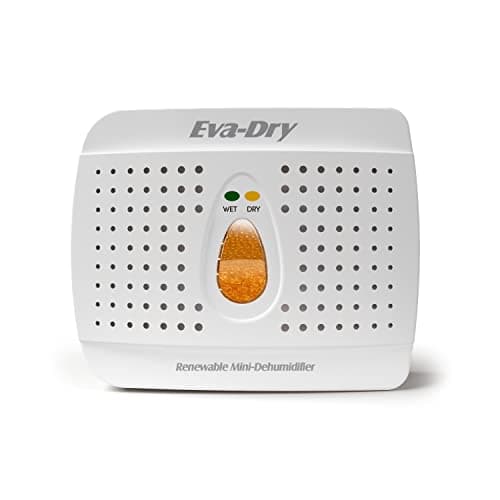
No power, no tank, no fan - a silica desiccant you plug in for a few hours to dry out and then put back. For a gun safe or a sealed closet this is often the honest answer.
#ad Price as of October 18, 2026, from Amazon. Prices change. How we make money.
Published specifications
| Specification | Value | Source |
|---|---|---|
| Type | Renewable silica gel desiccant, recharged by plugging in | Eva-Dry published specification |
What is good about it
- Zero running cost while it is working - it draws power only during the recharge cycle
- Nothing to empty, nothing to break, and no standing water to grow anything in
What is not
- Capacity is tiny; this handles a sealed cubic foot or two, not a room
- You have to remember to recharge it, and nothing reminds you
Who should skip this
Skip this for anything with a door that opens regularly. Desiccant works in sealed spaces; in a closet you open daily it never gets ahead of the moisture coming in.
How it scored
- Running cost10.0
- Fit for sealed spaces9.0
- Capacity2.0
- Maintenance burden6.0
Overall 7.2 / 10. This is our editorial score from published specifications and computed running cost. It is not a test result, and it is deliberately not marked up as a rating in this page’s structured data.
How we ranked these
We have not tested these units. Nobody here owns one. What we did was compile each manufacturer’s published specifications, check the coverage claims against AHAM’s room-sizing rule, and compute what each one costs to run for a year at the current US average electricity price. Every figure on this page is attributed to whoever published it, and the arithmetic is shown so you can redo it.
How we rank these sets out the full method, including what would change a ranking.
Questions people ask
+−How many pints of dehumidifier for 1,500 square feet?
For a damp 1,500 sq ft space, 35-40 pints. For the same area with visible moisture on walls or floor, 50 pints. Both assume a single connected space - two closed-off 750 sq ft rooms are two separate problems.
+−Is a 20 pint dehumidifier big enough?
For a damp space up to about 500 sq ft, yes. For a wet space, or for anything over 500 sq ft, no. The dampness level moves the answer as much as the area does, which is why the table has three columns rather than one. For one closed bedroom that is usually exactly the right size: best dehumidifiers for bedrooms.
+−Does a dehumidifier use a lot of electricity?
It is the most power-hungry device discussed on this site. A 545 W unit cycling in a damp basement is around $180-200 a year at the US average rate, against roughly $18 for a bedroom air purifier. That gap should influence how hard you look for the water source.
+−Can a dehumidifier be too big for a room?
Yes. An oversized unit short-cycles - reaching setpoint fast, shutting off, and restarting - which spends more of its running time in the compressor’s least efficient phase. Undersizing has its own cost too: ENERGY STAR’s figures show the smallest model in one popular range is also its least efficient, as we set out in our Midea Cube review. You get the same dryness for a similar or higher bill, from a larger and more expensive machine.
+−What setting should I use?
Set the humidistat to 50%, or 55% in a basement that struggles, and let it cycle. Below 50% you are spending money to go past the EPA’s ideal band for no additional benefit.