Guide
Ideal Indoor Humidity
One table settles most of the arguments on this site. This is the page every other page links back to.
By Scooter M. · Published · Last updated
How this page is funded: the buy links below are affiliate links. If you buy through one, we earn a commission at no extra cost to you. It does not change the order of the picks or what we say about them. Full disclosure.
The short answer
The EPA states that indoor relative humidity should be kept below 60 percent, ideally between 30 and 50 percent. Below 30% you get static, dry skin and nosebleeds. Above 50% dust mites do well. Above 60% mold risk climbs. In hard winter cold you may need to run lower than 30% to avoid condensation on the windows - the building sets that limit, not comfort.
The band, and what happens outside it
| Relative humidity | What happens | What to do |
|---|---|---|
| Below 20% | Persistent static, cracked lips, nosebleeds, wood shrinking and gapping. | Humidify - Dry Air |
| 20-30% | Below the EPA's ideal band. Noticeably dry, static common. | Humidify, unless the outdoor temperature makes this the practical ceiling. |
| 30-50% | The EPA's stated ideal range. Comfortable, and unfriendly to both extremes. | Nothing. This is the target. |
| 50-60% | Still under the ceiling, but dust mites do well here and condensation on cold surfaces becomes likely. | Bring it down - how to lower humidity |
| Above 60% | Over the EPA's ceiling. Mold risk climbs, musty smells appear, surfaces feel clammy. | Find the water first, then dehumidify - Damp & Mold |
Why the winter target is lower than the ideal band
The 30-50% band assumes your building can carry it. In cold weather it often cannot, because the inside face of your window glass is much colder than the room - and when moist air touches a surface below its dew point, the water comes out of the air and onto that surface.
Condensation on the inside of the windows is the signal that you have exceeded what the building tolerates. Ignore it and the same thing is happening in wall cavities where you cannot see it, which is a considerably more expensive problem than dry skin.
| Outdoor temperature | Practical indoor target | Watch for |
|---|---|---|
| Above 40°F | 40-50% | Nothing - the ideal band is achievable. |
| 20 to 40°F | 35-40% | Condensation at the bottom corners of windows. |
| 0 to 20°F | 25-35% | Frost on the glass. Back off if you see it. |
| Below 0°F | 20-25% | Any wetting at all. Address drafts instead of adding moisture. |
Room by room
One reading in the hallway does not describe a house. The rooms that matter are the ones with the problem:
- Bedroom. Eight hours a night with the door closed, so this is where dryness and dust mites both matter most. Measure here first.
- Basement. Almost always the highest reading in the house. 50-55% is a realistic working target; 60% is the ceiling.
- Bathroom. Will spike to 80-90% during a shower - that is normal. What matters is how fast it comes back down. More than 30 minutes means the ventilation is not doing its job.
- Crawl space. Reads high in winter for reasons that are partly an artefact of cold air - see crawl space and garage humidity.
- Closets on external walls. Still air plus a cold surface. Often the mustiest spot in an otherwise fine house.
How to measure it properly
- Not on an external wall, not in direct sun, and not directly above a radiator. All three give you a reading of the microclimate rather than the room.
- Give it 20 minutes to settle after moving it. Hygrometer sensors respond slowly.
- Read it in the morning, when the house is at its coolest and humidity at its highest.
- Measure over several days. A single reading catches a moment. If your problem varies overnight, you need a logging hygrometer to see it at all.
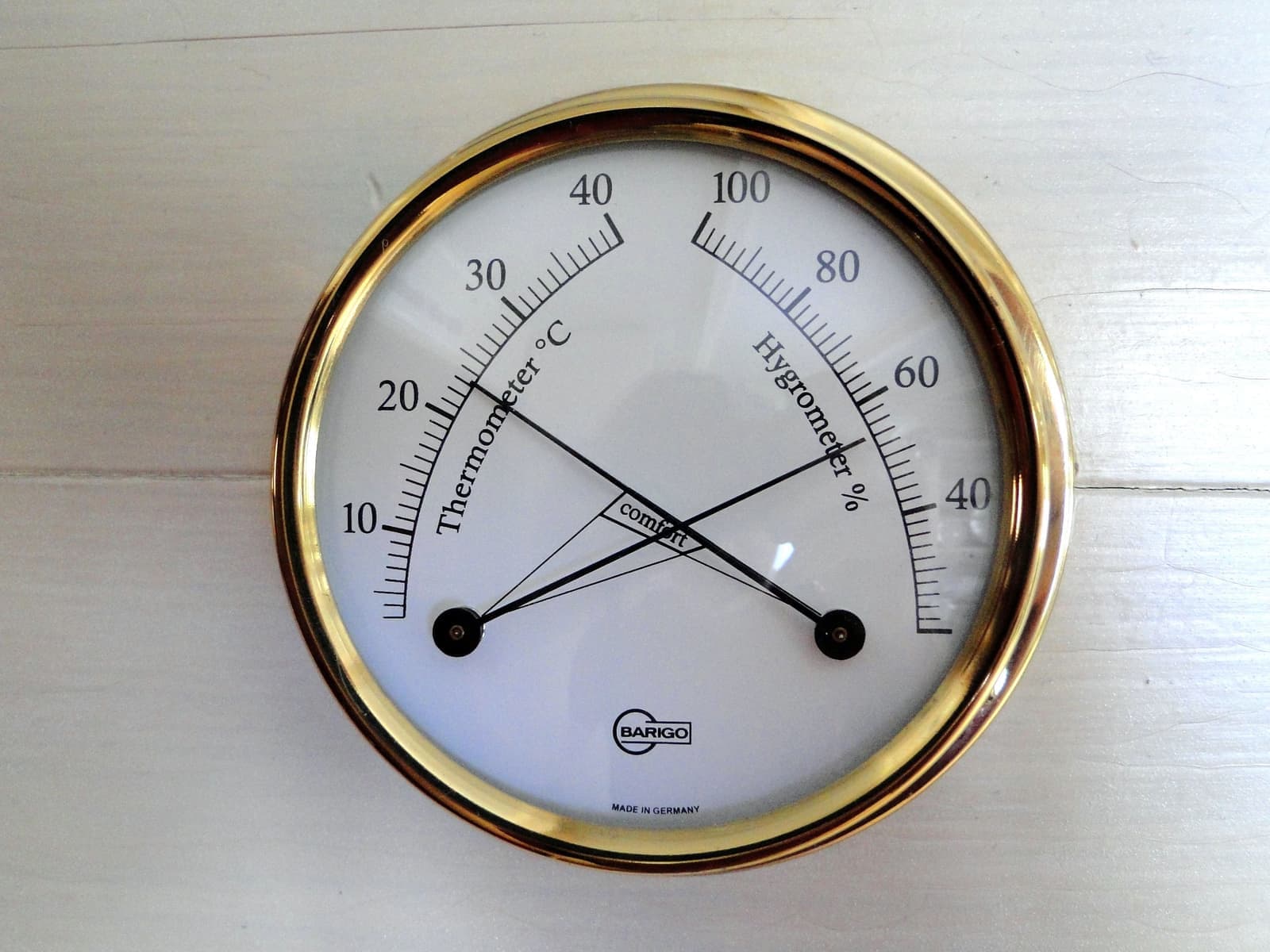
What we would buy for this
Chosen from the same registry as our roundups, on published specifications and computed running cost.
ThermoPro TP49 Hygrometer
Anyone about to buy a humidifier or a dehumidifier
An inexpensive digital hygrometer is the highest-value purchase on this entire site, because it is the one that tells you whether to buy anything else.
#ad We do not hold a current price for this product, so we do not show one. How we make money.
Published specifications
| Specification | Value | Source |
|---|---|---|
| Function | Digital temperature and relative humidity readout with a comfort indicator | ThermoPro published specification |
What is good about it
- Cheap enough to buy three and put one in the bedroom, one in the basement and one in the living room, which is what you actually want
- Gives you the reading that decides between a humidifier and a dehumidifier - a decision people routinely get backwards
What is not
- Consumer hygrometers are typically accurate to within a few percentage points, which is fine for the 30-50% question and not fine for anything precise
- No logging, so you see now rather than overnight
Who should skip this
Skip this only if you already own a hygrometer. There is no household we would tell not to measure.
How it scored
- Value for the decision it informs10.0
- Accuracy for the 30-50% question8.0
- Logging and history2.0
Overall 9.0 / 10. This is our editorial score from published specifications and computed running cost. It is not a test result, and it is deliberately not marked up as a rating in this page’s structured data.
Govee H5075 Bluetooth Hygrometer
Diagnosing a problem that changes overnight
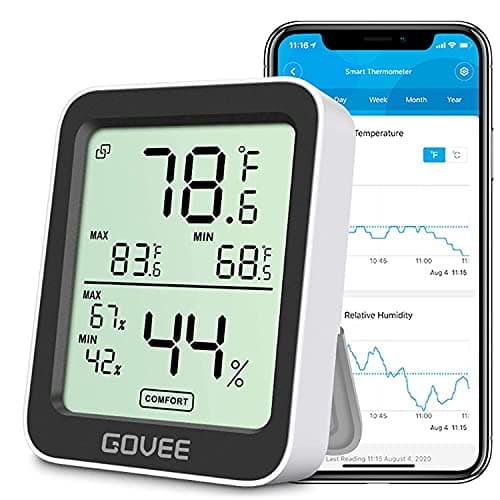
The one that logs. If your problem is that the house is dry at night but fine during the day, a hygrometer you have to walk over and read will never tell you that.
#ad Price as of October 18, 2026, from Amazon. Prices change. How we make money.
Published specifications
| Specification | Value | Source |
|---|---|---|
| Function | Bluetooth temperature and humidity sensor with app-based logging and data export | Govee published specification |
What is good about it
- Logging is the feature. Overnight humidity swings are invisible to a spot reading, and they explain most morning symptoms
- Data export means you can check whether the humidifier actually changed anything, rather than assuming
What is not
- Bluetooth range is room-scale; a basement sensor will not reach a phone upstairs
- Requires an app and an account, which is a genuine cost for some people
Who should skip this
Skip this if you just want a number on a wall. The logging is the whole premium, and it is wasted if you will not look at it.
How it scored
- Logging and history9.5
- Value for the decision it informs9.0
- Range and placement freedom6.0
Overall 8.6 / 10. This is our editorial score from published specifications and computed running cost. It is not a test result, and it is deliberately not marked up as a rating in this page’s structured data.
How we ranked these
We have not tested these units. Nobody here owns one. What we did was compile each manufacturer’s published specifications, check the coverage claims against AHAM’s room-sizing rule, and compute what each one costs to run for a year at the current US average electricity price. Every figure on this page is attributed to whoever published it, and the arithmetic is shown so you can redo it.
How we rank these sets out the full method, including what would change a ranking.
Questions people ask
+−What humidity should my house be in summer?
The same band applies - the EPA’s 30-50%, below 60%. Summer is when holding the top of it is difficult rather than the bottom, so air conditioning and ventilation timing do most of the work.
+−Is 60 humidity too high for a bedroom?
It is at the EPA’s stated ceiling, so there is no margin. Dust mites do well well before that point, so for a bedroom specifically we would treat 50% as the number to stay under rather than 60%.
+−What humidity should a basement be?
Below 60%, with 50-55% a realistic working target. Basements are cooler than the rest of the house, which pushes the relative reading up for the same amount of water - so a basement holding 55% is doing better than the number suggests.
+−Why is my humidity different in every room?
Because temperature is different in every room, and relative humidity depends on temperature. It is also because moisture is produced in specific places - bathrooms, kitchens, laundry - and does not distribute evenly through a house with closed doors.
+−Do I need a hygrometer in every room?
Not every room, but more than one. Bedroom, basement and living area covers most households. They are cheap enough that three is a reasonable purchase and the difference between the readings is often the most useful information you get - and the bedroom reading is the one that settles whether a humidifier is worth buying.
+−How accurate are cheap hygrometers?
Typically within a few percentage points, which is entirely adequate for the question you are asking - whether you are under 30, in the 30-50 band, or over 60. For that decision, a few points of error changes nothing.