Roundup
Best Air Purifiers for Pets
In a house with animals, the washable pre-filter is the specification that decides your three-year cost.
By Scooter M. · Published · Last updated
How this page is funded: the buy links below are affiliate links. If you buy through one, we earn a commission at no extra cost to you. It does not change the order of the picks or what we say about them. Full disclosure.
Living with animals changes which specification matters. Here is what and why, before the picks.
Is an air purifier the right fix for this?
Partly, and it is worth being precise about which part:
| The problem | Airborne? | Does a purifier help? |
|---|---|---|
| Dander - the skin flakes that carry the allergen | Yes, and it stays airborne for a long time | Yes. This is the strongest case for a purifier in a pet household. |
| Fine hair | Partly - the finest fraction floats | Somewhat, and it loads the filter fast. Pre-filter matters. |
| Hair on floors and furniture | No - too heavy | No. Vacuuming, not filtering. |
| Litter box smell | Gaseous | Only via carbon, partially - full detail here |
| Allergen embedded in sofa and carpet | Only when disturbed | Marginally. Cleaning and covers do more. |
One question this page deliberately does not answer, because it deserves its own: whether the machine itself is safe to run around the animal. The short version is that filtration adds nothing to the air while some extra stages do, and birds change the calculation - are air purifiers safe for pets has the published guidance.
Why the pre-filter is the spec that matters
Pet hair loads a filter far faster than dust does. A HEPA stage clogged with hair delivers less airflow, which means less CADR, which means the unit is quietly doing less than you paid for - and unlike a saturated carbon filter there is at least a visible sign, if you look.
A washable pre-filter catches hair and large debris before it reaches the expensive stage. In a pet household that single feature is what keeps the unit near its rated performance and what decides how often you buy filters. It is worth more here than a small CADR advantage. Which layers actually survive a wash, and which you simply replace, is set out in washable vs replaceable filters.
What size you actually need
The same AHAM two-thirds rule applies - a smoke CADR of roughly two-thirds the room area, with AHAM’s own worked example being 132 CFM for 200 sq ft. Size for the room the animal actually lives in, which is usually the living room rather than the bedroom.
One caveat specific to pets: if the animal sleeps in your bedroom, that room needs its own unit regardless of what is in the living room. Eight hours of close exposure in a closed room is not addressed by a purifier down the hall.
This page is about the environment - humidity, particles, ventilation - and what changes it. It is not medical advice and we hold no medical qualification. If symptoms are persistent, severe or getting worse, that is a question for a clinician rather than a purchase.
When to buy nothing at all
- The pet sleeps on the bed and that has not changed. Keeping the animal off bedding does more for allergen exposure than any filter, and it is free.
- You have not vacuumed with a decent filter recently. Most pet allergen is in soft furnishings, not the air.
- The problem is purely smell rather than allergy. That is a carbon question and a source question - pet and litter box odors.
Quick picks
Ranked on published specifications and computed running cost. Tap any row for the full write-up, including who should skip it.
| # | Product | Best for | Score | Price |
|---|---|---|---|---|
| 1 | 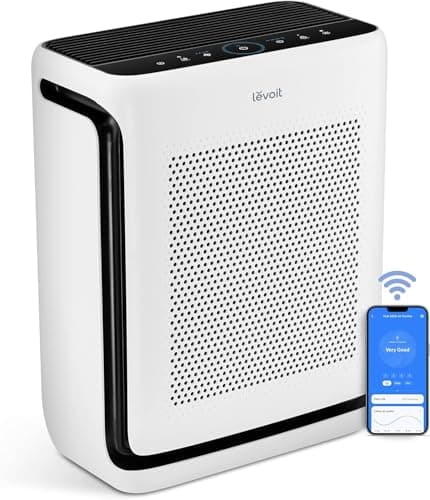 Levoit Vital 200SHomes with shedding pets Levoit Vital 200SHomes with shedding pets | Shedding pets | 8.0 | $169.99 - View on Amazon |
| 2 |  Winix 5500-2Smoke, cooking smells and pet odors Winix 5500-2Smoke, cooking smells and pet odors | Dander plus odor | 8.4 | Check price on Amazon |
| 3 | 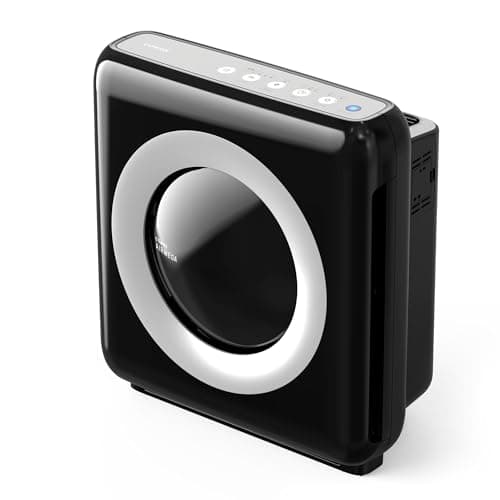 Coway Airmega AP-1512HH MightyRunning continuously in a medium room Coway Airmega AP-1512HH MightyRunning continuously in a medium room | Running continuously | 8.7 | $154.98 - View on Amazon |
| 4 | 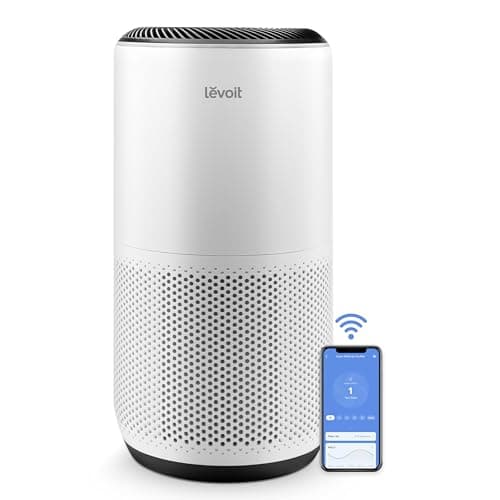 Levoit Core 400SLiving rooms and open-plan spaces Levoit Core 400SLiving rooms and open-plan spaces | Living rooms | 8.6 | $189.97 - View on Amazon |
#1 - Shedding pets
Levoit Vital 200S
Homes with shedding pets
The highest CADR we carry, built around a washable pre-filter and a wide intake - the right shape for a house with animals in it, because hair loads a filter far faster than dust does.
#ad Price as of October 18, 2026, from Amazon. Prices change. How we make money.
Published specifications
| Specification | Value | Source |
|---|---|---|
| CADR | 250 CFM | Levoit published specification |
| Coverage | 388 sq ft at 4.8 air changes/hr (1,862 sq ft at 1 ACH) | Levoit published specification |
| Rated power | 50 W | Levoit published specification |
| Noise | 23-54 dB | Levoit published specification |
| Filtration | 3-stage: washable pre-filter, HEPA, activated carbon. Pet allergy, toxin absorber and smoke remover carbon filters sold for the same body | Levoit published specification |
| Dimensions | 15.6 x 8.5 x 19.8 in | Levoit published specification |
What it costs to run
About $40 a year in electricity at 12 hours a day, before filters.
50 W / 1000 x 12 hours x 365 days = 219 kWh. At 18.34 cents/kWh that is $40.16 a year at rated power, and less on the lower fan speeds. That is roughly $10 a year more than the Core 400S for 19 CFM more CADR - worth it in a house with animals, hard to justify without them.
What is good about it
- 250 CFM is the highest CADR of anything we carry, and it covers about 375 sq ft under AHAM's two-thirds rule
- The washable pre-filter is the part that matters with pets - hair is what kills HEPA filters early
- Levoit publishes coverage at both 1 ACH and 4.8 ACH, and the 388 sq ft figure lines up closely with the AHAM arithmetic
- Four different carbon filters fit the same chassis, so the unit adapts to pets, smoke or off-gassing without replacing the body
What is not
- 50 W for 250 CFM is a worse clean-air-per-watt ratio than the Core 400S manages at 38 W for 231 CFM
- We could not find a published filter replacement interval for this model, so we are not quoting one
- Levoit does not publish power draw per fan speed, so continuous-running cost cannot be computed precisely
- The pet-specific carbon filter is a separate purchase and is not always in stock - check it is available before buying the body for that reason
Who should skip this
Skip this if you have no animals and no odor problem. Without pets you are paying for a wide pre-filter and a carbon option you will not use, and the Core 400S delivers comparable clean air on 12 W less.
How it scored
- Pre-filter design for hair9.0
- Clean air per watt7.0
- Honest coverage claim9.0
- Filter economics8.0
Overall 8.0 / 10. This is our editorial score from published specifications and computed running cost. It is not a test result, and it is deliberately not marked up as a rating in this page’s structured data.
#2 - Dander plus odor
Winix 5500-2
Smoke, cooking smells and pet odors
The one with a genuine granular carbon stage rather than a carbon-dusted sheet, which is why it belongs on a smoke and odor list and why it costs more to run.
#ad We do not hold a current price for this product, so we do not show one. How we make money.
Published specifications
| Specification | Value | Source |
|---|---|---|
| CADR (smoke) | 232 CFM | AHAM-verified figure published by Winix |
| CADR (dust) | 243 CFM | AHAM-verified figure published by Winix |
| CADR (pollen) | 246 CFM | AHAM-verified figure published by Winix |
| Coverage | 360 sq ft | Winix published specification |
| Rated power | 70 W | Winix published specification |
| Filtration | 4-stage: washable pre-filter, activated carbon, True HEPA, PlasmaWave | Winix published specification |
| Certification | Energy Star, CARB certified | Winix published specification |
What it costs to run
About $56 a year in electricity at 12 hours a day, before filters.
70 W / 1000 x 12 hours x 365 days = 306.6 kWh. At 18.34 cents/kWh that is $56.23 a year. Over three years that is roughly $95 more than the Levoit Core 400S at the same hours - typically more than the price gap between the two units at purchase.
What is good about it
- AHAM-verified CADR, which means the figure was measured to the AC-1 standard rather than asserted by marketing
- A real granular carbon filter, which is what actually adsorbs gases and odors
- The washable pre-filter slows down how fast the expensive filter loads up
What is not
- 70 W is roughly double the Levoit Core 400S for a similar CADR, and you pay that difference every year
- PlasmaWave is an ionizing stage; it can be switched off, and we would switch it off
Who should skip this
Skip this if odor is not your problem. Buying for dust and pollen alone means paying a 70 W electricity premium for a carbon stage you will not use.
How it scored
- Clean air per watt6.5
- Honest coverage claim9.0
- Odor and gas removal9.5
- Filter economics8.0
Overall 8.4 / 10. This is our editorial score from published specifications and computed running cost. It is not a test result, and it is deliberately not marked up as a rating in this page’s structured data.
#3 - Running continuously
Coway Airmega AP-1512HH Mighty
Running continuously in a medium room
The most efficient unit here at low speed - 3.7 W on speed one - which matters enormously if you leave a purifier running all day and almost not at all if you do not.
#ad Price as of October 18, 2026, from Amazon. Prices change. How we make money.
Published specifications
| Specification | Value | Source |
|---|---|---|
| CADR (smoke) | 233 CFM | Coway published specification |
| CADR (dust) | 246 CFM | Coway published specification |
| CADR (pollen) | 240 CFM | Coway published specification |
| Coverage | 361 sq ft at 4.8 air changes/hr (1,748 sq ft at 1 ACH) | Coway published specification |
| Power draw by speed | 0.3 W standby / 3.7 W speed 1 / 8.7 W speed 2 / 75.3 W speed 3 | Coway published specification |
| Filtration | Pre-filter, odor filter, Green True HEPA, bipolar device | Coway published specification |
What it costs to run
About $6 a year running 24/7 on speed one, or $121 a year running 24/7 on speed three.
Speed 1: 3.7 W / 1000 x 24 x 365 = 32.4 kWh = $5.94 a year. Speed 3: 75.3 W / 1000 x 24 x 365 = 659.6 kWh = $120.97 a year. That twenty-fold spread is the most important number on this page, and it is why we chase per-speed figures instead of accepting a single rated wattage.
What is good about it
- Coway publishes power draw per fan speed, which almost nobody does and which is the only way to compute a real running cost
- 3.7 W on speed one is remarkable - cheaper to run continuously than most nightlights
- Coverage published at 1, 2 and 4.8 air changes per hour, so you can size it honestly
What is not
- 75.3 W on speed three is the highest draw here; how the auto mode behaves decides your bill
- The bipolar device is a stage we would rather do without; check it can be disabled
Who should skip this
Skip this if you only run a purifier for an hour or two at a time. Its whole advantage is low-speed efficiency over long hours, and short bursts on high speed give that straight back.
How it scored
- Clean air per watt9.5
- Honest coverage claim9.5
- Quiet operation8.0
- Filter economics7.5
Overall 8.7 / 10. This is our editorial score from published specifications and computed running cost. It is not a test result, and it is deliberately not marked up as a rating in this page’s structured data.
#4 - Living rooms
Levoit Core 400S
Living rooms and open-plan spaces
The one to buy if you want a purifier that genuinely covers a living room, and one of the few spec sheets in this bracket that publishes coverage at a useful air-change rate rather than only the flattering one.
#ad Price as of October 18, 2026, from Amazon. Prices change. How we make money.
Published specifications
| Specification | Value | Source |
|---|---|---|
| CADR | 231 CFM | Levoit published specification |
| Coverage | 358 sq ft at 4.8 air changes/hr (1,718 sq ft at 1 ACH) | Levoit published specification |
| Rated power | 38 W | Levoit published specification |
| Noise | 22-52 dB | Levoit published specification |
| Filtration | 3-stage: pre-filter, HEPA, activated carbon | Levoit published specification |
| Dimensions | 10.8 x 10.8 x 20.5 in, 11 lb | Levoit published specification |
What it costs to run
About $25-30 a year in electricity at 12 hours a day, before filters.
38 W / 1000 x 12 hours x 365 days = 166.4 kWh. At 18.34 cents/kWh that is $30.52 a year at rated power - and the unit only draws its full 38 W on the top fan speed, so a mid setting lands nearer $25. Add the replacement filter, which you should price before you buy rather than after.
What is good about it
- Levoit publishes coverage at both 1 ACH and 4.8 ACH, which is unusually straight - most brands quote only the flattering 1 ACH number
- 38 W is low for this CADR, which is what keeps the running cost down
- 22 dB on its lowest setting is quiet enough to sleep beside
- Carbon, pet-allergy and smoke-specific replacement filters are sold for the same body
What is not
- We could not find a published filter replacement interval in Levoit's specification, so we are not quoting one
- The 1,718 sq ft headline is a single air change per hour, which is not a useful rate for allergies
Who should skip this
Skip this if your room is under 200 sq ft. The Core 300S covers that at lower power and lower cost, and the extra CADR buys you nothing in a small bedroom.
How it scored
- Clean air per watt9.0
- Honest coverage claim9.5
- Quiet operation8.5
- Filter economics7.5
Overall 8.6 / 10. This is our editorial score from published specifications and computed running cost. It is not a test result, and it is deliberately not marked up as a rating in this page’s structured data.
How we ranked these
We have not tested these units. Nobody here owns one. What we did was compile each manufacturer’s published specifications, check the coverage claims against AHAM’s room-sizing rule, and compute what each one costs to run for a year at the current US average electricity price. Every figure on this page is attributed to whoever published it, and the arithmetic is shown so you can redo it.
How we rank these sets out the full method, including what would change a ranking.
Questions people ask
+−Do air purifiers help with pet dander?
Yes - dander is fine, light and stays airborne, which is exactly what filtration is good at. It is the strongest case for a purifier in a pet household, and it works only in the room the unit is in.
+−Do air purifiers help with pet hair?
With the finest airborne fraction, yes. With hair on the floor and the sofa, no - that is too heavy to be airborne. What hair mainly does to a purifier is clog its filters, which is why the washable pre-filter matters so much here. We take the pre-filter argument apart in our Levoit Vital 200S review.
+−How often should I change filters with pets?
More often than the general guidance, because the load is higher. Vacuum the pre-filter monthly and inspect the main filter at least quarterly - visible matting is a reason to replace regardless of the calendar.
+−Will a purifier stop my allergy to cats?
It reduces airborne allergen in the room it is in. What that means for your symptoms is a medical question and not one we are qualified to answer. The environmental steps with the largest effect are keeping the animal out of the bedroom and off bedding. Cat allergen behaves differently enough from dander generally to deserve its own page - best air purifiers for cat allergies.
+−Is a bigger purifier better for pets?
Size to the room using the AHAM rule, then compare on pre-filter design and power draw. Extra CADR beyond what the room needs mostly buys noise and electricity.