Review
Levoit Core 400S Review
We have not tested this unit and we will not pretend otherwise. What we have done is read every figure Levoit publishes, check the coverage claim against AHAM's rule, and work out the running cost.
By Scooter M. · Published · Last updated
How this page is funded: the buy links below are affiliate links. If you buy through one, we earn a commission at no extra cost to you. It does not change the order of the picks or what we say about them. Full disclosure.
The short answer
Buy it for a living room, not a bedroom, and buy it for the wattage. 231 CFM of smoke CADR at 38 W is the best clean-air-per-watt figure among the units we carry, which is what makes it cheap to leave running. Levoit also publishes coverage at both 1 and 4.8 air changes per hour - a straightness almost nobody else in this category manages. The catch is that it is oversized and over-priced for a small bedroom, and Levoit does not publish a filter replacement interval.
The specification that matters: 231 CFM at 38 W
CADR is the only air purifier figure measured to a published standard - AHAM’s AC-1 protocol. The Core 400S publishes 231 CFM. Against AHAM’s two-thirds rule that covers a room of about 346 sq ft at a standard ceiling height, which is a genuine living room rather than a marketing one.
The number that makes it interesting is the 38 W rated power. Clean air per watt is the specification that decides what a purifier costs you over years rather than at the till, and 38 W for 231 CFM is the strongest ratio among the units on this site. A comparable-CADR unit at 70 W costs roughly $26 a year more at 12 hours a day - over three years that often exceeds the price gap at purchase.
The coverage claim, read properly
Levoit publishes two coverage figures for this machine: 1,718 sq ft at 1 air change per hour, and 358 sq ft at 4.8 air changes per hour. Both are true and they describe the same unit. The first is the one that ends up on retail listings; the second is the one to buy against, because one air change an hour is not a rate that keeps up with an allergy problem.
Publishing both is the single most creditable thing on this spec sheet. Most manufacturers publish only the 1 ACH number and let you assume it means something it does not.
What it costs to run for a year
38 W / 1000 x 12 hours x 365 days = 166.4 kWh. At 18.34 cents per kWh - the US average residential price published by the Energy Information Administration - that is $30.52 a year at rated power. In practice the unit only draws its full 38 W on the top fan speed, so a mid setting lands nearer $25.
Filters are the other half and the half we cannot complete for you, which brings us to the honest gap.
Two things Levoit does not publish
- A filter replacement interval for this model. We could not find one in Levoit’s published specification, so we are not quoting a figure. That matters, because the replacement filter is a recurring cost and the interval is what turns it into an annual number. Price the genuine filter before you buy, and use the parts-per-year method in washable vs replaceable filters.
- Per-speed power draw. The 38 W figure is the rated maximum. Coway publishes wattage for each fan speed on its competing unit, which is the only way to cost continuous running honestly. Levoit does not, so the $25-30 range above is a reasoned band rather than a precise figure.
Who should not buy it
Anyone treating a room under about 220 sq ft. In a small bedroom the extra CADR buys you nothing you can use, and you would be paying more at purchase and more per hour for capacity the room cannot absorb. That is a smaller, lower-wattage unit’s job.
It is also the wrong machine for odor as a primary complaint. The Core 400S has a three-stage filter with an activated carbon layer, but a carbon-impregnated layer inside a combined cartridge is not the same as a separate granular carbon bed - the distinction is set out in activated carbon explained. If smells are the reason you are shopping, buy for the carbon stage instead. The Winix 5510 schedules its carbon separately for exactly that reason, and we compare the two in Core 400S vs Winix 5510.
And it does nothing at all for humidity. If the complaint is static and cracked lips, or condensation and a musty smell, you are in the wrong aisle entirely: which device do I need.
How it compares with the obvious alternative
The Coway AP-1512HH Mighty is the unit most people cross-shop against this one, and it wins on a specification Levoit does not publish at all: power draw per fan speed, which is 3.7 W on speed one. If you intend to run a purifier continuously at a low speed, that figure is decisive. We put the two side by side in Core 400S vs Coway Mighty. The other unit it is cross-shopped against is the Winix 5510, which moves more air but publishes neither a wattage nor an ozone figure - Core 400S vs Winix 5510.
The verdict
For a living room or an open-plan space under about 350 sq ft, this is the unit we would buy, and the reason is the wattage rather than the headline CADR. Within Levoit’s own range, though, it is not the efficiency leader - we rank all ten certified models in best Levoit air purifiers. It is honest about its coverage in a way the category mostly is not. Deduct for the missing filter interval and the missing per-speed draw, both of which you need in order to predict what it costs you - and check the current price of the replacement filter before you commit to the body.
What we would buy for this
Chosen from the same registry as our roundups, on published specifications and computed running cost.
Levoit Core 400S
Living rooms and open-plan spaces
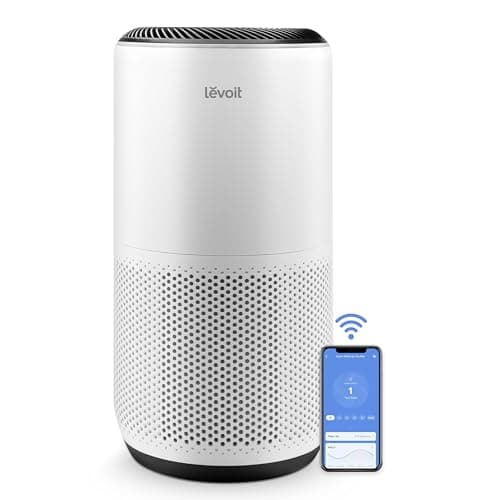
The one to buy if you want a purifier that genuinely covers a living room, and one of the few spec sheets in this bracket that publishes coverage at a useful air-change rate rather than only the flattering one.
#ad Price as of October 18, 2026, from Amazon. Prices change. How we make money.
Published specifications
| Specification | Value | Source |
|---|---|---|
| CADR | 231 CFM | Levoit published specification |
| Coverage | 358 sq ft at 4.8 air changes/hr (1,718 sq ft at 1 ACH) | Levoit published specification |
| Rated power | 38 W | Levoit published specification |
| Noise | 22-52 dB | Levoit published specification |
| Filtration | 3-stage: pre-filter, HEPA, activated carbon | Levoit published specification |
| Dimensions | 10.8 x 10.8 x 20.5 in, 11 lb | Levoit published specification |
What it costs to run
About $25-30 a year in electricity at 12 hours a day, before filters.
38 W / 1000 x 12 hours x 365 days = 166.4 kWh. At 18.34 cents/kWh that is $30.52 a year at rated power - and the unit only draws its full 38 W on the top fan speed, so a mid setting lands nearer $25. Add the replacement filter, which you should price before you buy rather than after.
What is good about it
- Levoit publishes coverage at both 1 ACH and 4.8 ACH, which is unusually straight - most brands quote only the flattering 1 ACH number
- 38 W is low for this CADR, which is what keeps the running cost down
- 22 dB on its lowest setting is quiet enough to sleep beside
- Carbon, pet-allergy and smoke-specific replacement filters are sold for the same body
What is not
- We could not find a published filter replacement interval in Levoit's specification, so we are not quoting one
- The 1,718 sq ft headline is a single air change per hour, which is not a useful rate for allergies
Who should skip this
Skip this if your room is under 200 sq ft. The Core 300S covers that at lower power and lower cost, and the extra CADR buys you nothing in a small bedroom.
How it scored
- Clean air per watt9.0
- Honest coverage claim9.5
- Quiet operation8.5
- Filter economics7.5
Overall 8.6 / 10. This is our editorial score from published specifications and computed running cost. It is not a test result, and it is deliberately not marked up as a rating in this page’s structured data.
Coway Airmega AP-1512HH Mighty
Running continuously in a medium room
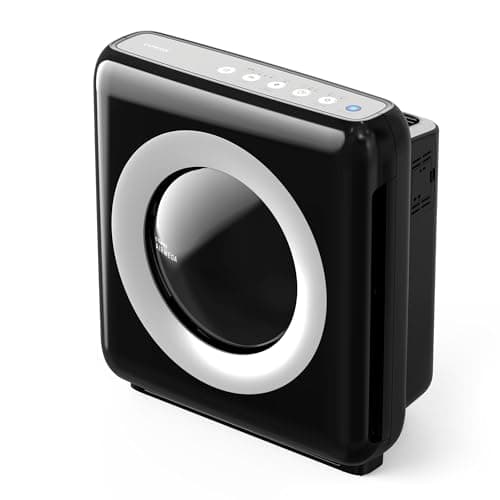
The most efficient unit here at low speed - 3.7 W on speed one - which matters enormously if you leave a purifier running all day and almost not at all if you do not.
#ad Price as of October 18, 2026, from Amazon. Prices change. How we make money.
Published specifications
| Specification | Value | Source |
|---|---|---|
| CADR (smoke) | 233 CFM | Coway published specification |
| CADR (dust) | 246 CFM | Coway published specification |
| CADR (pollen) | 240 CFM | Coway published specification |
| Coverage | 361 sq ft at 4.8 air changes/hr (1,748 sq ft at 1 ACH) | Coway published specification |
| Power draw by speed | 0.3 W standby / 3.7 W speed 1 / 8.7 W speed 2 / 75.3 W speed 3 | Coway published specification |
| Filtration | Pre-filter, odor filter, Green True HEPA, bipolar device | Coway published specification |
What it costs to run
About $6 a year running 24/7 on speed one, or $121 a year running 24/7 on speed three.
Speed 1: 3.7 W / 1000 x 24 x 365 = 32.4 kWh = $5.94 a year. Speed 3: 75.3 W / 1000 x 24 x 365 = 659.6 kWh = $120.97 a year. That twenty-fold spread is the most important number on this page, and it is why we chase per-speed figures instead of accepting a single rated wattage.
What is good about it
- Coway publishes power draw per fan speed, which almost nobody does and which is the only way to compute a real running cost
- 3.7 W on speed one is remarkable - cheaper to run continuously than most nightlights
- Coverage published at 1, 2 and 4.8 air changes per hour, so you can size it honestly
What is not
- 75.3 W on speed three is the highest draw here; how the auto mode behaves decides your bill
- The bipolar device is a stage we would rather do without; check it can be disabled
Who should skip this
Skip this if you only run a purifier for an hour or two at a time. Its whole advantage is low-speed efficiency over long hours, and short bursts on high speed give that straight back.
How it scored
- Clean air per watt9.5
- Honest coverage claim9.5
- Quiet operation8.0
- Filter economics7.5
Overall 8.7 / 10. This is our editorial score from published specifications and computed running cost. It is not a test result, and it is deliberately not marked up as a rating in this page’s structured data.
How we ranked these
We have not tested these units. Nobody here owns one. What we did was compile each manufacturer’s published specifications, check the coverage claims against AHAM’s room-sizing rule, and compute what each one costs to run for a year at the current US average electricity price. Every figure on this page is attributed to whoever published it, and the arithmetic is shown so you can redo it.
How we rank these sets out the full method, including what would change a ranking.
Questions people ask
+−Is the Levoit Core 400S good for a bedroom?
It is more than a bedroom needs. Below about 220 sq ft the extra CADR buys nothing usable and you pay for it twice - once at purchase and again every hour it runs. A smaller, lower-wattage unit is the better bedroom buy.
+−What room size does the Core 400S actually cover?
About 346 sq ft under AHAM’s two-thirds rule on its 231 CFM smoke CADR, and Levoit itself publishes 358 sq ft at 4.8 air changes per hour. The 1,718 sq ft figure on listings is quoted at one air change per hour.
+−How much does the Core 400S cost to run?
About $30.52 a year at rated power, 12 hours a day, at 18.34 cents per kWh - and nearer $25 on a mid fan speed. Filters are extra, and Levoit does not publish a replacement interval for this model, so we cannot turn that into a yearly figure.
+−Does the Core 400S remove smells?
Partly. It has an activated carbon layer inside its combined filter, which is not the same as a separate granular carbon stage. If odor is your main reason for buying, choose on carbon quantity rather than on CADR.
+−Core 400S or Core 300S?
Room size decides it: the 400S for a living room, the smaller unit for a bedroom under about 220 sq ft. Buying the larger unit for a small room is the most common way people overpay in this category. If you have pets, the third option is the Vital 200S, which trades 12 W for a wider washable pre-filter.