Roundup
Best Dehumidifiers for Basements
A dehumidifier is the most expensive appliance on this site to run. Size it right and it costs half as much as sizing it wrong.
By Scooter M. · Published · Last updated
How this page is funded: the buy links below are affiliate links. If you buy through one, we earn a commission at no extra cost to you. It does not change the order of the picks or what we say about them. Full disclosure.
Before the picks: the two things that decide whether a dehumidifier is the right purchase, and the arithmetic that decides which size.
Is a dehumidifier the right fix for this?
It is, if the basement is damp. It is not, if the basement is wet. The difference is whether liquid water is arriving:
- Damp - humidity above 60%, musty smell, condensation on cold surfaces in summer, but no visible water. A dehumidifier fixes this.
- Wet - standing water after rain, white efflorescence on the walls, a tide line, damp that returns within a day of drying. This is drainage or a leak, and a dehumidifier will run permanently against it at roughly $200 a year and never win.
The plastic-sheet test settles it: tape a two-foot square of plastic to the floor and leave it a day. Moisture underneath means water is coming through the slab. Moisture on top means it is condensing out of the air, which is the case a dehumidifier is for.
What size you actually need
Manufacturer coverage claims for dehumidifiers are close to meaningless - “up to 3,500 sq ft” assumes conditions no real basement has. Size on capacity against dampness instead:
| Space | Damp (musty smell) | Wet (visible moisture) |
|---|---|---|
| Up to 500 sq ft | 20-22 pints | 30 pints |
| 500-1,000 sq ft | 25-30 pints | 35-40 pints |
| 1,000-1,500 sq ft | 35-40 pints | 50 pints |
| Over 1,500 sq ft | 50 pints | 50 pints plus, or two units |
The full arithmetic, including why oversizing costs you money rather than buying headroom, is at what size dehumidifier do I need.
Cold basements change the answer
Thermoelectric (Peltier) mini dehumidifiers lose effectiveness sharply in cold rooms, which is exactly what an unheated basement is for much of the year. They appear on basement roundups constantly and they should not. If a unit does not have a compressor, it is for a closet.
When to buy nothing at all
- The basement measures under 60% already. There is nothing to remove.
- Water is actively coming in. Fix the drainage; a dehumidifier is a running cost with no end.
- The problem is one closet or a wardrobe. Buy a desiccant, ventilate it, and move stored items off the cold wall.
- It is midwinter and the basement is already cold and dry. Dehumidifiers do their work in humid weather; running one in January is often nothing but a heater.
Quick picks
Ranked on published specifications and computed running cost. Tap any row for the full write-up, including who should skip it.
| # | Product | Best for | Score | Price |
|---|---|---|---|---|
| 1 | 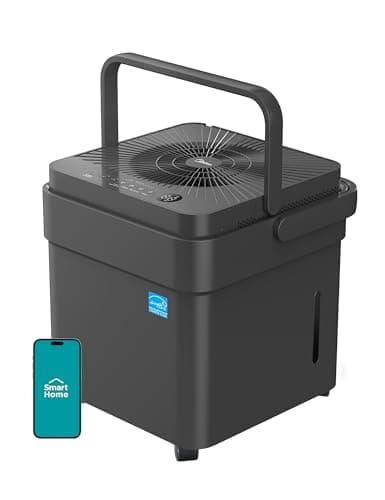 Midea Cube 35-PintBasements without a floor drain Midea Cube 35-PintBasements without a floor drain | Most basements | 8.7 | $211.10 - View on Amazon |
| 2 |  Frigidaire FFAD5033W1 50-PintWet basements that need real capacity Frigidaire FFAD5033W1 50-PintWet basements that need real capacity | Genuinely wet basements | 8.5 | Check price on Amazon |
| 3 | 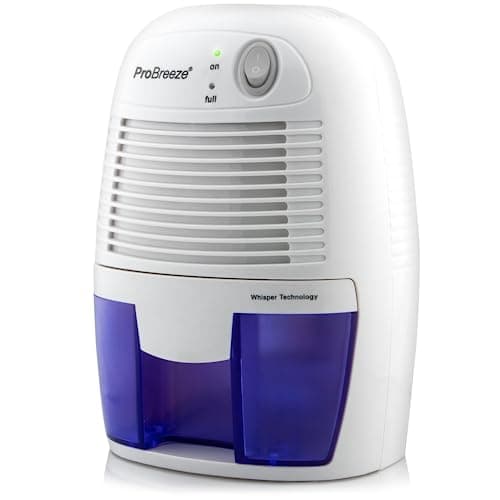 Pro Breeze Mini DehumidifierClosets, gun safes, small bathrooms, RVs Pro Breeze Mini DehumidifierClosets, gun safes, small bathrooms, RVs | Closets, not basements | 7.6 | $43.99 - View on Amazon |
| 4 |  ThermoPro TP49 HygrometerAnyone about to buy a humidifier or a dehumidifier ThermoPro TP49 HygrometerAnyone about to buy a humidifier or a dehumidifier | Buy this first | 9.0 | Check price on Amazon |
#1 - Most basements
Midea Cube 35-Pint
Basements without a floor drain
The adjustable 4.25-gallon bucket is the point. Most dehumidifiers get switched off because emptying a 2-gallon bucket twice a day is miserable; this one buys you a couple of days.
#ad Price as of October 18, 2026, from Amazon. Prices change. How we make money.
Published specifications
| Specification | Value | Source |
|---|---|---|
| Capacity | 35 pints per day | Midea published specification |
| Capacity (federal test) | 35.82 pints per day | ENERGY STAR certified products database |
| Coverage | Up to 3,500 sq ft | Midea published specification |
| Efficiency (IEF) | 2.01 L/kWh | ENERGY STAR certified products database |
| Annual energy use | 378 kWh/yr | ENERGY STAR certified products database |
| Bucket fill level | Adjustable, up to 4.25 gallons | Midea user manual |
| Fan speeds | 2 (High, Low) | Midea user manual |
| Dimensions | 14.76 x 14.57 x 14.45 in, 39.62 lb | Midea published specification |
| Certification | ENERGY STAR certified | ENERGY STAR certified products database |
What it costs to run
About $69 a year on ENERGY STAR's certified annual energy figure.
ENERGY STAR publishes 378 kWh a year for this model. At 18.34 cents/kWh that is $69.33 a year. That figure is calculated on the program's standardized test basis, not measured in your basement: a genuinely damp space where it cycles constantly will use more. Against the 50-pint Cube's 515 kWh ($94.45) it is the cheaper machine to own, which is the argument for sizing honestly rather than buying headroom.
What is good about it
- An adjustable bucket that holds up to 4.25 gallons - the difference between a unit you keep using and one you unplug in week three
- An IEF of 2.01 L/kWh removes about 18% more water per kWh than the 20-pint Cube's 1.70
- Nests down into a smaller shape for storage, which matters for an appliance you only use half the year
What is not
- The 3,500 sq ft coverage claim assumes conditions no real basement has; treat it as a ceiling, not a specification
- 35 pints is not enough for a genuinely wet basement with standing water
- Midea does not publish a rated wattage for this model, so we quote ENERGY STAR's certified annual energy figure instead
- No built-in pump on this model - without a floor drain you are either emptying the bucket or routing a gravity hose
Who should skip this
Skip this if your basement is wet rather than damp - visible water, white efflorescence on the walls, a musty smell that returns within a day of airing out. That is a drainage problem, and a 35-pint unit will run permanently and never win.
How it scored
- Tank interval10.0
- Capacity for the money8.5
- Efficiency per liter removed9.0
- Storage footprint9.0
Overall 8.7 / 10. This is our editorial score from published specifications and computed running cost. It is not a test result, and it is deliberately not marked up as a rating in this page’s structured data.
#2 - Genuinely wet basements
Frigidaire FFAD5033W1 50-Pint
Wet basements that need real capacity
A conventional 50-pint unit that publishes its Integrated Energy Factor, which is the one dehumidifier figure that actually predicts your bill.
#ad We do not hold a current price for this product, so we do not show one. How we make money.
Published specifications
| Specification | Value | Source |
|---|---|---|
| Capacity | 50 pints per day | Frigidaire published specification |
| Rated power | 545 W at 120 V | Frigidaire published specification |
| Integrated Energy Factor | 1.8 L/kWh | Frigidaire published specification |
| Bucket capacity | 2.1 gallons | Frigidaire published specification |
| Humidity setpoint range | 35% to 85% RH | Frigidaire published specification |
| Noise | 47 / 49 / 51 dBA by fan speed | Frigidaire published specification |
| Certification | Energy Star rated | Frigidaire published specification |
| Continuous drain | Yes | Frigidaire published specification |
What it costs to run
About $180-200 a year on a humidistat - and far less if you fix the water first.
545 W / 1000 x 10 hours x 365 days = 1,989 kWh = $364.79 a year at continuous duty. In practice a dehumidifier on a humidistat cycles rather than running flat out, so a realistic damp-basement figure is roughly half that, $180-200. Either way it dwarfs every purifier on this site, which is exactly why finding the water source matters more than choosing the unit.
What is good about it
- Publishes an Integrated Energy Factor of 1.8 L/kWh, which lets you compute cost per liter removed instead of guessing
- Continuous drain means you never empty a bucket, which is the single reason most dehumidifiers end up unplugged
- A 35% RH floor on the setpoint is low enough for a genuinely damp basement
What is not
- 545 W is a real load - a dehumidifier is by far the most expensive appliance discussed on this site
- 41 lb and nearly 25 inches tall; this is not a discreet object
Who should skip this
Skip this if your damp problem is one closet or one bathroom. A 50-pint compressor unit in a closet is enormously more machine than the job needs.
How it scored
- Capacity for the money9.0
- Published efficiency data9.5
- Set-and-forget drainage9.0
- Running cost6.0
Overall 8.5 / 10. This is our editorial score from published specifications and computed running cost. It is not a test result, and it is deliberately not marked up as a rating in this page’s structured data.
#3 - Closets, not basements
Pro Breeze Mini Dehumidifier
Closets, gun safes, small bathrooms, RVs
A thermoelectric unit, not a compressor. That means it is quiet and small and it will not touch a basement - but in a closet or an RV it is exactly right.
#ad Price as of October 18, 2026, from Amazon. Prices change. How we make money.
Published specifications
| Specification | Value | Source |
|---|---|---|
| Type | Thermoelectric (Peltier), not a compressor | Pro Breeze published specification |
What is good about it
- Near-silent, because there is no compressor to cycle
- Small enough to sit inside a wardrobe or under a sink
What is not
- Thermoelectric units lose effectiveness sharply in cold rooms, which is exactly what an unheated basement is
- Capacity is a fraction of any compressor unit - this manages dampness, it does not dehumidify a room
Who should skip this
Skip this for any room-sized job. If you are searching for a basement dehumidifier, this is not it, no matter how many roundups file it under that heading.
How it scored
- Fit for small enclosed spaces9.0
- Quiet operation9.5
- Capacity3.5
- Cold-room performance3.0
Overall 7.6 / 10. This is our editorial score from published specifications and computed running cost. It is not a test result, and it is deliberately not marked up as a rating in this page’s structured data.
#4 - Buy this first
ThermoPro TP49 Hygrometer
Anyone about to buy a humidifier or a dehumidifier
An inexpensive digital hygrometer is the highest-value purchase on this entire site, because it is the one that tells you whether to buy anything else.
#ad We do not hold a current price for this product, so we do not show one. How we make money.
Published specifications
| Specification | Value | Source |
|---|---|---|
| Function | Digital temperature and relative humidity readout with a comfort indicator | ThermoPro published specification |
What is good about it
- Cheap enough to buy three and put one in the bedroom, one in the basement and one in the living room, which is what you actually want
- Gives you the reading that decides between a humidifier and a dehumidifier - a decision people routinely get backwards
What is not
- Consumer hygrometers are typically accurate to within a few percentage points, which is fine for the 30-50% question and not fine for anything precise
- No logging, so you see now rather than overnight
Who should skip this
Skip this only if you already own a hygrometer. There is no household we would tell not to measure.
How it scored
- Value for the decision it informs10.0
- Accuracy for the 30-50% question8.0
- Logging and history2.0
Overall 9.0 / 10. This is our editorial score from published specifications and computed running cost. It is not a test result, and it is deliberately not marked up as a rating in this page’s structured data.
How we ranked these
We have not tested these units. Nobody here owns one. What we did was compile each manufacturer’s published specifications, check the coverage claims against AHAM’s room-sizing rule, and compute what each one costs to run for a year at the current US average electricity price. Every figure on this page is attributed to whoever published it, and the arithmetic is shown so you can redo it.
How we rank these sets out the full method, including what would change a ranking.
Questions people ask
+−What humidity should a basement be?
Below 60% is the EPA’s stated ceiling, with 30-50% the ideal band for indoor air generally. Basements are usually the hardest room in the house to hold in that band, and 50-55% is a realistic working target for most.
+−Is 60 humidity too high for a basement?
It is at the ceiling the EPA gives, which means you have no margin. Anything above it and mold risk climbs. We would treat a steady 60% reading as a prompt to act rather than a comfortable place to sit.
+−Should a basement dehumidifier run all the time?
It should run on a humidistat set to your target, not continuously. Continuous running is what turns a $115 annual cost into a $230 one, and it will keep pulling below your setpoint for no benefit. The same logic applies in a room you sleep in, where cycling is the real cost - best dehumidifiers for bedrooms.
+−How much does a basement dehumidifier cost to run?
At the current US average of 18.34 cents/kWh: a 345 W unit cycling roughly half the time is around $115 a year, and a 545 W unit doing the same is $180-200. Continuous running roughly doubles both. This is why sizing correctly matters more than the purchase price.
+−Where should I put a basement dehumidifier?
Central, with clearance around the intake and exhaust, and near a floor drain if one exists so you can use the continuous drain hose. For a worked example of what one manufacturer actually specifies - 8 inches all round, 16 for the outlet - see our Midea Cube dehumidifier review. Against a wall in a corner is the most common placement and it restricts the airflow the unit depends on.
+−Do I need a dehumidifier if I have air conditioning?
Air conditioning removes moisture as a side effect of cooling, which helps in the rooms it serves. Most basements are not on the cooling circuit and stay cool without it running, so the basement keeps its humidity while the rest of the house loses it. The two machines are compared properly at dehumidifier vs air conditioner.