Comparison
Whole House vs Portable Air Purifier
For most households the honest answer is: upgrade the furnace filter you already have, and put one portable unit in the bedroom.
By Scooter M. · Published · Last updated
How this page is funded: the buy links below are affiliate links. If you buy through one, we earn a commission at no extra cost to you. It does not change the order of the picks or what we say about them. Full disclosure.
The short answer
Do both, cheaply. If you have forced-air heating you already own a whole-house air cleaner - the furnace filter - and upgrading it costs a few dollars. Then put one correctly sized portable unit in the bedroom, where the longest exposure happens. A dedicated in-duct HEPA system is a large expense that most households do not need.
| Whole-house (in-duct) | Portable | |
|---|---|---|
| Coverage | Every room the ducts reach - but only while the fan runs | The room it is in, continuously |
| Requires ductwork | Yes. Radiators or ductless heat pumps rule it out. | No |
| Filtration level | Usually MERV rather than HEPA - a true HEPA filter would choke most systems | HEPA is standard |
| Measurable | No CADR figure - performance depends on your system's airflow | CADR, tested under AHAM AC-1, so you can size it |
| Cost | A filter upgrade is a few dollars; a dedicated in-duct HEPA system is a major expense | Modest purchase, then filters and $6-56 a year in electricity |
| Noise | Whatever your furnace fan already makes | Depends on the speed you run it at |
The cheap version of whole-house filtration
If you have forced-air heating or central air, air is already being pulled through a filter and pushed into every room. Two things make that far more useful than most people realize:
- Change it. An overdue furnace filter is restricting airflow and filtering less. This is the cheapest air quality improvement available to most households.
- Consider a higher MERV rating. MERV 13 is a substantial improvement over the basic filters many systems ship with.
The caveat is genuine and worth stating plainly: a higher-MERV filter restricts airflow more, and not every system is specified for one. A restricted system can run inefficiently or, in the worst case, be damaged. Check what your system supports before fitting a higher-rated filter. The MERV scale is explained at HEPA filters explained.
Buy whole-house filtration if...
- You have ductwork - without it, this is not an option at all
- The problem is house-wide rather than concentrated in one room
- You want something that requires no thought beyond a filter change
- You are already replacing or servicing the system
Buy a portable unit if...
- The problem is concentrated in the bedroom, which it usually is
- You have radiators, baseboard heating or ductless heat pumps
- You want a measured CADR you can size against a specific room
- You rent, or want to be able to move it
Buy neither if...
The trigger is dust mites or mold. Neither of those is primarily an airborne problem, and both have more effective non-filtration fixes - dust mites and mold respectively.
What we would actually do
Change the furnace filter, fit the highest MERV rating the system is specified for, and put one correctly sized portable unit in the bedroom. That covers the whole house at low level and the highest-exposure room properly, for a fraction of what a dedicated in-duct HEPA system costs.
What we would buy for this
Chosen from the same registry as our roundups, on published specifications and computed running cost.
Levoit Core 400S
Living rooms and open-plan spaces
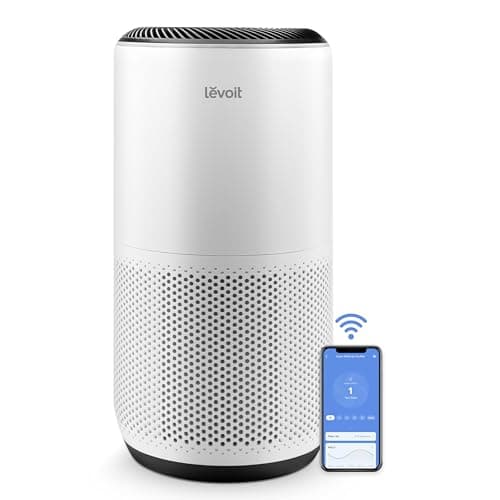
The one to buy if you want a purifier that genuinely covers a living room, and one of the few spec sheets in this bracket that publishes coverage at a useful air-change rate rather than only the flattering one.
#ad Price as of October 18, 2026, from Amazon. Prices change. How we make money.
Published specifications
| Specification | Value | Source |
|---|---|---|
| CADR | 231 CFM | Levoit published specification |
| Coverage | 358 sq ft at 4.8 air changes/hr (1,718 sq ft at 1 ACH) | Levoit published specification |
| Rated power | 38 W | Levoit published specification |
| Noise | 22-52 dB | Levoit published specification |
| Filtration | 3-stage: pre-filter, HEPA, activated carbon | Levoit published specification |
| Dimensions | 10.8 x 10.8 x 20.5 in, 11 lb | Levoit published specification |
What it costs to run
About $25-30 a year in electricity at 12 hours a day, before filters.
38 W / 1000 x 12 hours x 365 days = 166.4 kWh. At 18.34 cents/kWh that is $30.52 a year at rated power - and the unit only draws its full 38 W on the top fan speed, so a mid setting lands nearer $25. Add the replacement filter, which you should price before you buy rather than after.
What is good about it
- Levoit publishes coverage at both 1 ACH and 4.8 ACH, which is unusually straight - most brands quote only the flattering 1 ACH number
- 38 W is low for this CADR, which is what keeps the running cost down
- 22 dB on its lowest setting is quiet enough to sleep beside
- Carbon, pet-allergy and smoke-specific replacement filters are sold for the same body
What is not
- We could not find a published filter replacement interval in Levoit's specification, so we are not quoting one
- The 1,718 sq ft headline is a single air change per hour, which is not a useful rate for allergies
Who should skip this
Skip this if your room is under 200 sq ft. The Core 300S covers that at lower power and lower cost, and the extra CADR buys you nothing in a small bedroom.
How it scored
- Clean air per watt9.0
- Honest coverage claim9.5
- Quiet operation8.5
- Filter economics7.5
Overall 8.6 / 10. This is our editorial score from published specifications and computed running cost. It is not a test result, and it is deliberately not marked up as a rating in this page’s structured data.
Levoit Core 300S
Bedrooms up to about 220 sq ft
The right size for an actual bedroom. 23 W and 22 dB on low means you can run it all night without noticing it on the bill or on the pillow.
#ad We do not hold a current price for this product, so we do not show one. How we make money.
Published specifications
| Specification | Value | Source |
|---|---|---|
| CADR | 141 CFM (240 m3/h) | Levoit published specification |
| Coverage | 219 sq ft at 4.8 air changes/hr (1,051 sq ft at 1 ACH) | Levoit published specification |
| Rated power | 23 W | Levoit published specification |
| Noise | 22-50 dB | Levoit published specification |
| Filtration | 3-stage | Levoit published specification |
| Dimensions | 8.7 x 8.7 x 14.2 in, 5.95 lb | Levoit published specification |
What it costs to run
About $15-18 a year in electricity at 12 hours a day.
23 W / 1000 x 12 hours x 365 days = 100.7 kWh. At 18.34 cents/kWh that is $18.47 a year at rated power, and less on the lower fan speeds you would actually use overnight.
What is good about it
- 141 CFM clears AHAM's two-thirds rule for any room up to 211 sq ft, which covers most bedrooms
- 23 W is the lowest draw of anything we list with this much CADR
- Small enough to sit on a nightstand rather than take a corner of the floor
What is not
- Not enough for a living room - the useful 4.8 ACH figure is 219 sq ft, not the 1,051 sq ft headline
- No published filter replacement interval in the specification we could find
Who should skip this
Skip this if the room is over about 220 sq ft, or if you are trying to cover an open-plan downstairs. It will run flat out and still lose.
How it scored
- Clean air per watt9.5
- Honest coverage claim9.5
- Quiet operation9.0
- Filter economics7.5
Overall 8.8 / 10. This is our editorial score from published specifications and computed running cost. It is not a test result, and it is deliberately not marked up as a rating in this page’s structured data.
How we ranked these
We have not tested these units. Nobody here owns one. What we did was compile each manufacturer’s published specifications, check the coverage claims against AHAM’s room-sizing rule, and compute what each one costs to run for a year at the current US average electricity price. Every figure on this page is attributed to whoever published it, and the arithmetic is shown so you can redo it.
How we rank these sets out the full method, including what would change a ranking.
Questions people ask
+−Is a whole house air purifier worth it?
A furnace filter upgrade is worth it for almost everyone with ductwork - it is a few dollars. A dedicated in-duct HEPA system is a major expense and is hard to justify for a problem that is usually concentrated in one or two rooms.
+−Can I put a HEPA filter in my furnace?
Generally no. True HEPA filters restrict airflow far more than a residential HVAC system is designed for, and fitting one can reduce airflow enough to affect the system. In-duct HEPA installations use a dedicated bypass arrangement for exactly this reason.
+−What MERV rating should I use?
MERV 13 is a common recommendation for improved residential filtration, provided your system is specified for it. Check the manufacturer’s guidance for your unit - the right answer depends on your system, not on a general rule. If you are weighing two portable units instead, see Core 400S vs Coway Mighty.
+−Does running the furnace fan continuously help?
It does make the filter work continuously rather than only during heating cycles, which genuinely improves whole-house filtration. It also uses electricity continuously, so it is a trade rather than a free improvement.
+−How many portable purifiers do I need?
One per closed-door room you actually care about, sized with the AHAM rule. Most households get most of the benefit from a single well-sized unit in the bedroom.