Comparison
Dehumidifier vs Air Conditioner
Both pull water out of the air using the same physics. They differ in what they do with the heat, and that single difference decides which one belongs in your basement.
By Scooter M. · Published · Last updated
How this page is funded: the buy links below are affiliate links. If you buy through one, we earn a commission at no extra cost to you. It does not change the order of the picks or what we say about them. Full disclosure.
The short answer
Use the air conditioner if the room is also too hot; use a dehumidifier if it is only too damp. Both work by condensing moisture onto a cold coil. An air conditioner dumps the collected heat outside, so it cools and dries together. A dehumidifier puts that heat back into the room, so it dries and warms slightly. In a cool damp basement in October, cooling is the last thing you want - which is why the dehumidifier exists. The same physics decides what works in a caravan or a boat, where there is often no power at all - dehumidifiers for RVs and campers.
They are the same machine pointed differently
This surprises people, so it is worth being precise. Both devices run a refrigerant loop with a cold indoor coil - ENERGY STAR describes a dehumidifier as using refrigeration coils, a compressor and fans to remove moisture. The mechanism in both machines is condensation: air meets a surface below its dew point, water comes out of the air onto that surface, and it drains away. A dehumidifier then passes the air over its warm coil on the way out, returning the heat to the room. A split air conditioner sends that heat outside through the unit on the wall or the ground.
So the honest framing is not which one dries better. It is: do you want the heat back?
| Dehumidifier | Air conditioner | |
|---|---|---|
| Primary job | Lower relative humidity to a set point you choose | Lower temperature to a set point you choose |
| Effect on room temperature | Warms the room slightly - the compressor heat has nowhere else to go | Cools the room; that is the point |
| Control | Humidistat. It runs until the humidity target is met | Thermostat. It stops when the room is cold enough, whatever the humidity is doing |
| Works in a cool room | Yes - a cool damp basement is its home ground | Poorly. It has no reason to run once the room is already cold |
| Where the water goes | A bucket you empty, or a hose you run to a drain | A condensate drain, usually plumbed and out of sight |
| Installation | Plug it in and put it down | Window unit, portable with a hose, or a fitted split system |
Why the thermostat is the problem
The reason an air conditioner is unreliable as a dehumidifier is not the hardware, it is what it is being told to do. An air conditioner stops when the room reaches temperature. If the room cools quickly - because the unit is generously sized, or the day is mild - it satisfies the thermostat, shuts off, and stops removing moisture long before the humidity has come down. You get a cold, clammy room: the exact complaint people describe as their air conditioner not dehumidifying.
A dehumidifier does not have this failure mode because it is watching the right variable. You set 50%, and it runs until the room reads 50%, regardless of what the temperature is doing.
Where each one is the right answer
Buy or use the dehumidifier if...
- The space is a basement, crawl space, garage or laundry room - somewhere that is damp and already cool
- The problem persists in spring and autumn, when nobody wants the air conditioner running
- You want to hold a specific humidity target rather than a temperature. The EPA recommends keeping indoor humidity below 60 percent and ideally between 30 and 50 percent, and ENERGY STAR gives the same 30-50% band
- There is no window, or no way to fit a unit that vents outside
Use the air conditioner if...
- The room is hot as well as humid - in a hot summer this is the efficient answer
- You already have central air. ENERGY STAR suggests that where a home uses central air conditioning, adding an A/C vent to a humid space lets you use the system you already own
- You want the heat gone rather than recycled. A dehumidifier running hard in a small closed room in August is fighting you

The running-cost comparison people expect, and why we will not give it
The obvious next question is which is cheaper to run, and the honest answer is that the comparison is not like for like. A dehumidifier is doing one job; an air conditioner is doing two, one of which you may not want. Comparing watts between them tells you very little unless you also value the cooling, and only you know whether you do.
What we can do is the arithmetic on the machine that has one job. Take the published wattage, multiply by hours per day, divide by 1,000, multiply by 365, and multiply by your electricity rate - we use the current US average from the Energy Information Administration and show the working on every product on this site. A dehumidifier running in a basement is often a continuous load for months, so that number is worth knowing before you buy rather than after. The per-unit figures are on the cards in best dehumidifiers for basements.
What neither of them fixes
Both machines treat symptoms. If a basement is damp because water is getting in through the wall, through a failed gutter, or up through the slab, a dehumidifier will run continuously forever and the wall will stay wet. The EPA’s mold guidance puts the priority plainly: if wet or damp materials are dried within 24-48 hours of a leak or spill, in most cases mold will not grow. That is a drying-speed instruction, not a permanent-appliance instruction.
Find the water first. We walk through that order of operations in musty smell in the house and how to lower humidity.
Buy neither if...
Your hygrometer reads inside 30-50% already. In that case the smell or the condensation you are chasing is coming from a specific source - a cold surface, a bathroom with no extractor, a dryer venting indoors - and a machine that lowers a number which is already correct will not touch it. For a vehicle standing unplugged over winter the comparison tilts the other way, as we explain in dehumidifiers for RVs and campers.
What we would actually do
Measure the space first, because the reading decides this and nothing else does. If it is above 60% and cool, buy a dehumidifier sized with the pint arithmetic in what size dehumidifier do I need. If it is above 60% and hot, and you have air conditioning, use that first and see where the humidity lands before spending anything. And if the same room is damp in both seasons, the answer is the dehumidifier, because the air conditioner will not be running for half of the year you need it.
What we would buy for this
Chosen from the same registry as our roundups, on published specifications and computed running cost.
Midea Cube 35-Pint
Basements without a floor drain
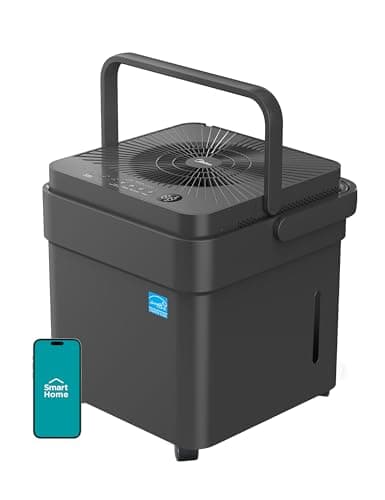
The adjustable 4.25-gallon bucket is the point. Most dehumidifiers get switched off because emptying a 2-gallon bucket twice a day is miserable; this one buys you a couple of days.
#ad Price as of October 18, 2026, from Amazon. Prices change. How we make money.
Published specifications
| Specification | Value | Source |
|---|---|---|
| Capacity | 35 pints per day | Midea published specification |
| Capacity (federal test) | 35.82 pints per day | ENERGY STAR certified products database |
| Coverage | Up to 3,500 sq ft | Midea published specification |
| Efficiency (IEF) | 2.01 L/kWh | ENERGY STAR certified products database |
| Annual energy use | 378 kWh/yr | ENERGY STAR certified products database |
| Bucket fill level | Adjustable, up to 4.25 gallons | Midea user manual |
| Fan speeds | 2 (High, Low) | Midea user manual |
| Dimensions | 14.76 x 14.57 x 14.45 in, 39.62 lb | Midea published specification |
| Certification | ENERGY STAR certified | ENERGY STAR certified products database |
What it costs to run
About $69 a year on ENERGY STAR's certified annual energy figure.
ENERGY STAR publishes 378 kWh a year for this model. At 18.34 cents/kWh that is $69.33 a year. That figure is calculated on the program's standardized test basis, not measured in your basement: a genuinely damp space where it cycles constantly will use more. Against the 50-pint Cube's 515 kWh ($94.45) it is the cheaper machine to own, which is the argument for sizing honestly rather than buying headroom.
What is good about it
- An adjustable bucket that holds up to 4.25 gallons - the difference between a unit you keep using and one you unplug in week three
- An IEF of 2.01 L/kWh removes about 18% more water per kWh than the 20-pint Cube's 1.70
- Nests down into a smaller shape for storage, which matters for an appliance you only use half the year
What is not
- The 3,500 sq ft coverage claim assumes conditions no real basement has; treat it as a ceiling, not a specification
- 35 pints is not enough for a genuinely wet basement with standing water
- Midea does not publish a rated wattage for this model, so we quote ENERGY STAR's certified annual energy figure instead
- No built-in pump on this model - without a floor drain you are either emptying the bucket or routing a gravity hose
Who should skip this
Skip this if your basement is wet rather than damp - visible water, white efflorescence on the walls, a musty smell that returns within a day of airing out. That is a drainage problem, and a 35-pint unit will run permanently and never win.
How it scored
- Tank interval10.0
- Capacity for the money8.5
- Efficiency per liter removed9.0
- Storage footprint9.0
Overall 8.7 / 10. This is our editorial score from published specifications and computed running cost. It is not a test result, and it is deliberately not marked up as a rating in this page’s structured data.
ThermoPro TP49 Hygrometer
Anyone about to buy a humidifier or a dehumidifier
An inexpensive digital hygrometer is the highest-value purchase on this entire site, because it is the one that tells you whether to buy anything else.
#ad We do not hold a current price for this product, so we do not show one. How we make money.
Published specifications
| Specification | Value | Source |
|---|---|---|
| Function | Digital temperature and relative humidity readout with a comfort indicator | ThermoPro published specification |
What is good about it
- Cheap enough to buy three and put one in the bedroom, one in the basement and one in the living room, which is what you actually want
- Gives you the reading that decides between a humidifier and a dehumidifier - a decision people routinely get backwards
What is not
- Consumer hygrometers are typically accurate to within a few percentage points, which is fine for the 30-50% question and not fine for anything precise
- No logging, so you see now rather than overnight
Who should skip this
Skip this only if you already own a hygrometer. There is no household we would tell not to measure.
How it scored
- Value for the decision it informs10.0
- Accuracy for the 30-50% question8.0
- Logging and history2.0
Overall 9.0 / 10. This is our editorial score from published specifications and computed running cost. It is not a test result, and it is deliberately not marked up as a rating in this page’s structured data.
How we ranked these
We have not tested these units. Nobody here owns one. What we did was compile each manufacturer’s published specifications, check the coverage claims against AHAM’s room-sizing rule, and compute what each one costs to run for a year at the current US average electricity price. Every figure on this page is attributed to whoever published it, and the arithmetic is shown so you can redo it.
How we rank these sets out the full method, including what would change a ranking.
Questions people ask
+−Does an air conditioner work as a dehumidifier?
It removes moisture as a side effect of cooling - the same condensation that forms on any surface below the dew point - but it answers to a thermostat, not a humidistat. Once the room is cool enough it stops, whatever the humidity is doing.
+−Is dry mode the same as a dehumidifier?
No. Dry mode favors condensation by running a lower fan speed, which genuinely helps on a humid day, but on most units it still cools and still takes a temperature setting. You cannot ask it to hold a cool basement at 50%.
+−Does a dehumidifier heat the room?
Slightly, yes. The compressor heat has nowhere to go but back into the room. In a basement in autumn that is a small bonus; in a small bedroom in August it is a reason to use the air conditioner instead.
+−Should I run a dehumidifier and the AC at the same time?
Usually not in the same room - you are paying to remove heat with one machine and adding it back with the other. Where it makes sense is different spaces: air conditioning upstairs, dehumidifier in the basement, which is a common and sensible arrangement.
+−What humidity should I set a dehumidifier to?
The EPA recommends keeping indoor humidity below 60 percent and ideally between 30 and 50 percent; ENERGY STAR gives the same 30-50% band. Setting 50% is a reasonable default that leaves margin without making the unit run constantly.