Guide
PM2.5 Explained
Every air quality monitor leads with this number and almost none of them explain it. It is a size, not a substance - and that is the key to reading it correctly.
By Scooter M. · Published · Last updated
How this page is funded: the buy links below are affiliate links. If you buy through one, we earn a commission at no extra cost to you. It does not change the order of the picks or what we say about them. Full disclosure.
The short answer
PM2.5 is a size category, not a chemical. The EPA defines it as fine inhalable particles with diameters generally 2.5 micrometers and smaller, and identifies particles in that range as posing the greatest risk to health. For scale, the agency notes the average human hair is about 70 micrometers across - about 30 times larger than the largest fine particle. Anything small enough qualifies: wildfire smoke, cooking smoke, candle soot, traffic particulate.
Size is the whole definition
The EPA splits inhalable particulate into two size bands. PM10 covers inhalable particles with diameters generally 10 micrometers and smaller. PM2.5 covers fine inhalable particles with diameters generally 2.5 micrometers and smaller - a subset of PM10, not a separate thing.
Why the split matters is a matter of where the particles end up. The EPA states that some particles less than 10 micrometers in diameter can get deep into the lungs and some may even get into the bloodstream, and identifies particles less than 2.5 micrometers - fine particles, PM2.5 - as posing the greatest risk to health. That is the entire reason your monitor leads with this number rather than a dust count.
Reading the number: AQI categories
Most consumer monitors report either a raw concentration in micrograms per cubic meter or an AQI value derived from it, and some show both. The AQI is the EPA’s index, and it covers five major pollutants: ground-level ozone, particulate matter (PM2.5 and PM10), carbon monoxide, sulfur dioxide and nitrogen dioxide. Its categories are published and worth committing to memory, because they are what the colors on your monitor are imitating.
| AQI | Category | What it means |
|---|---|---|
| 0-50 | Good (green) | Air quality is satisfactory, and air pollution poses little or no risk |
| 51-100 | Moderate (yellow) | Acceptable, but there may be a risk for some people who are unusually sensitive to air pollution |
| 101-150 | Unhealthy for Sensitive Groups (orange) | Members of sensitive groups may experience effects; the general public is less likely to be affected |
| 151-200 | Unhealthy (red) | Some members of the general public may experience health effects; sensitive groups more serious ones |
| 201-300 | Very Unhealthy (purple) | Health alert: the risk of health effects is increased for everyone |
| 301+ | Hazardous (maroon) | Health warning of emergency conditions: everyone is more likely to be affected |
What actually moves the number indoors
This is where a monitor stops being a curiosity and becomes useful. Watch the reading while you do these things and you will learn more about your house in a week than any article can tell you.
- Cooking. Frying and searing in particular. Watch the number climb, then watch what your extractor does or does not do about it.
- Candles and open flames. Frequently the largest single indoor spike in a home with no smokers.
- Vacuuming. Disturbing settled dust puts it back into the air, which is why a reading can rise during cleaning.
- Opening a window during a smoke event. The reason we advise the opposite of the VOC advice during wildfire smoke - the detail is in wildfire smoke indoors.
- Running a correctly sized purifier. The decline after switching one on is the clearest demonstration you will get that CADR sizing is real.

PM2.5 and sizing a purifier
There is a neat connection between this page and the sizing arithmetic elsewhere on the site. AHAM’s smoke CADR test uses fine particles precisely because they are the hardest to remove and the most relevant to health, which is why smoke CADR - not dust or pollen CADR - is the figure we size against. A purifier chosen on the two-thirds rule in CADR explained is a purifier chosen for its performance against particles in roughly this range.
It is also why a monitor and a purifier work well together and badly alone. The monitor tells you when the number is high and whether the intervention worked; the purifier is the intervention. Buying the monitor without ever acting on it is a common and expensive way to become anxious about your kitchen.
What a consumer PM2.5 sensor can and cannot tell you
Consumer monitors use optical sensors: a small laser and a detector counting how light scatters off particles passing through a chamber. That is a real measurement and it is not a laboratory-grade one. Optical sensors infer mass from scattering, respond differently to different particle types, and can be affected by high humidity.
The practical rule is to trust the direction and distrust the decimal. A reading that goes from 8 to 60 when you start cooking is telling you something true. A reading of 12 against a neighbor’s reading of 9 on a different device is telling you very little. We go into the accuracy question properly in are cheap air quality monitors accurate. The same distinction between measuring and estimating decides which CO2 monitor is worth buying - best CO2 monitors.
What PM2.5 does not measure
- Gases. Carbon monoxide, radon, VOCs and the smell of a musty basement are all invisible to a particle sensor. A CO alarm is a separate and non-negotiable device.
- Humidity. A PM2.5 monitor will tell you nothing about whether you need a humidifier or a dehumidifier. That is a hygrometer’s job, and the comparison is in air quality monitor vs hygrometer.
- Mold. Spores are particles, so a monitor may register a change, but no consumer device identifies what a particle is. Nothing on your monitor confirms or rules out mold.
- Allergens as such. Pollen and dust mite allergen are particles of various sizes; the sensor counts and does not identify.
What we would actually do
If nobody in the house has a specific reason to watch particulate - no smoke season, no asthma, no wood stove, no busy road - buy a hygrometer instead, because humidity is the variable that decides which device you actually need. If you do have a reason, buy a PM2.5 monitor and use it as a before-and-after instrument rather than an ambient anxiety generator: measure while cooking, measure with the extractor on, measure with the purifier running. The value is in the comparisons, not in the absolute number.
What we would buy for this
Chosen from the same registry as our roundups, on published specifications and computed running cost.
Temtop M10 Air Quality Monitor
Watching PM2.5 during smoke events
A particulate monitor rather than a hygrometer - it answers a different question, and it is the question you want answered during wildfire season.
#ad We do not hold a current price for this product, so we do not show one. How we make money.
Published specifications
| Specification | Value | Source |
|---|---|---|
| Measures | PM2.5 particulate and AQI; some variants add HCHO and TVOC | Temtop published specification |
What is good about it
- PM2.5 is the number that matters during a smoke event, and a monitor is the only way to tell whether closing the windows actually worked
- Small enough to move room to room, which is how you find where the smoke is getting in
What is not
- Consumer optical particle sensors drift and are not laboratory instruments; treat readings as relative rather than absolute
- It does not measure humidity, so it is not a substitute for a hygrometer
Who should skip this
Skip this if your problem is damp or dryness. It measures particles, and it will tell you nothing at all about humidity.
How it scored
- Usefulness during smoke events9.5
- Absolute accuracy6.0
- Portability9.0
Overall 8.0 / 10. This is our editorial score from published specifications and computed running cost. It is not a test result, and it is deliberately not marked up as a rating in this page’s structured data.
Levoit Core 400S
Living rooms and open-plan spaces
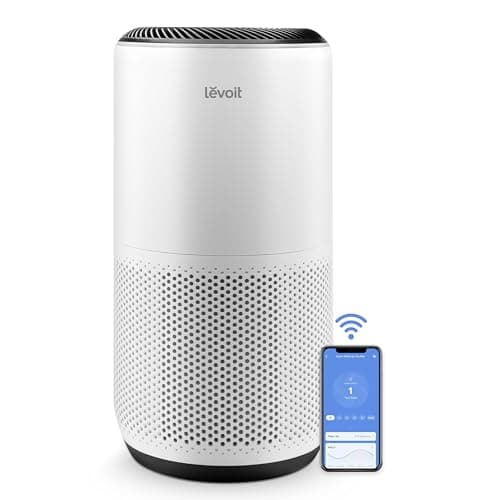
The one to buy if you want a purifier that genuinely covers a living room, and one of the few spec sheets in this bracket that publishes coverage at a useful air-change rate rather than only the flattering one.
#ad Price as of October 18, 2026, from Amazon. Prices change. How we make money.
Published specifications
| Specification | Value | Source |
|---|---|---|
| CADR | 231 CFM | Levoit published specification |
| Coverage | 358 sq ft at 4.8 air changes/hr (1,718 sq ft at 1 ACH) | Levoit published specification |
| Rated power | 38 W | Levoit published specification |
| Noise | 22-52 dB | Levoit published specification |
| Filtration | 3-stage: pre-filter, HEPA, activated carbon | Levoit published specification |
| Dimensions | 10.8 x 10.8 x 20.5 in, 11 lb | Levoit published specification |
What it costs to run
About $25-30 a year in electricity at 12 hours a day, before filters.
38 W / 1000 x 12 hours x 365 days = 166.4 kWh. At 18.34 cents/kWh that is $30.52 a year at rated power - and the unit only draws its full 38 W on the top fan speed, so a mid setting lands nearer $25. Add the replacement filter, which you should price before you buy rather than after.
What is good about it
- Levoit publishes coverage at both 1 ACH and 4.8 ACH, which is unusually straight - most brands quote only the flattering 1 ACH number
- 38 W is low for this CADR, which is what keeps the running cost down
- 22 dB on its lowest setting is quiet enough to sleep beside
- Carbon, pet-allergy and smoke-specific replacement filters are sold for the same body
What is not
- We could not find a published filter replacement interval in Levoit's specification, so we are not quoting one
- The 1,718 sq ft headline is a single air change per hour, which is not a useful rate for allergies
Who should skip this
Skip this if your room is under 200 sq ft. The Core 300S covers that at lower power and lower cost, and the extra CADR buys you nothing in a small bedroom.
How it scored
- Clean air per watt9.0
- Honest coverage claim9.5
- Quiet operation8.5
- Filter economics7.5
Overall 8.6 / 10. This is our editorial score from published specifications and computed running cost. It is not a test result, and it is deliberately not marked up as a rating in this page’s structured data.
How we ranked these
We have not tested these units. Nobody here owns one. What we did was compile each manufacturer’s published specifications, check the coverage claims against AHAM’s room-sizing rule, and compute what each one costs to run for a year at the current US average electricity price. Every figure on this page is attributed to whoever published it, and the arithmetic is shown so you can redo it.
How we rank these sets out the full method, including what would change a ranking.
Questions people ask
+−What is a good PM2.5 level indoors?
The EPA’s AQI puts 0-50 in the Good category, where air quality is satisfactory and pollution poses little or no risk, and 51-100 in Moderate. Note that official AQI is calculated from an averaged concentration, so a handheld monitor’s instantaneous number is related but not identical.
+−How small is PM2.5?
2.5 micrometers and smaller. The EPA’s comparison is that the average human hair is about 70 micrometers in diameter, making it around 30 times larger than the largest fine particle.
+−What is the difference between PM10 and PM2.5?
Size, and PM2.5 is a subset of PM10. PM10 is inhalable particles generally 10 micrometers and smaller; PM2.5 is the fine fraction at 2.5 micrometers and smaller, which the EPA identifies as posing the greatest risk to health.
+−Does an air purifier lower PM2.5?
A correctly sized one does, in the room it is in, while it runs. Watching the number fall after switching one on is the clearest practical demonstration that the CADR sizing rule is doing something real.
+−Can a PM2.5 monitor detect mold or gas?
No. It counts particles by light scattering and does not identify them, so it cannot confirm mold. It is entirely blind to gases - carbon monoxide needs its own alarm, and that is not optional. That blindness matters for a desktop 3D printer, which emits both particles and styrene - 3D printing.