Guide
Crawl Space & Garage Humidity
Two spaces where the standard advice - buy a dehumidifier - is most often the wrong first move.
By Scooter M. · Published · Last updated
How this page is funded: the buy links below are affiliate links. If you buy through one, we earn a commission at no extra cost to you. It does not change the order of the picks or what we say about them. Full disclosure.
The short answer
In a crawl space, moisture usually comes up from bare earth, and the first fix is a ground vapor barrier rather than an appliance. In a garage, it usually comes in with vehicles and warm outside air, and the first fix is ventilation and keeping water out. In both, a dehumidifier is a reasonable step after those, and an expensive one before them.
Crawl spaces
A crawl space with an exposed earth floor is continuously receiving water vapor from the ground. That is not a leak and it will not stop, so no amount of appliance capacity finishes the job - it just runs.
The order that works
- Ground vapor barrier. Heavy polyethylene sheet laid over the earth, overlapped at seams and run up the foundation walls. This is the fix that addresses the source.
- Water management outside. Downpipes discharging well away from the foundation, ground sloping away from the house, and gutters that actually work. Groundwater is the input.
- Decide on ventilation strategy. Vented and sealed crawl spaces are both legitimate approaches, and they have different requirements - this is genuinely a question for someone who can look at your building and the local code, not for a review site.
- Then measure, and dehumidify if needed. With a vapor barrier down, a sealed crawl space frequently needs a dehumidifier to hold below 60%, and now it has a finite job to do.
Garages
Garages get damp from a different set of inputs:
- Wet vehicles. A car brought in wet carries several liters of water, and in a sealed garage all of it evaporates and stays.
- Warm humid air on a cold slab. A concrete floor stays cool well into summer, so humid outdoor air condenses on it - the same mechanism as a basement.
- Ground moisture through an unsealed slab. The plastic sheet test works here too: tape a square down for a day and see which side is wet.
- Stored damp items. Cardboard, timber and fabric hold moisture and release it slowly.
The order that works
- Do not park a wet vehicle in a sealed garage - leave a door or vent open until it dries
- Ventilate when the outdoor dew point is lower than indoors
- Get stored cardboard and fabric off the floor and off external walls
- Seal an unsealed slab if the plastic test shows moisture underneath
- Then dehumidify if it still reads above 60%
When an appliance is genuinely the answer
After the source work: in a sealed crawl space, or in a garage used as a workshop or storing anything corrodible, a compressor dehumidifier on a humidistat is a reasonable ongoing cost. Size it with the pint table and note that both spaces are frequently cold, which reduces the capacity of any compressor unit and rules out thermoelectric ones entirely.
What we would buy for this
Chosen from the same registry as our roundups, on published specifications and computed running cost.
ThermoPro TP49 Hygrometer
Anyone about to buy a humidifier or a dehumidifier
An inexpensive digital hygrometer is the highest-value purchase on this entire site, because it is the one that tells you whether to buy anything else.
#ad We do not hold a current price for this product, so we do not show one. How we make money.
Published specifications
| Specification | Value | Source |
|---|---|---|
| Function | Digital temperature and relative humidity readout with a comfort indicator | ThermoPro published specification |
What is good about it
- Cheap enough to buy three and put one in the bedroom, one in the basement and one in the living room, which is what you actually want
- Gives you the reading that decides between a humidifier and a dehumidifier - a decision people routinely get backwards
What is not
- Consumer hygrometers are typically accurate to within a few percentage points, which is fine for the 30-50% question and not fine for anything precise
- No logging, so you see now rather than overnight
Who should skip this
Skip this only if you already own a hygrometer. There is no household we would tell not to measure.
How it scored
- Value for the decision it informs10.0
- Accuracy for the 30-50% question8.0
- Logging and history2.0
Overall 9.0 / 10. This is our editorial score from published specifications and computed running cost. It is not a test result, and it is deliberately not marked up as a rating in this page’s structured data.
Midea Cube 35-Pint
Basements without a floor drain
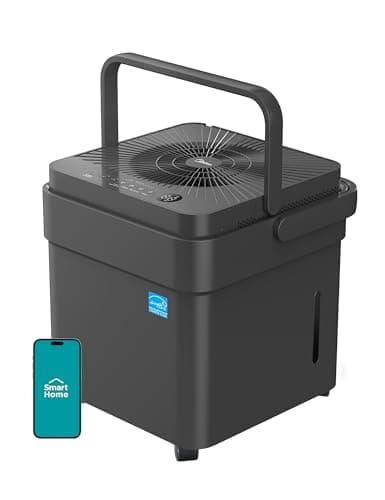
The adjustable 4.25-gallon bucket is the point. Most dehumidifiers get switched off because emptying a 2-gallon bucket twice a day is miserable; this one buys you a couple of days.
#ad Price as of October 18, 2026, from Amazon. Prices change. How we make money.
Published specifications
| Specification | Value | Source |
|---|---|---|
| Capacity | 35 pints per day | Midea published specification |
| Capacity (federal test) | 35.82 pints per day | ENERGY STAR certified products database |
| Coverage | Up to 3,500 sq ft | Midea published specification |
| Efficiency (IEF) | 2.01 L/kWh | ENERGY STAR certified products database |
| Annual energy use | 378 kWh/yr | ENERGY STAR certified products database |
| Bucket fill level | Adjustable, up to 4.25 gallons | Midea user manual |
| Fan speeds | 2 (High, Low) | Midea user manual |
| Dimensions | 14.76 x 14.57 x 14.45 in, 39.62 lb | Midea published specification |
| Certification | ENERGY STAR certified | ENERGY STAR certified products database |
What it costs to run
About $69 a year on ENERGY STAR's certified annual energy figure.
ENERGY STAR publishes 378 kWh a year for this model. At 18.34 cents/kWh that is $69.33 a year. That figure is calculated on the program's standardized test basis, not measured in your basement: a genuinely damp space where it cycles constantly will use more. Against the 50-pint Cube's 515 kWh ($94.45) it is the cheaper machine to own, which is the argument for sizing honestly rather than buying headroom.
What is good about it
- An adjustable bucket that holds up to 4.25 gallons - the difference between a unit you keep using and one you unplug in week three
- An IEF of 2.01 L/kWh removes about 18% more water per kWh than the 20-pint Cube's 1.70
- Nests down into a smaller shape for storage, which matters for an appliance you only use half the year
What is not
- The 3,500 sq ft coverage claim assumes conditions no real basement has; treat it as a ceiling, not a specification
- 35 pints is not enough for a genuinely wet basement with standing water
- Midea does not publish a rated wattage for this model, so we quote ENERGY STAR's certified annual energy figure instead
- No built-in pump on this model - without a floor drain you are either emptying the bucket or routing a gravity hose
Who should skip this
Skip this if your basement is wet rather than damp - visible water, white efflorescence on the walls, a musty smell that returns within a day of airing out. That is a drainage problem, and a 35-pint unit will run permanently and never win.
How it scored
- Tank interval10.0
- Capacity for the money8.5
- Efficiency per liter removed9.0
- Storage footprint9.0
Overall 8.7 / 10. This is our editorial score from published specifications and computed running cost. It is not a test result, and it is deliberately not marked up as a rating in this page’s structured data.
How we ranked these
We have not tested these units. Nobody here owns one. What we did was compile each manufacturer’s published specifications, check the coverage claims against AHAM’s room-sizing rule, and compute what each one costs to run for a year at the current US average electricity price. Every figure on this page is attributed to whoever published it, and the arithmetic is shown so you can redo it.
How we rank these sets out the full method, including what would change a ranking.
Questions people ask
+−What should crawl space humidity be in winter?
Below 60% is the EPA’s ceiling for indoor spaces and a reasonable target here. In practice, cold crawl spaces read high in winter simply because cold air has a lower capacity - what matters is whether surfaces are wet, not the percentage alone.
+−Should crawl space vents be open or closed?
Both vented and sealed approaches are used and both can work, but they are different systems with different requirements, and the right answer depends on your climate and local code. We are not going to give you a universal answer to a question that genuinely does not have one.
+−Do I need a dehumidifier in a garage?
Only after ventilation and keeping water out have been addressed. If the garage still reads above 60% with the slab sealed and vehicles drying elsewhere, then yes - particularly if you store tools that will rust.
+−Will a vapor barrier alone fix a crawl space?
Often it does most of the work, because it addresses the source rather than the symptom. Whether it is sufficient on its own depends on how much water is arriving and whether the space is vented or sealed - measure after installing it and decide from the reading.