Sizing guide
What Size Humidifier Do I Need?
There is no AHAM rule for humidifiers. The square-footage number on the box is a manufacturer's own claim, tested to nothing - so the sizing has to be done from output instead.
By Scooter M. · Published · Last updated
How this page is funded: the buy links below are affiliate links. If you buy through one, we earn a commission at no extra cost to you. It does not change the order of the picks or what we say about them. Full disclosure.
The short answer
Size on output, not on square feet. Air purifiers have AHAM CADR and dehumidifiers have a pints-per-day rating, both measured to a published standard. Humidifiers have neither. The square-footage figure on a humidifier box is the manufacturer’s own claim and is not verified by anybody. What you can actually compare is moisture output - mL per hour or gallons per day - and tank size, which decides how often you refill.
This page is deliberately shorter on rules than our dehumidifier sizing guide, and the reason is worth stating plainly at the top: the industry gave dehumidifiers a capacity standard and gave humidifiers nothing. We are not going to invent one to make this page look more authoritative than the underlying data supports.
Why the square-footage number is close to meaningless
Look at what two humidifiers from the same manufacturer publish. The Levoit Superior 6000S claims coverage up to 3,000 sq ft. The Levoit LV600S claims 430-753 sq ft. Those are both Levoit’s own figures and we do not doubt them as measurements of something - but neither is tested to an external standard, neither states the starting humidity, the target humidity, the ceiling height, the outdoor temperature, or the air change rate of the house. Change any one of those and the honest coverage figure moves by a large multiple.
Compare that with the two devices either side of it on this site. An air purifier’s CADR is measured under AHAM’s AC-1 protocol, which is why we can apply a two-thirds rule to it and mean something. A dehumidifier’s pint rating is measured at a defined temperature and humidity. A humidifier’s square footage is a marketing figure standing where a specification should be.
Size on output instead - and do the arithmetic
Output is published in one of two units and they convert cleanly:
- mL per hour - the instantaneous rate at the highest setting
- Gallons per day - the same thing over 24 hours. One US gallon is 3,785 mL, so 1,000 mL/h is 24,000 mL/day, which is about 6.3 gallons a day
Now apply that to a real spec sheet, because this is where the published figures start arguing with each other. Levoit publishes a maximum output of 1,500 mL/h for the Superior 6000S and a run time of up to 72 hours on the low fan setting, from a 6-gallon tank. Run those two claims together: 1,500 mL/h for 72 hours would be 108,000 mL, or roughly 28.5 gallons - from a 6-gallon tank. Both figures are true and they describe opposite ends of the dial. The 6-gallon-over-72-hours end works out at about 2 gallons a day; the maximum-output end would empty the tank in about four hours.
| Levoit Superior 6000S | Levoit LV600S Hybrid | |
|---|---|---|
| Tank | 6 gal / 22.7 L (Levoit published specification) | 1.58 gal / 6 L (Levoit published specification) |
| Max output | 1,500 mL/h (Levoit published specification) | Not published as a rate in the specification we could find |
| Run time | Up to 72 hours on the low fan setting | Up to 50 hours |
| Implied sustained output | 6 gal over 72 h = about 2 gallons a day | 1.58 gal over 50 h = about 0.76 gallons a day |
| Claimed coverage | 3,000 sq ft | 430-753 sq ft |
| Type | Evaporative - self-limiting, cannot over-humidify | Ultrasonic and warm mist - can over-humidify, and aerosolizes minerals |
Read the bottom two rows together and the coverage claims start to look stranger still. The Superior 6000S claims four times the coverage of the LV600S on roughly two and a half times the sustained output. That is not a scandal - it reflects a genuinely more efficient evaporative design - but it is a good illustration of why we would not buy on the square-footage line. Our Superior 6000S review takes that coverage claim apart in full.
The three questions that actually size a humidifier
- What is the room reading now? Not what it feels like. Below 30% relative humidity you have a real deficit and a humidifier is the right purchase. Between 30% and 40% you have a mild one. Above 40% the humidifier is not your problem and you should read why is my house so dry before you buy anything. A hygrometer costs a fraction of a humidifier and settles this in an afternoon.
- Is the door open or shut? A closed bedroom is a small, sealed volume and a modest humidifier holds it easily. An open-plan downstairs is not one room, it is a house, and a single portable unit chasing it is the most common reason people conclude humidifiers do not work.
- How often will you actually refill it? This is the question that decides which unit gets used and which one ends up in a cupboard by February. Tank capacity divided by your sustained output gives you the refill interval - the arithmetic above turns 6 gallons into roughly three days and 1.58 gallons into roughly two.

The ceiling nobody mentions: 50%
Sizing up is not free the way it is with a dehumidifier. The EPA’s guidance on home humidifiers is explicit: do not humidify to indoor relative humidity levels exceeding 50 percent. Its mold guidance sets the same ceiling from the other direction, recommending indoor humidity be kept below 60 percent and ideally between 30 and 50 percent. An oversized ultrasonic unit left running in a small closed bedroom will sail past that band and give you a condensation and mold problem in place of a dryness problem.
Evaporative units cannot do this, and that is their single best argument. A wick humidifier can only evaporate as fast as the air will accept moisture, so as the room approaches saturation it slows down on its own. An ultrasonic unit has no such feedback - it sprays whether the room needs it or not. If you are buying larger than you are certain you need, buy evaporative.
A practical starting point
- One closed bedroom. A small tank is fine. You are looking for a unit you can refill in the morning without resenting it, and quiet enough to sleep beside. Our picks for that room are in best humidifiers for a bedroom.
- A whole floor, doors open. This is where a 6-gallon evaporative unit earns its size - not because it covers more square feet in some tested sense, but because it can run for days without you attending to it. The three large-tank units we could verify are compared on exactly this arithmetic in best humidifiers for large rooms.
- A whole house, doors shut. One portable unit will not do this and no coverage claim should convince you otherwise. Either buy one per room that matters, or read whole house vs portable.
When to buy nothing at all
If your hygrometer reads inside 30-50% and you still have dry skin, a dry throat or static, the humidity is not the cause and a humidifier will not fix it. Static in particular tracks with very dry air but is also a function of flooring and footwear. Measure first. The cheapest useful outcome of this page is discovering you do not need the purchase.
What we would actually do
Put a hygrometer in the room for two days and note the overnight low, since that is when symptoms happen. If the number is below 30%, size on sustained output rather than the coverage claim: divide tank capacity by run time to get gallons a day, divide tank capacity by that to get your refill interval, and buy the unit whose refill interval you will actually keep up with. Prefer evaporative unless you have a specific reason to want warm mist, and set a target of 40-45% rather than as high as the dial will go.
What we would buy for this
Chosen from the same registry as our roundups, on published specifications and computed running cost.
Levoit Superior 6000S
Whole floors, and anyone tired of refilling
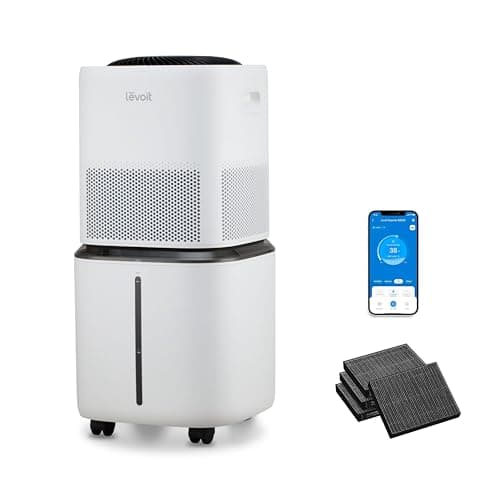
A 6-gallon evaporative unit at 30 W. If you have spent a winter refilling a small humidifier twice a day, this is the one that ends that.
#ad Price as of October 18, 2026, from Amazon. Prices change. How we make money.
Published specifications
| Specification | Value | Source |
|---|---|---|
| Tank capacity | 6 gal / 22.7 L | Levoit published specification |
| Coverage | 3,000 sq ft | Levoit published specification |
| Rated power | 30 W | Levoit published specification |
| Run time | Up to 72 hours on the low fan setting | Levoit published specification |
| Max output | 1,500 mL/h | Levoit published specification |
What it costs to run
About $12-13 a year in electricity across a heating season at 12 hours a day.
30 W / 1000 x 12 hours x 365 days = 131.4 kWh = $24.10 a year run year-round, so roughly $12-13 across a six-month heating season. On any evaporative unit the filters, not the electricity, are the larger cost.
What is good about it
- 30 W against 3,000 sq ft of claimed coverage is the best power-to-output ratio of any humidifier we list
- Evaporative, so it self-limits the same way the Honeywell does - it will not flood a room
- 72 hours per fill means refilling twice a week rather than twice a day
What is not
- It is a large object and it looks like one
- The 3,000 sq ft coverage claim assumes air moves freely between those rooms, which in a real house with doors it does not
Who should skip this
Skip this if you only need one bedroom humidified. A 6-gallon tank in a 120 sq ft room is a lot of standing water to keep clean for no additional benefit.
How it scored
- Cannot over-humidify10.0
- Refill interval9.5
- Power efficiency9.5
- Cleaning burden6.5
Overall 8.6 / 10. This is our editorial score from published specifications and computed running cost. It is not a test result, and it is deliberately not marked up as a rating in this page’s structured data.
Levoit LV600S Hybrid
People who want the option of warm mist
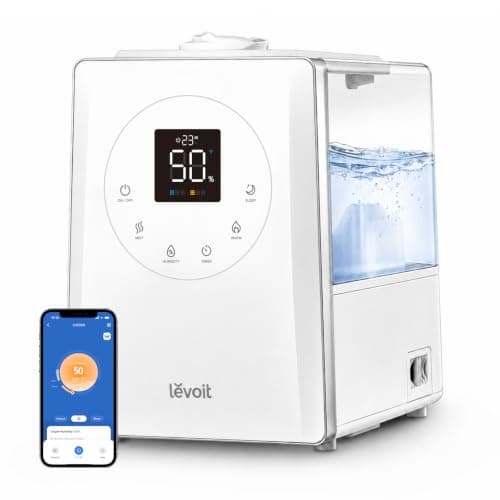
The one to pick if you specifically want warm mist - but note the 280 W rated power, because that is what heating water actually costs.
#ad Price as of October 18, 2026, from Amazon. Prices change. How we make money.
Published specifications
| Specification | Value | Source |
|---|---|---|
| Tank capacity | 1.58 gal / 6 L | Levoit published specification |
| Coverage | 753 sq ft | Levoit published specification |
| Rated power | 280 W | Levoit published specification |
| Run time | Up to 50 hours | Levoit published specification |
What it costs to run
Up to $225 a year on warm mist at 12 hours a day - the most expensive thing to run on this site.
280 W / 1000 x 12 hours x 365 days = 1,226 kWh = $224.86 a year at full warm-mist draw. On cool mist it draws a small fraction of that. This number, not the feature list, is what should decide whether you actually want warm mist.
What is good about it
- Warm and cool mist in one unit, so you are not committed to one type before you know which you prefer
- 50 hours per fill is good going for a 1.58 gallon tank
What is not
- 280 W rated. Warm mist is a kettle with a fan attached - the heat is the cost, and it is roughly ten times the Superior 6000S
- Ultrasonic, so it can over-humidify a room and it will aerosolize whatever minerals are in your water
Who should skip this
Skip this if you have hard water and no intention of using distilled. Ultrasonic units put the minerals in your water onto every surface in the room as white dust.
How it scored
- Cannot over-humidify3.0
- Refill interval8.0
- Power efficiency3.0
- Flexibility9.0
Overall 7.4 / 10. This is our editorial score from published specifications and computed running cost. It is not a test result, and it is deliberately not marked up as a rating in this page’s structured data.
ThermoPro TP49 Hygrometer
Anyone about to buy a humidifier or a dehumidifier
An inexpensive digital hygrometer is the highest-value purchase on this entire site, because it is the one that tells you whether to buy anything else.
#ad We do not hold a current price for this product, so we do not show one. How we make money.
Published specifications
| Specification | Value | Source |
|---|---|---|
| Function | Digital temperature and relative humidity readout with a comfort indicator | ThermoPro published specification |
What is good about it
- Cheap enough to buy three and put one in the bedroom, one in the basement and one in the living room, which is what you actually want
- Gives you the reading that decides between a humidifier and a dehumidifier - a decision people routinely get backwards
What is not
- Consumer hygrometers are typically accurate to within a few percentage points, which is fine for the 30-50% question and not fine for anything precise
- No logging, so you see now rather than overnight
Who should skip this
Skip this only if you already own a hygrometer. There is no household we would tell not to measure.
How it scored
- Value for the decision it informs10.0
- Accuracy for the 30-50% question8.0
- Logging and history2.0
Overall 9.0 / 10. This is our editorial score from published specifications and computed running cost. It is not a test result, and it is deliberately not marked up as a rating in this page’s structured data.
How we ranked these
We have not tested these units. Nobody here owns one. What we did was compile each manufacturer’s published specifications, check the coverage claims against AHAM’s room-sizing rule, and compute what each one costs to run for a year at the current US average electricity price. Every figure on this page is attributed to whoever published it, and the arithmetic is shown so you can redo it.
How we rank these sets out the full method, including what would change a ranking.
Questions people ask
+−What size humidifier do I need for a bedroom?
Smaller than most people buy. A closed bedroom is a small sealed volume, and the binding constraint is usually refill convenience and noise rather than output. Measure the room first - if it reads above 40% you do not need one at all.
+−Is humidifier coverage in square feet reliable?
It is a manufacturer’s own claim, not a figure measured to an external standard the way air purifier CADR and dehumidifier pint ratings are. Treat it as a rough ordering of a brand’s own range rather than a number you can size against.
+−How many gallons a day does a humidifier use?
Divide the published tank capacity by the published run time. On the Levoit Superior 6000S that is 6 gallons over 72 hours, or about 2 gallons a day; on the LV600S it is 1.58 gallons over 50 hours, or about 0.76. Those are low-setting figures - running higher empties the tank proportionally faster.
+−Can a humidifier be too big for a room?
An ultrasonic one can. It has no feedback loop and will keep spraying past the 50% ceiling the EPA recommends staying under, which turns a dryness problem into a condensation problem. An evaporative unit self-limits and is the safer choice if you are sizing up.
+−Do I need one humidifier per room?
If the doors are closed, yes - air does not move freely between closed rooms, so a unit humidifies the room it is in. Most households only genuinely need the bedroom treated, because that is where the longest continuous exposure happens.