Roundup
Best Air Purifiers for Cat Allergies
On this site we usually end up telling people filtration is the wrong lever. Cat allergen is the exception, and there is a measured reason why.
By Scooter M. · Published · Last updated
How this page is funded: the buy links below are affiliate links. If you buy through one, we earn a commission at no extra cost to you. It does not change the order of the picks or what we say about them. Full disclosure.
The short answer
This is one of the few indoor allergens where an air purifier is genuinely the right tool, and the reason is measurable. Cat allergen - Fel d 1 - is present in household air at levels around 160 times airborne dust mite allergen, and a substantial minority of it rides on particles small enough to stay suspended for long periods. Mite allergen sits in bedding and carpet where no filter can reach it; cat allergen is genuinely in the air. So filtration acts on a real fraction of your exposure here, which is not something we can say about most allergens on this site.
Why cat allergen behaves differently
Fel d 1 is produced in cat saliva and sebaceous glands and ends up on shed skin and hair, which breaks down into fine particles. Measured in real homes, the airborne fraction splits roughly like this: about 75% on particles 5 microns and larger, and about 25% on particles 2.5 microns and smaller - a figure that varies widely between homes, reported across a range of roughly 10% to 62%.
That split is the whole story. The large fraction settles out fairly quickly onto floors and furniture, where vacuuming and washing are the tools. The small fraction stays airborne for long periods, travels between rooms, and is the part a filter can remove - and because particles under about 5 microns can reach the smaller airways, it is also the fraction that matters most for symptoms.
How we judged these
We have not tested these machines and we are not making health claims. Every figure below is published by the manufacturer or by the ENERGY STAR certified room air cleaners database. Criteria, in order:
- Published smoke CADR. Smoke is measured over roughly 0.09 to 1.0 microns, which brackets the fine fraction of cat allergen better than the dust or pollen figures do. It is the number to size on.
- A pre-filter that handles hair. Cat hair and the coarse fraction load a filter fast. A washable pre-filter is the difference between replacing the expensive media on schedule and replacing it early.
- Enough capacity to run slowly. Allergen is produced continuously by a living animal, so the unit has to run continuously, which means it has to be quiet enough that you leave it on.
- No ozone-producing stage. Consistent with the rest of the site, and more pointed in a room shared with an animal that cannot leave it.
Sizing, and why you should oversize here
The usual rule applies - floor area times two-thirds gives the smoke CADR you need - but this is a case for deliberately buying above it.
The source never switches off. A cat produces allergen continuously and redistributes it every time it moves, so the useful mode is low-and-constant rather than high-and-occasional. CADR is measured at maximum fan speed, so a unit run on its lowest setting delivers a fraction of its rating. Buying 50% more CADR than the arithmetic demands lets you run it quietly and permanently, which delivers far more over a week than a correctly-sized unit run flat out for an hour.
| Room | Floor area | Rule minimum | What we would buy |
|---|---|---|---|
| Bedroom | 150 sq ft | 100 CFM | 150 CFM or more |
| Large bedroom | 200 sq ft | 133 CFM | 200 CFM or more |
| Living room | 300 sq ft | 200 CFM | 250 CFM or more |
| Open-plan space | 450 sq ft | 300 CFM | Two units, or shut a door |
The bedroom is the room that matters
If you only treat one room, treat the one you spend eight unconscious hours in with the door shut. A closed bedroom is also the only room in a cat household where you can plausibly control the source, because you can keep the cat out of it - and that single habit does more than any machine on this page.
Filtration and exclusion compound: the purifier removes the fine fraction already in the air, and a closed door stops it being replenished. Neither works nearly as well alone. The general case for bedroom-first is in best air purifiers for a bedroom.
The honest limits of this page
We describe rooms, not bodies. We can tell you what is measured about where cat allergen is and which machine moves the most filtered air through a room of a given size. We cannot tell you whether that will change how you feel, and the published research on symptom outcomes from air filtration alone is genuinely mixed.
If someone in the house has significant reactions, that is a conversation with a clinician and not a purchase decision. Everything here is about reducing airborne concentration, which is a precondition for helping rather than a promise of it.
Why these three
The Core 400S is the pick for a living room: 231 CFM of certified smoke CADR covers 358 sq ft, it is certified at 0.00 ppb ozone, and at 237 kWh a year it is affordable to run permanently, which is the mode this problem demands.
The Eleva 300X is the better bedroom unit. 161 CFM for a 250 sq ft room is ample margin to run on a low speed, it is the most efficient purchasable Levoit at 6.68 CFM per watt, it drops to 20 dB in sleep mode, and it is the one Levoit that publishes a filter interval - up to two years on the particle filter, which matters when hair is loading it.
The Coway AP-1512HH earns its place on the pre-filter. It is washable, and in a cat household the pre-filter is the stage doing the unglamorous work of catching hair before it reaches the HEPA media. Coway also publishes a per-speed power draw, which is rare and useful for a unit you intend to leave on its lowest setting indefinitely. Full detail is in our Coway Mighty review.
What we would actually do
Keep the cat out of the bedroom, shut the door, and put a unit rated well above the two-thirds figure in there running continuously on low. That combination - exclusion plus constant filtration in one bounded room - is the highest-value thing available, and it is mostly free.
Then deal with the settled fraction, because it is the larger one: wash bedding hot, use a vacuum that does not re-emit what it picks up, and accept that soft furnishings are a reservoir. Add a second unit in the main living room only after the bedroom is sorted. Buying two machines before closing one door is the common version of this mistake.
Quick picks
Ranked on published specifications and computed running cost. Tap any row for the full write-up, including who should skip it.
| # | Product | Best for | Score | Price |
|---|---|---|---|---|
| 1 | 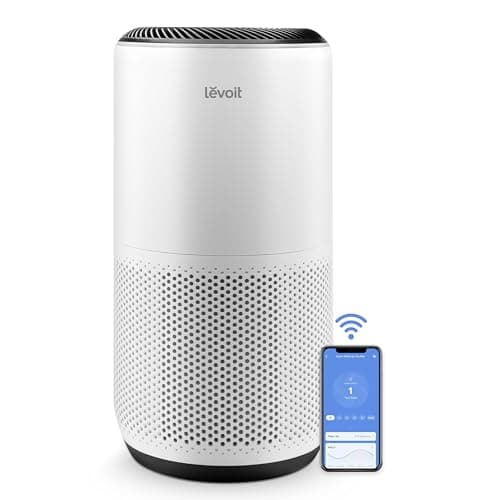 Levoit Core 400SLiving rooms and open-plan spaces | Best overall | 8.6 | $189.97 - View on Amazon |
| 2 | 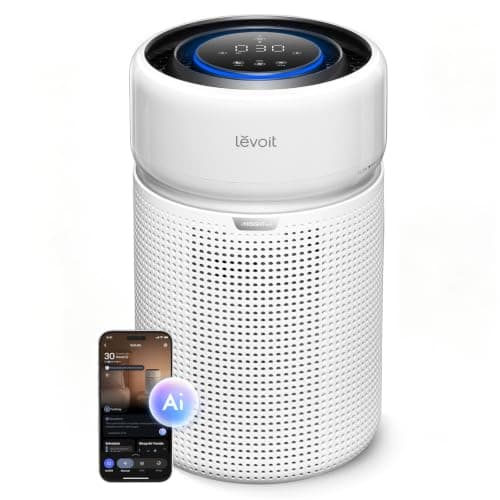 Levoit Eleva 300XA bedroom or home office up to about 250 sq ft | Best for a bedroom | 8.9 | $129.99 - View on Amazon |
| 3 | 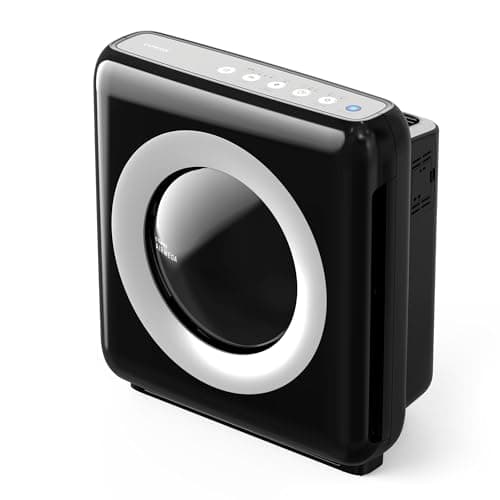 Coway Airmega AP-1512HH MightyRunning continuously in a medium room | Best washable pre-filter | 8.7 | $154.98 - View on Amazon |
#1 - Best overall
Levoit Core 400S
Living rooms and open-plan spaces
The one to buy if you want a purifier that genuinely covers a living room, and one of the few spec sheets in this bracket that publishes coverage at a useful air-change rate rather than only the flattering one.
#ad Price as of October 18, 2026, from Amazon. Prices change. How we make money.
Published specifications
| Specification | Value | Source |
|---|---|---|
| CADR | 231 CFM | Levoit published specification |
| Coverage | 358 sq ft at 4.8 air changes/hr (1,718 sq ft at 1 ACH) | Levoit published specification |
| Rated power | 38 W | Levoit published specification |
| Noise | 22-52 dB | Levoit published specification |
| Filtration | 3-stage: pre-filter, HEPA, activated carbon | Levoit published specification |
| Dimensions | 10.8 x 10.8 x 20.5 in, 11 lb | Levoit published specification |
What it costs to run
About $25-30 a year in electricity at 12 hours a day, before filters.
38 W / 1000 x 12 hours x 365 days = 166.4 kWh. At 18.34 cents/kWh that is $30.52 a year at rated power - and the unit only draws its full 38 W on the top fan speed, so a mid setting lands nearer $25. Add the replacement filter, which you should price before you buy rather than after.
What is good about it
- Levoit publishes coverage at both 1 ACH and 4.8 ACH, which is unusually straight - most brands quote only the flattering 1 ACH number
- 38 W is low for this CADR, which is what keeps the running cost down
- 22 dB on its lowest setting is quiet enough to sleep beside
- Carbon, pet-allergy and smoke-specific replacement filters are sold for the same body
What is not
- We could not find a published filter replacement interval in Levoit's specification, so we are not quoting one
- The 1,718 sq ft headline is a single air change per hour, which is not a useful rate for allergies
Who should skip this
Skip this if your room is under 200 sq ft. The Core 300S covers that at lower power and lower cost, and the extra CADR buys you nothing in a small bedroom.
How it scored
- Clean air per watt9.0
- Honest coverage claim9.5
- Quiet operation8.5
- Filter economics7.5
Overall 8.6 / 10. This is our editorial score from published specifications and computed running cost. It is not a test result, and it is deliberately not marked up as a rating in this page’s structured data.
#2 - Best for a bedroom
Levoit Eleva 300X
A bedroom or home office up to about 250 sq ft
The best-engineered Levoit purifier you can actually buy on Amazon, and the only one in the range for which Levoit publishes a filter replacement interval. It moves less air than a Core 400S and does more with every watt.
#ad Price as of October 18, 2026, from Amazon. Prices change. How we make money.
Published specifications
| Specification | Value | Source |
|---|---|---|
| CADR - smoke, dust, pollen | 161 CFM, AHAM Verifide | Levoit published specification |
| Coverage | 250 sq ft at 4.8 air changes/hr (1,200 sq ft at 1 ACH) | Levoit published specification |
| Clean air per watt | 6.68 CFM/W | ENERGY STAR certified room air cleaners database |
| Annual energy use | 145 kWh/yr | ENERGY STAR certified room air cleaners database |
| Ozone emissions | 0.00 ppb | ENERGY STAR certified room air cleaners database |
| Rated power | Under 25.5 W | Levoit published specification |
| Noise | 20-50 dB (20 dB in Sleep Mode) | Levoit published specification |
| Filtration | 3-stage sealed HEPA with a separate activated carbon filter | Levoit published specification |
| Filter replacement | Particle filter up to 2 years; carbon filter 6-12 months | Levoit published specification |
| Fan speeds | 4 plus Auto | Levoit published specification |
| Sensor | AirSight Plus 2.0, 3-channel (PM1.0, PM2.5, PM10) | Levoit published specification |
| Dimensions and weight | 9.4 x 9.4 x 15.1 in, 9.9 lb | Levoit published specification |
What it costs to run
About $27 a year on ENERGY STAR's certified annual energy figure.
ENERGY STAR publishes 145 kWh a year for LAP-C341S, the Eleva 300X. At 18.34 cents/kWh that is $26.59 a year. The Core 400S, on the same certified basis, is 237 kWh and $43.47 - so the Eleva costs about $17 a year less to run while covering a smaller room more efficiently.
What is good about it
- 6.68 CFM of clean air per watt against the Core 400S's 5.75 - a 16% improvement in the specification that decides your bill
- 145 kWh a year, about 40% less electricity than the Core 400S, for a machine sized to a bedroom rather than a living room
- The only Levoit purifier we have found where Levoit publishes a filter replacement interval - up to 2 years on the particle filter, 6-12 months on the carbon
- A separate activated carbon filter rather than a carbon layer inside a combined cartridge, which is the arrangement that actually holds up against odors
- 20 dB in Sleep Mode is genuinely quiet enough to sleep beside, and it publishes the figure
- Certified at 0.00 ppb ozone, with no ionizing stage
- A 3-channel particle sensor at this price is unusual; most units at any price infer air quality from a single channel
What is not
- 161 CFM is a 250 sq ft machine. It is not a living-room purifier and buying it for one would be a mistake
- Newer and less reviewed than the Core line, so there is less accumulated owner feedback to draw on
- The 1,200 sq ft figure on the listing is a one-air-change-per-hour number; the usable coverage is 250 sq ft and Levoit publishes both, to its credit
- Two filters on two different schedules is more to track than one combined cartridge, even though it is the better design
- Levoit's more efficient Eleva 500X is certified at 9.26 CFM/W but we could not find it purchasable on Amazon, so the range's best unit is not the one you can buy here
Who should skip this
Skip this if the room is much over 250 sq ft - the Core 600S is the honest answer there, and no amount of running this unit longer will substitute for CADR it does not have.
How it scored
- Clean air per watt9.0
- Published specifications9.5
- Quiet operation9.5
- Room size covered6.5
Overall 8.9 / 10. This is our editorial score from published specifications and computed running cost. It is not a test result, and it is deliberately not marked up as a rating in this page’s structured data.
#3 - Best washable pre-filter
Coway Airmega AP-1512HH Mighty
Running continuously in a medium room
The most efficient unit here at low speed - 3.7 W on speed one - which matters enormously if you leave a purifier running all day and almost not at all if you do not.
#ad Price as of October 18, 2026, from Amazon. Prices change. How we make money.
Published specifications
| Specification | Value | Source |
|---|---|---|
| CADR (smoke) | 233 CFM | Coway published specification |
| CADR (dust) | 246 CFM | Coway published specification |
| CADR (pollen) | 240 CFM | Coway published specification |
| Coverage | 361 sq ft at 4.8 air changes/hr (1,748 sq ft at 1 ACH) | Coway published specification |
| Power draw by speed | 0.3 W standby / 3.7 W speed 1 / 8.7 W speed 2 / 75.3 W speed 3 | Coway published specification |
| Filtration | Pre-filter, odor filter, Green True HEPA, bipolar device | Coway published specification |
What it costs to run
About $6 a year running 24/7 on speed one, or $121 a year running 24/7 on speed three.
Speed 1: 3.7 W / 1000 x 24 x 365 = 32.4 kWh = $5.94 a year. Speed 3: 75.3 W / 1000 x 24 x 365 = 659.6 kWh = $120.97 a year. That twenty-fold spread is the most important number on this page, and it is why we chase per-speed figures instead of accepting a single rated wattage.
What is good about it
- Coway publishes power draw per fan speed, which almost nobody does and which is the only way to compute a real running cost
- 3.7 W on speed one is remarkable - cheaper to run continuously than most nightlights
- Coverage published at 1, 2 and 4.8 air changes per hour, so you can size it honestly
What is not
- 75.3 W on speed three is the highest draw here; how the auto mode behaves decides your bill
- The bipolar device is a stage we would rather do without; check it can be disabled
Who should skip this
Skip this if you only run a purifier for an hour or two at a time. Its whole advantage is low-speed efficiency over long hours, and short bursts on high speed give that straight back.
How it scored
- Clean air per watt9.5
- Honest coverage claim9.5
- Quiet operation8.0
- Filter economics7.5
Overall 8.7 / 10. This is our editorial score from published specifications and computed running cost. It is not a test result, and it is deliberately not marked up as a rating in this page’s structured data.
How we ranked these
We have not tested these units. Nobody here owns one. What we did was compile each manufacturer’s published specifications, check the coverage claims against AHAM’s room-sizing rule, and compute what each one costs to run for a year at the current US average electricity price. Every figure on this page is attributed to whoever published it, and the arithmetic is shown so you can redo it.
How we rank these sets out the full method, including what would change a ranking.
Questions people ask
+−Do air purifiers help with cat allergies?
More than with most indoor allergens, yes. Airborne cat allergen in cat-owning homes has been measured at roughly 160 times airborne dust mite allergen levels, and about a quarter of it rides particles small enough to stay suspended for long periods - which is the fraction a filter can remove. It does nothing about the allergen bound into carpet, upholstery and bedding, which is the larger share of total exposure.
+−What size air purifier do I need for a cat?
Start with floor area times two-thirds for the smoke CADR, then add margin - we would buy about 50% above the minimum. The source is continuous, so the unit needs to run continuously on a low, quiet speed, and CADR is measured at maximum fan speed. A 150 sq ft bedroom calculates to 100 CFM; we would buy 150 CFM or more.
+−Is cat allergen different from dog allergen?
For filtration purposes the relevant difference is how much of it is airborne and on how small a particle. Measured airborne Fel d 1 levels in cat homes are high, and a substantial minority fraction sits on particles of 2.5 microns and under. We did not find a sound published comparison of cat versus dog allergen suspension times, so we are not going to claim one. Our dog allergy page sets out what the Can f 1 particle-size measurements do show.
+−Will an air purifier let me keep a cat if I am allergic?
That is a medical question and not one an appliance can answer. What a purifier does is lower the airborne concentration of the fine fraction in the room it is in. Whether that is enough for a particular person is between them and a clinician - we describe rooms, not bodies.
+−Where should I put the purifier in a cat household?
The bedroom, with the door shut and the cat outside it. That is the room where you spend the most continuous time and the only one where you can realistically control the source. A unit in an open-plan living space with the cat in it is working against continuous replenishment across a large volume.
+−Do I need a special filter for cat allergies?
No - true HEPA media captures particles in the relevant size range and there is no cat-specific filter worth paying extra for. What does matter is a washable pre-filter, because hair and the coarse fraction will load the expensive media early if nothing catches them first.
Sources
- EPA - Biological Pollutants' Impact on Indoor Air Quality
- AHAM - Tips for Choosing the Ideal Portable Room Air Cleaner
- AHAM Verifide - Air Filtration Standards (AC-1)
- EPA - Air Cleaners and Air Filters in the Home (Guide to Air Cleaners in the Home)
- ENERGY STAR - Certified Room Air Cleaners product database