Review
Midea Cube Dehumidifier Review
We have not tested any of the three Cube sizes. What we have done is read Midea's specifications and manual, pull each model from ENERGY STAR's certified database, and work out what each costs to run.
By Scooter M. · Published · Last updated
How this page is funded: the buy links below are affiliate links. If you buy through one, we earn a commission at no extra cost to you. It does not change the order of the picks or what we say about them. Full disclosure.
The short answer
Buy the 35-pint Cube for most basements, and buy it for the bucket. The Cube’s design idea is a bucket that holds up to 4.25 gallons with an adjustable fill level, so you empty it every couple of days rather than twice a day - which is the single thing that decides whether a dehumidifier stays switched on. ENERGY STAR certifies all three sizes. The surprise in its data is that the smallest Cube is the least efficient: the 20-pint removes about 18% less water per kilowatt-hour than the 35 and 50.
The three sizes, on figures that were actually measured
A dehumidifier’s headline pint rating is the manufacturer’s claim. The figure worth trusting more is the one measured to the federal test procedure and published by ENERGY STAR, alongside two numbers the box never shows: the Integrated Energy Factor, which is liters of water removed per kilowatt-hour, and the annual energy consumption the program certifies.
| Cube 20 | Cube 35 | Cube 50 | |
|---|---|---|---|
| Rated capacity | 20 pints/day | 35 pints/day | 50 pints/day |
| Federal-test capacity | 20.16 pints/day | 35.82 pints/day | 49.67 pints/day |
| Coverage (Midea) | Up to 1,500 sq ft | Up to 3,500 sq ft | Up to 4,500 sq ft |
| Efficiency (IEF) | 1.70 L/kWh | 2.01 L/kWh | 2.01 L/kWh |
| Annual energy | 249 kWh/yr | 378 kWh/yr | 515 kWh/yr |
| Cost per year | About $45.67 | About $69.33 | About $94.45 |
| Max bucket fill | 3 gallons | 4.25 gallons | 4.25 gallons |
Two things in that table are worth slowing down for. First, the federal-test capacities land essentially on the rated ones - 35.82 against a claimed 35, 49.67 against a claimed 50. That is not universal in this category, and it is a point in Midea’s favor. Second, the efficiency row is not flat. Third, if the water cannot leave by gravity, the drainage decision outranks both - see best dehumidifiers with a pump.
The finding the listings bury: the small one is the least efficient
The 35 and 50-pint Cubes both certify at 2.01 liters per kWh. The 20-pint certifies at 1.70. That means the smallest Cube removes roughly 18% less water for every kilowatt-hour it uses.
It does not make the 20-pint a bad buy - in a single closed bedroom it still uses the least electricity overall, because it is doing a smaller job. What it does mean is that buying the 20-pint for a space that is really a 35-pint job is the worst of both outcomes: a machine that runs longer to keep up, and does so less efficiently. If you are between sizes, the efficiency data is a genuine argument for sizing up rather than down.
The bucket is the actual product
Every dehumidifier roundup lists tank size. The reason the Cube earns its own review is that its whole design is organized around the bucket problem, and Midea’s manual describes it in more detail than the product pages do.
- The fill level is adjustable. The manual’s table gives four settings. On the 35 and 50-pint models they run from about 2.25 gallons (roughly 24 lb when full) up to 4.25 gallons (roughly 40.5 lb). On the 20-pint model the range is 1.5 to 3 gallons. The point of the lower settings is weight: a full 4.25-gallon bucket is heavy to carry up basement stairs, and you can trade interval for a load you can actually lift.
- It nests. The unit sits on top of the bucket when running and nests down into it for storage - Midea calls this lift-and-twist - so a machine you only use half the year takes up less space the other half.
- Four installation modes. The manual lists Bucket Mode, Bucketless Mode, Continuous Draining through a hose, and Drain Pump Mode on the pump models only. Bucketless mode lets you stand the unit directly over a drain without the bucket at all.
That last distinction catches people out. The 35 and 50-pint models reviewed here are the non-pump versions. Continuous draining on them relies on gravity - the hose has to run downhill to a drain. If your basement has no floor drain and the nearest one is above the unit, you need Midea’s separate pump model, and you should check which one a listing is actually selling.
How it runs, from the manual
- Three operating modes. Set mode runs until the room reaches your humidity setpoint and restarts when it rises again. Max mode runs continuously on high fan. Continuous mode runs continuously with the fan speed adjustable. The setpoint cannot be adjusted while in Max or Continuous.
- Two fan speeds, High and Low. Worth stating plainly, because some listings for this category imply more.
- Setpoint in 5% steps, with a timer that sets an automatic start or stop up to 24 hours ahead.
- Auto defrost. When frost builds on the coils the compressor cycles off to clear it.
- Filter cleaning every two weeks, with a reminder on the panel.
- Smart control through Midea’s app, and a bucket-full signal on the display when the set fill level is reached.
The limits Midea states itself
The manual is direct about two constraints that decide whether a Cube suits your space, and both matter more than any specification on the box.
- Not below 41°F. Midea says to place the unit where the temperature will not fall below 41°F (5°C), because the coils can frost over at lower temperatures and performance drops. An unheated garage or crawl space in winter is outside what this machine is designed for. The defrost cycle protects the coil; it does not make a refrigerant dehumidifier work well in the cold.
- Clearance. At least 8 inches of space on all sides and at least 16 inches for the air outlet. Pushed into a corner it recirculates its own dry air and loses capacity.
The cold-space limitation is common to compressor dehumidifiers generally, and it is one of the reasons we treat crawl spaces separately in crawl space and garage humidity.
What Midea does not publish
- A rated wattage for any of the three sizes on its US product pages. That is why this review costs them from ENERGY STAR’s certified annual energy figure instead - which is arguably the more useful number anyway.
- A noise figure in decibels on the product pages we read. A compressor dehumidifier makes compressor noise; we will not put a number on it that Midea has not.
Which size to buy
| Your space | Buy | Why |
|---|---|---|
| One closed bedroom | Cube 20 | Lowest annual energy; the efficiency penalty does not matter at this scale |
| A typical damp basement | Cube 35 | The best efficiency, the full-size bucket, and $25 a year less than the 50 |
| A large or persistently damp basement | Cube 50 | Same efficiency as the 35 with about 40% more daily capacity |
| A wet basement with water arriving | None of them | That is a drainage repair; any dehumidifier will run permanently and lose |
The underlying pint arithmetic - and why dampness level moves the answer as much as square footage - is in what size dehumidifier do I need. If the room is a bedroom specifically, the noise question matters more than capacity, which we cover in best dehumidifiers for bedrooms.
Who should not buy a Cube
- Anyone with liquid water arriving - standing water, efflorescence on the walls, damp that returns within a day. The EPA’s guidance is to keep indoor humidity below 60 percent and to dry wet materials within 24-48 hours; a leak is neither of those problems, and no dehumidifier fixes it.
- Anyone treating a closet, a gun safe or a stored caravan. That is a job for a desiccant or thermoelectric unit, compared in best budget dehumidifiers.
- Anyone needing to pump water uphill who is looking at these non-pump models.
- Anyone whose room reads inside 30-50% already. Measure first - a hygrometer costs a fraction of any Cube, and is a dehumidifier worth it walks through the reading that decides it.
The verdict
For a typical damp basement, the 35-pint Cube is the one we would buy. It has the best certified efficiency in the range, a federal-test capacity that matches its label, and a bucket design that addresses the real reason dehumidifiers get switched off. The 50-pint earns its extra $25 a year only in a space that genuinely needs the capacity. The 20-pint is the right size for a single bedroom and the wrong economy anywhere bigger.
Deduct for what Midea will not tell you on its product pages - wattage and noise - and check that you are buying the pump model if your drain is above the unit. Credit for labels that ENERGY STAR’s own test figures back up. Below even this tier sit the enclosure-only devices, which have one genuine home - RVs, campers and boats.
What we would buy for this
Chosen from the same registry as our roundups, on published specifications and computed running cost.
Midea Cube 35-Pint
Basements without a floor drain
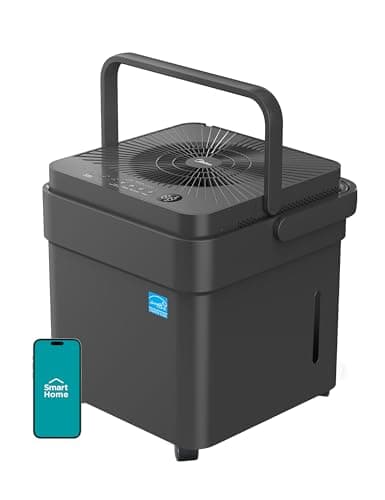
The adjustable 4.25-gallon bucket is the point. Most dehumidifiers get switched off because emptying a 2-gallon bucket twice a day is miserable; this one buys you a couple of days.
#ad Price as of October 18, 2026, from Amazon. Prices change. How we make money.
Published specifications
| Specification | Value | Source |
|---|---|---|
| Capacity | 35 pints per day | Midea published specification |
| Capacity (federal test) | 35.82 pints per day | ENERGY STAR certified products database |
| Coverage | Up to 3,500 sq ft | Midea published specification |
| Efficiency (IEF) | 2.01 L/kWh | ENERGY STAR certified products database |
| Annual energy use | 378 kWh/yr | ENERGY STAR certified products database |
| Bucket fill level | Adjustable, up to 4.25 gallons | Midea user manual |
| Fan speeds | 2 (High, Low) | Midea user manual |
| Dimensions | 14.76 x 14.57 x 14.45 in, 39.62 lb | Midea published specification |
| Certification | ENERGY STAR certified | ENERGY STAR certified products database |
What it costs to run
About $69 a year on ENERGY STAR's certified annual energy figure.
ENERGY STAR publishes 378 kWh a year for this model. At 18.34 cents/kWh that is $69.33 a year. That figure is calculated on the program's standardized test basis, not measured in your basement: a genuinely damp space where it cycles constantly will use more. Against the 50-pint Cube's 515 kWh ($94.45) it is the cheaper machine to own, which is the argument for sizing honestly rather than buying headroom.
What is good about it
- An adjustable bucket that holds up to 4.25 gallons - the difference between a unit you keep using and one you unplug in week three
- An IEF of 2.01 L/kWh removes about 18% more water per kWh than the 20-pint Cube's 1.70
- Nests down into a smaller shape for storage, which matters for an appliance you only use half the year
What is not
- The 3,500 sq ft coverage claim assumes conditions no real basement has; treat it as a ceiling, not a specification
- 35 pints is not enough for a genuinely wet basement with standing water
- Midea does not publish a rated wattage for this model, so we quote ENERGY STAR's certified annual energy figure instead
- No built-in pump on this model - without a floor drain you are either emptying the bucket or routing a gravity hose
Who should skip this
Skip this if your basement is wet rather than damp - visible water, white efflorescence on the walls, a musty smell that returns within a day of airing out. That is a drainage problem, and a 35-pint unit will run permanently and never win.
How it scored
- Tank interval10.0
- Capacity for the money8.5
- Efficiency per liter removed9.0
- Storage footprint9.0
Overall 8.7 / 10. This is our editorial score from published specifications and computed running cost. It is not a test result, and it is deliberately not marked up as a rating in this page’s structured data.
Midea Cube 20-Pint
Bedrooms and single rooms up to about 1,500 sq ft
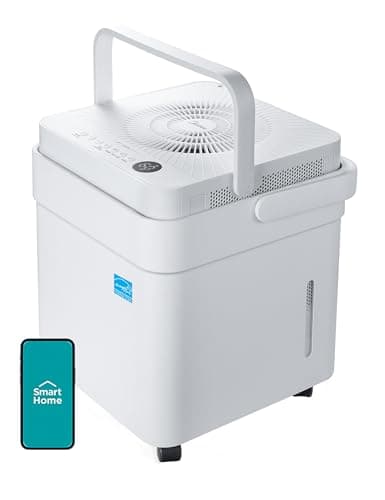
The smaller Cube, and the right size for a bedroom. Most people buying a bedroom dehumidifier buy far too much capacity and then run it on a setting that never cycles down.
#ad Price as of October 18, 2026, from Amazon. Prices change. How we make money.
Published specifications
| Specification | Value | Source |
|---|---|---|
| Capacity | 20 pints per day | Midea published specification |
| Capacity (federal test) | 20.16 pints per day | ENERGY STAR certified products database |
| Coverage | Up to 1,500 sq ft | Midea published specification |
| Efficiency (IEF) | 1.70 L/kWh | ENERGY STAR certified products database |
| Annual energy use | 249 kWh/yr | ENERGY STAR certified products database |
| Bucket fill level | Adjustable, up to 3 gallons | Midea user manual |
| Fan speeds | 2 (High, Low) | Midea user manual |
| Certification | ENERGY STAR certified | ENERGY STAR certified products database |
What it costs to run
About $46 a year on ENERGY STAR's certified annual energy figure.
ENERGY STAR publishes 249 kWh a year for this model. At 18.34 cents/kWh that is $45.67 a year. That figure is calculated on the program's standardized test basis, not measured in your room: a damp space where it cycles constantly will use more, a mildly damp one on a 50% setpoint less.
What is good about it
- 20 pints is the capacity a single closed bedroom actually calls for, so the compressor cycles off instead of running flat out
- The nested/extended body stores smaller than it runs, which matters for a machine you only want out for half the year
- ENERGY STAR certified, with the lowest annual energy figure of the three Cube sizes
What is not
- The least efficient Cube per unit of water removed: an IEF of 1.70 L/kWh against 2.01 for the 35 and 50-pint models
- Midea does not publish a rated wattage or a noise figure for this model, so we quote ENERGY STAR's certified annual energy figure instead of a wattage
- 1,500 sq ft is a coverage ceiling measured under favorable conditions, not a promise about a damp bedroom
- A compressor unit still makes compressor noise; if silence matters more than capacity, this is the wrong category
Who should skip this
Skip this if the room is a closet, a safe or a caravan - that is a job for a desiccant or thermoelectric unit, not a compressor. And skip it for a genuinely wet basement, where 20 pints will run continuously and never win.
How it scored
- Right-sized for one room9.5
- Efficiency per liter removed7.0
- Storage and handling9.0
Overall 8.3 / 10. This is our editorial score from published specifications and computed running cost. It is not a test result, and it is deliberately not marked up as a rating in this page’s structured data.
Midea Cube 50-Pint
Large basements and spaces that stay damp all summer
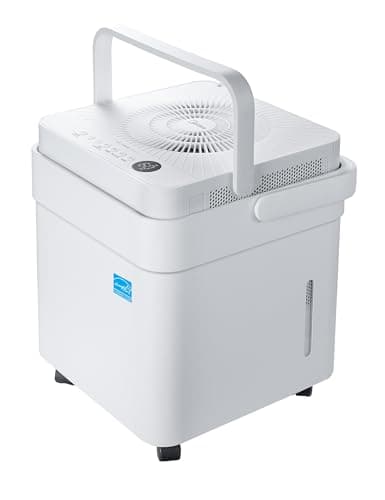
The same body as the 35 with more capacity. Worth it for a large or genuinely damp basement; wasted money and electricity in a space the 35 already handles.
#ad Price as of October 18, 2026, from Amazon. Prices change. How we make money.
Published specifications
| Specification | Value | Source |
|---|---|---|
| Capacity | 50 pints per day | Midea published specification |
| Capacity (federal test) | 49.67 pints per day | ENERGY STAR certified products database |
| Coverage | Up to 4,500 sq ft | Midea published specification |
| Efficiency (IEF) | 2.01 L/kWh | ENERGY STAR certified products database |
| Annual energy use | 515 kWh/yr | ENERGY STAR certified products database |
| Bucket fill level | Adjustable, up to 4.25 gallons | Midea user manual |
| Fan speeds | 2 (High, Low) | Midea user manual |
| Dimensions | 14.45 x 14.76 x 14.57 in, 41.54 lb | Midea published specification |
| Certification | ENERGY STAR certified | ENERGY STAR certified products database |
What it costs to run
About $94 a year on ENERGY STAR's certified annual energy figure.
ENERGY STAR publishes 515 kWh a year for this model. At 18.34 cents/kWh that is $94.45 a year, against $69.33 for the 35-pint Cube. That is calculated on the program's standardized test basis rather than measured in your basement; a very damp space will push it higher.
What is good about it
- Same 2.01 L/kWh efficiency as the 35-pint Cube, so the extra capacity does not cost you efficiency - only total consumption
- Near-identical footprint to the 35 for roughly 40% more water removed per day
- The same adjustable 4.25-gallon bucket, which matters more at 50 pints because it fills faster
What is not
- 515 kWh a year against the 35's 378 - about $25 more a year, which only buys you something if the space genuinely needs it
- The bucket is the same size as the 35's, so at full capacity it fills faster and you empty it more often
- No built-in pump on this model; a separate pump version exists, so check which one you are buying
- Midea does not publish a rated wattage for this model, so we quote ENERGY STAR's certified annual energy figure instead
Who should skip this
Skip this if the 35-pint Cube covers your space. The extra capacity is only useful in a large or persistently damp basement; anywhere else it is $25 a year of electricity for headroom you will not use. And skip it for a wet basement with liquid water arriving - that is a drainage repair.
How it scored
- Capacity for large spaces9.5
- Efficiency per liter removed9.0
- Bucket interval at full load7.0
- Running cost7.0
Overall 8.2 / 10. This is our editorial score from published specifications and computed running cost. It is not a test result, and it is deliberately not marked up as a rating in this page’s structured data.
How we ranked these
We have not tested these units. Nobody here owns one. What we did was compile each manufacturer’s published specifications, check the coverage claims against AHAM’s room-sizing rule, and compute what each one costs to run for a year at the current US average electricity price. Every figure on this page is attributed to whoever published it, and the arithmetic is shown so you can redo it.
How we rank these sets out the full method, including what would change a ranking.
Questions people ask
+−Which Midea Cube size should I buy?
The 35-pint for most basements, the 50-pint for a large or persistently damp one, and the 20-pint for a single closed bedroom. Buying the 20-pint for a basement is the costliest mistake in the range, because it is also the least efficient model.
+−How much does a Midea Cube cost to run?
On ENERGY STAR’s certified annual energy figures at 18.34 cents per kWh: about $45.67 a year for the 20-pint, $69.33 for the 35-pint and $94.45 for the 50-pint. Those are standardized test figures, so a very damp space will use more.
+−How big is the Midea Cube bucket?
Adjustable. Midea’s manual gives four fill levels: from about 2.25 up to 4.25 gallons on the 35 and 50-pint models, and from 1.5 up to 3 gallons on the 20-pint. A full 4.25-gallon bucket weighs roughly 40.5 lb.
+−Does the Midea Cube have a pump?
The standard 35 and 50-pint models reviewed here do not - continuous draining relies on gravity. Midea sells separate pump versions for draining uphill, so check which model a listing is selling.
+−Can I use a Midea Cube in a cold garage?
Not reliably in winter. Midea’s manual says to place it where the temperature will not fall below 41°F, because the coils can frost and performance drops. Auto defrost protects the coil but does not make it effective in the cold.
+−Is the Midea Cube Energy Star certified?
Yes. The 20, 35 and 50-pint models all appear in ENERGY STAR’s certified products database, which also publishes their federal-test capacity, efficiency and annual energy use. None of them, however, carries the stricter ENERGY STAR Most Efficient designation.