Symptom guide
Still Dry With a Humidifier Running
A humidifier is the only device on this site that can be working perfectly and still appear to do nothing, because it is competing with your house.
By Scooter M. · Published · Last updated
How this page is funded: the buy links below are affiliate links. If you buy through one, we earn a commission at no extra cost to you. It does not change the order of the picks or what we say about them. Full disclosure.
The short answer
Usually the house is winning, not the humidifier failing. A humidifier adds moisture to a volume of air that your house is continuously replacing with cold, dry outdoor air. If the room is large, the door is open, or the building leaks, a correctly working unit can run all night and move the reading by two or three points. Check in this order: are you measuring, is the door shut, is the unit sized for sustained output, and is the mist reaching the sensor rather than the room.
1. You are not actually measuring
Start here, because half of these cases end here. Dry skin, a dry throat and static are all real, and none of them is a measurement. Without a reading you cannot tell whether the humidifier is failing, succeeding modestly, or fixing a problem that was never humidity in the first place.
Get a hygrometer into the room - not next to the humidifier - and look at the overnight figure rather than the number at 7pm. Symptoms happen at 4am, and rooms are usually at their driest then, after a night of heating. A logging sensor is worth the small premium here for exactly that reason: a spot reading you take when you happen to walk past will not show you the overnight low.
2. The door is open
Air does not respect your intentions about which room is being humidified. With the bedroom door open, the humidifier is not treating a 130 sq ft room, it is treating the hallway, the landing and every room off it - probably several thousand cubic feet against a unit rated for a fraction of that.
This is the single cheapest fix on the page and it is free. Close the door, run the unit overnight, and compare the morning reading with the previous night. If the number moves, you have found your answer and you do not need a bigger humidifier.
3. The unit is sized on a coverage claim rather than output
Humidifier square-footage claims are the manufacturer’s own and are not measured to any external standard, unlike air purifier CADR or dehumidifier pint ratings. A unit sold as covering 750 sq ft may be perfectly honest about something and still be nowhere near enough for your 750 sq ft, because the claim does not state the starting humidity, the ceiling height or the air change rate it assumed.
The figure that predicts real behavior is sustained output: tank capacity divided by published run time. We work several of those through in what size humidifier do I need. If your unit works out at well under a gallon a day and you are trying to hold a whole floor, it is not broken - it is outmatched. The units that do clear two gallons a day are picked out in best humidifiers for large rooms.
4. Your house changes its air faster than the humidifier can fill it
This is the reason people find least intuitive and it is usually the real one. In winter, cold outdoor air holds very little moisture. Every cubic foot of it that leaks in and gets heated arrives effectively bone dry. A leaky house is therefore running a continuous, free dehumidifier, and your humidifier is trying to out-add it.
You can tell which situation you are in with one observation. If the humidity climbs steadily while the unit runs and then falls quickly once it stops, the house is leaking and the humidifier is doing its job against a headwind. If the number barely moves in either direction, look at sizing or placement instead. The underlying physics is set out in why is my house so dry.
| What you observe | Most likely cause | What to do |
|---|---|---|
| Climbs while running, drops fast when off | High air change rate - the house is leaking | Seal the obvious drafts; run the unit continuously rather than in bursts |
| Barely moves at all, either way | Undersized for the volume, or the door is open | Close the door and re-test before buying anything larger |
| High near the unit, low across the room | Sensor or humidistat sitting in the mist plume | Move the sensor; move the unit off the floor and away from walls |
| Reads 40-50% and symptoms persist | The symptom is probably not humidity | Stop adding moisture - above 50% you are creating a different problem |

5. It is only running while you are asleep
Eight hours of humidifying against sixteen hours of heated, leaking, drying house is a losing schedule. The room starts each night from a lower baseline than the last, and the unit spends most of the night climbing back to where it was. Running continuously at a lower setting almost always holds a steadier number than running hard overnight, and on an evaporative unit it costs very little to do - the Levoit Superior 6000S draws 30 W by its published specification, which is less than a typical light bulb.
6. The wick or the filter is spent
On an evaporative humidifier the wick is the whole mechanism. A wick that has stiffened with mineral scale passes far less air and evaporates far less water, and the symptom is exactly the one on this page: the unit runs, the tank empties slowly, the room stays dry. Manufacturers publish a replacement interval for a reason.
While you have it apart, look at it. A wick that smells is telling you something separate and more important, which we cover in humidifier mold and cleaning. The EPA’s guidance on home humidifiers is to change the water daily and clean portable units every third day, and a neglected unit is a worse outcome than a dry room.
This page is about the environment - humidity, particles, ventilation - and what changes it. It is not medical advice and we hold no medical qualification. If symptoms are persistent, severe or getting worse, that is a question for a clinician rather than a purchase.
What we would actually do
Buy the hygrometer before the bigger humidifier. Put it across the room, log two nights with the door open and two with it shut, and compare. Most of the time one of those two changes - the door, or the placement - moves the number more than a larger unit would have, and costs nothing. If after that you are still under 30% overnight with the door shut, then you have a genuine sizing problem and the arithmetic in the sizing guide will tell you how much more output you need.
What we would buy for this
Chosen from the same registry as our roundups, on published specifications and computed running cost.
ThermoPro TP49 Hygrometer
Anyone about to buy a humidifier or a dehumidifier
An inexpensive digital hygrometer is the highest-value purchase on this entire site, because it is the one that tells you whether to buy anything else.
#ad We do not hold a current price for this product, so we do not show one. How we make money.
Published specifications
| Specification | Value | Source |
|---|---|---|
| Function | Digital temperature and relative humidity readout with a comfort indicator | ThermoPro published specification |
What is good about it
- Cheap enough to buy three and put one in the bedroom, one in the basement and one in the living room, which is what you actually want
- Gives you the reading that decides between a humidifier and a dehumidifier - a decision people routinely get backwards
What is not
- Consumer hygrometers are typically accurate to within a few percentage points, which is fine for the 30-50% question and not fine for anything precise
- No logging, so you see now rather than overnight
Who should skip this
Skip this only if you already own a hygrometer. There is no household we would tell not to measure.
How it scored
- Value for the decision it informs10.0
- Accuracy for the 30-50% question8.0
- Logging and history2.0
Overall 9.0 / 10. This is our editorial score from published specifications and computed running cost. It is not a test result, and it is deliberately not marked up as a rating in this page’s structured data.
Govee H5075 Bluetooth Hygrometer
Diagnosing a problem that changes overnight
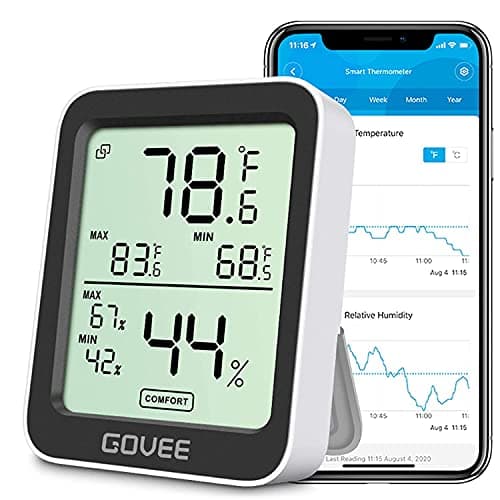
The one that logs. If your problem is that the house is dry at night but fine during the day, a hygrometer you have to walk over and read will never tell you that.
#ad Price as of October 18, 2026, from Amazon. Prices change. How we make money.
Published specifications
| Specification | Value | Source |
|---|---|---|
| Function | Bluetooth temperature and humidity sensor with app-based logging and data export | Govee published specification |
What is good about it
- Logging is the feature. Overnight humidity swings are invisible to a spot reading, and they explain most morning symptoms
- Data export means you can check whether the humidifier actually changed anything, rather than assuming
What is not
- Bluetooth range is room-scale; a basement sensor will not reach a phone upstairs
- Requires an app and an account, which is a genuine cost for some people
Who should skip this
Skip this if you just want a number on a wall. The logging is the whole premium, and it is wasted if you will not look at it.
How it scored
- Logging and history9.5
- Value for the decision it informs9.0
- Range and placement freedom6.0
Overall 8.6 / 10. This is our editorial score from published specifications and computed running cost. It is not a test result, and it is deliberately not marked up as a rating in this page’s structured data.
Levoit Superior 6000S
Whole floors, and anyone tired of refilling
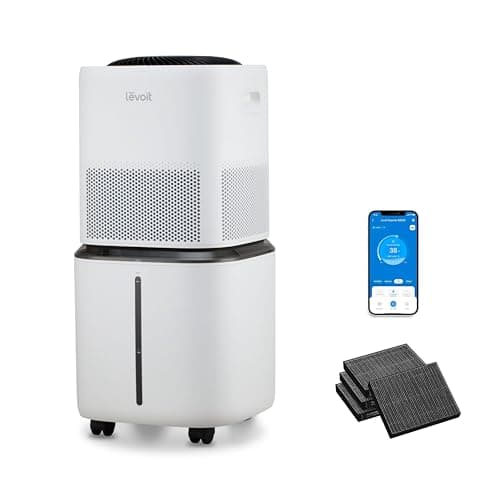
A 6-gallon evaporative unit at 30 W. If you have spent a winter refilling a small humidifier twice a day, this is the one that ends that.
#ad Price as of October 18, 2026, from Amazon. Prices change. How we make money.
Published specifications
| Specification | Value | Source |
|---|---|---|
| Tank capacity | 6 gal / 22.7 L | Levoit published specification |
| Coverage | 3,000 sq ft | Levoit published specification |
| Rated power | 30 W | Levoit published specification |
| Run time | Up to 72 hours on the low fan setting | Levoit published specification |
| Max output | 1,500 mL/h | Levoit published specification |
What it costs to run
About $12-13 a year in electricity across a heating season at 12 hours a day.
30 W / 1000 x 12 hours x 365 days = 131.4 kWh = $24.10 a year run year-round, so roughly $12-13 across a six-month heating season. On any evaporative unit the filters, not the electricity, are the larger cost.
What is good about it
- 30 W against 3,000 sq ft of claimed coverage is the best power-to-output ratio of any humidifier we list
- Evaporative, so it self-limits the same way the Honeywell does - it will not flood a room
- 72 hours per fill means refilling twice a week rather than twice a day
What is not
- It is a large object and it looks like one
- The 3,000 sq ft coverage claim assumes air moves freely between those rooms, which in a real house with doors it does not
Who should skip this
Skip this if you only need one bedroom humidified. A 6-gallon tank in a 120 sq ft room is a lot of standing water to keep clean for no additional benefit.
How it scored
- Cannot over-humidify10.0
- Refill interval9.5
- Power efficiency9.5
- Cleaning burden6.5
Overall 8.6 / 10. This is our editorial score from published specifications and computed running cost. It is not a test result, and it is deliberately not marked up as a rating in this page’s structured data.
How we ranked these
We have not tested these units. Nobody here owns one. What we did was compile each manufacturer’s published specifications, check the coverage claims against AHAM’s room-sizing rule, and compute what each one costs to run for a year at the current US average electricity price. Every figure on this page is attributed to whoever published it, and the arithmetic is shown so you can redo it.
How we rank these sets out the full method, including what would change a ranking.
Questions people ask
+−Why is my house so dry even with a humidifier?
Most often because the space being humidified is larger than you think - an open door turns one bedroom into a whole floor - or because the house is exchanging air with cold outdoor air faster than the unit can add moisture. Both look identical from the outside: a humidifier that runs and a reading that does not move.
+−Where should I put the humidifier in a room?
Off the floor, away from walls and furniture, and not directly beside a hygrometer or a bed. A unit tucked into a corner humidifies the corner, and its own humidistat reads the plume rather than the room.
+−Should a humidifier run all night or all day?
Continuously at a lower setting usually holds a steadier reading than running hard overnight only, because the room does not have to be recovered from scratch each evening. On a low-wattage evaporative unit that costs very little.
+−How long should it take to raise humidity in a room?
In a closed room with an adequately sized unit you would expect to see the number moving within a few hours. If a full night produces no measurable change with the door shut, the problem is sizing, placement or a spent wick rather than patience.
+−Is 35% humidity too dry?
It is inside the 30-50% band the EPA recommends, so it is not a problem in itself. Some people are comfortable at 35% and some are not. What you should not do is chase a number above 50%, which is where condensation and mold risk start.