Comparison
Air Quality Monitor vs Hygrometer
These are sold in the same aisle and they are not substitutes. Each is completely blind to what the other measures.
By Scooter M. · Published · Last updated
How this page is funded: the buy links below are affiliate links. If you buy through one, we earn a commission at no extra cost to you. It does not change the order of the picks or what we say about them. Full disclosure.
The short answer
Buy a hygrometer if your problem is damp, dryness, condensation, a musty smell, or choosing between a humidifier and a dehumidifier. Buy a particulate monitor if your problem is smoke, dust or wildfire season. They measure completely different quantities and neither can detect the other’s subject. For most households the hygrometer is the right first purchase and it is a tenth of the price.
| Hygrometer | Particulate (PM2.5) monitor | |
|---|---|---|
| Measures | Relative humidity and temperature | Airborne particle concentration; some add VOC or CO2 |
| Question it answers | Am I above 60% or below 30%? | Is there smoke or dust in this room right now? |
| Blind to | Particles entirely | Moisture entirely |
| Device it points at | Humidifier or dehumidifier | Air purifier |
| Accuracy character | A few percentage points; fine for a coarse decision | Optical sensors drift; best read as relative change |
| Relative cost | Very low | Several times higher |
What each one actually does
A hygrometer uses a capacitive sensor whose electrical properties change with the moisture in the air. It is a mature, cheap, well-behaved measurement, which is why a $10 device gives you a number you can act on.
An optical particle monitor shines a light through a small air sample and infers particle concentration from how the light scatters. That inference depends on assumptions about particle density and refractive index which vary with what the particles actually are - so the same sensor reads differently for cooking smoke, wildfire smoke and household dust. It is genuinely useful and it is not a laboratory instrument.
Buy a hygrometer if...
- Anything in your house smells musty
- You are getting static shocks, or condensation on the windows
- You are about to buy a humidifier or a dehumidifier
- You have a basement, a crawl space, or a bathroom without a working fan
Buy a particulate monitor if...
- You live somewhere with a wildfire season
- Someone smokes indoors, or you cook a lot at high heat
- You own an air purifier and want to know whether it is doing anything
- Your symptoms are respiratory and track with outdoor air quality
Buy both if...
You genuinely have both kinds of problem - a damp basement and a wildfire season, say. That is a real combination in a lot of the country. Just buy the hygrometer first, because it is cheap and because more household air problems turn out to be moisture than turn out to be particles.
Buy neither if...
You already know the diagnosis and the fix. Instruments are for deciding; once the decision is made the money is better spent on what changes the air. And if you own a smart thermostat, check it first - many already display humidity.
What we would buy for this
Chosen from the same registry as our roundups, on published specifications and computed running cost.
ThermoPro TP49 Hygrometer
Anyone about to buy a humidifier or a dehumidifier
An inexpensive digital hygrometer is the highest-value purchase on this entire site, because it is the one that tells you whether to buy anything else.
#ad We do not hold a current price for this product, so we do not show one. How we make money.
Published specifications
| Specification | Value | Source |
|---|---|---|
| Function | Digital temperature and relative humidity readout with a comfort indicator | ThermoPro published specification |
What is good about it
- Cheap enough to buy three and put one in the bedroom, one in the basement and one in the living room, which is what you actually want
- Gives you the reading that decides between a humidifier and a dehumidifier - a decision people routinely get backwards
What is not
- Consumer hygrometers are typically accurate to within a few percentage points, which is fine for the 30-50% question and not fine for anything precise
- No logging, so you see now rather than overnight
Who should skip this
Skip this only if you already own a hygrometer. There is no household we would tell not to measure.
How it scored
- Value for the decision it informs10.0
- Accuracy for the 30-50% question8.0
- Logging and history2.0
Overall 9.0 / 10. This is our editorial score from published specifications and computed running cost. It is not a test result, and it is deliberately not marked up as a rating in this page’s structured data.
Temtop M10 Air Quality Monitor
Watching PM2.5 during smoke events
A particulate monitor rather than a hygrometer - it answers a different question, and it is the question you want answered during wildfire season.
#ad We do not hold a current price for this product, so we do not show one. How we make money.
Published specifications
| Specification | Value | Source |
|---|---|---|
| Measures | PM2.5 particulate and AQI; some variants add HCHO and TVOC | Temtop published specification |
What is good about it
- PM2.5 is the number that matters during a smoke event, and a monitor is the only way to tell whether closing the windows actually worked
- Small enough to move room to room, which is how you find where the smoke is getting in
What is not
- Consumer optical particle sensors drift and are not laboratory instruments; treat readings as relative rather than absolute
- It does not measure humidity, so it is not a substitute for a hygrometer
Who should skip this
Skip this if your problem is damp or dryness. It measures particles, and it will tell you nothing at all about humidity.
How it scored
- Usefulness during smoke events9.5
- Absolute accuracy6.0
- Portability9.0
Overall 8.0 / 10. This is our editorial score from published specifications and computed running cost. It is not a test result, and it is deliberately not marked up as a rating in this page’s structured data.
Govee H5075 Bluetooth Hygrometer
Diagnosing a problem that changes overnight
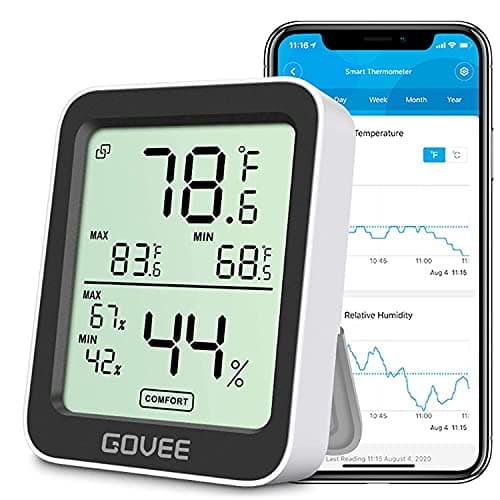
The one that logs. If your problem is that the house is dry at night but fine during the day, a hygrometer you have to walk over and read will never tell you that.
#ad Price as of October 18, 2026, from Amazon. Prices change. How we make money.
Published specifications
| Specification | Value | Source |
|---|---|---|
| Function | Bluetooth temperature and humidity sensor with app-based logging and data export | Govee published specification |
What is good about it
- Logging is the feature. Overnight humidity swings are invisible to a spot reading, and they explain most morning symptoms
- Data export means you can check whether the humidifier actually changed anything, rather than assuming
What is not
- Bluetooth range is room-scale; a basement sensor will not reach a phone upstairs
- Requires an app and an account, which is a genuine cost for some people
Who should skip this
Skip this if you just want a number on a wall. The logging is the whole premium, and it is wasted if you will not look at it.
How it scored
- Logging and history9.5
- Value for the decision it informs9.0
- Range and placement freedom6.0
Overall 8.6 / 10. This is our editorial score from published specifications and computed running cost. It is not a test result, and it is deliberately not marked up as a rating in this page’s structured data.
How we ranked these
We have not tested these units. Nobody here owns one. What we did was compile each manufacturer’s published specifications, check the coverage claims against AHAM’s room-sizing rule, and compute what each one costs to run for a year at the current US average electricity price. Every figure on this page is attributed to whoever published it, and the arithmetic is shown so you can redo it.
How we rank these sets out the full method, including what would change a ranking.
Questions people ask
+−Does an air quality monitor measure humidity?
Some do, as a secondary readout, and that is worth checking before buying both devices. But a monitor built around a particle sensor is designed for particles, and its humidity readout is a bonus rather than its purpose.
+−Which should I buy first?
The hygrometer, almost always. It is far cheaper, and more household air complaints trace back to moisture than to particles. If it comes back inside the 30-50% band and you still have a problem, that is the point to consider a particle monitor.
+−Can one device do both?
Combination units exist and they work, with the caveat that you are paying particle-monitor money for a humidity readout you could have had for a few dollars. Two separate devices lets you put each one where it needs to be, which is frequently different rooms.
+−Are the readings comparable between brands?
For humidity, broadly yes - it is a well-standardized measurement. For particles, not reliably: different sensors and different processing produce different absolute numbers for the same air. Compare a monitor against itself over time rather than against someone else’s device.