Comparison
Air Purifier vs Diffuser
These two devices are sold beside each other, look alike on a nightstand, and do precisely opposite jobs. One takes things out of the air. The other puts things in.
By Scooter M. · Published · Last updated
How this page is funded: the buy links below are affiliate links. If you buy through one, we earn a commission at no extra cost to you. It does not change the order of the picks or what we say about them. Full disclosure.
The short answer
They are not alternatives. They are opposites. An air purifier pulls room air through filters and takes particles out of it. A diffuser aerosolizes water and essential oil and puts that into the room. If you want the air to contain less of something, a diffuser is the wrong machine - and if what you actually want is a room that smells pleasant, it is worth knowing that the EPA lists air fresheners and fragrances among the things that contribute to indoor particulate matter.

The direction of travel
Almost every confusion in this category resolves once you ask a single question about a device: does it move things out of the air, or into it? Three machines get bought for overlapping reasons and only one of them is subtractive.
| Air purifier | Diffuser | Humidifier | |
|---|---|---|---|
| Direction | Removes | Adds | Adds |
| What it moves | Particles, and gases if it has a carbon stage | Water vapor plus aerosolized essential oil | Water vapor |
| Measured how | CADR, tested under AHAM AC-1 | Nothing standardized. Tank size and run time only | No external standard either - output and tank size |
| Effect on humidity | None at all | Negligible - the tank is far too small | This is the entire point |
| Effect on smell | Carbon adsorbs some odor gases | Covers one smell with another | None |
| Consumables | Filters | Oil, continuously | Wicks or distilled water, depending on type |
Read the first row on its own and the rest of this page is mostly detail. A purifier and a diffuser cannot substitute for one another in either direction, because subtraction and addition are not two ways of doing the same job.
A diffuser is a very small ultrasonic humidifier
Mechanically, the common ultrasonic diffuser and the ultrasonic humidifier are the same device at different scales. A piezoelectric plate vibrates at a frequency above hearing, throws the liquid above it into a fine aerosol, and a small fan pushes that into the room. The diffuser simply has oil in the water and a much smaller reservoir.
How much smaller is the part worth doing arithmetic on, because it settles the most common misconception about these devices. A 300 mL tank is the standard capacity across the ultrasonic diffusers sold at general retailers. The Levoit Superior 6000S, an actual room humidifier, publishes a 6 gallon / 22.7 L tank. That is 22,700 mL against 300 mL - roughly seventy-five times the water, and the humidifier is sized for one house, not one nightstand.
The shared mechanism also means the shared drawback applies. The EPA’s guidance on home humidifiers identifies ultrasonic units as very efficient at dispersing minerals in tap water into the air, which is where white dust on surfaces comes from, and notes that the resulting scale can be a breeding ground for microorganisms. A diffuser filled from the tap does the same thing on a smaller scale, and the same fix applies: distilled water, and cleaning it out rather than letting water stand. We go through that properly in distilled vs tap water in a humidifier.
The part the product listings leave out
This is the finding that reorders the comparison, and it comes straight from the EPA rather than from us. On its page about indoor sources of particulate matter, the agency states that many products used in the home, including cleaning solutions, air fresheners and personal care products, can contribute to indoor PM. It goes further on the mechanism: air fresheners, cleaning products and fragrances that have a pine or citrus scent can react with ozone to form PM and formaldehyde in indoor environments. Its list of indoor PM sources includes indoor chemical reactions alongside cooking, candles and fireplaces.
So the honest framing of a diffuser running next to an air purifier is not two appliances cooperating. It is one machine producing a fine aerosol of fragrance compounds and the other one working to remove particulate from the same room. What PM2.5 actually is, and why it is the number these devices are judged on, is set out in PM2.5 explained.
Fragrance is a gas, and gases are a carbon problem
The scent itself is not a particle. It is a volatile organic compound - the whole reason you can smell it from across the room is that the molecules have evaporated and travelled. That places it firmly in the half of this category that HEPA media does nothing about.
The EPA reports that concentrations of many VOCs are consistently higher indoors - up to ten times higher - than outdoors, and names cosmetic products among the household sources that contain organic solvents. Its recommended action for products that emit VOCs is to increase ventilation, not to filter harder. We cover that in full at VOCs and off-gassing.
If your reason for buying a diffuser is that the house smells of something you would rather it did not, then the device that addresses that is a purifier with a genuine activated carbon stage, because carbon adsorbs odor gases rather than covering them. Which is a real carbon stage and which is a carbon-dusted sheet is the whole subject of activated carbon explained, and the particles-versus-gases split is at HEPA vs carbon filters.
Can you run both?
Yes, and plenty of people do. Two things are worth knowing before you set them up in the same room.
- They partly cancel. The purifier will pull in and capture some of what the diffuser is putting out. You are not damaging either machine, but you are paying for filter life to remove something you are paying oil to add.
- Distance helps if you want both. A diffuser sitting directly in the purifier’s intake is the least useful arrangement possible. Put them at opposite ends of the room and run the purifier on a lower speed.
The genuinely sensible version of running both is time-separated rather than simultaneous: diffuser in the evening when you want the room to smell of something, purifier running overnight when you do not care what it smells like and would rather it were clean. New office furniture is the commonest source of this problem outside the home - purifiers for offices and dorm rooms.
Buy an air purifier if...
- The problem is something you want less of - pollen, dust, dander, smoke
- Anyone in the house reacts to airborne triggers, where the sizing rule in CADR explained is what decides the purchase
- You want an odor genuinely reduced rather than covered, which means a real carbon stage
- You want a device with a measured specification behind it rather than a claim
Buy a diffuser if...
- You want the room to smell of something specific, and you are treating that as a pleasant thing rather than an air quality improvement
- Nobody in the household is sensitive to fragrance, and there are no birds in the house - birds have notoriously sensitive respiratory systems and airborne fragrance is a common veterinary caution
- You are prepared to clean it, and to fill it with distilled water
There is nothing wrong with wanting a room to smell nice. The failure mode is buying one instead of a purifier and expecting the air to get cleaner.
Buy a humidifier if...
- A hygrometer says the room is under 30% - the measurement comes first, and it is the cheapest device here
- The symptoms are dryness symptoms: static, cracked lips, a cough that only shows up in winter. Start at why is my house so dry
- You want the moisture without aerosolizing minerals, in which case an evaporative unit is the type to look at
Buy none of them if...
The smell you are covering is musty. A musty smell is moisture and microbial growth, and fragrance over the top of it changes nothing except what you notice. That belongs in musty smell in the house, and the order of operations there starts with finding the water. Equally, if you can smell gas or something burning, that is not an air quality purchase - it is an immediate safety issue.
This page is about the environment - humidity, particles, ventilation - and what changes it. It is not medical advice and we hold no medical qualification. If symptoms are persistent, severe or getting worse, that is a question for a clinician rather than a purchase.
What we would actually do
Decide which direction you want the air to move, and buy the machine that moves it that way. If the answer is “less of something” - dust, pollen, smoke, a cooking smell that lingers - buy a purifier sized on smoke CADR against the room, and make sure it has a carbon stage if odor is the reason. If the answer is “more moisture,” measure first and then buy a humidifier that is actually sized for the room rather than a 300 mL tank. And if the answer is “I would like the bedroom to smell of bergamot in the evening,” buy the diffuser, enjoy it, and do not file it under air quality.
What we would buy for this
Chosen from the same registry as our roundups, on published specifications and computed running cost.
Coway Airmega AP-1512HH Mighty
Running continuously in a medium room
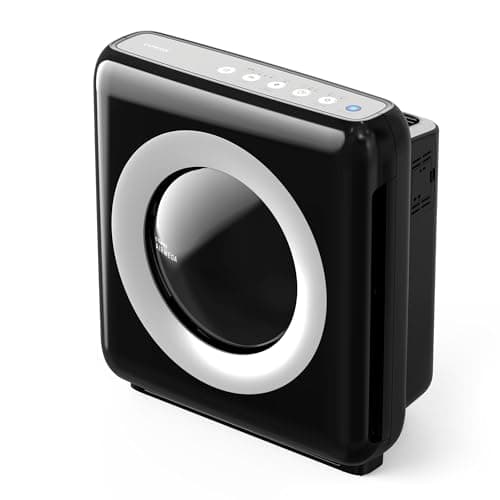
The most efficient unit here at low speed - 3.7 W on speed one - which matters enormously if you leave a purifier running all day and almost not at all if you do not.
#ad Price as of October 18, 2026, from Amazon. Prices change. How we make money.
Published specifications
| Specification | Value | Source |
|---|---|---|
| CADR (smoke) | 233 CFM | Coway published specification |
| CADR (dust) | 246 CFM | Coway published specification |
| CADR (pollen) | 240 CFM | Coway published specification |
| Coverage | 361 sq ft at 4.8 air changes/hr (1,748 sq ft at 1 ACH) | Coway published specification |
| Power draw by speed | 0.3 W standby / 3.7 W speed 1 / 8.7 W speed 2 / 75.3 W speed 3 | Coway published specification |
| Filtration | Pre-filter, odor filter, Green True HEPA, bipolar device | Coway published specification |
What it costs to run
About $6 a year running 24/7 on speed one, or $121 a year running 24/7 on speed three.
Speed 1: 3.7 W / 1000 x 24 x 365 = 32.4 kWh = $5.94 a year. Speed 3: 75.3 W / 1000 x 24 x 365 = 659.6 kWh = $120.97 a year. That twenty-fold spread is the most important number on this page, and it is why we chase per-speed figures instead of accepting a single rated wattage.
What is good about it
- Coway publishes power draw per fan speed, which almost nobody does and which is the only way to compute a real running cost
- 3.7 W on speed one is remarkable - cheaper to run continuously than most nightlights
- Coverage published at 1, 2 and 4.8 air changes per hour, so you can size it honestly
What is not
- 75.3 W on speed three is the highest draw here; how the auto mode behaves decides your bill
- The bipolar device is a stage we would rather do without; check it can be disabled
Who should skip this
Skip this if you only run a purifier for an hour or two at a time. Its whole advantage is low-speed efficiency over long hours, and short bursts on high speed give that straight back.
How it scored
- Clean air per watt9.5
- Honest coverage claim9.5
- Quiet operation8.0
- Filter economics7.5
Overall 8.7 / 10. This is our editorial score from published specifications and computed running cost. It is not a test result, and it is deliberately not marked up as a rating in this page’s structured data.
Levoit Core 400S
Living rooms and open-plan spaces
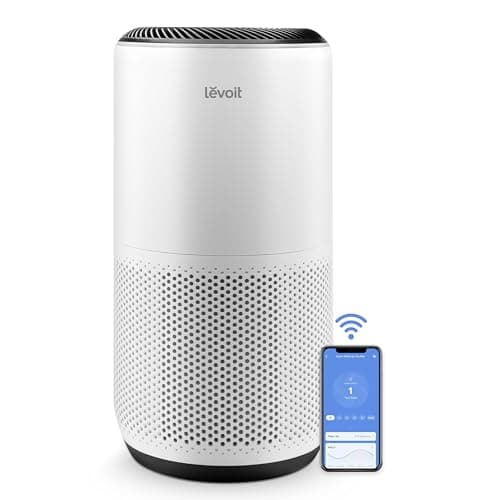
The one to buy if you want a purifier that genuinely covers a living room, and one of the few spec sheets in this bracket that publishes coverage at a useful air-change rate rather than only the flattering one.
#ad Price as of October 18, 2026, from Amazon. Prices change. How we make money.
Published specifications
| Specification | Value | Source |
|---|---|---|
| CADR | 231 CFM | Levoit published specification |
| Coverage | 358 sq ft at 4.8 air changes/hr (1,718 sq ft at 1 ACH) | Levoit published specification |
| Rated power | 38 W | Levoit published specification |
| Noise | 22-52 dB | Levoit published specification |
| Filtration | 3-stage: pre-filter, HEPA, activated carbon | Levoit published specification |
| Dimensions | 10.8 x 10.8 x 20.5 in, 11 lb | Levoit published specification |
What it costs to run
About $25-30 a year in electricity at 12 hours a day, before filters.
38 W / 1000 x 12 hours x 365 days = 166.4 kWh. At 18.34 cents/kWh that is $30.52 a year at rated power - and the unit only draws its full 38 W on the top fan speed, so a mid setting lands nearer $25. Add the replacement filter, which you should price before you buy rather than after.
What is good about it
- Levoit publishes coverage at both 1 ACH and 4.8 ACH, which is unusually straight - most brands quote only the flattering 1 ACH number
- 38 W is low for this CADR, which is what keeps the running cost down
- 22 dB on its lowest setting is quiet enough to sleep beside
- Carbon, pet-allergy and smoke-specific replacement filters are sold for the same body
What is not
- We could not find a published filter replacement interval in Levoit's specification, so we are not quoting one
- The 1,718 sq ft headline is a single air change per hour, which is not a useful rate for allergies
Who should skip this
Skip this if your room is under 200 sq ft. The Core 300S covers that at lower power and lower cost, and the extra CADR buys you nothing in a small bedroom.
How it scored
- Clean air per watt9.0
- Honest coverage claim9.5
- Quiet operation8.5
- Filter economics7.5
Overall 8.6 / 10. This is our editorial score from published specifications and computed running cost. It is not a test result, and it is deliberately not marked up as a rating in this page’s structured data.
Levoit Superior 6000S
Whole floors, and anyone tired of refilling
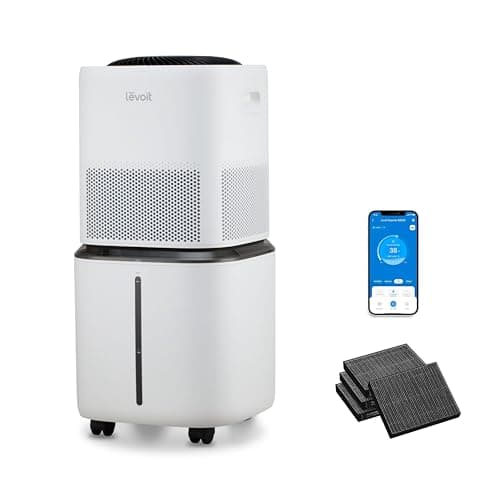
A 6-gallon evaporative unit at 30 W. If you have spent a winter refilling a small humidifier twice a day, this is the one that ends that.
#ad Price as of October 18, 2026, from Amazon. Prices change. How we make money.
Published specifications
| Specification | Value | Source |
|---|---|---|
| Tank capacity | 6 gal / 22.7 L | Levoit published specification |
| Coverage | 3,000 sq ft | Levoit published specification |
| Rated power | 30 W | Levoit published specification |
| Run time | Up to 72 hours on the low fan setting | Levoit published specification |
| Max output | 1,500 mL/h | Levoit published specification |
What it costs to run
About $12-13 a year in electricity across a heating season at 12 hours a day.
30 W / 1000 x 12 hours x 365 days = 131.4 kWh = $24.10 a year run year-round, so roughly $12-13 across a six-month heating season. On any evaporative unit the filters, not the electricity, are the larger cost.
What is good about it
- 30 W against 3,000 sq ft of claimed coverage is the best power-to-output ratio of any humidifier we list
- Evaporative, so it self-limits the same way the Honeywell does - it will not flood a room
- 72 hours per fill means refilling twice a week rather than twice a day
What is not
- It is a large object and it looks like one
- The 3,000 sq ft coverage claim assumes air moves freely between those rooms, which in a real house with doors it does not
Who should skip this
Skip this if you only need one bedroom humidified. A 6-gallon tank in a 120 sq ft room is a lot of standing water to keep clean for no additional benefit.
How it scored
- Cannot over-humidify10.0
- Refill interval9.5
- Power efficiency9.5
- Cleaning burden6.5
Overall 8.6 / 10. This is our editorial score from published specifications and computed running cost. It is not a test result, and it is deliberately not marked up as a rating in this page’s structured data.
How we ranked these
We have not tested these units. Nobody here owns one. What we did was compile each manufacturer’s published specifications, check the coverage claims against AHAM’s room-sizing rule, and compute what each one costs to run for a year at the current US average electricity price. Every figure on this page is attributed to whoever published it, and the arithmetic is shown so you can redo it.
How we rank these sets out the full method, including what would change a ranking.
Questions people ask
+−Does a diffuser purify the air?
No. It adds a water and essential oil aerosol to the room rather than removing anything from it. The EPA lists air fresheners and fragrances among the products that can contribute to indoor particulate matter, and notes that pine or citrus scents can react with ozone to form PM and formaldehyde indoors.
+−Is a diffuser the same as a humidifier?
Mechanically an ultrasonic diffuser and an ultrasonic humidifier work the same way, but the scale is not comparable. A standard diffuser tank is about 300 mL; the Levoit Superior 6000S publishes a 6 gallon tank, which is roughly seventy-five times as much water. A diffuser will not measurably raise the humidity of a room.
+−Can I run a diffuser and an air purifier together?
You can, and nothing is harmed, but they work against each other - the purifier captures some of what the diffuser emits. If you want both, keep them apart and consider running them at different times of day rather than together.
+−Will an air purifier remove essential oil smell?
A carbon stage will adsorb some of it, because fragrance is a gas rather than a particle. HEPA media on its own will not, since it is a physical barrier sized for particles. How much carbon a unit really carries decides how well it does this.
+−Do I need distilled water in a diffuser?
For the same reason as an ultrasonic humidifier, it helps. The EPA notes that ultrasonic units are very efficient at dispersing tap-water minerals into the air, which produces white dust and builds scale that can be a breeding ground for microorganisms.
+−Which should I buy first, a purifier or a diffuser?
If you have an actual air quality complaint - allergies, smoke, a lingering odor - the purifier, and it is not close. A diffuser is a comfort purchase. Buying one expecting cleaner air is the single most common mistake in this comparison. The same question decides a real purchase comparison: the Winix 5510 carries an ionizing PlasmaWave stage and the Levoit Core 400S carries none - Core 400S vs Winix 5510.